Chapter 34 of 126
The sentinel of the frontier—the warden of the borders who ensures that the empire is a closed system, protected from all external ripples.
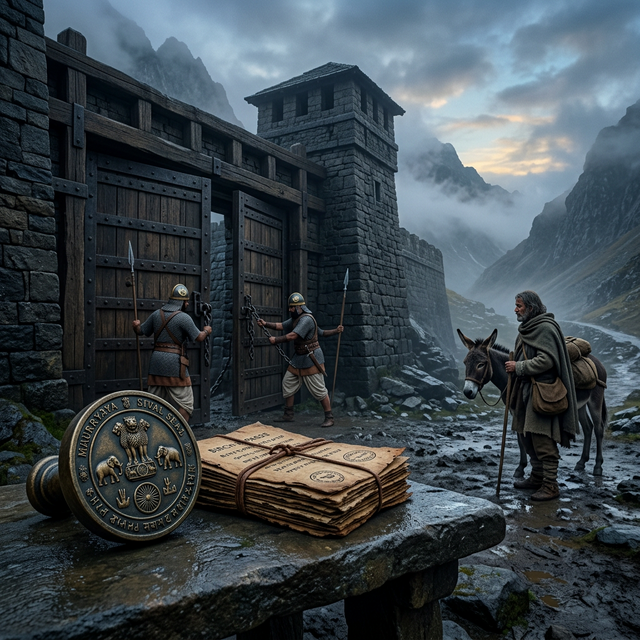
The mountain passes of the Mauryan frontier at dawn are a world of heavy mist and the rhythmic clatter of iron-bound gates being unbarred for the day. Here, the Mudrádhyaksha, the Superintendent of Passports, presides over an environment where the entrance and exit of the empire are strictly audited. This is "The Seal of the Frontier," a place where the King’s sovereignty is literalized in the pressure of a signet. Kautilya leads the Prince past the stone watchtowers where travelers are lined up in the damp air, the scent of charcoal smoke and the sharp, clean smell of mountain pine hanging heavy around them. In this outpost, the state does not just guard the border; it filters the subject. The "standard of the one-masha pass" is the measure of the state’s forensic and protective control.
A single, heavy bronze seal, its surface engraved with the royal image and its handle cold from the mountain night, rests on a stone table near the gate. This object is the stake of the empire’s control over the "mobility of the subject": it is the "Vessel of Access." Kautilya explains that the state is the ultimate master of the "entry and exit from the country." He points to the systematic fee: "passes at the rate of a masha per pass." To Kautilya, a traveler is not just a person but a "node of potential intrusion." The stability of the Maurya interior is built upon this "migratory ledger." A superintendent who allows a "native or foreigner" to move without a "sanctioned pass" is a man who is puncturing the King’s security.
The action of the frontier is a forensic monitoring of movement and threat. Kautilya walks the Prince through the inspection point where every traveler must produce their credentials. They watch as the "superintendent of pasture lands" examines the passes of those moving through the valleys. It is a world of strict legal liability: "Whoever... enters into or goes out of the country without a pass shall be fined 12 panas." They see the punitive hierarchy: the highest amercement for a foreigner, the first for a false pass.
They observe the "clearing of the valleys": the systematic removal of the "fear of thieves, elephants, and other beasts." It is a technical, defensive discipline: the state measures the "rhythm of the road" as precisely as it measures the "depth of the coffer," ensuring that the border is a source of safety as much as surveillance.
But the frontier is also a center of total reconnaissance and environmental engineering. Kautilya points to the "hunters with their hounds," explaining that the state must manage even the "thick grown forests" and "ancient ruins" through active reconnaissance. The Prince realizes that "The Seal of the Frontier" is the ultimate expression of the "Duties of Government Superintendents"—the place where the state’s power to "filter and protect" is literalized in the price of a masha. The King’s power is the power to "ascertain the distance of roads" and to ensure that the "readiness for the enemy" is as regulated as the price of grain. "The Seal of the Frontier" is the defensive conscience of the state, captured in the "stamping of the bronze seal" that binds the edge to the center.
Whoever is provided with a pass shall be at liberty to enter into, or go out of, the country... Whoever, being a native of the country enters into or goes out of the country without a pass shall be fined 12 panas... Valleys shall be cleared from the fear of thieves, elephants, and other beasts.
This is the rule of the migratory regulation, the documentation for a world where "unmonitored movement" is the enemy of the state. It says that the "Superintendent of Passports" must be a scientist of access, and that the "clearing of barren tracts" is as strategic as a mountain pass. It recognizes that "passes" and "hunters' hounds" are the nodes of a network of security that connects the King to "The Seal of the Frontier." The state outpost, with its "buildings for shelter" and its "Superintendent of Passports," is the physical evidence of this discipline. The men who need such a rule are those who have understood that the state's strength is first filtered, then secured.
The logic of the seal is the logic of the "Duties of Government Superintendents." It completes the transition from the architecture of the chariot workshop to the architecture of the imperial gate. It assumes that if you can master the "one-masha fee" and the "forensic precision of the hunter's scout," you can master the boundaries of the world. The state is no longer a master of the path; it is a master of the boundary.
The canto concludes on the image of a bronze seal being pressed into red wax onto a birch-bark pass, the smoke from the heated wax swirling in the cold morning air. At the outpost, the gate groans open, and the first traveler is signaled forward into the King's territory, their pass held tightly in their hand. The sound of the gate is a resonant, metallic clang that echoes through the valley, a resonant finality to the state's will. Kautilya looks at the "net balance" of the morning’s inspections and sees the resilient reach of the Mauryas written in the silence of the pass.
Outside, the sun begins to climb over the peaks of the frontier. But inside "The Seal of the Frontier," the world is categorized, filtered, and secure. The Prince walks back from the gate, his mind full of mashas and panas. He has seen the bronze seals, and he has heard the baying of the hounds. He now knows that the empire is held together not just by gold or iron, but by the "uniform texture" of the boundary and the unblinking eye of the man who knows exactly what it means to be a traveler in the King's land.