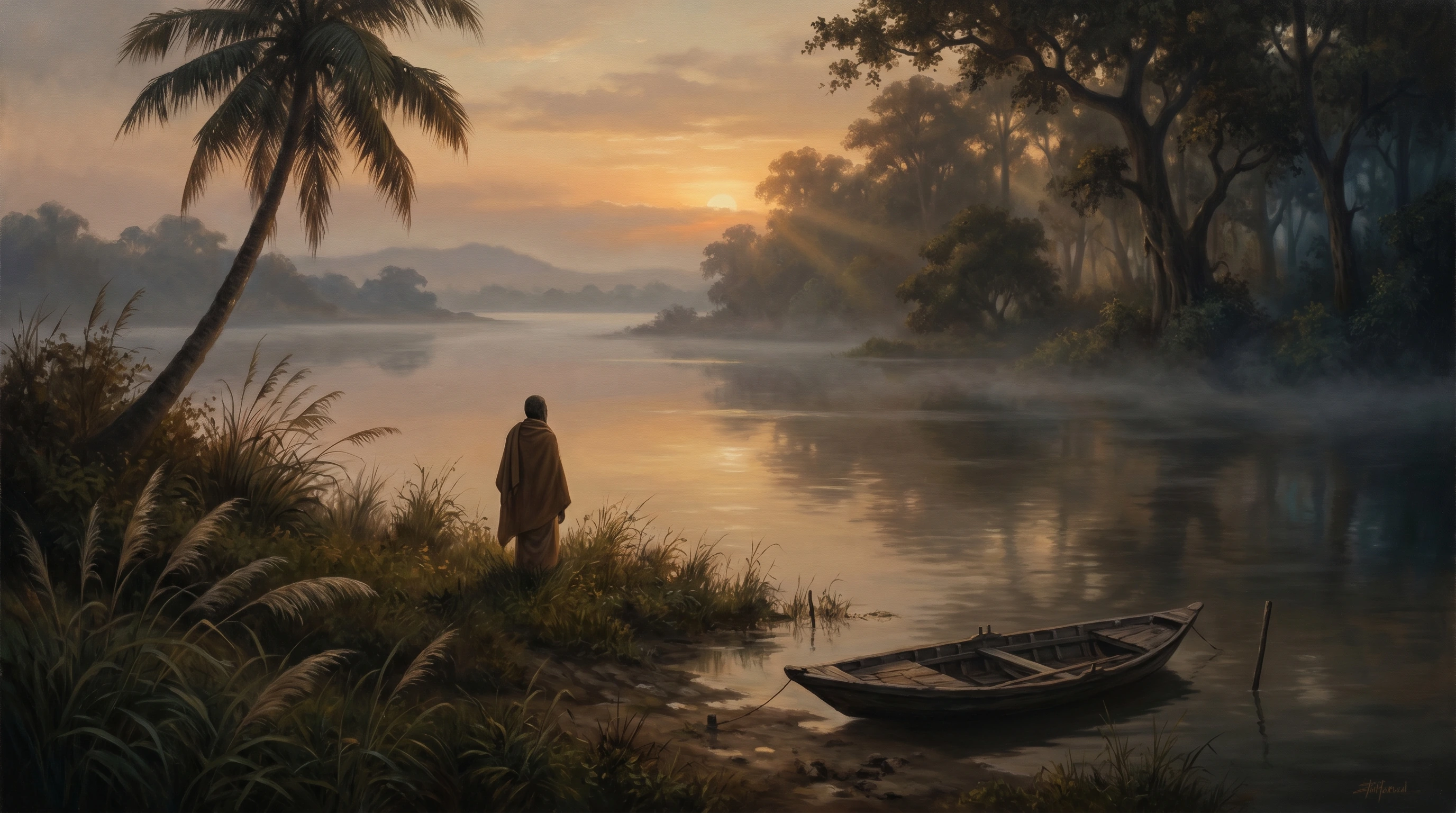
A Seeker’s Journey from the Brahman’s House to the River
Hermann Hesse's seeker in one sitting — the Brahman's son who leaves home for the ascetics, walks away from the Buddha himself, loses himself in love and wealth in the city, despairs at a river, and learns at last from a ferryman that all things are one.
Invoking the sacred fire...
# A Seeker’s Journey from the Brahman’s House to the River
## The Brahman’s Son
**Narrator:**
In a town beside a wide river there lived a Brahman’s son named Siddhartha — handsome, quick of mind, the pride of his father and the joy of his mother. He had learned the sacred verses, the art of debate, the silent speaking of Om. The wise men loved to talk with him; the young women watched him pass; and his friend Govinda loved him above all, certain that Siddhartha would one day become a great priest, a prince among Brahmans.
**Narrator:**
But Siddhartha was not a joy to himself. Beneath the praise and the rituals, a restlessness gnawed at him. He had filled his mind with all the wisdom of his elders, and still the vessel was not full; the soul was not content. The ablutions were good — but they were only water. The sacrifices were excellent — but did they truly quench the thirst within?
**Siddhartha:**
"My father and my teachers have poured the best of their knowledge into me, and yet I am not at peace. Atman — the self, the innermost — must be found. But none of them has shown me the way to it. Knowledge they have in plenty. The one thing needful, they do not possess."
**Narrator:**
So when three ascetics — Samanas, dusty and gaunt, strangers to the world — passed through the town, Siddhartha knew his road. That evening he told his father he would leave. The Brahman forbade it; Siddhartha simply stood, arms folded, through the whole night, unmoving as an arrow drawn to the string. By dawn his father understood that his son had already departed in spirit. He gave his blessing. And waiting at the edge of town, Govinda rose from the shadows to follow.
## With the Samanas
**Narrator:**
Among the Samanas in the forest, Siddhartha gave away his fine clothes, fasted until his flesh wasted, and learned the great arts of the ascetic: to think, to wait, to fast. He learned to step out of his own self — to become a heron, a jackal, a stone, a corpse — and to return again. A thousand times he killed his self; a thousand times the self came back.
**Siddhartha:**
"This is no path, Govinda. The oldest Samana among us is sixty years old and has not reached Nirvana. What we call escape is only a brief numbing of the self — the same flight a drunkard finds in wine. We turn in a circle and never leave it."
**Narrator:**
Then a rumor spread through the land: that a man had appeared who had truly overcome suffering and stopped the wheel of rebirths — Gotama, the Buddha, the Awakened One. Siddhartha and Govinda left the Samanas and went to find him.
## Gotama, the Awakened One
**Narrator:**
They found the Buddha in the Jeta grove near Savathi, walking quietly among his monks. Siddhartha knew him at a glance — not by his robe, but by the perfect peace in every motion, a stillness like a ray of light. Govinda was overcome. He took refuge in the teaching and joined the order. But Siddhartha, though he honored the man, could not stay.
**Siddhartha:**
(speaking to the Buddha himself)
"Your teaching is flawless, O Exalted One — the world explained as one unbroken chain. And yet that very chain breaks at one link: you have not taught us what you yourself found in the hour of your awakening. That cannot be taught in words. So I will not seek another doctrine. I will go and learn from myself."
**Narrator:**
The Buddha warned him only to beware of his own cleverness, and let him go in peace. So the two friends parted — Govinda to the cloister, Siddhartha to the open road, alone for the first time in his life.
## Awakening
**Narrator:**
And in his aloneness, something turned over in him. He had spent his life fleeing the self, drowning it in doctrines and gods and sacred words. Now he saw it: he would learn from no teacher again. He would learn from himself, and from the world.
**Siddhartha:**
"I have been afraid of myself; I have been fleeing myself. I sought Atman, I sought Brahman, and in the seeking I lost myself along the way. I will learn from the river, from the trees, from the colour of the sky — I will be a pupil of the world."
**Narrator:**
And the world, which he had always dismissed as illusion, suddenly stood before him beautiful and real — blue, yellow, green, the river and the forest, all of it no longer a veil over meaning but full of meaning itself. Siddhartha awoke as if newly born.
## Kamala and the City
**Narrator:**
He came to a river, and a kind ferryman carried him across, saying the river had much to teach and that they would surely meet again. Beyond it lay a great city. At its gate, in a pleasure grove, Siddhartha saw the courtesan Kamala, beautiful and clever, carried in her litter — and he resolved that she would be his teacher in love.
**Kamala:**
"A handsome Samana from the forest cannot win me with nothing. You must come with fine clothes, fine shoes, and money in your purse. What can you do?"
**Siddhartha:**
"I can think. I can wait. I can fast. And I can write poetry. For a poem, will you give me a kiss?"
**Narrator:**
Charmed, Kamala sent him to the rich merchant Kamaswami, and Siddhartha — who needed nothing and therefore feared nothing — became a successful merchant. He learned the ways of what he called the child-people: their business and their pleasures, their dice and their wine. He gave Kamala the gift of love, and she gave him hers. For a long while he watched it all from a height, half-smiling, an onlooker in his own life.
## Sansara
**Narrator:**
But the years did their slow work. The merchant’s game, which had once amused him, began to own him. He gambled with a fury, drank to deaden himself, grew soft and rich and weary. The clear, listening voice within — the bird in his breast — fell silent. The seeker had become one of the child-people he once pitied, and worse, for he no longer even believed in the search.
**Siddhartha:**
"I have learned the worst from these people, and the most useless thing of all — greed. I have lost the ability to think, to wait, to fast. I have made myself sick of the very life I built."
**Narrator:**
One night he dreamed that Kamala’s rare songbird had died in its cage, and he flung the dead bird into the street. He woke in horror, understanding that he had thrown away everything of value in himself. That same night, telling no one, he walked out of the city and the garden and the whole hollow life, and did not look back. Unknown to him, he left Kamala carrying his child.
## Despair at the River
**Narrator:**
He wandered until he came again to the river — the same river the ferryman had crossed for him years before. Empty, ruined, disgusted with himself, Siddhartha bent over the green water and longed to let it swallow him, to be done at last with the wretched thing he had become.
**Narrator:**
And in that very moment, from the deepest part of him, rose a single sound he had not spoken in years — Om. The perfect. The beginning and the end of all sacred words. It struck through his stupor and woke the sleeping spirit. He drew back from the water, lay down among the roots of a coconut tree, and fell into a deep, healing sleep.
**Narrator:**
When he woke he felt newborn. Beside him sat a monk in yellow — Govinda, who had passed by and watched over the sleeping stranger, not knowing him. They recognized each other with joy, spoke a while, and parted again. Siddhartha stayed by the river. He no longer wished to leave it.
## Vasudeva the Ferryman
**Narrator:**
He found the old ferryman, Vasudeva, and asked to stay and learn. Vasudeva was a man of few words and vast peace, and his greatest gift was simply this: he knew how to listen. Together they ferried travellers, and together they listened to the river.
**Vasudeva:**
"The river has taught me, and it will teach you. It knows everything. Have you learned its secret — that there is no such thing as time? The river is in all places at once: at its source and at its mouth, at the waterfall and the sea, everywhere at the same moment, and for it only the present exists."
**Narrator:**
Year by year, Siddhartha grew calm and whole. From the flowing water he learned to listen with a still heart, without desire, without judgment — and in that listening, the long, settled peace he had hunted across the whole world at last began to dwell in him.
## The Son
**Narrator:**
Then the world returned to test him one last time. Kamala, now a follower of the Buddha, came on pilgrimage to the dying Gotama and was bitten by a snake on the riverbank. Siddhartha held her as she died — and was left with their son, a spoiled, grieving boy who scorned the two poor ferrymen and their humble life.
**Narrator:**
Siddhartha loved the boy helplessly, and in loving him learned at last the ordinary, foolish, blinding love of the child-people he had always watched from above. He bore the boy’s contempt with endless patience. Vasudeva warned him gently that the child could not be held, that he too must go his own way and burn in his own fires. And one day the boy stole away and fled to the city. Siddhartha, half-mad with loss, followed as far as the city gate — and there, at Kamala’s old pleasure garden, he stopped, and understood the wound was his to carry, not to heal.
## Om, and the Unity of All Things
**Narrator:**
He carried the wound back to the river, and the river laughed at him — a bright, mocking, knowing laughter. He bent over the water, and this time, instead of his own ruined face, he saw the faces of all whom he had loved and lost: his father, who had grieved for a runaway son as Siddhartha now grieved; Kamala; Govinda; the boy; everyone. All their faces flowed and changed and merged, and all of them were the river, hurrying toward their goals, and all the voices — of grief and laughter, of longing and pain — flowed together into a single sound.
**Siddhartha:**
"Om. Perfection."
**Narrator:**
In that moment his wound healed. His self dissolved into the unity of all things. Vasudeva looked at him with a radiant smile and said his work here was done — and walked into the forest, into the oneness, leaving Siddhartha as the ferryman in his place, at peace at last.
## Govinda’s Vision
**Narrator:**
Years later, old Govinda — still a seeker, still searching for the door he could not find — came again to the river and asked the serene old ferryman to teach him. Siddhartha told him that wisdom cannot be passed on in words, that the opposite of every truth is also true, that he had learned to love the world exactly as it is — a stone, a river, a person — not as it should be.
**Siddhartha:**
"Govinda, lean close, and kiss me on the forehead."
**Narrator:**
Govinda did — and in that instant he no longer saw his friend’s face. He saw a ceaseless river of faces, hundreds, thousands: the newborn and the dying, murderers and gods, fish and elephants, all forms flowing into one another, all of them dying and being born, all of them held in one quiet, eternal, knowing smile — the very smile of the Buddha. Tears ran down Govinda’s face. He bowed low before the old man sitting motionless before him, whose smile reminded him of everything he had ever loved, everything that had ever been holy in his long life.