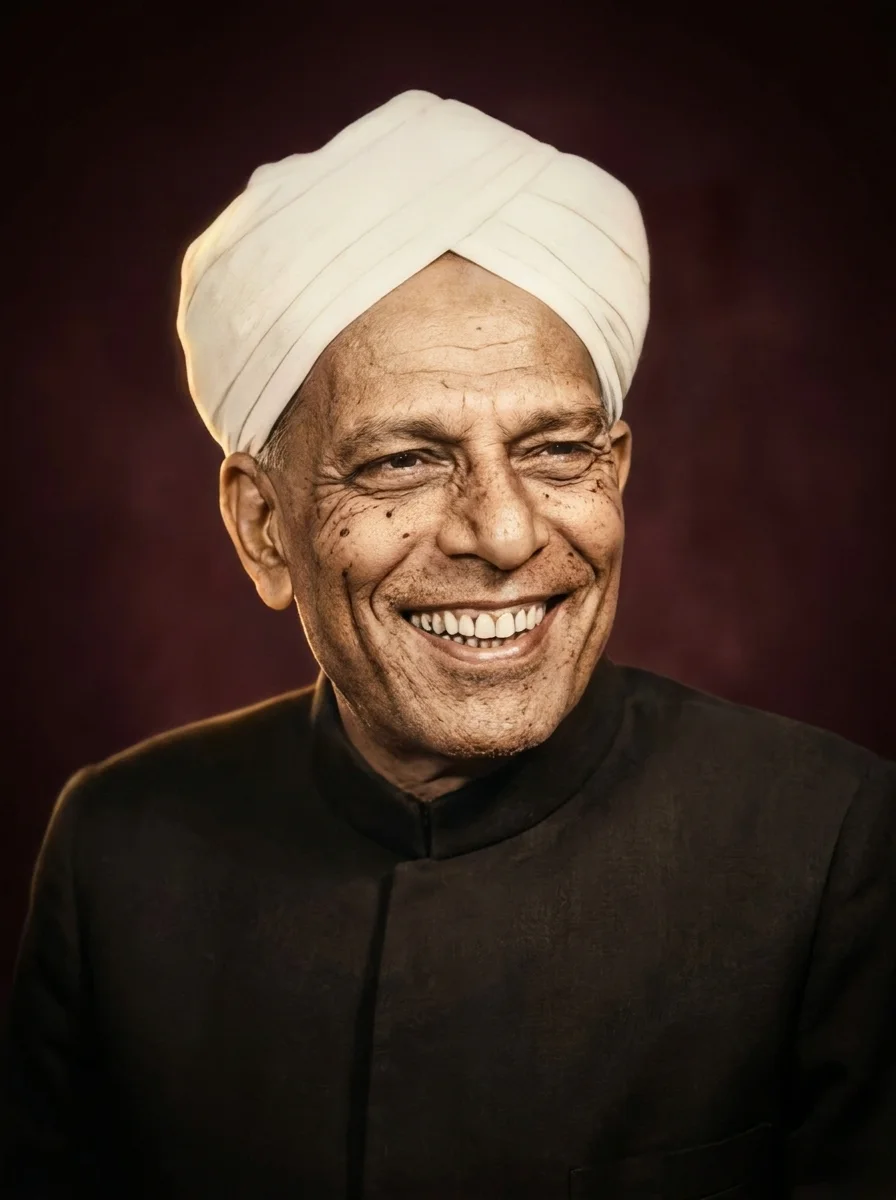
# The Life of Gubbi Veeranna
**Narrator:**
On January 24, 1891, a boy was born in Gulaganjihalli — a small village near the town of Gubbi, in the Tumkur district of the princely state of Mysore. His name was G.H. Veeranna. He came from no theatrical dynasty and inherited no fortune. Yet over the next eighty-one years he would take a wandering village troupe and turn it into the grandest professional theatre in South India — a company of two hundred and fifty people that travelled by special train, staged plays with live elephants, and outdrew the cinema at the height of its power. By the time he died he was called Nataka Ratna, the Jewel of Theatre; an honorary Doctor of Letters of the University of Mysore; and a Padma Shri of the Republic of India. The historians simply call him the father of Kannada professional theatre.
This is the story of how a boy from Gulaganjihalli became the stage spirit of a language.
## The Boy Who Joined the Stage at Five
**Narrator:**
The Gubbi Sree Channabasaveshwara Nataka Company already existed when Veeranna was born. It had been founded in 1884 by two men named Channanna and Abdul Azeez Saheb — a partnership across community lines that set the tone for everything the company would later become. In 1896, at the age of five, Veeranna joined it. He did not arrive as a star. He arrived as a child of the troupe, learning the stage the way a carpenter's son learns wood — by living inside the work.
He grew up in a world of temple courtyards and village fairs, of oil-lamp footlights and painted backcloths, of mythological dramas performed through the night. A woman performer named Rajamma had joined around 1891, making the company one of the earliest Karnatak troupes to put a woman on the professional stage — decades ahead of its time. Into this world the boy was absorbed, and he learned all of it: acting, music, the painting of scenes, and above all the business of keeping a touring company alive.
## Becoming the Proprietor
**Narrator:**
For twenty years he served his apprenticeship. By 1917, having mastered every craft the stage demanded, Veeranna had virtually become the proprietor of the entire management. The company was no longer a village troupe drifting from fair to fair. Under him it became a professional enterprise — disciplined, ambitious, and aimed at audiences far beyond Gubbi.
**Narrator:**
That was the whole of his life's purpose. Kannada theatre had been entertainment; the historians would later credit Veeranna with giving the art itself a standing it had never had. He made it an institution.
## Bellave, Women on Stage, and the Royal Word
**Narrator:**
In 1919 a playwright named Bellave Narahari Shastri began writing for the company. Over the following decades he produced nearly forty plays specially for Veeranna — among them *Krishna Leela* in 1919, *Yama Garvabhanga* in 1922, and *Markandeya* in 1932. The Gubbi Company had its writer; the writer had his company. It was a partnership that gave the Kannada stage a repertoire of literary weight, not merely spectacle.
The reputation grew until it reached the palace. On November 17, 1923, His Highness the Maharajah of Mysore personally presented Veeranna with a formal commendation, honouring him as "Proprietor and Versatile Comedian" of the company. For a man who had joined as a child performer in a village troupe, royal recognition was a kind of coronation. He would return to that date again and again across his life — the final page of his memoir, written nearly forty years later, circles back to it.
> PRESENTED BY HIS HIGHNESS THE MAHARAJAH OF MYSORE G.C.S.I.
> To G.H. VEERANNA
> PROPRIETOR AND VERSATILE COMEDIAN
> OF C.B.K.N. CO. OF GUBBI 17-11-23
## The Great Touring Company
**Narrator:**
Through the 1920s the company swelled into something the Kannada land had never seen. By 1926 it numbered about two hundred and fifty people — artists and their families — running three separate touring wings that rehearsed and performed in different regions at once. It built its own play-house in Bangalore in 1924, then a second and larger one in 1930, inaugurated by Sir Mirza Ismail, the Dewan of Mysore and one of the most powerful administrators in princely India. Veeranna founded a children's theatre, the Balakalavardhini, run on professional lines, and a youth music company to grow the next generation.
The troupe moved by special trains because no ordinary transport could carry its equipment and its people. It travelled across Mysore State, deep into Tamil country — Trichy, Kumbhakonam, Ettiyapuram — and into Andhra, where in Vijayanagaram Veeranna was publicly honoured as "Karnatka Andhra Nataka Sarvabhauma," Emperor of Karnataka-Andhra Theatre. With its fabulous paraphernalia, its band of over a hundred artists, and its unsurpassed showmanship, it had become, by common account, the most colourful and best-equipped professional troupe in all of South India.
## Kurukshetra — The Masterpiece
**Narrator:**
The company had been founded in 1884. For its Golden Jubilee in 1934, Veeranna commissioned a production unlike anything before it: *Kurukshetra*, written by B. Puttaswamiah. It cost thirty thousand rupees — a fortune for the time, and the largest single figure recorded anywhere in his diary. Staged in a custom four-thousand-seat zinc pandal, the six-hour spectacle put elephants, horses, chariots, and film projectors on the stage, and played forty continuous nights in Bangalore.
The cinema could not compete.
**A. N. Krishna Rao:**
*(The writer, recording what the box-office did to the films)*
"Many film shows were cancelled and the organisers wrote and wired to the distributors asking them not to send good films owing to negligible public response to the films because of Gubbi's Kuruksetra."
**Narrator:**
There was an irony inside the triumph. In *Kurukshetra* Veeranna attempted the tragic role of Duryodhana. The audiences would not have it. They had come to love him as a comedian, and they demanded their comedian back.
## The Comedian and His Titles
**Narrator:**
For Veeranna was, before all else, a comic genius. He had built his early fame on physical comedy — contortions, gesture, fast-coloured costumes — and the public crowned him with names. He was the "Versatile Comedian" of the royal commendation. He was "Vinoda Ratnakara," the jewel-mine of entertainment, as his comedy grew more refined and word-based. The audiences called him affectionately "Nakali Veeranna" — the jester. And a critic, watching him blend physical comedy with social feeling, named him the Chaplin of Karnatak.
His great roles were comic ones: Adimoorti in *Sadarame*, Makaranda in *Krishnaleela*, Hasim in *Swami Niste*. He was not a person playing parts. He was the part the audience came for.
## Cinema and the Studios
**Narrator:**
When the talkies arrived, Veeranna did not stand aside. He had already founded the Karnataka Pictures Corporation around 1930 with a capital of one lakh of rupees, declaring, "I stand by this spirit." He built and opened a cinema house, the Gaiety Theatre, in 1935. He produced and acted in films across two decades — from the early *Sadarame* through *Hemareddi Mallamma* to *Bedara Kannappa* in 1954. And he established Sree Kanteerava Studios, one of Bangalore's first film studios. The Gubbi Company had become the great incubator of Kannada cinema talent: actors who began on its stage — B. Jayamma, Honnappa Bhagavatar, Raghavendra Rao — carried it onto the screen.
**Narrator:**
Distributor, performer, studio executive, proprietor — he held all of these at once, and held them for half a century. Such men are rare.
## War, Independence, and a New State
**Narrator:**
The company performed through everything. It played through two world wars; even in 1944, in the middle of wartime, the troupe drew packed houses for one hundred and twenty-five continuous shows of *Sri Krishna Leela* in Mysore. In 1942, during the Mysore Dasara festival, Maharaja Jayachamarajendra Wodeyar conferred upon Veeranna the title "Nataka Ratna" — Jewel of Theatre, the highest honour the state could give a stage artist.
Then the country itself changed beneath him. India became independent in 1947, and the company that had risen under princely patronage now performed in a democratic nation. In 1956 Karnataka was formed as a unified state — the end of the very princely system in which Veeranna had first knelt before a Maharajah. He served eight years in the Karnataka Legislative Assembly, carrying the voice of the arts into governance. Through every one of these upheavals the company kept its houses full — owing its long survival, the historians judged, to a rare capacity to move with the changing tastes of the age without ever letting go of dignity in production.
## The Diary, the Honours, the End
**Narrator:**
In 1962, at the age of seventy-one, Veeranna sat down on the twenty-eighth of September to write. Across one hundred and seventy-two handwritten pages he set down the company's arc from 1921 to 1956 — its tours, its accounts, the revenues that climbed from Rs. 1,200 in 1921 to Rs. 30,000 in its golden years. But the diary was more than a ledger. He filled it with hand-drawn portraits of theatrical characters, an animal illustration, and intricate rangoli patterns, and he closed it with a devotional prayer. It is the only surviving first-person account of this extraordinary journey, and it bookends itself with the spiritual sensibility it opened with.
The honours of the new India found him. In 1955 he received the Sangeet Natak Akademi Award for acting, the nation's highest recognition for the performing arts. In 1970 the University of Mysore made him an honorary Doctor of Letters — the "Dr." by which he is still known. In 1972 the Government of India awarded him the Padma Shri. That same year, on October 18, Gubbi Veeranna died at the age of eighty-one.
**Narrator:**
He left behind a company that had carried theatre to millions across hundreds of towns — many of whom had never before seen a professional stage. He left behind the careers of artists who would build Kannada cinema. He left behind a diary in his own hand. And he left behind an idea: that the theatre of a language could be given dignity, status, and a permanent place in the cultural life of a people.
His friend, the writer Devudu Narasimhashastri, said it most simply:
> He is not a person — a great stage power — actually he is the stage spirit of Kannada.
> — Devudu Narasimhashastri
0
The Life of Dr. Gubbi Veeranna
Overview
The Life of Dr. Gubbi Veeranna
Eighty-one years in fifteen minutes — the village boy who joined a touring theatre at five, became its proprietor, was crowned "Nataka Ratna" by a Maharaja, staged a Rs. 30,000 Kurukshetra with elephants on stage, founded a film studio, and left a 172-page diary in his own hand.