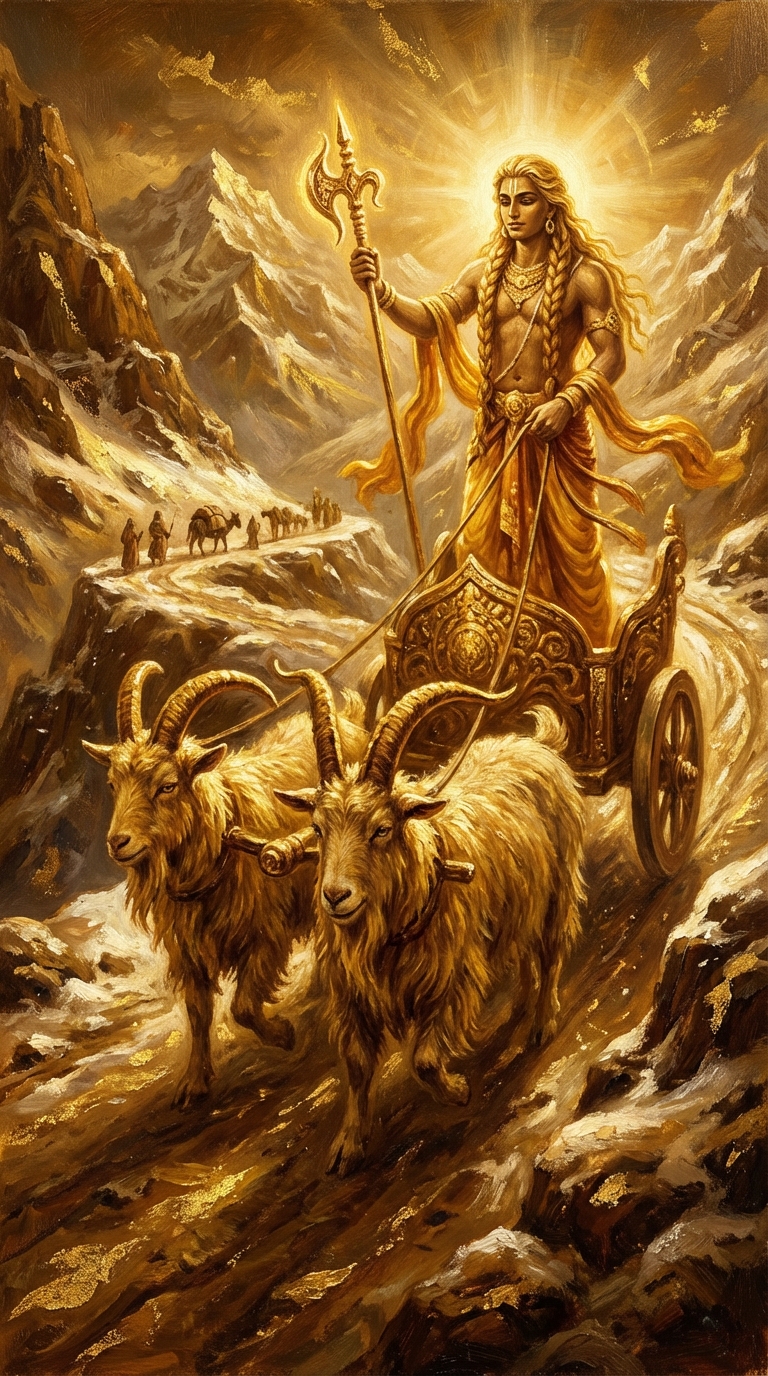
Book 6 of 10
Attributed to the Angirasa rishi Bharadvaja, this book comprises 75 hymns. The deities praised include Agni, Indra, and Pushan. The hymns often seek material prosperity, victory in battle, and divine protection, reflecting the societal concerns of the time.
Hymn I. Agni.
This hymn opens the book by addressing Agni as a divine messenger and herald, a worker of wonders who brings strength and overcomes all challenges. The poet establishes a close, reverential bond, seeking the fire god's auspicious favor and protection.
1. THOU, first inventor of this prayer, O Agni, Worker of Marvels, hast become our Herald. > Thou, Bull, hast made us strength which none may conquer, strength that shall overcome all other prowess. > 2 As Priest thou sattest at the seat of worship, furthering us, best Offerer, meet for honour. > So first to thee have pious men resorted, turning thy mind to thoughts of ample riches. > 3 In thee, still watching, they have followed riches, who goest with much wealth as with an army, > The radiant Agni, lofty, fair to look on, worshipped with marrow, evermore resplendent. > 4 They who approached the God's abode with homage, eager for glory, won them perfect glory: > Yea, they gained even sacrificial titles, and found delight in thine auspicious aspect. > 5 On earth the people magnify thee greatly, thee their celestial and terrestrial riches. > Thou, Helper, must be known as our Preserver, Father and Mother of mankind for ever. > 6 Dear priest among mankind, adorable Agni hath seated him, joy-giver, skilled in worship. > Let us approach thee shining in thy dwelling, kneeling upon our knees, with adoration. > 7 Longing for bliss, pure-minded, God-devoted, Agni, we seek thee, such, meet to be lauded. > Thou, Agni, leddest forth our men to battle, refulgent with the heaven's exalted splendour. > 8 Sage of mankind, all peoples' Lord and Master, the Bull of men, the sender down of blessings, > Still pressing on, promoting, purifying, Agni the Holy One, the Lord of riches. > 9 Agni, the mortal who hath toiled and worshipped, brought thee oblations with his kindled fuel, > And well knows sacrifice with adoration, gains every joy with thee to guard and help him. > 10 Mightily let us worship thee the Mighty, with reverence, Agni! fuel and oblations, > With songs, O Son of Strength, with hymns, with altar: so may we strive for thine auspicious favour. > 11 Thou who hast covered heaven and earth with splendour and with thy glories, glorious and triumphant. > Continue thou to shine on us, O Agni, with strength abundant, rich, and long enduring. > 12 Vouchsafe us ever, as man needs, O Vasu, abundant wealth of kine for son and offspring. > Food noble, plenteous, far from sin and evil, he with us, and fair fame to make us happy. > 13 May I obtain much wealth in many places by love of thee and through thy grace, King Agni; > For in thee Bounteous One, in thee the Sovran, Agni, are many boons for him who serves thee.
Hymn II. Agni.
The poet praises Agni's princely glory, comparing him to Mitra and the Sun in his radiance. This hymn celebrates Agni as a friendly, ever-present force who brings prosperity and ensures security for those who honor him.
1. THOU, Agni, even as Mitra, hast a princely glory of thine own. > Thou, active Vasu, makest fame increase like full prosperity. > 2 For, verily, men pray to thee with sacrifices and with songs. > To thee the Friendly Courser, seen of all, comes speeding through the air. > 3 Of one accord men kindle thee Heaven's signal of the sacrifice, > When, craving bliss, this race of man invites thee to the solemn rite. > 4 Let the man thrive who travails sore, in prayer, far thee the Bountiful. > He with the help of lofty Dyaus comes safe through straits of enmity. > 5 The mortal who with fuel lights thy flame and offers unto thee, > Supports a house with many a branch, Agni, to live a hundred years. > 6 Thy bright smoke lifts itself aloft, and far-extended shines in heaven. > For, Purifier! like the Sun thou beamest with thy radiant glow. > 7 For in men's houses thou must be glorified as a well-loved guest, > Gay like an elder in a fort, claiming protection like a son. > 8 Thou, Agni, like an able steed, art urged by wisdom in the wood. > Thou art like wind; food, home art thou, like a young horse that runs astray. > 9 E’en things imperishable, thou, O Agni, like a gazing ox, > Eatest, when hosts, Eternal One! of thee the Mighty rend the woods. > 10 Agni, thou enterest as Priest the home of men who sacrifice. > Lord of the people, prosper them. Accept the ofrering, Aṅgiras! > 11 O Agni, God with Mitra's might, call hither the favour of the Gods from earth and heaven. > Bring weal from heaven, that men may dwell securely. May we o’ercome the foe's malign oppressions, may we o’ercome them, through thy help o’ercome them.
Hymn III. Agni.
Here, Agni's fierce and untamed nature is brought to the forefront, his form as a devouring force that moves like an archer and a smelter. The hymn captures the raw power of fire, both as a destructive element and as an immortal, red-hued messenger.
1. TRUE, guardian of the Law, thy faithful servant wins ample light and dwells in peace, O Agni, > Whom thou, as Varuṇa in accord with Mitra, guardest, O God, by banishing his trouble. > 2 He hath paid sacrifices, toiled in worship, and offered gifts to wealth increasing Agni. > Him the displeasure of the famous moves not, outrage and scorn affect not such a mortal. > 3 Bright God, whose look is free from stain like Sūrya's, thou, swift, what time thou earnestly desirest, > Hast gear to give us. Come with joy at evening, where, Child of Wood, thou mayest also tarry. > 4 Fierce is his gait and vast his wondrous body: he champeth like a horse with bit and bridle, > And, darting forth his tongue, as ’twere a hatchet, burning the woods, smelteth them like a smelter. > 5 Archer-like, fain toshoot, he sets his arrow, and whets his splendour like the edge of iron: > The messenger of night with brilliant pathway, like a tree-roosting bird of rapid pinion. > 6 In beams of morn he clothes him like the singer, and bright as Mitra with his splendour crackles. > Red in the night, by day the men's possession: red, he belongs to men by day, Immortal. > 7 Like Heaven's when scattering beams his voice was uttered: among the plants the radiant Hero shouted, > Who with his glow in rapid course came hither to fill both worlds, well wedded Dames, with treasure. > 8 Who, with supporting streams and rays that suit him, hath flashed like lightning with his native vigour. > Like the deft Maker of the band of Maruts, the bright impetuous One hath shone refulgent.
Hymn IV. Agni.
This hymn portrays Agni as an all-knowing, ever-present guide and protector, a "feast-companion" who dispels darkness and shields his worshipers from sorrow. The verses emphasize his role in connecting the human and divine worlds, ensuring the success of the sacrifice.
1. As at man's service of the Gods, Invoker, thou, Son of Strength, dost sacrifice and worship, > So bring for us to-day all Gods together, bring willingly the willing Gods, O Agni. > 2 May Agni, radiant Herald of the morning, meet to be known, accept our praise with favour. > Dear to all life, mid mortal men Immortal, our guest, awake at dawn, is Jātavedas. > 3 Whose might the very heavens regard with wonder: bright as the Sun he clothes himself with lustre. > He who sends forth,, Eternal Purifier, hath shattered e’en the ancient works of Aśna. > 4 Thou art a Singer, Son! our feast-companion: Agni at birth prepared his food and pathway. > Therefore vouchsafe us strength, O Strength-bestower. Win like a King: foes trouble not thy dwelling. > 5 Even he who cats his firm hard food with swiftness,and overtakes the nights as Vāyu kingdoms. > May we o’ercome those who resist thine orders, like a steed casting down the flying foemen. > 6 Like Sūrya with his fulgent rays, O Agni, thou overspreadest both the worlds with splendour. > Decked with bright colour he dispels the darkness, like Auśija, with clear flame swifily flying. > 7 We have elected thee as most delightful for thy beams' glow: hear our great laud, O Agni. > The best men praise thee as the peer of Indra in strength, mid Gods, like Viyu in thy bounty. > 8 Now, Agni, on the tranquil paths of riches come to us for our weal: save us from sorrow. > Grant chiefs and bard this boon. May we live happy, with hero children, through a hundred winters.
Hymn V. Agni.
Addressed to the "Youngest God," this hymn is a plea for wealth, strength, and protection from all malice. The poet seeks Agni's favor, invoking him as a bringer of boons and a fierce, burning guardian against all who attack.
1. I INVOCATE your Son of Strength, the Youthful, with hymns, the Youngest God, whose speech is guileless; > Sage who sends wealth comprising every treasure, bringer of many boons, devoid of malice. > 2 At eve and morn thy pious servants bring thee their precious gifts, O Priest of many aspects, > On whom, the Purifier, all things living as on firm. ground their happiness have stablished. > 3 Thou from of old hast dwelt among these people, by mental power the charioteer of blessings. > Hence sendest thou, O sapient Jātavedas, to him who serves thee treasures in succession. > 4 Agni, whoever secretly attacks us, the neighbour, thou with Mitra's might! who harms us, > Burn him with thine own Steers for ever youthful, burning with burning heat, thou fiercest burner. > 5 He who serves thee with sacrifice and fuel, with hymn, O Son of Strength, and chanted praises, > Shines out, Immortal! in the midst of mortals, a sage, with wealth, with splendour and with glory. > 6 Do this, O Agni, when we urge thee, quickly, triumphant in thy might subdue our foemen. > When thou art praised with words and decked with brightness, accept this chanted hymn, the singer's worship. > 7 Help us, that we may gain this wish, O Agni, gain riches, Wealthy One! with store of heroes. > Desiring strength from thee may we be strengthened, and win, Eternal! thine eternal glory.
Hymn VI. Agni.
This hymn takes the form of a refrain-like praise song, a litany that values Agni as the central point of the home and the source of all sustenance. Each stanza builds upon the idea of fire as the bringer of food, wealth, and delight, the constant friend to those who sing his praise.
1. I VALUE Agni that good Lord, the home to which the kine return: > Whom fleet-foot coursers seek as home, and strong enduring steeds as home. Bring food to those who sing thy praise. > 2 ’Tis Agni whom we laud as good, to whom the milch-kine come in herds, > To whom the chargers swift of foot, to whom our well-born princes come. Bring food to those who sing thy praise. > 3 Agni the God of all mankind, gives, verily, a steed to man. > Agni gives precious gear for wealth, treasure he gives when he is pleased. Bring food to those who sing thy praise. > 4 God, Agni, we will kindle thee, rich in thy splendour, fading not, > So that this glorious fuel may send forth by day its light for thee. Bring food to those who sing thy praise. > 5 To thee the splendid, Lord of flame, bright, wondrous, Prince of men, is brought. > Oblation with the holy verse, O Agni, bearer of our gifts. > Bring food to those who sing thy praise. > 6 These Agnis in the seats of the fire nourish each thing most excellent. > They give delight, they spread abroad, they move themselves continually. Bring food to those who sing thy praise. > 7 Agni, these brilliant flames of thine wax like strong chargers mightily, > Who with the treadings of their hoofs go swiftly to the stalls of kine. Bring food to those who sing thy praise. > 8 To us who laud thee, Agni, bring fresh food and safe and happy homes. > May we who have sung hymns to thee have thee for envoy in each house. Bring food to those who sing thy praise. > 9 Thou, brilliant God, within thy mouth warmest both ladles of the oil. > So fill us also, in our hymns, abundantly, O Lord of Strength. Bring food to those who sing thy praise. > 10 Thus Agni have we duly served with sacrifices and with hymns. > So may he give us what we crave, store of brave sons and fleet-foot steeds. Bring food to those who sing thy praise.
Hymn VII. Agni.
The poet sends forth a song to Agni, the victorious messenger and "Son of Strength," whose presence is a signal in the night. The hymn celebrates his role in sanctifying the sacrifice and grasping the reins of the cosmic order.
1. OFFER to Agni, O my friends, your seemly food, your seemly praise; > To him supremest o’er the folk, the Son of Strength, the mighty Lord: > 2 Him in whose presence, when they meet in full assembly, men rejoice; > Even him whom worthy ones inflame, and living creatures bring to life. > 3 When we present to him the food and sacrificial gifts of men, > He by the might of splendour grasps the holy Ordinance's rein. > 4 He gives a signal in the night even to him who is afar, > When he, the Bright, unchanged by eld, consumes the sovrans of the wood. > 5 He in whose service on the ways they offer up their drops of sweat, > On him is their high kin have they mounted, as ridges on the earth. > 6 Whom, sought of many, mortal man hath found to be the Stay of all; > He who gives flavour to our food, the home of every man that lives. > 7 Even as a herd that crops the grass he shears the field and wilderness, > With flashing teeth and beard of gold, deft with his unabated might. > 8 For him, to whom, bright as an axe he, as to Atri, hath flashed forth, > Hath the well-bearing Mother borne, producing when her time is come. > 9 Agni to whom the oil is shed by him thou lovest to support, > Bestow upon these mortals fame and splendour and intelligence. > 10 Such zeal hath he, resistless one: he gained the cattle given by thee. > Agni, may Atri overcome the Dasyus who bestow no gifts, subdue the men who give no food.
Hymn VIII. Agni.
This hymn is a vibrant portrait of Agni's divine nature, celebrating his power, beauty, and intimate connection to the human world. The poet praises him as the "joyous Priest" and "redoubled force" who chases away sickness and blesses the singers.
1. O AGNI urged to strength, the men of old who loved the Law enkindled thee, > the Ancient, for their aid, > Thee very bright, and holy, nourisher of all, most excellent, the Friend and Master of the home. > 2 Thee, Agni, men have stablished as their guest of old, as Master of the household, thee, with hair of flame; > High-bannered, multiform, distributor of wealth, kind helper, good protector, drier of the floods. > 3 The tribes of men praise thee, Agni, who knowest well burnt offerings, the Discerner, lavishest of wealth, > Dwelling in secret, Blest One! visible to all, loud-roaring, skilled in worship, glorified with oil. > 4 Ever to thee, O Agni, as exceeding strong have we drawn nigh with songs and reverence singing hymns. > So be thou pleased with us, Aṅgiras! as a God enkindled by the noble with man's goodly light. > 5 Thou, Agni! multiform, God who art lauded much! givest in every house subsistence as of old. > Thou rulest by thy might o’er food of many a sort: that light of thine when blazing may not be opposed. > 6 The Gods, Most Youthful Agni, have made thee, inflamed, the bearer of oblations and the messenger. > Thee, widely-reaching, homed in sacred oil, invoked, effulgent, have they made the Eye that stirs the thought. > 7 Men seeking joy have lit thee worshipped from of old, O Agni, with good fuel and with sacred oil. > So thou, bedewed and waxing mighty by the plants, spreadest thyself abroad over the realms of earth.
Hymn IX. Agni.
Focusing on Agni as the guest and envoy, this hymn describes his essential role in the sacrifice. The verses paint a picture of Agni tended by men, consuming the offerings, and standing as a fierce, protective force.
1. BEARING; oblations mortal men, O Agni, worship thee the God. > I deem thee Jātavedas: bear our offerings, thou, unceasingly. > 2 In the man's home who offers gifts, where grass is trimmed, Agni is Priest, > To whom all sacrifices come and strengthenings that win renown. > 3 Whom, as an infant newly-born, the kindling-sticks have brought to life, > Sustainer of the tribes of men, skilled in well-ordered sacrifice. > 4 Yea, very hard art thou to grasp, like offspring of the wriggling snakes, > When thou consumest many woods like an ox, Agni, in the mead. > 5 Whose flames, when thou art sending forth the smoke, completely reach the mark, > When Tṛta in the height of heaven, like as a smelter fanneth thee, e’en as a smelter sharpeneth thee. > 6 O Agni, by thy succour and by Mitra's friendly furtherance, > May we, averting hate, subdue the wickedness of mortal men. > 7 O Agni, to our heroes bring such riches, thou victorious God. > May he protect and nourish us, and help in gaining strength: be thou near us in fight for our success.
Hymn X. Agni.
This hymn is a direct and forceful invocation, calling upon Agni to bring the most potent splendor and riches. The verses see Agni as an unstoppable force, a source of light and power that can mark out a path to strength for his worshipers.
1. BRING us most mighty splendour thou, Agni, resistless on thy way. > With overflowing store of wealth mark out for us a path to strength. > 2 Ours art thou, wondrous Agni, by wisdom and bounteousness of power. > The might of Asuras rests on thee, like Mitra worshipful in act. > 3 Agni, increase our means of life, increase the house and home of these, > The men, the princes who have won great riches through our hymns of praise. > 4 Bright Agni, they who deck their songs for thee have horses as their meed. > The men are mighty in their might, they whose high laud, as that of heaven, awakes thee of its own accord. > 5 O Agni, those resplendent flames of thine go valorously forth, > Like lightnings flashing round us, like a rattling car that seeks the spoil. > 6 Now, Agni, come to succour us; let priests draw nigh to offer gifts; > And let the patrons of our rites subdue all regions of the earth. > 7 Bring to us, Agni, Aṅgiras, lauded of old and lauded now, > Invoker! wealth to quell the strong, that singers may extol thee. Be near us in fight for our success.
Hymn XI. Agni.
Here, Agni is praised as the watchful guardian of the people, the first household-priest, born to bring prosperity. The hymn recalls Agni's discovery by the ancient Aṅgirases and celebrates his essential role as the envoy who connects humanity to the divine.
1. THE watchful Guardian of the people hath been born, Agni, the very strong, for fresh prosperity. > With oil upon his face, with high heaven-touching flame, he shineth splendidly, pure, for the Bharatas. > 2 Ensign of sacrifice, the earliest Household-Priest, the men have kindled Agni in his threefold seat, > With Indra and the Gods together on the grass let the wise Priest sit to complete the sacrifice. > 3 Pure , unadorned, from thy two Mothers art thou born: thou camest from Vivasvān as a charming Sage. > With oil they strengthened thee, O Agni, worshipped God: thy banner was the smoke that mounted to the sky. > 4 May Agni graciously come to our sacrifice. The men bear Agni here and there in every house. > He hath become an envoy, bearer of our gifts: electing Agni, men choose one exceeding wise. > 5 For thee, O Agni, is this sweetest prayer of mine: dear to thy spirit be this product of my thought. > As great streams fill the river so our song of praise fill thee, and make thee yet more mighty in thy strength. > 6 O Agni, the Aṅgirases discovered thee what time thou layest hidden, fleeing back from wood to wood. > Thou by attrition art produced as conquering might, and men, O Aṅgiras, call thee the Son of Strength.
Hymn XII. Agni.
Addressed to Agni as the lofty Asura and the "Steer of eternal Law," this hymn is a profound meditation on his divine order. The poet seeks to understand Agni's nature and his role in upholding cosmic truth, expressing a desire to follow his path and avoid the ways of falsehood.
1. To Agni, lofty Asura, meet for worship, Steer of eternal Law, my prayer I offer; > I bring my song directed to the Mighty like pure oil for his mouth at sacrifices. > 2 Mark the Law, thou who knowest, yea, observe it: send forth the full streams of eternal Order. > I use no sorcery with might or falsehood the sacred Law of the Red Steer I follow. > 3 How hast thou, follower of the Law eternal, become the knower of a new song, Agni? > The God, the Guardian of the seasons, knows me: the Lord of him who won this wealth I know not. > 4 Who, Agni, in alliance with thy foeman, what splendid helpers won for them their riches? > Agni, who guard the dwelling-place of falsehood? Who are protectors of the speech of liars? > 5 Agni, those friends of thine have turned them from thee: gracious of old, they have become ungracious. > They have deceived themselves by their own speeches, uttering wicked words against the righteous. > 6 He who pays sacrifice to thee with homage, O Agni, keeps the Red Steer's Law eternal; > Wide is his dwelling. May the noble offspring of Nahuṣa who wandered forth come hither.
Hymn XIII. Agni.
This brief but potent hymn is a direct and simple call to Agni, kindling him with songs of praise for help. The verses emphasize the intimate, personal connection between the worshiper and the fire god, who is invoked as a dear and excellent priest.
1. WITH songs of praise we call on thee, we kindle thee with songs of praise, > Agni, with songs of praise, for help. > 2 Eager for wealth, we meditate Agni's effectual praise to-day, > Praise of the God who touches heaven. > 3 May Agni, Priest among mankind, take pleasure in our songs of praise, > And worship the Celestial Folk. > 4 Thou, Agni, art spread widely forth, Priest dear and excellent; through thee > Men make the sacrifice complete. > 5 Singers exalt thee, Agni, well lauded, best giver of our strength: > So grant thou us heroic might. > 6 Thou Agni, as the felly rings the spokes, encompassest the Gods. > I yearn for bounty manifold.
Hymn XIV. Agni.
The poet calls for Agni to be awakened with song, enkindling the immortal messenger who bears human offerings to the gods. This hymn portrays Agni as a radiant, victorious force who slays the demons of darkness and finds the light for humanity.
1. ENKINDLING the Immortal, wake Agni with song of praise: may he bear our oblations to the Gods. > 2 At high solemnities mortal men glorify him the Immortal, best > At sacrifice among mankind. > 3 That he may bear their gifts to heaven, all glorify him Agni, God, > With ladle that distilleth oil. > 4 Agni shone bright when born, with light killing the Dasyus and the dark: > He found the Kine, the Floods, the Sun. > 5 Serve Agni, God adorable, the Sage whose back is balmed with oil: > Let him approach, and hear my call. > 6 They have exalted Agni, God of all mankind, with oil and hymns > Of praise, devout and eloquent.
Hymn XV. Agni.
This hymn celebrates Agni as the far-renowned and wise ordainer, the firm support of noble riches. It speaks of his role in supporting the cosmic order and his power to conquer all who oppose him, ending with a plea for wealth and protection.
1. To him, the far-renowned, the wise Ordainer, ancient and glorious, a song I offer. > Enthroned in oil, the Asura, bliss-giver, is Agni, firm support of noble, riches. > 2 By holy Law they kept supporting Order, by help of sacrifice, in loftiest heaven,— > They who attained with born men to the unborn, men seated on that stay, heaven's firm sustainer. > 3 Averting woe, they labour hard to bring him, the ancient, plenteous food as power resistless. > May he, born newly, conquer his assailants: round him they stand as round an angry lion. > 4 When, like a mother, spreading forth to nourish, to cherish and regard each man that liveth,— > Consuming all the strength that thou hast gotten, thou wanderest round, thyself, in varied fashion. > 5 May strength preserve the compass of thy vigour, God! that broad stream of thine that beareth riches. > Thou, like a thief who keeps his refuge secret, hast holpen Atri to great wealth, by teaching.
Hymn XVI. Agni.
The poet calls to Agni as a dear and wise envoy, the immortal messenger who can bring riches and ensure the success of the sacrifice. This extended hymn is a comprehensive praise of Agni's many functions, from his role as Herald and Priest to his power as a protector and a source of fame.
1. WITH this my reverent hymn I call Agni for you, the Son of Strength, > Dear, wisest envoy, served with noble sacrifice, immortal messenger of all. > 2 His two red horses, all-supporting, let him yoke: let him, well worshipped, urge them fast. > Then hath the sacrifice good prayers and happy end, and heavenly gift of wealth to men. > 3 The flame of him the Bountiful, the Much-invoked, hath mounted up, > And his red-coloured smoke-clouds reach and touch the sky: the men are kindling Agni well. > 4 Thee, thee Most Glorious One we make our messenger. Bring the Gods hither to the feast. > Give us, O Son of Strength, all food that fcedeth man: give that for which we pray to thee. > 5 Thou, Agni, art the homestead's Lord, our Herald at the sacrifice. > Lord of all boons, thou art the Cleanser and a Sage. Pay worship, and enjoy the good. > 6 Give riches to the sacrificer, O Most Wise, for thou art he who granteth wealth. > Inspire with zeal each priest at this our solemn rite; all who are skilled in singing praise. > 7 O Agni who art worshipped well, dear let our princes he to thee, > Our wealthy patrons who are governors of men, who part, as gifts, their stalls of kine. > 8 They in whose home, her hand bearing the sacred oil, Iḷā sits down well-satisfied > Guard them, Victorious God, from slander and from harm. give us a refuge famed afar. > 9 Do thou, a Priest with pleasant tongue, most wise, and very near to us, > Agni, bring riches hither to our liberal chiefs, and speed the oflering of our gifts. > 10 They who bestow as bounty plenteous wealth of steeds, moved by desire of great renown > Do thou with saving help preserve them from distress, Most Youthful! with a hundred forts. > 11 The God who gives your wealth demands a full libation poured to him. > Pour ye it forth, then fill the vessel full again: then doth the God pay heed to you. > 12 Him have the Gods appointed Priest of sacrifice, oblation-bearer, passing wise. > Agni gives wealth and valour to the worshipper, to folk who offer up their gifts.
Hymn XVII. Indra.
This hymn celebrates Indra's mighty deeds, praising his power to break open the firm enclosures of the sky and release the life-giving waters. The verses recount his cosmic victories and his generosity, culminating in a plea for his continued favor and protection.
1. DRINK Soma, Mighty One, for which, when lauded, thou breakest through the cattle-stall, O Indra; > Thou who, O Bold One, armed with thunder smotest Vṛtra with might, and every hostile being. > 2 Drink it thou God who art impetuous victor, Lord of our hymns, with beauteousjaws, the Hero, > Render of kine-stalls, car-borne, thunder-wielding, so pierce thy way to wondrous strength, O Indra. > 3 Drink as of old, and let the draught delight thee. hear thou our prayer and let our songs exalt thee. > Make the Sun visible, make food abundant, slaughter the foes, pierce through and free the cattle. > 4 These gladdening drops, O Indra, Self-sustainer, quaffed shall augment thee in thy mighty splendour. > Yea, let the cheering drops delight thee greatly, great, perfect, strong, powerful, all-subduing. > 5 Gladdened whereby, bursting the firm enclosures, thou gavest splendour to the Sun and Morning. > The mighty rock that compassed in the cattle, ne’er moved, thou shookest from its seat, O Indra. > 6 Thou with thy wisdom, power, and works of wonder, hast stored the ripe milk in the raw cows' udders > Unbarred the firm doors for the kine of Morning, and, with the Aṅgirases, set free the cattle. > 7 Thou hast spread out wide earth, a mighty marvel, and, high thyself, propped lofty heaven, O Indra. > Both worlds, whose Sons are Gods, thou hast supported, young, Mothers from old time ofholy Order. > 8 Yea, Indra, all the Deities installed thee their one strong Champion in the van for battle. > What time the godless was the Gods’ assailant, Indra they chose to win the light of heaven. > 9 Yea, e’en that heaven itself of old bent backward before thy bolt, in terror of its anger, > When Indra, life of every living creature, smote down within his lair the assailing Dragon. > 10 Yea, Strong One! Tvaṣṭar turned for thee, the Mighty, the bolt with thousand spikes and hundred edges, > Eager and prompt at will, wherewith thou crushedst the boasting Dragon, O impetuous Hero. > 11 He dressed a hundred buffaloes, O Indra, for thee whom all accordant Maruts strengthen. > He, Pūṣan Viṣṇu, poured forth three great vessels to him, the juice that cheers, that slaughters Vṛtra. > 12 Thou settest free the rushing wave of waters, the floods' great swell encompassed and obstructed. > Along steep slopes their course thou tumedst, Indra, directed downward, speeding to the ocean. > 13 So may our new prayer bring thee to protect us, thee well-armed Hero with thy bolt of thunder, > Indra, who made these worlds, the Strong, the ty, who never groweth old, the victory-giver. > 14 So, Indra, form us brilliant holy singers for strength, for glory, and for food and riches. > Give Bharadvāja hero patrons, Indra Indra, be ours upon the day of trial. > 15 With this may we obtain strength God-appointed, and brave sons gladden us through a hundred winters.
Hymn XVIII. Indra.
This hymn is a powerful and direct address to Indra, celebrating his unrivaled might as a warrior and his central role in the cosmos. The poet recounts Indra's heroic deeds, from taming the Dasyus to his awe-inspiring conquest of Vṛtra, affirming his status as the supreme, all-conquering deity.
1. GLORIFY him whose might is all-surpassing, Indra the much-invoked who fights uninjured. > Magnify with these songs the never-vanquished, the Strong, the Bull of men, the Mighty Victor. > 2 He, Champion, Hero, Warrior, Lord of battles, impetuous, loudly roaring, great destroyer, > Who whirls the dust on high, alone, oerthrower, hath made all races of mankind his subjects. > 3 Thou, thou alone, hast tamed the Dasyus; singly thou hast subdued the people for the Ārya. > In this, or is it not, thine hero exploit, Indra? Declare it at the proper season. > 4 For true, I deem, thy strength is, thine the Mighty, thine, O Most Potent, thine the Conquering Victor; > Strong, of the strong, Most Mighty, of the mighty, thine, driver of the churl to acts of bounty. > 5 Be this our ancient bond of friendship with you and with Aṅgirases here who speak of Vala. > Thou, Wondrous, Shaker of things firm, didst smite him in his fresh strength, and force his doors and castles. > 6 With holy thoughts must he be called, the Mighty, showing his power in the great fight with Vṛtra. > He must be called to give us seed and offspring, the Thunderer must he moved and sped to battle. > 7 He in his might, with name that lives for ever, hath far surpassed all human generations. > He, most heroic, hath his home with splendour, with glory and with riches and with valour. > 8 Stranger to guile, who ne’er was false or faithless, bearing a name that may be well remembered, > Indra crushed Cumuri, Dhuni, Śambara, Pipru, and Śuṣṇa, that their castles fell in ruin. > 9 With saving might that must be praised and lauded, Indra, ascend thy car to smite down Vṛtra. > In thy right hand hold fast thy bolt of thunder, and weaken, Bounteous Lord, his art and magic. > 10 As Agni, as the dart burns the dry forest, like the dread shaft burn down the fiends, O Indra; > Thou who with high deep-reaching spear hast broken, hast covered over mischief and destroyed it. > 11 With wealth, by thousand paths come hither, Agni, paths that bring ample strength, O thou Most Splendid. > Come, Son of Strength, o’er whom, Invoked of many! the godless hath no power to keep thee distant. > 12 From heaven, from earth is bruited forth the greatness of him the firm, the fiery, the resplendent. > No foe hath he, no counterpart, no refuge is there from him the Conqueror full of wisdom > 13 This day the deed that thou hast done is famous, when thou, for him, with many thousand others > Laidest low Kutsa, Āyu, Atithigva, and boldly didst deliver Tūrvayāṇa. > 14 In thee, O God, the wisest of the Sages, all Gods were joyful when thou slewest Ahi. > When lauded for thyself, thou gavest freedom to sore-afflicted Heaven and to the people. > 15 This power of thine both heaven and earth acknowledge, the deathless Gods acknowledge it, O Indra. > Do what thou ne’er hast done, O Mighty Worker: beget a new hymn at thy sacrifices.
Hymn XIX. Indra.
This hymn calls upon Indra as a great, hero-like controller of men, whose power is renewed and strengthened by the sacred Soma. The verses are a plea for his friendship and aid, seeking to win his favor and share in the spoils of victory.
1. GREAT, hero-like controlling men is Indra, unwasting in his powers, doubled in vastness. > He, turned to us, hath grown to hero vigour: broad, wide, he hath been decked by those who serve him. > 2 The bowl made Indra swift to gather booty, the High, the Lofty, Youthful, Undecaying, > Him who hath waxed by strength which none may conquer, and even at once grown to complete perfection. > 3 Stretch out those hands of thine, extend to us-ward thy wide capacious arms, and grant us glory. > Like as the household herdsman guards the cattle, so move thou round about us in the combat. > 4 Now, fain for strength, let us invite your Indra hither, who lieth hidden with his Heroes,— > Free from all blame, without reproach, uninjured, e’en as were those who sang, of old, his praises. > 5 With steadfast laws, wealth-giver, strong through Soma, he hath much fair and precious food to feed us. > In him unite all paths that lead to riches, like rivers that commingle with the ocean. > 6 Bring unto us the mightiest might, O Hero, strong and most potent force, thou great Subduer! > All splendid vigorous powers of men vouchsafe us, Lord of Bay Steeds, that they may make us joyful. > 7 Bring us, grown mighty in its strength, O Indra, thy friendly rapturous joy that wins the battle, > Wherewith by thee assisted and triumphant, we may laud thee in gaining seed and offspring. > 8 Indra, bestow on us the power heroic skilled and exceeding strong, that wins the booty, > Wherewith, by thine assistance, we may conquer our foes in battle, be they kin or stranger. > 9 Let thine heroic strength come from behind us, before us, from above us or below us. > From every side may it approach us, Indra. Give us the glory of the realm of splendour. > 10 With most heroic aid from thee, like heroes Indra, may we win wealth by deeds glory. > Thou, King, art Lord of earthly, heavenly treasure: vouchsafe us riches vast, sublime, and lasting. > 11 The Bull, whose strength hath waxed, whom Maruts follow, free giving Indra, the Celestial Ruler, > Mighty, all-conquering, the victory-giver, him let us call to grant us new protection. > 12 Give up the people who are high and haughty to these men and to me, O Thunder-wielder! > Therefore upon the earth do we invoke thee, where heroes win, for sons and kine and waters. > 13 Through these thy friendships, God invoked of many! may we be victors over every foeman. > Slaying both kinds of foe, may we, O Hero, be happy, helped by thee, with ample riches.
Hymn XX. Indra.
The poet offers a hymn to Indra, the "Strong, Victor, Mightier than the mighty," whose power extends over all of creation. The verses celebrate his role as the slayer of Vṛtra and the creator of earth and waters, and they implore him to share his bountiful riches.
1. GIVE us wealth, Indra, that with might, as heaven o’ertops the earth, o’ercomes our foes in battle > Wealth that brings thousands and that wins the corn-lands, wealth, Son of Strength! that vanquishes the foeman. > 2 Even as the power of Dyaus, to thee, O Indra, all Asura sway was by the Gods entrusted, > When thou, Impetuous! leagued with Viṣṇu, slewest Vṛtra the Dragon who enclosed the waters. > 3 Indra, Strong, Victor, Mightier than the mighty, addressed with prayer and perfect in his splendour, > Lord of the bolt that breaketh forts in pieces, became the King of the sweet juice of Soma.. > 4 There, Indra, while the light was won, the Paṇis f1ed, 'neath a hundred blows, for wise Dasoni, > And greedy Śuṣṇa's magical devices nor left he any of their food remaining. > 5 What time the thunder fell and Śuṣṇa perished, all life's support from the great Druh was taken. > Indra made room for his car-drivcr Kutsa who sate beside him, when he gained the sunlight. > 6 As the Hawk rent for him the stalk that gladdens, he wrenched the head from Namuci the Dāsa. > He guarded Nam, Sayya's son, in slumber, and sated him with food, success, and riches. > 7 Thou, thunder-armed, with thy great might hast shattered Pipru's strong forts who knew the wiles of serpents. > Thou gavest to thy worshipper Ṛjiśvan imperishable Wealth, O Bounteous Giver. > 8 The crafty Vetasu, the swift Dasni, and Tugra speedily with all his servants, > Hath Indra, gladdening with strong assistance, forced near as ’twere to glorify the Mother. > 9 Resistless, with the hosts he battles, bearing in both his arms the Vṛtra slaying thunder. > He mounts his Bays, as the car-seat an archer: yoked at a word they bear the lofty Indra. > 10 May we, O Indra, gain by thy new favour: so Parus laud thee, with their sacrifices, > That thou hast wrecked seven autumn forts, their shelter, slain Dāsa tribes and aided Purukutsa. > 11 Favouring Uśanā the son of Kavi, thou wast his ancient strengthener, O Indra. > Thou gavest Navavāstva. as a present, to the great father gavest back his grandson. > 12 Thou, roaring Indra, drovest on the waters that made a roaring sound like rushing rivers, > What time, O Hero, o’er the sea thou broughtest, in safety broughtest Turvaśa and Yadu.
Hymn XXI. Indra. Viśvedevas.
This hymn is a complex tapestry of invocation, calling upon Indra alongside the entire pantheon of gods. The poet seeks their collective aid and protection, recalling Indra's past deeds and the strength he lends to those who praise him.
1. THESE the most constant singer's invocations call thee who art to be invoked, O Hero; > Hymns call anew the chariot-borne, Eternal: by eloquence men gain abundant riches. > 2 I praise that Indra, known to all men, honoured with songs, extolled with hymns at sacrifices, > Whose majesty, rich in wondrous arts, surpasseth the magnitude of earth, and heaven in greatness. > 3 He hath made pathways, with the Sun to aid him, throughout the darkness that extended pathless. > Mortals who yearn to worship ne’er dishonour, O Mighty God, thy Law who art Immortal. > 4 And he who did these things, where is that Indra? among what tribes? what people doth he visit? > What sacrifice contents thy mind , and wishes? What priest among them all? what hymn, O Indra? > 5 Yea, here were they who, born of old, have served thee, thy friends of ancient time, thou active Worker. > Bethink thee now of these, Invoked of many! the midmost and the recent, and the youngest. > 6 Inquiring after him, thy later servants, Indra, have gained thy former old traditions. > Hero, to whom the prayer is brought, we praise thee as great for that wherein we know thee mighty. > 7 The demon's strength is gathered fast against thee: great as that strength hath grown, go forth to meet it. > With thine own ancient friend and companion, the thunderbolt, brave Champion! drive it backward. > 8 Hear, too, the prayer of this thy present beadsman, O Indra, Hero, cherishing the singer. > For thou wast aye our fathers' Friend aforetime, still swift to listen to their supplication.
Hymn XXII. Indra.
This hymn is a direct appeal to Indra, asking him to drink the Soma and be cheered by the praises of the worshiper, Vasiṣṭha. The poet establishes an intimate dialogue with the god, reminding him of his strength, his victories, and the joy he finds in the offerings.
1. DRINK Soma, Lord of Bays, and let it cheer thee: Indra, the stone, like a well guided courser, > Directed by the presser's arms hath pressed it. > 2 So let the draught of joy, thy dear companion, by which, O Lord of Bays, thou slayest foemen, > Delight thee, Indra, Lord of princely treasures. > 3 Mark closely, Maghavan, the words I utter, this eulogy recited by Vasiṣṭha: > Accept the prayers I offer at thy banquet. > 4 Hear thou the call of the juice-drinking press-stone: hear thou the Brahman's hymn who sings and lauds thee. > Take to thine inmost self these adorations. > 5 I know and ne’er forget the hymns and praises of thee, the Conqueror, and thy strength immortal. > Thy name I ever utter. Self-Refulgent > 6 Among mankind many are thy libations, and many a time the pious sageinvokes thee. > O Maghavan, be not long distant from us. > 7 All these libations are for thee, O Hero: to thee I offer these my prayers. that strengthen. > Ever, in every place, must men invoke thee. > 8 Never do men attain, O Wonder-Worker, thy greatness, Mighty One, who must be lauded, > Nor, Indra, thine heroic power and bounty. > 9 Among all Ṛṣis, Indra, old and recent, who have engendered hymns as sacred singers, > Even with us be thine auspicious friendships. Ye Gods, preserve us evermore with blessings.
Hymn XXIII. Indra.
In this hymn, the poet rouses Indra with songs of praise, calling him to the sacrifice as a victorious and powerful friend. The verses are filled with a sense of urgency and devotion, asking Indra to accept the offerings and to share his might with his worshipers.
1. PRAYERS have been offered up through love of glory: Vasiṣṭha, honour Indra in the battle. > He who with might extends through all existence hears words which I, his faithful servant, utter. > 2 A cry was raised which reached the Gods, O Indra, a cry to them to send us strength in combat. > None among men knows his own life's duration: bear us in safety over these our troubles. > 3 The Bays, the booty-seeking car I harness: my prayers have reached him who accepts them gladly. > Indra, when he had slain resistless foemen, forced with his might the two world-halves asunder. > 4 Like barren cows, moreover, swelled the waters: the singen sought thy holy rite, O Indra. > Come unto us as with his team comes Vāyu: thou, through our solemn hymns bestowest booty. > 5 So may these gladdening draughts rejoice thee, Indra, the Mighty, very bounteous to the singer. > Alone among the Gods thou pitiest mortals: O Hero, make thee glad at this libation. > 6 Thus the Vasisthas glorify with praises Indra, the Powerful whose arm wields thunder. > Praised, may he guard our wealth in kine and heroes. Ye Gods, preserve us evermore with blessings.
Hymn XXIV. Indra.
This hymn is a call to Indra to come and rejoice in the pressed Soma, portraying him as a mighty and approachable god. The poet creates a scene of eager worship, with the sacred grass strewn and the hymns prepared, all in anticipation of the god's arrival.
1. A HOME is made for thee to dwell in, Indra: O Much-invoked, go thitherwith the heroes. > That thou, to prosper us, mayst be our Helper, vouchsafe us wealth, rejoice with draughts of Soma. > 2 Indra, thy wish, twice-strong, is comprehended: pressed is the Soma, poured are pleasant juices. > This hymn of praise, from loosened tongue, made perfect, draws Indra to itself with loud invoking. > 3 Come, thou Impetuous; God, from earth or heaven; come to our holy grass to drink the Soma. > Hither to me let thy Bay Horses bring thee to listen to our hymns and make thee joyful. > 4 Come unto us with all thine aids, accordant, Lord of Bay Steeds, accepting our devotions, > Fair-helmeted, o’ercoming with the mighty, and lending us the strength of bulls, O Indra. > 5 As to the chariot pole a vigorous courser, this laud is brought to the great strong Upholder. > This hymn solicits wealth of thee: in heaven, as ’twere above the sky, set thou our glory. > 6 With precious things. O Indra, thus content us: may we attain to thine exalted favour. > Send our chiefs plenteous food with hero children. Preserve us evermore, ye Gods, with blessings.
Hymn XXV. Indra.
The poet addresses Indra, the potent god, in a time of conflict, seeking his mighty help to overcome all adversaries. The verses express a deep trust in Indra's power, asking him to strike down foes and to guide his worshipers to victory and wealth.
1. WHEN with thy mighty help, O potent Indra, the armies rush together in their fury. > When from the strong man's arm the lightning flieth, let not the mind go forth to side with others. > 2 O Indra, where the ground is hard to traverse, smite down our foes, the mortals who assail us, > Keep far from us the curse of the reviler: bring us accumulated store of treasures. > 3 God of the fair helm, give Sudās a hundred succours, a thousand blessings, and thy bounty. > Strike down the weapon of our mortal foeman: bestow upon us splendid fame and riches. > 4 I wait the power of one like thee, O Indra, gifts of a Helper such as thou art, Hero. > Strong, Mighty God, dwell with me now and ever: Lord of Bay Horses, do not thou desert us. > 5 Here are the Kutsas supplicating Indra for might, the Lord of Bays for God-sent conquest. > Make our foes ever easy to be vanquished: may we, victorious, win the spoil, O Hero. > 6 With precious things, O Indra, thus content us: may we attain to thine exalted favour. > Send our chiefs plenteous food with hero children. Preserve us evermore, ye Gods, with blessings.
Hymn XXVI. Indra.
This hymn celebrates Indra's delight in the Soma offering, declaring that no unpressed juice can gladden him. The poet generates a new and heroic laud to capture the god's attention, affirming that Indra's favor is won through active and heartfelt worship.
1. SOMA unpressed ne’er gladdened liberal Indra, no juices pressed without a prayer have pleased him. > I generate a laud that shall delight him, new and heroic, so that he may hear us. > 2 At every laud the Soma gladdens Indra: pressed juices please him as each psalm is chanted, > What time the priests with one united effort call him to aid, as sons invoke their father. > 3 These deeds he did; let him achieve new exploits, such as the priests declare at their libations. > Indra hath taken and possessed all castles, like as one common husband doth his spouses. > 4 Even thus have they declared him. Famed is Indra as Conqueror, sole distributer of treasures; > Whose many succours come in close succession. May dear delightful benefits attend us. > 5 Thus, to bring help to men, Vasiṣṭha laudeth Indra, the peoples' Hero, at libation. > Bestow upon us strength and wealth in thousands. Preserve us evermore, ye Gods, with blessings.
Hymn XXVII. Indra.
The poet calls upon Indra, the mighty and much-invoked god, to share in the strength of the sacrifice. The verses express a deep sense of friendship and dependence, seeking Indra's favor and protection in the face of all challenges.
1. MEN call on Indra in the armed encounter that he may make the hymns they sing decisive. > Hero, rejoicing in thy might, in combat give us a portion of the stall of cattle, > 2 Grant, Indra Maghavan, invoked of many, to these my friends the strength which thou possessest. > Thou, Maghavan, hast rent strong places open: unclose for us, Wise God, thy hidden bounty. > 3 King of the living world, of men, is Indra, of all in varied form that earth containeth. > Thence to the worshipper he giveth riches: may he enrich us also when we laud him. > 4 Maghavan Indra, when we all invoke him, bountiful ever sendeth strength to aid us: > Whose perfect guerdon, never failing, bringeth wealth to the men, to friends the thing they covet. > 5 Quick, Indra, give us room and way to riches, and let us bring thy mind to grant us treasures, > That we may win us cars and Steeds and cattle. Preserve us evermore, ye Gods, with blessings.
Hymn XXVIII. Indra.
This hymn is a direct appeal to Indra's greatness and a plea for his presence at the sacrifice. The poet speaks of Indra's power to overcome all obstacles and to bless his worshipers with ample riches, all while reminding the god of their close, friendly bond.
1. COME to our prayers, O Indra, thou who knowest: let thy Bay Steeds be yoked and guided hither. > Though mortal men on every side invoke thee, still give thine ear to us, O All-impeller. > 2 Thy greatness reacheth to our invocation, the sages' prayer which, Potent God, thou guardest. > What time thy hand, O Mighty, holds the thunder, awful in strength thou hast become resistless. > 3 What time thou drewest both world-halves together, like heroes led by thee who call each other > For thou wast born for strength and high dominion-then e’en the active overthrew the sluggish. > 4 Honour us in these present days, O Indra, for hostile men are making expiation. > Our sin that sinless Varuṇa discovered, the Wondrous-Wise hath long ago forgiven. > 5 We will address this liberal Lord, this Indra, that he may grant us gifts of ample riches, > Best favourer of the singer's prayer and praises. Preserve us evermore, ye Gods, with blessings.
Hymn XXIX. Indra.
In this hymn, the poet offers the pressed Soma juice to Indra, inviting the "Lord of Bays" to the sacrifice with a sense of intimate friendship. The verses express a deep yearning for the god's presence and a firm belief in his power to grant wealth and protection.
1. THIS Soma hath been pressed for thee, O Indra: come hither, Lord of Bays, for this thou lovest. > Drink of this fair, this well-effused libation: Maghavan, give us wealth when we implore thee. > 2 Come to us quickly with thy Bay Steeds, Hero, come to our prayer, accepting our devotion. > Enjoy thyself aright at this libation, and listen thou unto the prayers we offer. > 3 What satisfaction do our hymns afford thee? When, Maghavan? Now let us do thee service. > Hymns, only hymns, with love for thee, I weave thee: then hear, O Indra, these mine invocations. > 4 They, verily, were also human beings whom thou wast wont to hear, those earlier sages. > Hence I, O Indra Maghavan, invoke thee: thou art our Providence, even as a Father. > 5 We will address this liberal Lord, this Indra, that he may grant us gifts of ample riches, > Best favourer of the singer's prayer and praises. Preserve us evermore, ye Gods, with blessings.
Hymn XXX. Indra.
This hymn is a powerful invocation to Indra, the mighty god of thunder and battle, asking for his strength, riches, and dominion. The verses celebrate his role as a warrior who conquers foes and a generous lord who bestows wealth upon his worshipers.
1. WITH power and strength, O Mighty God, approach us: be the augmenter, Indra, of these riches; > Strong Thunderer, Lord of men, for potent valour, for manly exploit and for high dominion. > 2 Thee, worth invoking, in the din of battle, heroes invoke in fray for life and sunlight. > Among all people thou art foremost fighter: give up our enemies to easy slaughter. > 3 When fair bright days shall dawn on us, O Indra, and thou shalt bring thy banner near in battle, > Agni the Asura shall sit as Herald, calling Gods hither for our great good fortune. > 4 Thine are we, Indra, thine, both these who praise thee, and those who give rich gifts, O God and Hero. > Grant to our princes excellent protection, may they wax old and still be strong and happy. > 5 We will address this liberal Lord, this Indra that he may grant us gifts of ample riches: > Best favourer of the singer's prayer and praises. Preserve us evermore, ye Gods, with blessings.
Hymn XXXI. Indra.
This hymn is a pure and direct praise of Indra, sung by his friends to gladden him with the Soma offering. The verses celebrate his might, his faithfulness, and his role as a champion who protects his worshipers and vanquishes all foes.
1. SING ye a song, to make him glad, to Indra, Lord of Tawny Steeds, > The Soma-drinker, O my friends. > 2 To him the Bounteous say the laud, and let us glorify, as men May do, the Giver of true gifts. > 3 O Indra, Lord of boundless might, for us thou winnest strength and kine, > Thou winnest gold for us, Good Lord. > 4 Faithful to thee we loudly sing, heroic Indra, songs to thee: Mark, O Good Lord, this act of ours. > 5 Give us not up to man's reproach, to foeman's hateful calumny: In thee alone is all my strength. > 6 Thou art mine ample coat of mail, my Champion, Vṛtra-Slayer, thou: > With thee for Friend I brave the foe. > 7 Yea, great art thou whose conquering might two independent Powers confess. > The Heaven, O India, and the Earth. > 8 So let the voice surround thee, which attends the Maruts on their way, > Reaching thee with the rays of light. > 9 Let the ascending drops attain to thee, the Wondrous God, in heaven: > Let all the folk bow down to thee. > 10 Bring to the Wise, the Great, who waxeth mighty, your offerings, and make ready your devotion; > To many clans he goeth, man's controller. > 11 For Indra, the sublime, the far-pervading, have singers generated prayer and praises: > The sages never violate his statutes. > 12 The choirs have stablished Indra King for ever, for victory, him whose anger is resistless: > And, for the Bays' Lord, strengthened those he loveth.
Hymn XXXII. Indra.
This hymn is an urgent call to Indra, whose presence is sought at the Soma sacrifice. The poet, fearing penury and neglect, reminds the god of his boundless power and his duty to support the faithful singer, asking him to drink the offered juice and divide the wealth of the ungenerous.
1. LET none, no, not thy worshippers, delay thee far away from us. > Even from far away come thou unto our feast, or listen if already here. > 2 For here, like flies on honey, these who pray to thee sit by the juice that they have poured. > Wealth-craving singers have on Indra set their hope, as men set foot upon a car. > 3 Longing for wealth I call on him, the Thunderer with the strong right hand, > As a son calleth on his sire. > 4 These Soma juices, mixed with curd, have been expressed for Indra here. > Come with thy Bay Steeds, Thunder-wielder, to our home, to drink them till they make thee glad. > 5 May he whose ear is open hear us. He is asked for wealth: will he despise our prayer? > Him who bestows at once a hundred thousand gifts none shall restrain when he would give. > 6 The hero never checked by men hath gained his strength through Indra, he > Who presses out and pours his deep libations forth, O Vṛtra-slayer, unto thee. > 7 When thou dost drive the fighting men together be, thou Mighty One, the mighty's shield. > May we divide the wealth of him whom thou hast slain: bring us, Unreachable, his goods. > 8 For Indra, Soma-drinker, armed with thunder, press the Soma juice. > Make ready your dressed meats: cause him to favour us. The Giver blesses him who gives. > 9 Grudge not, ye Soma pourers; stir you, pay the rites, for wealth, to the great Conqueror. > Only the active conquers dwells in peace, and thrives: not for the niggard are the Gods. > 10 No one hath overturned or stayed the car of him who freely gives. > The man whom Indra and the Marut host defend comes to a stable full of kine. > 11 Indra, that man when fighting shall obtain the spoil, whose strong defender thou wilt be. > Be thou the gracious helper, Hero I of our cars, be thou the helper of our men. > 12 His portion is exceeding great like a victorious soldier's spoil. > Him who is Indra, Lord of Bays, no foes subdue. He gives the Soma pourer strength. > 13 Make for the Holy Gods a hymn that is not mean, but well-arranged and fair of form. > Even many snares and bonds subdue not him who dwells with Indra through his sacrifice. > 14 Indra, what mortal will attack the man who hath his wealth in thee? > The strong will win the spoil on the decisive day through faith in thee, O Maghavan. > 15 In battles with the foe urge on our mighty ones who give the treasures dear to thee, > And may we with our princes, Lord of Tawny Steeds! pass through all peril, led by thee. > 16 Thine, Indra, is the lowest wealth, thou cherishest the mid-most wealth, > Thou ever rulest all the highest: in the fray for cattle none resisteth thee. > 17 Thou art renowned as giving wealth to every one in all the battles that are fought. > Craving protection, all these people of the earth, O Much-invoked, implore thy name. > 18 If I, O Indra, were the Lord of riches ample as thine own, > I should support the singer, God. who givest wealth! and not abandon him to woe. > 19 Each day would I enrich the man who sang my praise, in whatsoever place he were. > No kinship is there better, Maghavan, than thine: a father even is no more. > 20 With Plenty for his true ally the active man will gain the spoil. > Your Indra, Much-invoked, I bend with song, as bends a wright his wheel of solid wood. > 21 A moral wins no riches by unworthy praise: wealth comes not to the niggard churl. > Light is the task to give, O Maghavan, to one like me on the decisive day. > 22 Like kine unmilked we call aloud, Hero, to thee, and sing thy praise, > Looker on heavenly light, Lord of this moving world, Lord, Indra, of what moveth not. > 23 None other like to thee, of earth or of the heavens, hath been or ever will be born. > Desiring horses, Indra Maghavan! and kine, as men of might we call on thee. > 24 Bring, Indra, the Victorious Ones; bring, elder thou, the younger host. > For, Maghavan, thou art rich in treasures from of old, and must be called in every fight. > 25 Drive thou away our enemies, O Maghavan: make riches easy to be won. > Be thou our good Protector in the strife for spoil: Cherisher of our friends be thou. > 26 O Indra, give us wisdom as a sire gives wisdom to his sons. > Guide us, O Much-invoked, in this our way may we still live and look upon the light. > 27 Grant that no mighty foes, unknown, malevolent, unhallowed, tread us to the ground. > With thine assistance, Hero, may we ass through all the waters that are rul`ng down.
Hymn XXXIII. Vasiṣṭha.
This hymn is a mythic account of the sage Vasiṣṭha and his clan, celebrating their special relationship with Indra. The verses recount their role in the battle of the Ten Kings, their divine origin, and their power to invigorate the gods through their sacred songs.
1. THESE who wear hair-knots on the right, the movers of holy thought, white-robed, have won me over. > I warned the men, when from the grass I raised me, Not from afar can my Vasisthas help you. > 2 With Soma they brought Indra from a distance, Over Vaisanta, from the strong libation. > Indra preferred Vasisthas to the Soma pressed by the son of Vayata, Pasadyumna. > 3 So, verily, with these he crossed the river, in company with these he slaughtered Bheda. > So in the fight with the Ten Kings, Vasisthas! did Indra help Sudās through your devotions. > 4 I gladly, men I with prayer prayed by our fathers have fixed your axle: ye shall not be injured: > Since, when ye sang aloud the Sakvari verses, Vasisthas! ye invigorated Indra. > 5 Like thirsty men they looked to heaven, in battle with the Ten Kings, surrounded and imploring. > Then Indra heard Vasiṣṭha as he praised him, and gave the Trtsus ample room and freedom. > 6 Like sticks and staves wherewith they drive the cattle, Stripped bare, the Bharatas were found defenceless: > Vasiṣṭha then became their chief and leader: then widely. were the Trtsus' clans extended. > 7 Three fertilize the worlds with genial moisture: three noble Creatures cast a light before them. > Three that give warmth to all attend the morning. All these have they discovered, these Vasisthas. > 8 Like the Sun's growing glory is their splendour, and like the sea's is their unflathomed greatness. > Their course is like the wind's. Your laud, Vasisthas, can never be attained by any other. > 9 They with perceptions of the heart in secret resort to that which spreads a thousand branches. > The Apsaras brought hither the Vasisthas wearing the vesture spun for them by Yama. > 10 A form of lustre springing from the lightning wast thou, when Varuṇa and Mitra saw thee. > Tliy one and only birth was then, Vasiṣṭha, when from thy stock Agastya brought thee hither. > 11 Born of their love for Urvasi, Vasiṣṭha thou, priest, art son of Varuṇa and Mitra; > And as a fallen drop, in heavenly fervour, all the Gods laid thee on a lotus-blossorn. > 12 He thinker, knower both of earth and heaven, endowed with many a gift, bestowing thousands, > Destined to wear the vesture spun by Yama, sprang from the Apsaras to life, Vasiṣṭha. > 13 Born at the sacrifice, urged by adorations, both with a common flow bedewed the pitcher. > Then from the midst thereof there rose up Māna, and thence they say was born the sage Vasiṣṭha. > 14 He brings the bearer of the laud and Sāman: first shall he speak bringing the stone for pressing. > With grateful hearts in reverence approach him: to you, O Pratrdas, Vasiṣṭha cometh.
Hymn XXXIV. Viśvedevas.
This hymn is a call to the All-Gods, invoking them through a series of divine names and asking for their protection and blessing. The verses weave together imagery of nature, the sacrifice, and cosmic order, seeking to align the worshiper with the divine forces that govern the universe.
1. MAY our divine and brilliant hymn go forth, like a swift chariot wrought and fashioned well. > 2 The waters listen as they flow along: they know the origin of heaven and earth. > 3 Yea, the broad waters swell their flood ior him: of him strong heroes think amid their foes. > 4 Set ye for him the coursers to the pole: like Indra Thunderer is the Golden-armed. > 5 Arouse you, like the days, to sacrifice speed gladly like a traveller on the way. > 6 Go swift to battles, to the sacrifice: set up a flag, a hero for the folk. > 7 Up from his strength hath risen as ’twere a light: it bears the load as earth bears living things. > 8 Agni, no demon I invoke the Gods: by law completing it, I form a hymn. > 9 Closely albout you lay your heavenly song, and send your voice to where the Gods abide. > 10 Varuṇa, Mighty, with a thousand eyes, beholds the paths wherein these rivers run. > 11 He, King of kings, the glory of the floods, o’er all that liveth hath resistless sway. > 12 May he assist us among all the tribes, and make the envier's praise devoid of light. > 13 May the foes' threatening arrow pass us by: may he put far from us our bodies' sin. > 14 Agni, oblation-cater, through our prayers aid us: to him our dearest laud is brought. > 15 Accordant with the Gods choose for our Friend the Waters’ Child: may he be good to us. > 16 With lauds I sing the Dragon born of floods: he sits beneath the streams in middle air. > 17 Ne’er may the Dragon of the Deep harm us: ne’er fail this faithful servant's sacrifice. > 18 To these our heroes may they grant renown: may pious men march boldly on to wealth. > 19 Leading great hosts, with fierce attacks of these, they burn their foes as the Sun burns the earth. > 20 What time our wives draw near to us, may he, left-handed Tvaṣṭar, give us hero sons. > 21 May Tvaṣṭar find our hymn acceptable, and may Aramati, seeking wealth, be ours. > 22 May they who lavish gifts bestow those treasures: may Rodasī and Varuṇānī listen. > May he, with the Varūtrīs, be our refuge, may bountiful Tvaṣṭar give us store of riches. > 23 So may rich Mountains and the liberal Waters, so may all Herbs that grow on ground, and Heaven, > And Earth accordant with the Forest-Sovrans, and both the World halves round about protect us. > 24 To this may both the wide Worlds lend approval, and Varuṇa in heaven, whose Friend is Indra. > May all the Maruts give consent, the Victors, that we may hold great wealth in firm possession. > 25 May Indra, Varuṇa, Mitra, and Agni, Waters, Herbs, Trees accept the praise we offer. > May we find refuge in the Marut's bosom. Protect us evermore, ye Gods, with blessings.
Hymn XXXV. Viśvedevas.
This hymn is a comprehensive plea for friendship and protection from the entire pantheon of gods. The poet calls upon Indra, Agni, Soma, the Vasus, Rudras, and Ādityas, asking for their aid in battle and their blessing on the sacrifice.
1. BEFRIEND us with their aids Indra and Agni, Indra and Varuṇa who receive oblations! > Indra and Soma give health, strength and comfort, Indra and Pūṣan be our help in battle. > 2 Auspicious Friends to us be Bhaga, Sathsa, auspicious be Purandhi aid all Riches; > The blessing of the true and well-conducted, and Aryaman in many forms apparent. > 3 Kind unto us he Maker and Sustainer, and the far-reaching Pair with God-like natures. > Auspicious unto us be Earth and Heaven, the Mountain, and the Gods’ fair invocations. > 4 Favour us Agni with his face of splendour, and Varuva and Mitra and the Aśvins. > Favour us noble actions of the pious, impetuous vita blow on us with favour. > 5 Early invoked, may Heaven and Earth be friendly, and Air's mid-region good for us to look on. > To us may Herbs and Forest-Trees be gracious, gracious the Lord Victorious of the region. > 6 Be the God Indra with the Vasus friendly, and, with Ādityas, Varuṇa who blesseth. > Kind, with the Rudras, be the Healer Rudra, and, with the Dames, may Tvaṣṭar kindly listen. > 7 Blest unto us be Soma, and devotions, blest be the Sacrifice, the Stones for pressing. > Blest be the fixing of the sacred Pillars, blest be the tender Grass and blest the Altar. > 8 May the far-seeing Sun rise up to bless us: be the four Quarters of the sky auspicious. > Auspicious be the firmly-seated Mountains, auspicious be the Rivers and the Waters. > 9 May Adid through holy works be gracioas, and may the Maruts, loud in song, be friendly. > May Viṣṇu give felicity, and Pūṣan, the Air that cherisheth our life, and Vāyu. > 10 Prosper us Savitar, the God who rescues, and let the radiant Mornings be propitious. > Auspicious to all creatures be Parjanya, auspicious be the field's benign Protector. > 11 May all the fellowship of Gods befriend us, Sarasvatī, with Holy Thoughts, be gracious. > Friendly be they, the Liberal Ones who seek us, yea, those who dwell in heaven, on earth, in waters. > 12 May the great Lords of Truth protect and aid us: blest to us be our horses and our cattle. > Kind be the pious skilful-handed Ṛbhus, kind be the Fathers at our invocations. > 13 May Aja-Ekapād, the God, be gracious, gracious the Dragon of the Deep, and Ocean. > Gracious be he the swelling Child of Waters, gracious be Pṛśni who hath Gods to guard her. > 14 So may the Rudras, Vasus, and Ādityas accept the new hymn which we now are making. > May all the Holy Ones of earth and heaven, and the Cow's offipring hear our invocation. > 15 They who of Holy Gods are very holy, Immortal, knowing Law, whom man must worship,— > May these to-day give us broad paths to travel. Preserve us evermore, ye Gods, with blessings.
Hymn XXXVI. Viśvedevas.
This hymn is a prayer for favor and protection from the All-Gods, offered as a song of praise. The poet seeks refuge from all foes, the blessing of prosperous paths, and the gift of wealth from the benevolent deities.
1. LET the prayer issue from the seat of Order, for Sūrya with his beams hath loosed the cattle. > With lofty ridges earth is far extended, and Agni's flame hath lit the spacious surface. > 2 O Asuras, O Varuṇa and Mitra, this hymn to you, like food, anew I offer. > One of you is a strong unerring Leader, and Mitra, speaking, stirreth men to labour. > 3 The movements of the gliding wind come hither: like cows, the springs are filled to overflowing. > Born in the station e’en of lofty heaven the Bull hath loudly bellowed in this region. > 4 May I bring hither with my song, O Indra, wise Aryaman who yokes thy dear Bay Horses, > Voracious, with thy noble car, O Hero, him who defeats the wrath of the malicious. > 5 In their own place of sacrifice adorers worship to gain long life and win his friendship. > He hath poured food on men when they have praised him; be this, the dearest reverence, paid to Rudra. > 6 Coming together, glorious, loudly roaring - Sarasvatī, Mother of Floods, the seventh > With copious milk, with fair streams, strongly flowing, full swelling with the volume of their water; > 7. And may the mighty Maruts, too, rejoicing, aid our devotion and protect our offspring. > Let not swift-moving Aksara neglect us: they have increased our own appropriate riches, > 8 Bring ye the great Aramati before you, and Pūṣan as the Hero of the synod, > Bhaga who looks upon this hymn with favour, and, as our strength, the bountiful Purandbi. > 9 May this our song of praise reach you, O Maruts, and Viṣṇu guardian of the future infant. > May they vouchsafe the singer strength for offspring. Preserve us evermore, ye Gods, with blessings.
Hymn XXXVII. Viśvedevas.
In this hymn, the poet calls upon a host of deities, including Vājas and Ṛbhukṣans, to come to the sacrifice and partake of the Soma. The verses are a plea for their favor, asking for wealth, protection, and the strength to overcome all obstacles.
1. LET your best-bearing car that must be lauded, ne’er injured, bring you Vājas and Ṛbhukṣans. > Fill you, fair-helmeted! with mighty Soma, thrice-mixed, at our libations to delight you. > 2 Ye who behold the light of heaven, Ṛbhukṣans, give our rich patrons unmolested riches. > Drink, heavenly-natured. at our sacrifices, and give us bounties for the hymns we sing you. > 3 For thou, O Bounteous One, art used to giving, at parting treasure whether small or ample. > Filled full are both thine arms with great possessions: thy goodness keeps thee not from granting riches. > 4 Indra, high-famed, as Vāja and Ṛbhukṣans, thou goest working, singing to the dwelling. > Lord of Bay Steeds, this day may we Vasisthas offer our prayers to thee and bring oblations. > 5 Thou winnest swift advancement for thy servant, through hymns, Lord of Bay Steeds, which thou hast favoured. > For thee with friendly succour have we battled, and when, O Indra, wilt thou grant us riches? > 6 To us thy priests a home, as ’twere, thou givest: when, Indra wilt thou recognize our praises? > May thy strong Steed, through our ancestral worship, bring food and wealth with heroes to our dwelling. > 7 Though Nirrti the Goddess reigneth round him, Autumns with food in plenty come to Indra. > With three close Friends to length of days he cometh, he whom men let not rest at home in quiet. > 8 Promise us gifts, O Savitar: may riches come unto us in Parvata's full bounty. > May the Celestial Guardian still attend us. Preserve us evermore, ye Gods, with blessings.
Hymn XXXVIII. Savitar.
This hymn is a vibrant praise of Savitar, the golden-handed god who extends his lustre across the heavens. The poet invokes him for his life-giving power, his protection, and his ability to bestow wealth and long life upon his worshipers.
1. ON high hath Savitar, this God, extended the golden lustre which he spreads around him. > Now, now must Bhaga be invoked by mortals, Lord of great riches who distributes treasures. > 2 Rise up, O Savitar whose hands are golden, and hear this man while sacrifice is offered, > Spreading afar thy broad and wide effulgence, and bringing mortal men the food that feeds them. > 3 Let Savitar the God he hymned with praises, to whom the Vasus, even, all sing glory. > Sweet be our lauds to him whose due is worship: may he with all protection guard our princes. > 4 Even he whom Aditi the Goddess praises, rejoicing in God Savitar's incitement: > Even he who praise the high imperial Rulers, Varuṇa, Mitra, Aryaman, sing in concert. > 5 They who come emulous to our oblation, dispensing bounty, from the earth and heaven. > May they and Ahibudhnya hear our calling: guard us Varūtrī with the Ekadhenus. > 6 This may the Lord of Life, entreated, grant us,—the wealth which Savitar the God possesses. > The mighty calls on Bhaga for protection, on Bhaga calls the weak to give him riches. > 7 Bless us the Vajins when we call, while slowly they move, strong Singers, to the Gods’ assembly. > Crushing the wolf, the serpent, and the demons, may they completely banish all affliction. > 8 Deep-skilled in Law eternal, deathless, Singers, O Vajins, help us in each fray for booty. > Drink of this meath, he satisfied, be joyful: then go on paths which Gods are wont to travel.
Hymn XXXIX. Viśvedevas.
This hymn is a complex and layered invocation to the All-Gods, weaving together imagery of the sacrifice, cosmic order, and divine power. The poet seeks their favor and protection, calling upon a host of deities to bring strength, riches, and victory.
1. AGNI, erect, hath shown enriching favour: the flame goes forward to the Gods’ assembly. > Like car-borne men the stones their path have chosen: let the priest, quickened, celebrate our worship. > 2 Soft to the tread, their sacred grass is scattered: these go like Kings amid the band around them, > At the folks early call on Night and Morning,—Vāyu, and Pūṣan with his team, to bless us. > 3 Here on their path the noble Gods proceeded: in the wide firmament the Beauteous decked them. > Bend your way hither, ye who travel widely: hear this our envoy who hath gone to meet you. > 4 For they are holy aids at sacrifices: all Gods approach the place of congregation. > Bring these, desirous, to our worship, Agni, swift the Nisatyas, Bhaga, and Purandhi. > 5 Agni, to these men's hymns, from earth, from heaven, bring Mitra, Varuṇa, Indra, and Agni, > And Aryaman, and Aditi, and Viṣṇu. Sarasvatī be joyful, and the Maruts. > 6 Even as the holy wish, the gift is offered: may he, unsated, come when men desire him. > Give never-failing ever-conquering riches: with Gods for our allies may we be victors. > 7 Now have both worlds been praised by the Vasisthas; and holy Mitra, Varuṇa, and Agni. > May they, bright Deities, make our song supremest. Preserve us evermore, ye Gods, with blessings.
Hymn XL. Viśvedevas.
In this hymn, the poet calls upon the "audience of the synod" to praise the swift-moving gods. The verses are a plea for their favor, asking for wealth, protection, and the strength to overcome all obstacles.
1. BE gathered all the audience of the synod: let us begin their praise whose course is rapid. > Whate’er God Savitar this day produces, may we be where the Wealthy One distributes. > 2 This, dealt from heaven ' may both the Worlds vouchsafe us, and Varuṇa, Indra, Aryaman, and Mitra. > May Goddess Aditi assign us riches, Vāyu and Bhaga make them ours for ever. > 3 Strong be the man and full of power, O Maruts, whom ye, borne on by spotted coursers, favour. > Him, too, Sarasvatī and Agni further, and there is none to rob him of his riches. > 4 This Varuṇa is guide of Law, he, Mitra, and Aryaman, the Kings, our work have finished. > Divine and foeless Aditi quickly listens. May these deliver us unharmed from trouble. > 5 With offerings I propitiate the branches of this swift-moving God, the bounteous Viṣṇu. > Hence Rudra gained his Rudra-strength: O Aśvins, ye sought the house that hath celestial viands. > 6 Be not thou angry here, O glowing Pūṣan, for what Varūtrī and the Bounteous gave us. > May the swift-moving Gods protect and bless us, and Vāta send us rain, wha wanders round us. > 7 Now have both worlds been praised by the Vasisthas, and holy Mitra, Varuṇa, and Agni. > May they, bright Deities, make our song supremest. Preserve us evermore, ye Gods, with blessings.
Hymn XLI. Bhaga.
This hymn is a morning invocation to a host of deities, with a special focus on Bhaga, the bestower of wealth and good fortune. The poet calls upon him to guide, protect, and enrich his worshipers, ensuring their prosperity from dawn to sunset.
1. AGNI at dawn, and Indra we invoke at dawn, and Varuṇa and Mitra, and the Aśvins twain. > Bhaga at dawn, Pūṣan, and Brahmaṇaspati, Soma at dawn, Rudra we will invoke at dawn. > 2 We will invoke strong, early-conquering Bhaga, the Son of Aditi, the great supporter: > Thinking of whom, the poor, yea, even the mighty, even the King himself says, Give me Bhaga. > 3 Bhaga our guide, Bhaga whose gifts are faithful, favour this song, and give us wealth, O Bhaga. > Bhaga, augment our store of kine and horses, Bhaga, may we be rich in men and heroes. > 4 So may felicity be ours at present, and when the day approaches, and at noontide; > And may we still, O Bounteous One, at sunset be happy in the Deities' loving-kindness. > 5 May Bhaga verily be bliss-bestower, and through him, Gods! may happiness attend us. > As such, O Bhaga, all with might invoke thee: as such be thou our Champion here, O Bhaga. > 6 To this our worship may all Dawns incline them, and come to the pure place like Dadhikrāvan. > As strong steeds draw a chariot may they bring us hitherward Bhaga who discovers treasure. > 7 May blessed Mornings dawn on us for ever, with wealth of kine, of horses, and of heroes, > Streaming with all abundance, pouring fatness. Preserve us evermore, ye Gods, with blessings.
Hymn XLII. Viśvedevas.
This hymn is a rich and complex invocation to the All-Gods, weaving together imagery of the sacrifice, the cosmos, and the divine. The poet calls upon a host of deities, from Agni and the Maruts to Heaven and Earth, seeking their favor and protection.
1. LET Brahmans and Aṅgirases come forward, and let the roar of cloudy heaven surround us. > Loud low the Milch-kine swimming in the waters: set be the stones that grace our holy service. > 2 Fair, Agni, is thy long-known path to travel: yoke for the juice tfiy bay, thy ruddy horses, > Or red steeds, Hero-bearing, for the chamber. Seated, I call the Deities' generations. > 3 They glorify your sacrifice with worship, yet the glad Priest near them is left unequalled. > Bring the Gods hither, thou of many aspects: turn hitherward Aramati the Holy. > 4 What time the Guest hath made himself apparent, at ease reclining in the rich man's dwelling, > Agni, well-pleased, well-placed within the chamber gives to a house like this wealth worth the choosing. > 5 Accept this sacrifice of ours, O Agni; glorify it with Indra and the Maruts. > Here on our grass let Night and Dawn be seated: bring longing Varuṇa and Mitra hither. > 6 Thus hath Vasiṣṭha praised victorious Agni, yearning for wealth that giveth all subsistence. > May he bestow on us food, strength, and riches. Preserve us evermore, ye Gods, with blessings.
Hymn XLIII. Viśvedevas.
This hymn is a praise of the All-Gods, celebrating their power to create, sustain, and bring forth blessings. The poet calls upon them with songs and offerings, seeking their favor and protection, and a share in the abundant wealth they bestow.
1. SING out the pious at your sacrifices to move with adorations Earth and Heaven > The Holy Singers, whose unmatched devotions, like a tree's branches, part in all directions. > 2 Let sacrifice proceed like some fleet courser: with one accord lift ye on high the ladles. > Strew sacred grass meet for the solenm service: bright flames that love the Gods have mounted upward. > 3 Like babes in arms reposing on their mother, let the Gods sit upon the grass's summit. > Let general fire make bright the flame of worship: scorn us not, Agni, in the Gods’ assembly. > 4 Gladly the Gods have let themselves be honoured, milking the copious streams of holy Order. > The highest might to-day is yours, the Vasits': come ye, as many as ye are, one-minded. > 5 So, Agni, send us wealth among the people: may we be closely knit to thee, O Victor, > Unharmed, and rich, and taking joy together. Preserve us evermore, ye ods, with blessings.
Hymn XLIV. Dadhikrās.
This hymn is a praise of Dadhikrās, the divine horse, who is invoked alongside a host of other gods. The verses celebrate his speed, his power, and his role as a bringer of strength and light, asking for his favor and protection.
1. I CALL on Dadhikrās, the first, to give you aid, the Aśvins, Bhaga, Dawn, and Agni kindled well, > Indra, and Viṣṇu, Pūṣan, Brahmaṇaspati, Ādityas, Heaven and Earth, the Waters, and the Light. > 2 When, rising, to the sacrifice we hasten, awaking Dadhikrās with adorations. > Seating on sacred grass the Goddess Iḷā. let us invoke the sage swift hearing Aśvins. > 3 While I am thus arousing Dadhikrāvan I speak to Agni, Earth, and Dawn, and Sūrya, > The red, the brown of Varuṇa ever mindful: may they ward off from us all grief and trouble. > 4 Foremost is Dadhikrāvan, vigorous courser; in forefront of the cars, his way he knoweth, > Closely allied with Sūrya and with Morning, Ādityas, and Aṅgirases, and Vasus. > 5 May Dadhikrās prepare the way we travel that we may pass along the path of Order. > May Agni bear us, and the Heavenly Army: hear us all Mighty Ones whom none deceiveth.
Hymn XLV. Savitar.
This hymn is a praise of Savitar, the god of motion and impulse, who brings forth life and sets all creatures to their tasks. The poet invokes him for his vivifying force, his protection, and his ability to bestow wealth and long life upon his worshipers.
1. MAY the God Savitar, rich in goodly treasures, filling the region, borne by steeds, come hither, > In his hand holding much that makes men happy, lulling to slumber and arousing creatures. > 2 Golden, sublime, and easy in their motion, his arms extend unto the bounds of heaven. > Now shall that mightiness of his he lauded: even Sūrya yields to him in active vigour. > 3 May this God Savitar, the Strong and Mighty, the Lord of precious wealth, vouchsafe us treasures. > May he, advancing his far-spreading lustre, bestow on us the food that feedeth mortals. > 4 These songs praise Savitar whose tongue is pleasant, praise him whose arms are full, whose hands are lovely. > High vital strength, and manifold, may he grant us. Preserve us evermore, ye Gods, with blessings.
Hymn XLVI. Rudra.
This hymn is a direct and reverent address to Rudra, the fierce and powerful god, asking for his healing and protection. The poet seeks his most saving medicines, imploring him to ward off all enmity, sickness, and trouble.
1. To Rudra bring these songs, whose bow is firm and strong, the self dependent God with swiftly-flying shafts, > The Wise, the Conqueror whom none may overcome, armed with sharp pointed weapons: may he hear our call. > 2 He through his lordship thinks on beings of the earth, on heavenly beings through his high imperial sway. > Come willingly to our doors that gladly welcome thee, and heal all sickness, Rudra., in our families. > 3 May thy bright arrow which, shot down by thee from heaven, flieth upon the earth, pass us uninjured by. > Thou, very gracious God, hast thousand medicines: inflict no evil on our sons or progeny. > 4 Slay us not, nor abandon us, O Rudra let not thy noose, when thou art angry, seize us. > Give us trimmed grass and fame among the living. Preserve us evermore, ye Gods, with blessings.
Hymn XLVII. Waters.
This hymn is a praise of the divine Waters, invoking them as a source of pure refreshment, healing, and prosperity. The poet asks for their blessing, celebrating their life-giving power and their role in the cosmic order.
1. MAY we obtain this day from you, O Waters, that wave of pure refreshment, which the pious > Made erst the special beverage of Indra, bright, stainless, rich in sweets and dropping fatness. > 2 May the Floods' Offspring, he whose course is rapid, protect that wave most rich in sweets, O Waters, > That shall make Indra and the Vasus joyful. This may we gain from you to-day, we pious. > 3 All-purifying, joying in their nature, to paths of Gods the Goddesses move onward. > They never violate the laws of Indra. Present the oil-rich offering to the Rivers. > 4 Whom Sūrya with his bright beams hath attracted, and Indra dug the path for them to travel, > May these Streams give us ample room and freedom. Preserve us evermore, ye Gods, with blessings.
Hymn XLVIII. Ṛbhus.
This hymn is a call to the Ṛbhus, the divine artisans, to come to the Soma sacrifice and share in its delight. The poet praises their skill and their power, asking for their favor and the abundant wealth they bestow upon their worshipers.
1. YE liberal Heroes, Vājas and Ṛbhukṣans, come and delight you with our flowing Soma. > May your strength, Vibhus, as ye come to meet us, turn hitherward your car that brings men profit. > 2 May we as Ṛbhu with your Ṛbhus conquer strength with our strength, as Vibhus with the Vibhus. > May Vāja aid us in the fight for booty, and helped by Indra may we quell the foeman. > 3 For they rule many tribes with high dominion, and conquer all their foes in close encounter. > May Indra, Vibhvan, Vāja, and Ṛbhukṣan destroy by turns the wicked foeman's valour. > 4 Now, Deities, give us ample room and freedom: be all of you, one minded, our protection. > So let the Vasus grant us strength and vigour. Preserve us evermore, ye Gods, with blessings.
Hymn XLIX. Waters.
This hymn is a prayer for protection to the divine Waters, which are invoked as a purifying and life-giving force. The poet calls upon them to guard and bless, seeing in their flow the presence of the great gods Varuṇa and Soma.
1. FORTH from the middle of the flood the Waters-their chief the Sea flow cleansing, never sleeping. > Indra, the Bull, the Thunderer, dug their channels: here let those Waters, Goddesses, protect me. > 2 Waters which come from heaven, or those that wander dug from the earth, or flowing free by nature, > Bright, purifying, speeding to the Ocean, here let those Waters. Goddesses, protect me. > 3 Those amid whom goes Varuṇa the Sovran, he who discriminates men's truth and falsehood > Distilling meath, the bright, the purifying, here let those Waters, Goddesses, protect me. > 4 They from whom Varuṇa the King, and Soma, and all the Deities drink strength and vigour, > They into whom Vaiśvānara Agni entered, here let those Waters, Goddesses, protect Me.
Hymn L. Various Deities.
This hymn is a charm against poison and disease, calling upon Mitra and Varuṇa to ward off the scorpion, the winding worm, and other afflictions. The poet seeks protection from all sources of harm, whether from the earth, the water, or the air.
1. O MITRA-VARUNA, guard and protect me here: let not that come to me which nests within and swells. > I drive afar the scorpion hateful to the sight: let not the winding worm touch me and wound my foot. > 2 Eruption that appears upon the twofold joints, and that which overspreads the ankles and the knees, > May the refulgent Agni banish far away let not the winding worm touch me and wound my foot. > 3 The poison that is formed upon the Salmali, that which is found in streams, that which the plants produce, > All this may all the Gods banish and drive away: let not the winding worm touch me and wound my foot. > 4 The steep declivities, the valleys, and the heights, the channels full of water, and the waterless > May those who swell with water, gracious Goddesses, never afflict us with the Sipada disease, may all the rivers keep us free from Simida.
Hymn LI. Ādityas.
This hymn is a plea for protection and favor from the Ādityas, the sons of Aditi, who are invoked as guardians of the world and upholders of cosmic law. The poet seeks their most auspicious shelter, asking them to rejoice in the sacrifice and to lead their worshipers to freedom and sinlessness.
1. THROUGH the Ādityas’ most auspicious shelter, through their most recent succour may we conquer. > May they, the Mighty, giving ear, establish this sacrifice, to make us free and sinless. > 2 Let Aditi rejoice and the Ādityas, Varuṇa, Mitra, Aryaman, most righteous. > May they, the Guardians of the world, protect us, and, to show favour, drink this day our Soma. > 3 All Universal Deities, the Maruts, all the Ādityas, yea, and all the Ṛbhus, > Indra, and Agni, and the Aśvins, lauded. Preserve us evermore, ye Gods, with blessings.
Hymn LII. Ādityas.
The poet addresses the Ādityas, seeking freedom from every bond and asking for their shelter and blessing. This hymn is a prayer for protection, asking that the worshipers not suffer for the sins of others and that their home may be a strong castle of peace.
1. MAY we be free from every bond, Ādityas! a castle among Gods and men, ye Vasus. > Winning, may we win Varuṇa and Mitra, and, being, may we be, O Earth and Heaven. > 2 May Varuṇa and Mitra grant this blessing, our Guardians, shelter to our seed and offspring. > Let us not suffer for another's trespass. nor do the thing that ye, O Vasus, punish. > 3 The ever-prompt Aṅgirases, imploring riches from Savitar the God, obtained them. > So may our Father who is great and holy, and all the Gods, accordant, grant this favour.
Hymn LIII. Heaven and Earth.
This hymn is a praise of Heaven and Earth, the two great parents of the gods and all of creation. The poet worships them with solemn rites, asking for their protection and the abundant treasures they hold for the liberal giver.
1. AS priest with solemn rites and adorations I worship Heaven and Earth, the High and Holy. > To them, great Parents of the Gods, have sages of ancient time, singing, assigned precedence. > 2 With newest hymns set in the seat of Order, those the Two Parents, born before all others, > Come, Heaven and Earth, with the Celestial People, hither to us, for strong is your protection. > 3 Yea, Heaven and Earth, ye hold in your possession full many a treasure for the liberal giver. > Grant us that wealth which comes in free abundance. Preserve us evermore, ye Gods, with blessings.
Hymn LIV. Vastospati.
This hymn is an invocation to Vastospati, the Guardian of the Homestead, asking him for protection, prosperity, and a happy entrance. The poet seeks his favor, praying that he may increase the wealth of the household and be a benevolent friend to all.
1. ACKNOWLEDGE us, O Guardian of the Homestead: bring no disease, and give us happy entrance. > Whate’er we ask of thee, be pleased to grant it, and prosper thou quadrupeds and bipeds. > 2 Protector of the Home, be our promoter: increase our wealth in kine and steeds, O Indu. > May we be ever-youthful in thy friendship: be pleased in us as in his sons a father. > 3 Through thy dear fellowship that bringeth welfare, may we be victors, Guardian of the Dwelling! > Protect our happiness in rest and labour. Preserve us evermore, ye Gods, with blessings.
Hymn LV. Vastospati.
This hymn is a charm addressed to the household dog, the "Son of Saramā," who is lulled to sleep alongside all the inhabitants of the house. The verses are a spell to ensure peace and rest, transforming the watchful guardian into a part of the tranquil night.
1. VASTOSPATI, who killest all disease and wearest every form, > Be an auspicious Friend to us. > 2 When, O bright Son of Saramā, thou showest, tawny-hued! thy teeth, > They gleam like lances' points within thy mouth when thou wouldst bite; go thou to steep. > 3 Saramā's Son, retrace thy way: bark at the robber and the thief. > At Indra's singers barkest thou? Why dust thou seek to terrify us? Go to sleep. > 4 Be on thy guard against the boar, and let the boar beware of thee. > At Indra's singers barkest thou? Why dost thou seek to terrify us? Go to sleep. > 5 Sleep mother, let the father sleep, sleep dog and master of the house. > Let all the kinsmen sleep, sleep all the people who are round about. > 6 The man who sits, the man who walks, and whosoever looks on us, > Of these we closely shut the eyes, even as we closely shut this house. > 7 The Bull who hath a thousand horns, who rises up from out the sea,— > By him the Strong and Mighty One we lull and make the people sleep. > 8 The women sleeping in the court, lying without, or stretched on beds, > The matrons with their odorous sweetsthese, one and all, we lull to sleep.
Hymn LVI. Maruts.
This hymn is a praise of the Maruts, the radiant and impetuous sons of Rudra. The poet celebrates their mysterious origins, their brilliant appearance, and their power to shake the heavens, asking for their favor and protection.
1. Wno are these radiant men in serried rank, Rudra's young heroes borne by noble steeds? > 2 Verily no one knoweth whence they sprang: they, and they only, know each other's birth. > 3 They strew each other with their blasts, these Hawks: they strove together, roaring like the wind. > 4 A sage was he who knew these mysteries, what in her udder mighty Pṛśni bore. > 5 Ever victorious, through the Maruts, be this band of Heroes, nursing manly strength, > 6 Most bright in splendour, flectest on their way, close-knit to glory, strong with varied power. > 7 Yea, mighty is your power and firm your strength: so, potent, with the Maruts, be the band. > 8 Bright is your spirit, wrathful are your minds: your bold troop's minstrel is like one inspired. > 9 Ever avert your blazing shaft from us, and let not your displeasure reach us here > 10 Your dear names, conquering Maruts, we invoke, calling aloud till we are satisfied.
Hymn LVII. Maruts.
The poet offers a hymn to the Maruts, celebrating their power to bring rain and their role as promoters of the sacrifice. The verses paint a vivid picture of their brilliant appearance and their swift, unstoppable movement across the heavens.
1. YEA, through the power of your sweet juice, ye Holy! the Marut host is glad at sacrifices. > They cause even spacious heaven and earth to tremble, they make the spring flow when they come, the Mighty. > 2 The Maruts watch the man who sings their praises, promoters of the thought of him who worships. > Seat you on sacred grass in our assembly, this day, with friendly minds, to share the banquet. > 3 No others gleam so brightly as these Maruts with their own forms, their golden gauds, their weapons. > With all adornments, decking earth and heaven, they heighten, for bright show, their common splendour. > 4 Far from us be your blazing dart, O Maruts, when we, through human frailty, sin against you. > Let us not he exposed to that, ye Holy! May your most loving favour still attend us. > 5 May even what we have done delight the Maruts, the blameless Ones, the bright, the purifying. > Further us, O ye Holy, with your kindness: advance us mightily that we may prosper. > 6 And may the Maruts, praised by all their titles, Heroes, enjoy the taste of our oblations. > Give us of Amṛta for the sake of offspring: awake the excellent fair stores of riches. > 7 Hither, ye Maruts, praised, with all your succours, with all felicity come to our princes, > Who, of themselves, a hundredfold increase us. Preserve us evermore, ye Gods, with blessings.
Hymn LVIII. Maruts.
This hymn is a vibrant praise of the Maruts, the mighty company of storm-gods who pour down rain and shake the world with their greatness. The poet sings of their wild commotion, their brilliant appearance, and their power to bring life and abundance to their worshipers.
1. SING to the troop that pours down rain in common, the Mighty Company of celestial nature. > They make the world-halves tremble with their greatness: from depths of earth and sky they reach to heaven. > 2 Yea, your birth, Maruts, was with wild commotion, ye who move swiftly, fierce in wrath, terrific. > Ye all-surpassing in your might and vigour, each looker on the light fears at your coming. > 3 Give ample vital power unto our princes let our fair praises gratify the Maruts. > As the way travelled helpeth people onward, so further us with your delightful succours. > 4 Your favoured singer counts his wealth by hundreds: the strong steed whom ye favour wins a thousand. > The Sovran whom ye aid destroys the foeman. May this your gift, ye Shakers, be distinguished. > 5 I call, as such, the Sons of bounteous Rudra: will not the Maruts turn again to us-ward? > What secret sin or open stirs their anger, that we implore the Swift Ones to forgive us. > 6 This eulogy of the Bounteous hath been spoken: accept, ye Maruts, this our hymn of praises. > Ye Bulls, keep those who hate us at a distance. Preserve us evermore, ye Gods, with blessings.
Hymn LIX. Maruts.
This hymn is a reverent and urgent call to the Maruts, asking for their protection and their presence at the sacrifice. The poet seeks their favor, invoking them with hymns and offerings, and imploring them to come quickly and bestow their blessings.
1. WHOMSO ye rescue here and there, whomso ye guide, O Deities, > To him give shelter, Agni, Mitra, Varuṇa, ye Maruts, and thou Aryaman. > 2 Through your kind favour, Gods, on some auspicious day, the worshipper subdues his foes. > That man increases home and strengthening ample food who brings you offerings as ye list. > 3 Vasiṣṭha will not overlook the lowliest one among you all. > O Maruts, of our Soma juice effused to-day drink all of you with eager haste. > 4 Your succour in the battle injures not the man to whom ye, Heroes, grant your gifts. > May your most recent favour turn to us again. Come quickly, ye who fain would drink. > 5 Come hitherward to drink the juice, O ye whose bounties give you joy. > These offerings are for you, these, Maruts, I present. Go not to any place but this. > 6 Sit on our sacred grass, be graciously inclined to give the wealth for which we long, > To take delight, ye Maruts, Friends of all, with Svāhā, in sweet Soma juice. > 7 Decking the beauty of their forms in secret the Swans with purple backs have flown down hither. > Around me all the Company hath settled, like joyous Heroes glad in our libation. > 8 Maruts, the man whose wrath is hard to master, he who would slay us ere we think, O Vasus, > May he be tangled in the toils of mischief; smite ye him down with your most flaming weapon. > 9 O Maruts, ye consuming Gods, enjoy this offering brought for you, > To help us, ye who slay the foe. > 10 Sharers of household sacrifice, come, Maruts, stay not far away, > That ye may help us, Bounteous Ones. > 11 Here, Self-strong Maruts, yea, even here. ye Sages with your sunbright skins > I dedicate your sacrifice. > 12 Tryambaka we worship, sweet augmenter of prosperity. > As from its stem the cucumber, so may I be released from death, not reft of immortality.
Hymn LX. Mitra-Varuṇa.
This hymn is a praise of Mitra and Varuṇa, the two great guardians of cosmic order, whose power is manifest in the rising Sun. The poet invokes them for their favor, their protection, and their ability to guide the thoughtless and chastise the false.
1. WHEN thou, O Sun, this day, arising sinless, shalt speak the truth to Varuṇa and Mitra, > O Aditi, may all the Deities love us, and thou, O Aryaman, while we are singing. > 2 Looking on man, O Varuṇa and Mitra, this Sun ascendeth up by both the pathways, > Guardian of all things fixt, of all that moveth, beholding good and evil acts of mortals. > 3 He from their home hath yoked the Seven gold Coursers who, dropping oil and fatness, carry Sūrya. > Yours, Varuṇa and Mitra, he surveyeth the worlds and living creatures like a herdsman. > 4 Your coursers rich in store of sweets have mounted: to the bright ocean Sūrya hath ascended, > For whom the Ādityas make his pathway ready, Aryaman, Mitra, Varuṇa, accordant. > 5 For these, even Aryaman, Varuṇa and Mitra, are the chastisers of all guile and falsehood. > These, Aditi's Sons, infallible and mighty, have waxen in the home of law Eternal. > 6 These, Mitra, Varuṇa whom none deceiveth, with great power quicken even the fool to wisdom, > And, wakening, moreover, thoughtful insight, lead it by easy paths o’er grief and trouble. > 7 They ever vigilant, with eyes that close not, caring for heaven and earth, lead on the thoughtless. > Even in the river's bed there is a shallow. across this broad expanse may they conduct us. > 8 When Aditi and Varuṇa and Mitra, like guardians, give Sudās their friendly shelter, > Granting him sons and lineal succession, let us not, bold ones! move the Gods to anger. > 9 May he with ofierings purify the altar from any stains of Varuṇa's reviler. > Aryaman save us us all those who hate us: give room and freedom to Sudās, ye Mighty. > 10 Hid from our eyes is their resplendent meeting: by their mysterious might they hold dominion. > Heroes! we cry trembling in fear before you, even in the greatness of your power have mercy. > 11 He who wins favour for his prayer by worship, that he may gain him strength and highest riches, > That good man's mind the Mighty Ones will follow: they have brought comfort to his spacious dwelling. > 12 This priestly task, Gods! Varuṇa and Mitra! hath been performed for you at sacrifices. > Convey us safely over every peril. Preserve us evermore, ye Gods, with blessings.
Hymn LXI. Mitra-Varuṇa.
The poet offers a hymn to Mitra and Varuṇa, celebrating their strength, their wisdom, and their unwavering adherence to the cosmic law. The verses are a plea for their favor, asking them to watch over their worshipers and to protect them from all harm.
1. O VARUNA and Mitra, Sūrya spreading the beauteous light of you Twain Gods ariseth. > He who beholdetb all existing creatures observetb well the zeal that is in mortals. > 2 The holy sage, renowned afar, directeth his hymns to you, O Varuṇa and Mitra,— > He whose devotions, sapient Gods, ye favour so that ye fill, as ’twere, with power his autumns. > 3 From the wide earth, O Varuṇa and Mitra from the great lofty heaven, ye, Bounteous Givers, - > Have in the fields and houses set your warder-, who visit every spot and watch unceasing. > 4 I praise the strength of Varuṇa and Mitra that strength, by mightiness, keeps both worlds asunder. > Heroless pass the months of the ungodly he who loves sacrifice makes his home enduring. > 5 Steers, all infallible are these your people in whom no wondrous thing is seen, no worship. > Guile follows close the men who are untruthful: no secrets may be hidden from your knowledge. > 6 I will exalt your sacrifice with homage: as priest, I, Mitra-Varuṇa, invoke you. > May these new hymns and prayers that I have fashioned delight you to the profit of the singer. > 7 This priestly task, Gods! Varuṇa and Mitra! hath been performed for you at sacrifices. > Convey us safely over every peril. Preserve us evermore, ye Gods, with blessings.
Hymn LXII. Mitra-Varuṇa.
This hymn is a praise of Mitra and Varuṇa, whose power is revealed in the rising Sun. The poet invokes them for their favor, their protection, and their ability to lengthen the lives of their worshipers, asking for freedom and room to prosper.
1. SURYA hath sent aloft his beams of splendour o’er all the tribes of men in countless places. > Together with the heaven he shines apparent, formed by his Makers well with power and wisdom. > 2 So hast thou mounted up before us, Sūrya, through these our praises, with fleet dappled horses. > Declare us free from all offence to Mitra, and Varuṇa, and Aryaman, and Agni. > 3 May holy Agni, Varuṇa, and Mitra send down their riches upon us in thousands. > May they, the Bright Ones, make our praise-song perfect, and, when we laud them, grant us all our wishes. > 4 O undivided Heaven and Earth, preserve us, us, Lofty Ones! your nobIy-born descendants. > Let us not anger Varuṇa, nor Vāyu, nor him, the dearest Friend of mortals, Mitra. > 5 Stretch forth your arms and let our lives be lengthened: with fatness dew the pastures of our cattle. > Ye Youthful, make us famed among the people: hear, Mitra-Varuṇa, these mine invocations. > 6 Now Mitra, Varuṇa, Aryaman vouchsafe us freedom and room, for us and for our children. > May we find paths all fair and good to travel. Preserve us evermore, ye Gods, with blessings.
Hymn LXIII. Mitra-Varuṇa.
The poet praises Mitra and Varuṇa, whose presence is felt in the rising of the auspicious Sūrya. This hymn is a celebration of the cosmic order they uphold and a plea for their continued favor, asking them to guide their worshipers on fair and prosperous paths.
1. COMMON to all mankind, auspicious Sūrya, he who beholdeth all, is mounting upward; > The God, the eye of Varuṇa and Mitra, who rolled up darkness like a piece of leather. > 2 Sūrya's great ensign, restless as the billow, that urgeth men to action, is advancing: > Onward he still would roll the wheel well-rounded, which Etaśa, harnessed to the car-pole, moveth. > 3 Refulgent from the bosom of the Mornings, he in Whom singers take delight ascendeth. > This Savitar, God, is my chief joy and pleasure, who breaketh not the universal statute. > 4 Golden, far-seeing, from the heaven he riseth: far is his goal, he hasteth on resplendent. > Men, verily, inspirited by Sūrya speed to their aims and do the work assigned them. > 5 Where the irrunortals have prepared his pathway he flieth through the region like a falcon. > With homage and oblations will we serve you, O Mitra-Varuṇa, when the Sun hath risen. > 6 Now Mitra, Varuṇa, Aryaman vouchsafe us freedom and room, for us and for our children. > May we find paths all fair and good to travel. Preserve us evermore, ye Gods, with blessings.
Hymn LXIV. Mitra-Varuṇa.
This hymn is a direct appeal to Mitra and Varuṇa, the two kings who rule over heaven and earth. The poet offers them a laud like bright Soma juice, asking them to send down rain and sweet food, and to guide their worshipers on the most effective pathways.
1. YE Twain who rule, in heaven and earth, the region, clothed be your clouds in robes of oil and fatness. > May the imperial Varuṇa, and Mitra, and high-born Aryaman accept our presents. > 2 Kings, guards of rrtighty everlasting Order, come hitherward, ye Princes, Lords of Rivers. > Send us from heaven, O Varuṇa and Mitra, rain and sweet food, ye who pour down your bounties. > 3 May the dear God, and Varuṇa and Mitra conduct us by the most effective pathways, > That foes may say unto Sudās our chieftain, May, we, too, joy in food with Gods to guard us. > 4 Him who hath wrought for you this car in spirit, who makes the song rise upward and sustains it, > Bedew with fatness, Varuṇa nd Mitra ye Kings, make glad the pleasant dwelling-places. > 5 To you this laud, O Varuṇa and Mitra is offered like bright Soma juice to Vāyu. > Favour our songs of praise, wake thought and spirit. Preserve us evermore, ye Gods, with blessings.
Hymn LXV. Mitra-Varuṇa.
The poet calls upon Mitra and Varuṇa at sunrise, invoking their supreme and everlasting power. The hymn is a plea for their favor and a prayer to be led safely over all trouble, asking them to pour down their sweet celestial water.
1. WITH hymns I call you, when the Sun hath risen, Mitra, and Varuṇa whose thoughts are holy, > Whose Power Divine, supreme and everlasting, comes with good heed at each man's supplication. > 2 For they are Asuras of Gods, the friendly make, both of you, our lands exceeding fruitful. > May we obtain you, Varuṇa and Mitra, wherever Heaven and Earth and days may bless us. > 3 Bonds of the sinner, they bear many nooses: the wicked mortal hardly may escape them. > Varuṇa-Mitra, may your path of Order bear us o’er trouble as a boat o’er waters. > 4 Come, taste our offering, Varuṇa and Mitra: bedew our pasture wil sweet food and fatness. > Pour down in plenty here upon the people the choicest of your fair celestial water. > 5 To you this laud, O Varuṇa and Mitra, is offered, like bright Soma juice to Vāyu. > Favour our songs of praise, wake thought and spirit. Preserve us evermore, ye Gods, with blessings.
Hymn LXVI. Mitra-Varuṇa.
This hymn is a praise of Mitra and Varuṇa, the two wise sons of Dakṣa, who were ordained for lordship. The poet offers them a strong hymn, asking them to fulfill the thoughts of their worshipers and to guide them on the path of law.
1. LET our strong hymn of praise go forth, the laud of Mitra-Varuṇa, > With homage to that high-born Pair; > 2 The Two exceeding wise, the Sons of Dakṣa, whom the gods ordained > For lordship, excellently great. > 3 Such, Guardians of our homes and us, O Mitra-Varuṇa, fulfil > The thoughts of those who sing your praise. > 4 So when the Sun hath risen to-day, may sinless Mitra, Aryaman, > Bhaga, and Savitar sendus forth. > 5 May this our home be guarded well forward, ye Bounteous, on the way, > Who bear us safely o’er distress. > 6. And those Self-reigning, Aditi, whose statute is inviolate, > The Kings who rule a vast domain. > 7 Soon as the Sun hath risen, to you, to Mitra-Varuṇa, I sing, > And Aryarnan who slays the foe. > 8 With wealth of gold may this my song bring unmolested power and might, > And, Brahmans, gain the sacrifice. > 9 May we be thine, God Varuṇa, and with our princes, Mitra, thine. > Food and Heaven's light will we obtain. > 10 Many are they who strengthen Law, Sun-eyed, with Agni for their tongue, > They who direct the three great gatherings with their thoughts, yea, all things with surpassing might. > 11 They who have stablished year and month and then the day, night, sacrifice and holy verse, > Varuṇa, Mitra, Aryarnan, the Kings, have won dominion which none else may gain. > 12 So at the rising of the Sun we think of you with hymns to-day, > Even as Varuṇa, Mitra, Aryaman deserve: ye are the charioteers of Law. > 13 True to Law, born in Law the strengtheners of Law, terrible, haters of the false, > In their felicity which gives the best defence may we men and our princes dwell. > 14 Uprises, on the slope of heaven, that marvel that attracts die sight > As swift celestial Etaśa bears it away, prepared for every eye to see. > 15 Lord of each single head, of fixt and moving things, equally through the whole expanse, > The Seven sister Bays bear Sūrya on his car, to bring us wealth and happiness. > 16 A hundred autumns may we see that bright Eye, God-ordained, arise > A hundred autumns may we live. > 17 Infallible through your wisdom, come hither, resplendent Varuṇa, > And Mitra, to the Soma draught. > 18 Come as the laws of Heaven ordain, Varuṇa, Mitra, void of guile: > Press near and drink the Soma juice. > 19 Come, Mitra, Varuṇa, accept, Heroes, our sacrificial gift: > Drink Soma, ye who strengthen Law.
Hymn LXVII. Aśvins.
The poet sings forth praise to meet the car of the Aśvins, the divine twins, who are invoked with a holy heart. The verses are a plea for their presence, their protection, and the abundant treasures they bestow upon their worshipers.
1. I WITH a holy heart that brings oblation will sing forth praise to meet your car, ye Princes, > Which, Much-desired! hath wakened as your envoy. I call you hither as a son his parents. > 2 Brightly hath Agni shone by us enkindled: the limits even of darkness were apparent. > Eastward is seen the Banner of the Morning, the Banner born to give Heaven's Daughter glory. > 3 With hymns the deft priest is about you, Aśvins, the eloquent priest attends you now, Nāsatyas. > Come by the paths that ye are wont to travel, on car that finds the light, laden with treasure. > 4 When, suppliant for your help, Lovers of Sweetness! I seeking wealth call you to our libation, > Hitherward let your vigorous horses bear you: drink ye with us the well pressed Soma juices. > 5 Bring forward, Aśvins, Gods, to its fulfilment my never-wearied prayer that asks for riches. > Vouchsafe us all high spirit in the combat, and with your powers, O Lords of Power, assist us. > 6 Favour us in these prayers of ours, O Aśvins. May we have genial vigour, ne’er to fail us. > So may we, strong in children and descendants, go, wealthy, to the banquet that awaits you. > 7 Lovers of Sweetness, we have brought this treasure to you as ’twere an envoy sent for friendship. > Come unto us with spirits free from anger, in homes of men enjoying our oblation. > 8 With one, the same, intention, ye swift movers, o’er the Seven Rivers hath your chariot travelled. > Yoked by the Gods, your strong steeds never weary while speeding forward at the pole they bear you. > 9 Exhaustless be your bounty to our princes who with their wealth incite the gift of riches, > Who further friendship with their noble natures, combining wealth in kine with wealth in herses. > 10 Now hear, O Youthful Twain, mine invocation: come, Aśvins, to the home where food aboundeth. > Vouchsafe us wealth, do honour to our nobles. Preserve us evermore, ye Gods, with blessings.
Hymn LXVIII. Aśvins.
This hymn is a direct and heartfelt invocation to the Aśvins, asking them to come to the sacrifice and partake of the gladdening Soma juice. The poet praises their wondrous deeds, their healing powers, and their ability to bring prosperity and long life to their worshipers.
1. COME, radiant Aśvins, with your noble horses: accept your servant's hymns, ye Wonder-Workers: > Enjoy oblations which we bring to greet you. > 2 The gladdening juices stand prepared before you: come quickly and partake of mine oblation. > Pass by the calling of our foe and bear us. > 3 Your chariot with a hundred aids, O Aśvins, beareth you swift as thought across the regions, > Speeding to us, O ye whose wealth is Sūrya. > 4 What time this stone of yours, the Gods’ adorer, upraised, sounds forth for you as Soma-presser, > Let the priest bring you, Fair Ones, through oblations. > 5 The nourishment ye have is, truly, wondrous: ye gave thereof a quickening store to Atri, > Who being dear to you, receives your favour. > 6 That gift, which all may gain, ye gave Cyavāna, when he grew old, who offered you oblations, > When ye bestowed on him enduring beauty. > 7 What time his wicked friends abandoned Bhujyu, O Aśvins, in the middle of the ocean, > Your horse delivered him, your faithful servant. > 8 Ye lent your aid to Vrka when exhausted, and listened when invoked to Śayu's calling. > Ye made the cow pour forth her milk like water, and, Aśvins, strengthened with your strength the barren. > 9 With his fair hymns this singer, too, extols you, waking with glad thoughts at the break of morning. > May the cow nourish him with milk to feed llim. Preserve us evermore, ye Gods, with blessings.
Hymn LXIX. Aśvins.
This hymn is a praise of the Aśvins' golden chariot, a celestial vehicle that blocks up heaven and earth and travels on paths that drop with fatness. The poet invokes the divine twins to come on this car, to partake of the Soma, and to bring peace and blessing to their worshipers.
1. MAY your gold chariot, drawn by vigorous horses, come to us, blocking up the earth > and heaven, > Bright with its fellies while its way drops fatness, food-laden, rich in coursers, man's protector. > 2 Let it approach, yoked by thewill, three-seated, extending far and wide o’er fivefold beings, > Whereon ye visit God-adoring races, bending your course whither ye will, O Aśvins. > 3 Renowned, with noble horses, come ye hither: drink, Wondrous Pair, the cup that holds sweet juices. > Your car whereon your Spouse is wont to travel marks with its track the farthest ends of heaven. > 4 When night was turning to the grey of morning the Maiden, Sūrya's Daughter, chose your splendour. > When with your power and might ye aid the pious he comes through heat to life by your assistance. > 5 O Chariot-borne, this car of yours invested with rays of light comes harnessed to our dwelling. > Herewith, O Aśvins, while the dawn is breaking, to this our sacrifice bring peace and blessing. > 6 Like the wild cattle thirsty for the lightning, Heroes, come nigh this day to our libations. > Men call on you with hymns in many places, but let not other worshippers detain you. > 7 Bhujyu, abandoned in the midst of ocean, ye raised from out the water with your horses, > Uninjured, winged, flagging not, undaunted, with deeds of wonder saving him, O Aśvins. > 8 Now hear, O Youthful Twain, mine invocation: come, Aśvins, to the home where food aboundeth. > Vouchsafe us wealth, do honour to our nobles. Preserve us evermore, ye Gods, with blessings.
Hymn LXX. Aśvins.
The poet offers a delightful eulogy to the Aśvins, who are invited to come and sit firmly in their own special place of worship. The hymn is a plea for their favor, asking them to rejoice in the offered Soma and to accept the prayers of their devoted worshipers.
1. RICH in all blessings, Aśvins come ye hither: this place on earth is called your own possession, > Like a strong horse with a fair back it standeth, whereon, as in a lap, ye seat you firmly. > 2 This most delightful eulogy awaits you in the man's house drink offering hath been heated, > Which bringeth you over the seas and rivers, yoking as’twere two well matched shining horses. > 3 Whatever dwellings ye possess, O Aśvins, in fields of men or in the streams of heaven, > Resting upon the summit of the mountain, or bringing food to him who gives oblation, > 4 Delight yourselves, ye Gods, in plants and waters when Ṛṣis give them and ye find they suit You. > Enriching us with treasures in abundance ye have looked back to former generations. > 5 Aśvins, though ye have heard them oft aforetime, regard the many prayers which Ṛṣis offer. > Come to the man even as his heart desireth: may we enjoy your most delightful favour. > 6 Come to the sacrifice offered you, Nāsatyas, with men, oblations, and prayer duly uttered. > Come to Vasiṣṭha as his heart desireth, for unto you these holy hymns are chanted. > 7 This is the thought, this is the song, O Aśvins: accept this hymn of ours, ye Steers, with favour. > May these our prayers addressed to you come nigh you. Preserve us evermore, ye Gods, with blessings.
Hymn LXXI. Aśvins.
This hymn is a praise of the Aśvins, who are invoked to come on their chariot at the earliest flush of morning. The poet celebrates their power to free their worshipers from old age and weakness, to rescue them from distress, and to bring them prosperity.
1. THE Night retireth from the Dawn her Sister; the Dark one yieldeth to the Red her pathway. > Let us invoke you rich in steeds and cattle - by day and night keep far from us the arrow. > 2 Bearing rich treasure in your car, O Aśvins, come to the mortal who presents oblation. > Keep at a distance penury and sickness; Lovers of Sweetness, day and night preserve us. > 3 May your strong horses, seeking bliss, bring hither your chariot at the earliest flush of morning. > With coursers yoked by Law drive hither, Aśvins, your car whose reins are light, laden with treasure. > 4 The chariot, Princes, that conveys you, moving at daylight, triple seated, fraught with riches, > Even with this come unto us, Nāsatyas, that laden with all food it may approach us. > 5 Ye freed Cyavāna from old age and weakness: ye brought the courser fleet of food to Pedu. > Ye rescued Atri from distress and darkness, and loosed for Jāhuṣa the bonds that bound him. > 6 This is the thought, this is the song, O Aśvins: accept this hymn of ours, ye Steers, With favour. > May these our prayers addressed to you come nigh you. Preserve us evermore, ye Gods, with blessings.
Hymn LXXII. Aśvins.
The poet awakens the songs that praise the Aśvins, the divine twins, calling them to come to the sacrifice with their resplendent car. The hymn is a plea for their presence, their friendship, and the wealth they bestow, reminding them of the ancestral bond that connects them to their worshipers.
1. COME, O Nāsatyas, on your car resplendent, rich in abundant wealth of kine and horses. > As harnessed steeds, all our laudations follow you whose forms shine with most delightful beauty. > 2 Come with the Gods associate, come ye hither to us, Nāsatyas, with your car accordant. > 'Twixt you and us there is ancestral friendship and common kin: remember and regard it. > 3 Awakened are the songs that praise the Aśvins, the kindred prayers and the Celestial Mornings. > Inviting those we long for, Earth and Heaven, the singer calleth these Nāsatyas hither. > 4 What time the Dawns break forth in light, O Aśvins, to you the poets offer their devotions. > God Savitar hath sent aloft his splendour, and fires sing praises with the kindled fuel. > 5 Come from the west, come from the cast, Nāsatyas, come, Aśvins, from below and from above us. > Bring wealth from all sides for the Fivefold People. Preserve us evermore, ye Gods, with blessings.
Hymn LXXIII. Aśvins.
This hymn is a praise of the Aśvins, who are invoked as the "far-reaching, born of old, great WonderWorkers." The poet offers them the pleasant juice of the Soma, asking them to come to the sacrifice and to bring with them their happy fortune.
1. WE have o’erpassed the limit of this darkness while, worshipping the Gods, we sang their praises. > The song invoketh both Immortal Aśvins far-reaching, born of old, great WonderWorkers. > 2 And, O Nāsatyas, man's dear Priest is seated, who brings to sacrifice and offers worship, > Be near and taste the pleasant juice, O Aśvins: with food, I call you to the sacrifices. > 3 We choosing you, have let our worship follow its course: ye Steers, accept this hymn with favour. > Obeying you as your appointed servant, Vasiṣṭha singing hath with lauds aroused you. > 4 And these Two Priests come nigh unto our people, united, demon slayers, mighty-handed. > The juices that exhilarate are mingled. Injure us not, but come with happy fortune. > 5 Come from the west, come from the cast, Nāsatyas, come, Aśvins, from below and from above us. > Bring wealth from all sides for the Fivefold People. Preserve us evermore, ye Gods, with blessings.
Hymn LXXIV. Aśvins.
The poet offers a morning sacrifice to the Aśvins, who are invoked as rich and powerful heroes. The verses are a plea for their presence, their nourishment, and their aid, asking them to come swiftly on their car and to partake of the savory Soma juice.
1. THESE morning sacrifices call you, Aśvins, at the break of day. > For help have I invoked you rich in power and might: for, house by house ye visit all. > 2 O Heroes, ye bestow wonderful nourishment. send it to him whose songs are sweet > Accordant, both of you, drive your car down to us, and drink the savoury Soma juice. > 3 Approach ye and be near to us. drink, O ye Aśvins, of the meath. > Draw forth the milk, ye Mighty, rich in genuine wealth: injure us not, and come to us. > 4 The horses that convey you in their rapid flight down to the worshipper's abode, > With these your speedy coursers, Heroes, Aśvins, come, ye Gods, come well-inclined to us. > 5 Yea, verily, our princes seek the Aśvins in pursuit of food. > These shall give lasting glory to our liberal lords, and, both Nāsatyas, shelter us. > 6 Those who have led the way, like cars, offending none, those who are guardians of the men > Also through their own might the heroes have grown strong, and dwell in safe and happy homes.
Hymn LXXV. Dawn.
This hymn is a vibrant praise of Dawn, who is born in the heavens and comes forth in her majesty, uncovering the darkness and waking the world. The poet celebrates her as the "best of Aṅgirases," the "Spouse of Sūrya," and the "Imperial Lady" who brings wealth, heroes, and all good fortune.
1. BORN in the heavens the Dawn hath flushed, and showing her majesty is come as Law ordaineth. > She hath uncovered fiends and hateful darkness; best of Aṅgirases, hath waked the pathways. > 2 Rouse us this day to high and happy fortune: to great felicity, O Dawn, promote us. > Vouchsafe us manifold and splendid riches, famed among mortals, man befriending Goddess! > 3 See, lovely Morning's everlasting splendours, bright with their varied colours, have approached us. > Filling the region of mid-air, producing the rites of holy worship, they have mounted. > 4 She yokes her chariot far away, and swiftly visits the lands where the Five Tribes are settled, > Looking upon the works and ways of mortals, Daughter of Heaven, the world's Imperial Lady. > 5 She who is rich in spoil, the Spouse of Sūrya, wondrously opulent, rules all wealth and treasures. > Consumer of our youth, the seers extol her: lauded by priests rich Dawn shines out refulgent. > 6 Apparent are the steeds of varied colour, the red steeds carrying resplendent Morning. > On her all-lovely car she comes, the Fair One, and brings rich treasure for her faithful servant. > 7 True with the True and Mighty with the Mighty, with Gods a Goddess, Holy with the Holy, > She brake strong fences down and gave the cattle: the kine were lowing as they greeted Morning. > 8 O Dawn, now give us wealth in kine and heroes, and horses, fraught with manifold enjoyment. > Protect our sacred grass from man's reproaches. Preserve us evermore, ye Gods, with blessings.