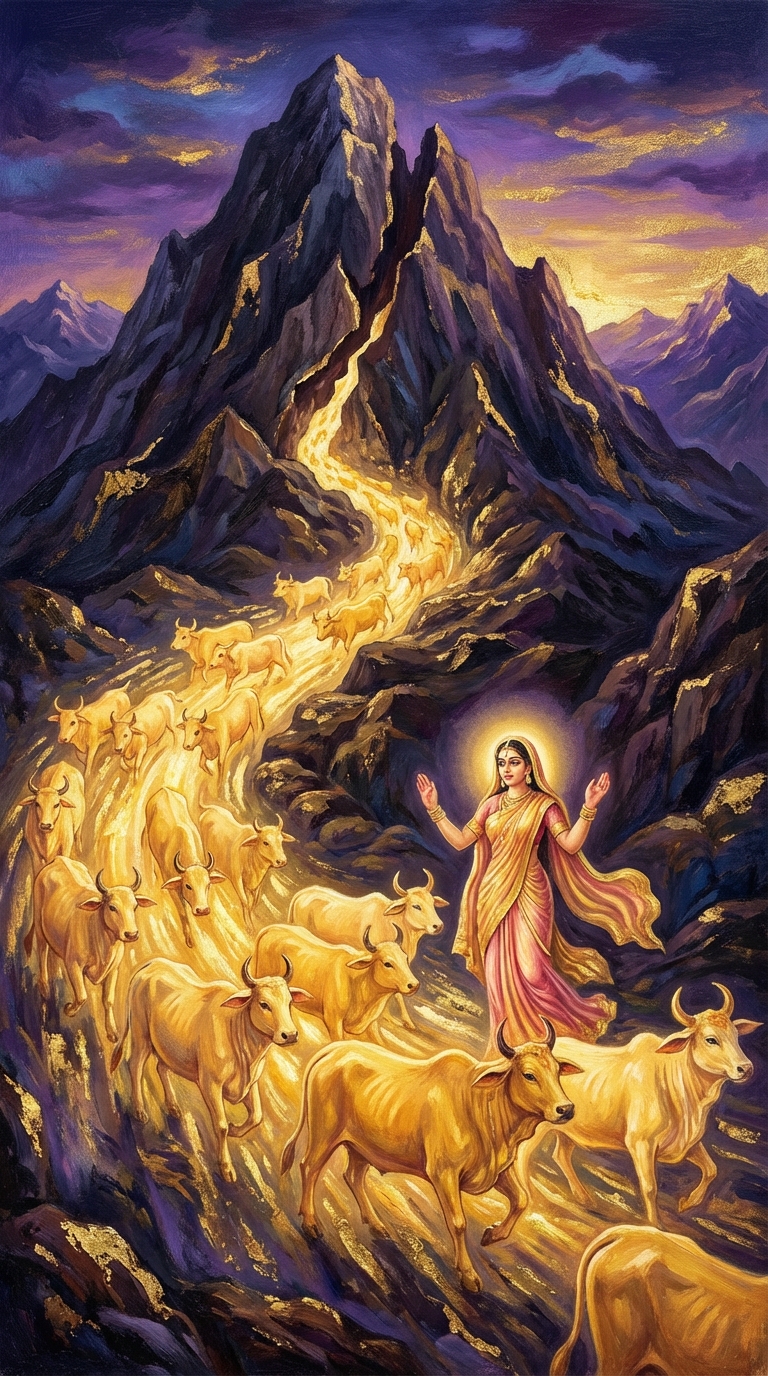
Book 4 of 10
Attributed to Vamadeva and his family, this book consists of 58 hymns. The hymns are addressed to a range of deities including Indra, Agni, the Ashvins, and Dadhikra. The book is known for its philosophical depth and contains hymns that explore themes of creation and the nature of the divine.
Hymn I. Agni.
This hymn addresses Agni as a divine messenger sent down by the gods, a being who reconciles humanity with the celestial powers. The verses particularly emphasize his role as an intercessor with the formidable Varuṇa, asking the sacred fire to turn that great god's favor toward the worshippers.
1, THEE Agni, have the Gods, ever of one accord, sent hither down, a God, appointed messenger, yea, with their wisdom sent thee down. > The Immortal, O thou Holy One, mid mortal men, the God-devoted God, the wise, have they brought forth, brought forth the omnipresent God devoted Sage. > 2 As such, O Agni, bring with favour to the Gods thy Brother Varuṇa who loveth sacrifice, > True to the Law, the Āditya who supporteth men, the King, supporter of mankind. > 3 Do thou, O Friend, turn hither him who is our Friend, swift as a wheel, like two car-steeds in rapid course, Wondrous! to us in rapid course. > O Agni, find thou grace for us with Varuṇa, with Maruts who illumine all. > Bless us, thou Radiant One, for seed and progeny, yea, bless us, O thou Wondrous God. > 4 Do thou who knowest Varuṇa, O Agni, put far away from us the God's displeasure. > Best Sacrificer, brightest One, refulgent remove thou far from us all those who hate us. > 5 Be thou, O Agni, nearest us with succour, our closest Friend while now this Morn is breaking. > Reconcile to us Varuṇa, be bounteous enjoy the gracious juice; be swift to hear us. > 6 Excellent is the glance, of brightest splendour, which the auspicious God bestows on mortals > The God's glance, longed-for even as the butter, pure, heated, of the cow, the milch-cow's bounty. > 7 Three are those births, the true, the most exalted, eagerly longed-for, of the God, of Agni. > He came invested in the boundless region, pure, radiant, friendly, mightily resplendent. > 8 This envoy joyeth in all seats of worship, borne on his golden car, sweet-tongued Invoker: > Lovely to look on, with red steeds, effulgent, like a feast rich in food, joyous for ever. > 9 Allied by worship, let him give man knowledge: by an extended cord they lead him onward. > He stays, effectual in this mortal's dwelling, and the God wins a share in his possessions. > 10 Let Agni -for he knows the way- conduct us to all that he enjoys of God-sent riches, > What all the Immortals have prepared with wisdom, Dyaus, Sire, Begetter, raining down true blessings. > 11 In houses first he sprang into existence, at great heaven's base, and in this region's bosom; > Footless and headless, both his ends concealing, in his Bull's lair drawing himself together. > 12 Wondrously first he rose aloft, defiant, in the Bull's lair, the homeof holy Order, > Longed-for, young, beautiful, and far-resplendent: and sevendear frieuds sprang up unto the Mighty. > 13 Here did our human fathers take their places, fain to fulfil the sacred Law of worship. > Forth drave they, with loud call, Dawn's teeming Milch-kine bid in the mountainstable, in the cavern. > 14 Splendid were they when they had rent the mountain: others, around, shall tell forth this their exploit. > They sang their song, prepared to free the cattle: they found the light; with holy hymns they worshipped. > 15 Eager, with thought intent upon the booty, the men with their celestial speech threw open, > The solid mountain firm, compact, enclosing, confining Cows, the stable full of cattle. > 16 The Milch-cow's earliest name they comprehended: they found the Mother's thrice-seven noblest titles. > This the bands knew, and sent forth acclamation:with the Bull's sheen the Red One was apparent. > 17 The turbid darkness fled, the heaven was sp, endid! up rose the bright beam of celestial Morning. > Sūrya ascended to the wide expanses, beholding deeds of men both good and evil. > 18 Then, afterwards they looked around, awakened, when first they held that Heaven allotted treasure. > Now all the Gods abide in all their dwellings. Varuṇa, Mitra, be the prayer effective. > 19 I will call hither brightly-beaming Agni, the Herald, all-supporting, best at worship. > He hath disclosed, like the milch cows' pure udder, the Sorria's juice when cleansed and poured from beakers. > 20 The freest God of all who should be worshipped, the guest who is received in all men's houses, > Agni who hath secured the Gods’ high favour,—may he be gracious, to us Jātavedas.
Hymn II. Agni.
This hymn to Agni, the sacred fire, describes his cosmic significance and central role in the sacrifice. He is depicted as a radiant and eternal messenger, a divine chariot of the rite, who brings the gods and bestows wealth upon the faithful. The verses ask for his protection and good guidance, celebrating him as the leader who ensures prosperity for his people.
1. THE, Faithful One, Immortal among mortals, a God among the Gods, appointed envoy, > Priest, best at worship, must shine forth in glory . Agni shall be raised high with man's oblations. > 2 Born for us here this day, O Son of Vigour, between both races of born beings, Agni, > Thou farest as an envoy, having harnessed, Sublime One! thy strong muscled radiant stallions. > 3 I laud the ruddy steeds who pour down blessing, dropping oil, flectest through the thoualit of Order. > Yoking red horses to and fro thou goest between you Deities and mortal races. > 4 Aryaman, Mitra, Varuṇa, and Indra with Viṣṇu, of the Gods, Maruts and Aśvins > These, Agni, with good car and steeds, bring hither, most bountiful, to folk with fair oblations. > 5 Agni, be this our sacrifice eternal, with brave friends, rich in kine and sheep and horses, > Rich, Asura! in sacred food and children, in full assembly, wealth broad based and during. > 6 The man who, sweating, brings for thee the fuel, and makes his head to ache, thy faithful servant,— > Agni, to him be a self-strong Protector guard him from all who seek to do him mischief. > 7 Who brings thee food, though thou hast food in plenty, welcomes his cheerful guest and speeds him onward, > Who kindles thee devoutly in his dwelling,to him be wealth secure and freely giving. > 8 Whoso sings praise to thee at eve or morning, and, with oblation, doth the thing thou lovest,— > In his own home, even as a goId-girt courser, rescue him from distress, the bounteous giver. > 9 Whoso brings gifts to thee Immortal, Agni, and doth thee service with uplifted ladle,— > Let him not, sorely toiling, lose his riches; let not the sinner's wickedness enclose him. > 10 Whose well-wrought worship thou acceptest, Agni, thou God a mortal's gift, thou liberal Giver,— > Dear be his sacrifice to thee, Most Youthful! and may we strengthen him when he adores thee. > 11 May he who knows distinguish sense and folly of men, like straight and crooked backs of horses. > Lead us, O God, to wealth and noble offspring: keep penury afar and grant us plenty. > 12 This Sage the Sages, ne’er deceived, commanded, setting him down in dwellings of the living. > Hence mayst thou, friendly God, with rapid footsteps behold the Gods, wonderful, fair to look on. > 13 Good guidance hast thou for the priest, O Agni, who, Youngest God! with outpoured Soma serves thee. > Ruler of men, thou joyous God, bring treasure splendid and plentiful to aid the toiler. > 14 Now all that we, thy faithful servants, Agni, have done with feet, with hands, and with our bodies, > The wise, with toil, the holy rite have guided, as those who frame a car with manual cunning. > 15 May we, seven sages first in rank, engender, from Dawn the Mother, men to be ordainers. > May we, Aṅgirases, be sons of Heaven, and, radiant, burst the wealth containing mountain. > 16 As in the days of old our ancient Fathers, speeding the work of holy worship, Agni, > Sought pure light and devotion, singing praises; they cleft the ground and made red Dawns apparent. > 17 Gods, doing holy acts, devout, resplendent, smelting like ore their human generations. > Enkindling Agni and exalting Indra, they came encompassing the stall of cattle. > 18 Strong One! he marked them-and the Gods before them-like herds of cattle in a foodful pasture. > There they moaned forth their strong desire for mortals, to aid the True, the nearest One, the Living. > 19 We have worked for thee, we have laboured nobly-bright Dawns have shed their light upon our worship > Adding a beauty to the perfect Agni, and the God's beauteous eye that shines for ever. > 20 Agni, Disposer, we have sung these praises to thee the Wise: do thou accept them gladly. > Blaze up on high and ever make us richer. Give us great wealth, O thou whose boons are many.
Hymn III. Agni.
This hymn has a questioning and almost anxious tone, as the singer asks Agni how to properly intercede with the other gods on humanity's behalf. Addressing Agni as the circumambient envoy, the hymn inquires what should be said to Varuṇa about transgressions, to Rudra about his might, or to Pūṣan for welfare. It is a plea for Agni's diplomatic skill in navigating the complex relationships between mortals and the divine pantheon.
1. THOU, Agni, who wilt have the strong, hast made me the Soma's priest, to worship in assembly. > Thou shinest to the Gods, I set the press-stones. I toil; be joyful in thyself, O Agni. > 2 East have we turned the rite; may the hymn aid it. With wood and worship shall they honour Agni. > From heaven the synods of the wise have learnt it: e’en for the quick and strong they seek advancement. > 3 The Prudent, he whose will is pure, brought welfare, allied by birth to Heaven and Earth in kinship. > The Gods discovered in the midst of waters beautiful Agni with the Sisters' labour. > 4 Him, Blessed One, the Seven strong Floods augmented, him white at birth and red when waxen mighty. > As mother mares run to their new-born you ling, so at his birth the Gods wondered at Agni. > 5 Spreading with radiant limbs throughout the region, purging his power with wise purifications, > Robing himself in light, the life of waters, he spreads abroad his high and perfect glories. > 6 What, when thou blazest on the lesser altars, what to the mighty Wind who comes to bless us, > True, circumambient? what to Earth, O Agni, what wilt thou say to man destroying Rudra? > 7 How to great Pūṣan who promotes our welfare,—to honoured Rudra what, who gives oblations? > What sin of ours to the far-striding Viṣṇu, what, Agni, wilt thou tell the Lofty Arrow. > 8 What wilt thou tell the truthful band of Maruts, how answer the great Sun when thou art questioned? > Before the Free, before the Swift, defend us: fulfil heaven's work, all knowing Jātavedas. > 9 I crave the cow's true gift arranged by Order: though raw, she hath the sweet ripe juice, O Agni. > Though she is black of hue with milk she teemeth, nutritious, brightly shining, all-sustaining. > 10 Agni the Bull, the manly, hath been sprinkled with oil upon his back, by Law eternal. > He who gives vital power goes on unswerving. Pṛśni the Bull hath milked the pure wiiite udder. > 11 By Law the Aṅgirases cleft the rock asunder, and sang their hymns together with the cattle. > Bringing great bliss the men encompassed Morning: light was apparent at the birth of Agni. > 12 By Law the Immortal Goddesses the Waters, with meath-rich waves, O Agni, and uninjured, > Like a strong courser lauded in his running, sped to flow onward swiftly and for ever. > 13 Go never to the feast of one who harms us, the treacherous neighbour or unworthy kinsman. > Punish us not for a false brother's trespass. Let us not feel the might of friend or foeman. > 14 O Agni, keep us safe with thy protection, loving us, honoured God! and ever guarding. > Beat thou away, destroy severe affliction slay e’en the demon when he waxes mighty. > 15 Through these our songs of praise be gracious, Agni; moved by our prayers, O Hero, touch our viands. > Accept, O Aṅgiras, these our devotions, and let the praise which Gods desire address thee. > 16 To thee who knowest, Agni, thou Disposer, all these wise secret speeches have I uttered, > Sung to thee, Sage, the charming words of wisdom, to thee, O Singer, with. my thoughts and Praises.
Hymn IV. Agni.
This hymn invokes Agni in his martial aspect, as a divine warrior who burns down foes and protects the people with his sharpened arrows. The singer calls on Agni to destroy demons and malevolent men, using his flame like a weapon to clear a path for the sacrificer. It is a powerful appeal for divine protection and the smiting of all who would bring harm.
1. PUT forth like a wide-spreading net thy vigour; go like a mighty King with his attendants. > Thou, following thy swift net, shootest arrows: transfix the fiends with darts that burn most fiercely. > 2 Forth go in rapid flight thy whirling weapons: follow them closely, glowing in thy fury. > Spread with thy tongue the winged flames, O Agni; unfettered, cast thy firebrands all around thee. > 3 Send thy spies forward, fleetest in thy motion; be, ne’er deceived, the guardian of this people > From him who, near or far, is bent on evil, and let no trouble sent from thee o’ercome us. > 4 Rise up, O Agni, spread thee out before us: burn down our foes, thou who hast sharpened arrows. > Him, blazing Agni! who hath worked us mischief, consume thou utterly like dried-up stubble. > 5 Rise, Agni, drive off those who fight against us: make manifest thine own celestial vigour. > Slacken the strong bows of the demon-driven: destroy our foemen whether kin or stranger. > 6 Most Youthful God, he knoweth well thy favour who gave an impulse to this high devotion. > All fair days and magnificence of riches hast thou beamed forth upon the good man's portals. > 7 Blest, Agni, be the man, the liberal giver, who with his lauds and regular oblation > Is fain to please thee for his life and dwelling. May all his days be bright: be this his longing. > 8 I praise thy gracious favour: sing in answer. May this my song sing like a loved one with thee. > Lords of good steeds and cars may we adorn thee, and day by day vouchsafe thou us dominion. > 9 Here of free choice let each one serve thee richly, resplendent day by day at eve and morning. > So may we honour thee, content and joyous, passing beyond the glories of the people. > 10 Whoso with good steeds and fine gold, O Agni, comes nigh thee on a car laden with treasure, > His Friend art thou, yea, thou art his Protector whose joy it is to entertain thee duly. > 11 Through words and kinship I destroy the mighty: this power I have from Gotama my father. > Mark thou this speech of ours, O thou Most Youthful, Friend of the House, exceeding wise, Invoker. > 12 Knowing no slumber, speedy and propitious, alert and ever friendly, most unwearied, > May thy protecting powers, unerring Agni, taking their places here, combined, preserve us. > 13 Thy guardian rays, O Agni, when they saw him, preserved blind Māmateya from affliction. > Lord of all riches, he preserved the pious: the fees who fain would harm them did no mischief > 14 Aided by thee with thee may we be wealthy, may we gain strength with thee to guide us onward. > Fulfil the words of both, O Ever Truthful: straightway do this, thou God whom power emboldens. > 15 O Agni, with this fuel will we serve thee; accept the laud we sing to thee with favour > Destroy the cursing Rākṣasas: preserve us, O rich in friends, from guile and scorn and slander.
Hymn V. Agni.
This is a profoundly mystical hymn that explores Agni's hidden and multiple natures, from his secret birth in the waters to his cosmic role. The verses are filled with enigmatic metaphors, speaking of him as an infant who brings forth his own mothers and a radiant Cow whose apparition is followed from of old. The hymn is a deep meditation on the mysterious origin and boundless power of the sacred fire.
1. How shall we give with one accord oblation to Agni, to Vaiśvānara the Bounteous? > Great light, with full high growth hath he uplifted, and, as a pillar bears the roof, sustains it. > 2 Reproach not him who, God and self-reliant, vouchsafed this bounty unto me a mortal,— > Deathless, discerner, wise, to me the simple, Vaiśvānara most manly, youthful Agni. > 3 Sharp-pointed, powerful, strong, of boundless vigour, Agni who knows the lofty hymn, kept secret > As the lost milch-cow's track, the doubly Mighty,—he hath declared to me this hidden knowledge. > 4 May he with sharpened teeth, the Bounteous Giver, Agni, consume with flame most fiercely glowing. > Those who regard not Varuṇa's commandments and the dear stedfast laws of sapient Mitra. > 5 Like youthful women without brothers, straying, like dames who hate their lords, of evil conduct, > They who are full of sin, untrue, unfaithful, they have engendered this abysmal station. > 6 To me, weak, innocent, thou, luminous Agni, hast boldly given as ’twere a heavy burthen, > This Pṛṣṭha hymn, profound and strong and mighty, of seven elements, and with offered dainties. > 7 So may our song that purifies, through wisdom reach in a moment him the Universal, > Established on the height, on earth's best station, above the beauteous grassy skin of Pṛśni. > 8 Of this my speech what shall I utter further? They indicate the milk stored up in secret > When they have thrown as ’twere the cows' stalls open. The Bird protects earths’ best and well-loved station. > 9 This is the Great Ones’ mighty apparition which from of old the radiant Cow hath followed. > This, shining brightly in the place of Order, swift, hasting on in secret, she discovered. > 10 He then who shone together with his Parents remembered Pṛśni's fair and secret treasure, > Which, in the Mother Cow's most lofty station, the Bull's tongue, of the flame bent forward, tasted. > 11 With reverence I declare the Law, O Agni; what is, comes by thine order, Jātavedas. > Of this, whate’er it be, thou art the Sovran, yea, all the wealth that is in earth or > heaven. > 12 What is our wealth therefrom, and what our treasure? Tell us O Jātavedas, for thou > knowest, > What is our best course in this secret passage: we, unreproached, have reached a place far distant. > 13 What is the limit, what the rules, the guerdon? Like fleet-foot coursers speed we to the contest. > When will the Goddesses, the Immortal's Spouses, the Dawns, spread over us the Sun-God's splendour? > 14 Unsatisfied, with speech devoid of vigour, scanty and frivolous and inconclusive, > Wherefore do they address thee here, O Agni? Let these who have no weapons suffer sorrow. > 15 The majesty of him the Good, the Mighty, aflame, hath shone for glory in the dwelling. > He, clothed in light, hath shone most fair to look on, wealthy in boons, as a home shines with riches.
Hymn VI. Agni.
Focused on the ritual process, this hymn portrays Agni as the central priest whose movements define the sacred space. He circles the rite with measured motion, his flames rising like vigorous horses and his smoke ascending to heaven like a builder's pillar. The hymn is a vivid depiction of the sacred fire's active role in sanctifying the ceremony and connecting the human world to the divine.
1. PRIEST of our rite, stand up erect, O Agni, in the Gods’ service best of sacrificers, > For over evei y thought thou art the Ruler: thou furtherest e’en the wisdom of the pious. > 2 He was set down mid men as Priest unerring, Agni, wise, welcome in our holy synods. > Like Savitar he hath lifted up his splendour, and like a builder raised his smoke to heaven. > 3 The glowing ladle, filled with oil, is lifted; choosing Gods’ service to the right he circles. > Eager he rises like the new-wrought pillar which, firmly set and fixed, anoints the victims. > 4 When sacred grass is strewn and Agni kindled, the Adhvaryu rises to, his task rejoicing. > Agni the Priest, like one who tends the cattle, goes three times round, as from of old he wills it. > 5 Agni himself, the Priest, with measured motion, goes round, with sweet speech, cheerful, true to Order. > His fulgent flames run forth like vigorous horses; all creatures are affrighted when he blazes. > 6 Beautiful and auspicious is thine aspect, O lovely Agni, terrible when spreading. > Thy splendours are not covered by the darkness: detraction leaves no stain upon thy body. > 7 Naught hindered his production, Bounteous Giver: his Mother and his Sire were free to send him. > Then as Friend benevolent, refulgent, Agni shone forth in human habitations. > 8 He, Agni, whom the twice-five sisters, dwelling together, in the homes of men engendered, > Bright like a spear's tooth, wakened in the morning, with powerful mouth and like an axe well-sharpened. > 9 These thy Bay Coursers, Agni, dropping fatness, ruddy vigorous, speeding straightly forward, > And red steeds, wonderful, of mighty muscle, are to this service of the Gods invited: > 10 These brightly-shining games of thine, O Agni, that move for ever restless, all-subduing, > Like falcons hasting eagerly to the quarry, roar loudly like the army of the Maruts. > 11 To thee, O flaming God, hath prayer been offered. Let the priest laud thee: give to him who worships. > Men have established Agni as Invoker, fain to adore the glory of the living.
Hymn VII. Agni.
This hymn celebrates Agni as the ancient and established messenger, brought forth by legendary figures like the Bhṛgus and serving as Vivasvān's envoy. He is the swift, intelligent link between heaven and earth, his path black with smoke and his form concealed within eternal mothers. The verses honor his lineage and his essential, ever-renewed role as the Herald of the sacrifice.
1. HERE by ordainers was this God appointed first Invoker, best at worship, to be praised at rites: > Whom Apnavāna, and the Bhṛgus caused to shine bright-coloured in the wood, spreading from home to home. > 2 When shall thy glory as a God, Agni, be suddenly shown forth. > For mortal men have held thee fast, adorable in all their homes, > 3 Seeing thee faithful to the Law, most sapient, like the starry heaven, Illumining with cheerful ray each solemn rite in every house. > 4 Vivasvān's envoy living men have taken as their ensign, swift, > The ruler over all mankind, moving like Bhṛgu in each home. > 5 Him the intelligent have they placed duly as Invoking Priest, > Welcome, with sanctifying flame, best worshipper, with sevenfold might; > 6 In his Eternal Mothers, in the wood, concealed and unapproached, > Kept secret though his flames are bright seeking on all sides, quickly found. > 7 That as food spreads forth in this earthly udder, Gods may rejoice them in the home of Order, > Great Agni, served with reverence and oblation, flies ever to the sacrifice, the Faithful. > 8 Bird of each rite, skilled in an envoy's duties, knowing both worlds and that which lies between them, > Thou goest from of old a willing Herald, knowing full well heaven's innermost recesses. > 9 Bright God, thy path is black: light is before thee: thy moving splendour is the chief of wonders. > When she, yet unimpregnate, hath conceived thee, even when newly born thou art an envoy. > 10 Yet newly born, his vigour is apparent when the wind blows upon his fiery splendour, > His sharpened tongue he layeth on the brushwood, and with his teeth e’en solid food consumeth. > 11 When he hath borne off food with swift flame swiftly, strong Agni makes himself a speedy envoy, > Follows the rustling of the wind, consuming, and courser-like, speeds, drives the swift horse onward.
Hymn VIII. Agni.
This hymn is a direct and powerful invocation of Agni as the all-possessing envoy and best worshipper. The singer woos him with song, seeking his favor and the wealth he bestows upon those who serve him reverently. It is a clear expression of faith in Agni's power to connect mortals with the gods and to bring prosperity to his followers.
1. YOUR envoy who possesses all, Immortal, bearer of your gifts, > Best worshipper, I woo with song. > 2 He, Mighty, knows the gift of wealth, he knows the deep recess of heaven: > He shall bring hitherward the Gods. > 3 He knows, a God himself, to guide Gods to the righteous in his home: > He gives e’en treasures that we love. > 4 He is the Herald: well-informed, he doth his errand to and fro, > Knowing the deep recess of heaven. > 5 May we be they who gratify Agni with sacrificial gifts, > Who cherish and enkindle him. > 6 Illustrious for wealth are they, and hero deeds, victorious, > Who have served Agni reverently. > 7 So unto us, day after day, may riches craved by many come, > And power and might spring up for us. > 8 That holy Singer in his strength shoots forth his arrows swifter than > The swift shafts of the tribes of men.
Hymn IX. Agni.
This hymn calls upon Agni to assume his various priestly roles—Hotar, Potar, and Brahman—at the sacrifice. He is addressed as the immortal messenger and the guide of the people, whose inviolable chariot protects those who offer him worship. It is a plea for Agni to show favor, take his seat upon the sacred grass, and perform his sacred duties.
1. AGNI, show favour: great art thou who to this pious man art come, > To seat thee on the sacred grass. > 2 May he the Immortal, Helper, bard to be deceived among mankind, > Become the messenger of all. > 3 Around the altar is he led, welcome Chief Priest at solemn rites, > Or as the Potar sits him down. > 4 Agni in fire at sacrifice, and in the house as Lord thereof, > And as a Brahman takes his seat. > 5 Thou comest as the guide of folk who celebrate a sacrifice, > And to oblations brought by men. > 6 Thou servest as his messenger whose sacrifice thou lovest well, > To bear the mortal's gifts to heaven. > 7 Accept our solemn rite; be pleased, Aṅgiras, with our sacrifice: > Give ear and listen to our call. > 8 May thine inviolable car, wherewith thou guardest those who give, > Come near to us from every side.
Hymn X. Agni.
In this hymn, Agni is praised as a noble car-driver, whose aspect is as bright as the sunlight and whose power is like the roaring of heaven. The singer brings praise like a well-judged steed to the sacred fire, celebrating his beauty and strength. The verses ask for Agni to come with all his aspects, a radiant presence at the heart of the rite.
1. This day with praises, Agni, we bring thee that which thou lovest. > Right judgment, like a horse, with our devotions. > 2 For thou hast ever been the Car-driver, Agni, of noble > Strength, lofty sacrifice, and rightful judgment. > 3 Through these our praises come thou to meet us, bright as the sunlight, > O Agni, well disposed, with all thine aspects. > 4 Now may we serve thee singing these lauds this day to thee, Agni. > Loud as the voice of Heaven thy blasts are roaring. > 5 Just at this time of the day and the night thy look is the sweetest: > It shineth near us even as gold for glory. > 6 Spotless thy body, brilliant as gold, like clarified butter: > This gleams like gold on thee, O Self. dependent. > 7 All hate and mischief, yea, if committed, Agni, thou turnest, > Holy One, from the man who rightly worships. > 8 Agni, with you Gods, prosperous be our friendships and kinships. > Be this our bond here by this place, thine altar.
Hymn XI. Agni.
This hymn to Agni celebrates him as the source of poetic wisdom, heroic strength, and all forms of wealth. He is praised as the pleasant-voiced, unerring Friend of the Home, whom religious mortals invite to their sacrifices. The verses are a prayer for the blessings he bestows, from swift chargers to the welfare of his worshippers.
1. THY blessed majesty, victorious Agni, shines brightly in the > neighbourhood of Sūrya. > Splendid to see, it shows even at nighttime, and food is fair to look on in > thy beauty. > 2 Agni, disclose his thought for him who singeth, the well, Strong God! > while thou art praised with fervour. > Vouchsafe to us that powerful hymn, O Mighty, which, Radiant One! > with all the Gods thou lovest. > 3 From thee, O Agni, springs poetic wisdom, from thee come thoughts > and hymns of praise that prosper; > From thee flows wealth, with heroes to adorn it, to the true-hearted man > who gives oblation. > 4 From thee the hero springs who wins the booty, bringer of help, > mighty, of real courage. > From thee comes wealth, sent by the Gods, bliss-giving; Agni, from thee > the fleet impetuous charger. > 5 Immortal Agni, thee whose voice is pleasant, as first in rank, as God, > religious mortals > Invite with hymns; thee who removest hatred, Friend of the Home, the > household's Lord, unerring. > 6 Far from us thou removest want and sorrow, far from us all ill-will > when thou protectest. > Son of Strength, Agni, blest is he at evening, whom thou as God > attendest for his welfare.
Hymn XII. Agni.
This hymn is a prayer for protection from sin and affliction, addressed to Agni, the Most Youthful God. The singer asks Agni to make them sinless in the sight of Aditi and to free them from the "prison of the Gods or mortals." It is a plea for deliverance and the extension of life, born from a humble recognition of human folly.
1. WHOSO enkindles thee, with lifted ladle, and thrice this day offers > thee food, O Agni, > May he excel, triumphant through thy splendours, wise through thy mental power, O Jātavedas. > 2 Whoso with toil and trouble brings thee fuel, serving the majesty of > mighty Agni, > He, kindling thee at evening and at morning, prospers, and comes to > wealth, and slays his foemen. > 3 Agni is Master of sublime dominion, Agni is Lord of strength and lofty > riches. > Straightway the self-reliant God, Most Youthful, gives treasures to the > mortal who adores him. > 4 Most Youthful God, whatever sin, through folly, we here, as human > beings, have committed, > In sight of Aditi make thou us sinless remit, entirely, Agni, our offences. > 5 Even in the presence of great sin, O Agni, free us from prison of the > Gods or mortals. > Never may we who are thy friends be injured: grant health and strength > unto our seed and offspring. > 6 Even as ye here, Gods Excellent and Holy, have loosed the cow that by > the foot was tethered, > So also set us free from this affliction long let our life, O Agni, be > extended.
Hymn XIII. Agni.
This hymn to Agni connects his light with the rising of the Sun and the coming of the Aśvins at dawn. The verses celebrate the cosmic order established by Savitar, Varuṇa, and Mitra, which Agni's kindling represents on earth. The central mystery of the hymn is the Sun's journey—how he travels unbound and unsupported, a close-set pillar guarding the vault of heaven.
1. AGNI hath looked, benevolently-minded, on the wealth-giving spring > of radiant Mornings. > Come, Aśvins, to the dwelling of the pious: Sūrya the God is rising with > his splendour. > 2 Savitar, God, hath spread on high his lustre, waving his flag like a > spoil-seeking hero. > Their stablished way go Varuṇa and Mitra, what time they make the Sun > ascend the heaven. > 3 Him whom they made to drive away the darkness, Lords of sure > mansions, constant to their object, > Him who beholds the universe, the Sun-God, seven strong and youthful > Coursers carry onward. > 4 Spreading thy web with mightiest Steeds thou comest, rending apart, > thou God, the black-hued mantle. > The rays of Sūrya tremulously shining sink, like a hide, the darkness in > the waters. > 5 How is it that, unbound and not supported, he falleth not although > directed downward? > By what self power moves he? Who hath seen it? He guards the vault of > heaven, a close-set pillar.
Hymn XIV. Agni.
This hymn, like the one preceding it, is an ode to the dawn, linking the kindling of Agni with the rising of the Sun and the arrival of the Aśvins. Agni, Savitar, and the red Dawn work in concert to produce light for the world and bring the gods to the sacrifice. The hymn repeats the central question from Hymn 13, marveling at the cosmic power that keeps the sun on its course.
1. THE God hath looked, even Agni Jātavedas, to meet the Dawns > refulgent in their glories. > Come on your chariot, ye who travel widely, come to this sacrifice of > ours, Nāsatyas. > 2 Producing light for all the world of creatures, God Savitar hath raised > aloft his banner. > Making his presence known by sunbeams, Sūrya hath filled the > firmament and earth and heaven. > 3 Red Dawn is come, riding with brightness onward, distinguished by > her beams, gay-hued and mighty. > Dawn on her nobly-harnessed car, the Goddess, awaking men to > happiness, approacheth. > 4 May those most powerful steeds and chariot bring you, O Aśvins, > hither at the break of morning. > Here for your draught of meath are Soma juices: at this our sacrifice > rejoice, ye Mighty. > 5 How is it that, unbound and unsupported, he falleth not although > directed downward? > By what self-power moves he? Who hath seen it? He guards the vault of > heaven, a close-set pillar?
Hymn XV. Agni.
This hymn celebrates Agni as the adorable Herald who is led forth at the solemn rite like a prized horse. The verses praise him as the wise Lord of Strength who gives precious boons to the offerer. The final verses are a personal address from the princely son of Sahadeva, who thanks the Aśvins and Agni for the gift of noble bay horses.
1. AGNI the Herald, like a horse, is led forth at our solemn rite, > God among Gods adorable. > 2 Three times unto our solemn rite comes Agni like a charioteer, > Bearing the viands to the Gods. > 3 Round the oblations hath he paced, Agni the Wise, the Lord of > Strength, > Giving the offerer precious boons. > 4 He who is kindled eastward for Sṛñjaya, Devāvata's son, > Resplendent, tamer of the foe. > 5 So mighty be the Agni whom the mortal hero shall command, > With sharpened teeth and bountiful. > 6 Day after day they dress him, as they clean a horse who wins the prize. > Dress the red Scion of the Sky. > 7 When Sahadeva's princely son with two bay horses thought of me, > Summoned by him I drew not back. > 8 And truly those two noble bays I straightway took when offered me, > From Sahadeva's princely son. > 9 Long, O ye Aśvins, may he live, your care, ye Gods, the princely son. > Of Sahadeva, Somaka. > 10 Cause him the youthful prince, the son of Sahadeva, to enjoy > Long life, O Aśvins, O ye Gods.
Hymn XVI. Indra.
This hymn is a powerful and vivid invocation of Indra, the impetuous hero and Vṛtra-slayer. The singer, Vamadeva, speaks in Indra's own voice, recounting his cosmic deeds: scattering darkness, letting loose the waters, and even stopping the Sun's chariot wheel. The hymn captures Indra's immense, untamable power and his role as the great champion who establishes order in the universe.
1. IMPETUOUS, true, let Maghavan come hither, and let his Tawny > Coursers speed to reach us. > For him have we pressed juice exceeding potent: here, praised with song, > let him effect his visit. > 2 Unyoke, as at thy journey's end, O Hero, to gladden thee today at this > libation. > Like Uśanā, the priest a laud shall utter, a hymn to thee, the Lord Divine, > who markest. > 3 When the Bull, quaffing, praises our libation, as a sage paying holy > rites in secret, > Seven singers here from heaven hath he begotten, who e’en by day have > wrought their works while singing. > 4 When heaven's fair light by hymns was made apparent (they made > great splendour shine at break of morning), > He with his succour, best of Heroes, scattered the blinding darkness so > that men saw clearly. > 5 Indra, Impetuous One, hath waxed immensely: he with his vastness > hath filled earth and heaven. > E’en beyond this his majesty extendeth who hath exceeded all the worlds > in greatness. > 6 Śakra who knoweth well all human actions hath with his eager Friends > let loose the waters. > They with their songs cleft e’en the mountain open and willingly > disclosed the stall of cattle. > 7 He smote away the floods' obstructer, Vṛtra; Earth, conscious, lent her > aid to speed thy thunder. > Thou sentest forth the waters of the ocean, as Lord through power and > might, O daring Hero. > 8 When, Much-invoked! the water's rock thou cleftest, Saramā showed > herself and went before thee. > Hymned by Aṅgirases, bursting the cow-stalls, much strength thou > foundest for us as our leader. > 9 Come, Maghavan, Friend of Man, to aid the singer imploring thee in > battle for the sunlight. > Speed him with help in his inspired invokings: down sink the sorcerer, > the prayerless Dasyu. > 10 Come to our home resolved to slay the Dasyu: Kutsa longed eagerly to > win thy friendship. > Alike in form ye both sate in his dwelling the faithful Lady was in doubt > between you. > 11 Thou comest, fain to succour him, with Kutsa,—a goad that masters > both the Wind-God's horses, > That, holding the brown steeds like spoil for capture, the sage may on the > final day be present. > 12 For Kutsa, with thy thousand, thou at day-break didst hurl down > greedy Śuṣṇa, foe of harvest. > Quickly with Kutsa's friend destroy the Dasyus, and roll the chariot wheel of Sūrya near us. > 13 Thou to the son of Vidathin, Ṛjiśvan, gavest up mighty Mṛgaya and > Pipru. > Thou smotest down the swarthy fifty thousand, and rentest forts as age > consumes a garment. > 14 What time thou settest near the Sun thy body, thy form, Immortal > One, is seen expanding: > Thou a wild elephant with might invested. like a dread lion as thou > wieldest weapons. > 15 Wishes for wealth have gone to Indra, longing for him in war for light > and at libation, > Eager for glory, labouring with praisesongs: he is like home, like sweet > and fair nutrition. > 16 Call we for you that Indra, prompt to listen, him who hath done so > much for men's advantage; > Who, Lord of envied bounty, to a singer like me brings quickly booty > worth the capture. > 17 When the sharp-pointed arrow, O thou Hero, flieth mid any conflict of > the people, > When, Faithful One, the dread encounter cometh, then be thou the > Protector of our body. > 18 Further the holy thoughts of Vamadeva be thou a guileless Friend in > fight for booty. > We come to thee whose providence protects us: wide be thy sway for ever > for thy singer. > 19 O Indra, with these men who love thee truly, free givers, Maghavan, in > every battle, > May we rejoice through many autumns, quelling our foes, as days subdue > the nights with splendour. > 20 Now, as the Bhṛgus wrought a car, for Indra the Strong, the Mighty, > we our prayer have fashioned, > That he may, ne’er withdraw from us his friendship, but be our bodies' > guard and strong defender. > 21 Now, Indra! lauded, glorified with praises, let power swell. high like > rivers for the singer. > For thee a new hymn, Lord of Bays, is fashioned. May we, car-borne, > through song be victors ever.
Hymn XVII. Indra.
This hymn to Indra celebrates his immense, heaven-propping might and his foundational role in shaping the cosmos. He is the hero who slays Krivi, frees the waters, and establishes the earth, all while being lauded by his followers. The verses are a prayer for Indra's manifold assistance, invoking him as a liberal giver and a source of strength and knowledge.
1. GREAT art thou, Indra; yea, the earth, with gladness, and heaven > confess to thee thine high dominion. > Thou in thy vigour having slaughtered Vṛtra didst free the floods arrested > by the Dragon. > 2 Heaven trembled at the birth of thine effulgence; Earth trembled at the > fear of thy displeasure. > The stedfast mountains shook in agitation . the waters flowed, and desert > spots were flooded. > 3 Hurling his bolt with might he cleft the mountain, while, putting forth > his strength, he showed his vigour. > He slaughtered Vṛtra with his bolt, exulting, and, their lord slain, forth > flowed the waters swiftly. > 4 Thy Father Dyaus esteemed himself a hero: most noble was the work of > Indra's Maker, > His who begat the strong bolt's Lord who roareth, immovable like earth from her foundation. > 5 He who alone o’erthrows the world of creatures, Indra the peoples' > King, invoked of many > Verily all rejoice in him, extolling the boons which Maghavan the God > hath sent them. > 6 All Soma juices are his own for ever, most gladdening draughts are > ever his, the Mighty, > Thou ever wast the Treasure-Lord of treasures: Indra, thou lettest all folk > share thy bounty. > 7 Moreover, when thou first wast born, O Indra, thou struckest terror > into all the people. > Thou, Maghavan, rentest with thy bolt the Dragon who lay against the > waterfloods of heaven. > 8 The ever-slaying, bold and furious Indra, the bright bolt's Lord, > infinite, strong and mighty, > Who slayeth Vṛtra and acquireth booty, giver of blessings, Maghavan the > bounteous: > 9 Alone renowned as Maghavan in battles, he frighteneth away > assembled armies. > He bringeth us the booty that he winneth may we, well-loved, continue > in his friendship. > 10 Renowned is he when conquering and when slaying: 'fis he who > winneth cattle in the combat. > When Indra hardeneth his indignation all that is fixed and all that > moveth fear him. > 11 Indra hath won all kine, all gold, all horses,—Maghavan, he who > breaketh forts in pieces; > Most manly with these men of his who help him, dealing out wealth and > gathering the treasure. > 12 What is the care of Indra for his Mother, what cares he for the Father > who begat him? > His care is that which speeds his might in conflicts, like wind borne > onward by the clouds that thunder. > 13 Maghavan makes the settled man unsettled: he scatters dust that he > hath swept together, > Breaking in pieces like Heaven armed with lightning: Maghavan shall > enrich the man who lauds h;m. > 14 He urged the chariot-wheel of Sūrya forward: Etaśa, speeding on his way, he rested. > Him the black undulating cloud bedeweth, in this mid-air's depth, at the > base of darkness, > 15 As in the night the sacrificing priest. > 16 Eager for booty, craving strength and horses, we-singers stir Indra, > the strong, for friendship, > Who gives the wives we seek, whose succour fails not, to hasten, like a > pitcher to the fountain. > 17 Be thou our guardian, show thyself our kinsman, watching and > blessing those who pour the Soma; > As Friend, as Sire, most fatherly of fathers giving the suppliant vital > strength and freedom. > 18 Be helping Friend of those who seek thy friendship . give life, when > lauded, Indra, to the singer. > For, Indra, we the priests have paid thee worship, exalting thee with > these our sacrifices. > 19 Alone, when Indra Maghavan is lauded, he slayeth many ne’er resisted Vṛtras. > Him in whose keeping is the well-loved singer never do Gods or mortals > stay or hinder. > 20 E’en so let Maghavan, the loud-voiced Indra, give us true blessings, > foeless, men's upholder. > King of all creatures, give us glory amply, exalted glory due to him who > lauds thee. > 21 Now, Indra! lauded, glorified with praises, let power swell high like > rivers for the singer. > For thee a new hymn, Lord of Bays! is fashioned. May we, car-borne, > through song be victors ever.
Hymn XVIII. Indra and Others.
This complex and dramatic hymn recounts the strange and miraculous birth of Indra. It portrays him speaking from the womb, choosing to emerge "obliquely from the side" to avoid harming his mother, and immediately filling heaven and earth with his power. The verses unfold as a dialogue and narrative involving Indra, his mother, the waters, and even a falcon, culminating in the declaration of his cosmic might.
1. THIS is the ancient and accepted pathway by which all Gods have > come into existence. > Hereby could one be born though waxen mighty. Let him not, otherwise, > destroy his Mother. > 2 Not this way go I forth: hard is the passage. Forth from the side > obliquely will I issue. > Much that is yet undone must I accomplish; one must I combat and the > other question. > 3 He bent his eye upon the dying Mother: My word I now withdraw. That > way I follow. > In Tvaṣṭar's dwelling India drank the Soma, a hundredworth of juice > pressed from the mortar. > 4 What strange act shall he do, he whom his Mother bore for a thousand > months and many autumns? > No peer hath he among those born already, nor among those who shall > be born hereafter. > 5 Deeming him a reproach, his mother hid him, Indra, endowed with all > heroic valour. > Then up he sprang himself, assumed his vesture, and filled, as soon as > born, the earth and heaven. > 6 With lively motion onward flow these waters, the Holy Ones, shouting, > as ’twere, together. > Ask them to. tell thee what the floods are saying, what girdling rock the > waters burst asunder. > 7 Are they addressing him with words of welcome? Will the floods take > on them the shame of Indra? > With his great thunderbolt my Son hath slaughtered Vṛtra, and set these > rivers free to wander. > 8 I cast thee from me, mine,—thy youthful mother: thee, mine own > offspring, Kusava hath swallowed. > To him, mine infant, were the waters gracious. Indra, my Son, rose up in > conquering vigour. > 9 Thou art mine own, O Maghavan, whom Vyaṁsa struck to the ground > and smote thy jaws in pieces. > But, smitten through, the mastery thou wonnest, and with thy bolt the > Dāsa's head thou crushedst. > 10 The Heifer hath brought forth the Strong, the Mighty, the > unconquerable Bull, the furious Indra. > The Mother left her unlicked Calf to wander, seeking himself, the path > that he would follow. > 11 Then to her mighty Child the Mother turned her, saying, My son, these > Deities forsake thee. > Then Indra said, about to slaughter Vṛtra, O my friend Vṛtra, stride full > boldly forward. > 12 Who was he then who made thy Mother widow? Who sought to stay > thee lying still or moving? > What God, when by the foot thy Sire thou tookest and slewest, was at > hand to give thee comfort? > 13 In deep distress I cooked a dog's intestines. Among the Gods I found > not one to comfort. > My consort I beheld in degradation. The Falcon then brought me the > pleasant Soma.
Hymn XIX. Indra.
This hymn recounts the heroic deeds of Indra, the thunder-wielding god who brings order to the cosmos. It praises his slaying of Ahi, the serpent who held back the waters, and his establishment of the Sun and the seasons. The verses celebrate Indra as the champion who frees the rivers, shatters mountain strongholds, and brings light and life to the world.
1. THEE, verily, O Thunder-wielding Indra, all the Gods here, the > Helpers swift to listen, > And both the worlds elected, thee the Mighty, High, waxen strong, alone > to slaughter Vṛtra. > 2 The Gods, as worn witheld, relaxed their efforts: thou, Indra, born of > truth, wast Sovran Ruler. > Thou slewest Ahi who besieged the waters, and duggest out their all supporting channels. > 3 The insatiate one, extended, hard to waken, who slumbered in > perpetual sleep, O Indra,— > The Dragon stretched against the seven prone rivers, where no joint was, > thou rentest with thy thunder. > 4 Indra with might shook earth and her foundation as the wind stirs the > water with its fury. > Striving, with strength he burst the firm asunder, and tore away the > summits of the mountains. > 5 They ran to thee as mothers to their offspring: the clouds, like chariots, > hastened forth together. > Thou didst refresh the streams and force the billows: thou, Indra, settest > free obstructed rivers. > 6 Thou for the sake of Vayya and Turvīti didst stay the great stream, > flowing, all-sustaining: > Yea, at their prayer didst check the rushing river and make the floods > easy to cross, O Indra. > 7 He let the young Maids skilled in Law, unwedded, like fountains, > bubbling, flow forth streaming onward. > He inundated thirsty plains and deserts, and milked the dry Cows of the > mighty master. > 8 Through many a morn and many a lovely autumn, having slain Vṛtra, > he set free the rivers. > Indra hath set at liberty to wander on earth the streams encompassed > pressed together. > 9 Lord of Bay Steeds, thou broughtest from the ant-hill the unwedded > damsel's son whom ants were eating. > The blind saw clearly, as he grasped the serpent, rose, brake the jar: his > joints again united. > 10 To the wise man, O Sage and Sovran Ruler, the man who knoweth all > thine ancient exploits. > Hath told these deeds of might as thou hast wrought them, great acts, > spontaneous, and to man's advantage. > 11 Now, Indra! lauded, glorified with praises, let powers swell high, like > rivers, for the singer. > For thee a new hymn, Lord of Bays! is fashioned. May we, car-borne, > through song be victors ever.
Hymn XX. Indra.
This hymn is a praise-song to Indra, the mighty Fort-destroyer and Vṛtra-slayer, who brings treasures and victory. The verses recount his heroic deeds, from shattering Pipru's forts to driving on the waters and bringing the Sun to light. It is a powerful invocation for Indra's favor, asking him to come to the sacrifice and grant wealth to his worshippers.
1. FROM near or far away may mighty Indra giver of succour, come for > our protection > Lord of men, armed with thunder, with the Strongest, slaying his foes in > conflict, in the battles. > 2 May Indra come to us with Tawny Coursers, inclined to us, to favour > and enrich us. > May Maghavan, loud-voiced and wielding thunder, stand by us at this > sacrifice, in combat. > 3 Thou, honouring this our sacrifice, O Indra, shalt give us strength and > fill us full of courage. > To win the booty, Thunder-armed! like hunters may we with thee subdue > in fight our foemen. > 4 Loving us well, benevolent, close beside us, drink, Godlike Indra, of the > well-pressed Soma. > Drink of the meath we offer, and delight thee with food that cometh from > the mountain ridges. > 5 Him who is sung aloud by recent sages, like a ripe-fruited tree, a > scythe-armed victor,— > I, like a bridegroom thinking of his consort, call hither Indra, him > invoked of many; > 6 Him who in native strength is like a mountain, the lofty Indra born or > old for conquest, > Terrific wielder of the ancient thunder. filled full with splendour as a jar > with water. > 7 Whom from of old there is not one to hinder, none to curtail the riches > of his bounty. > Pouring forth freely, O thou Strong and Mighty, vouchsafe us riches, God > invoked of many! > 8 Of wealth and homes of men thou art the ruler, and opener of the > stable of the cattle. > Helper of men, winner of spoil in combats, thou leadest to an ample heap > of riches. > 9 By what great might is he renowned as strongest, wherewith the Lofty > One stirs up wild battles? > Best soother of the worshipper's great sorrow, he gives possessions to the > man who lauds him. > 10 Slay us not; bring, bestow onus the ample gift which thou hast to give > to him who offers. > At this new gift, with this laud sung before thee, extolling thee, we, Indra, > will declare it. > 11 Now, Indra! lauded, glorified with praises, let power swell high, like > rivers, for the singer. > A new hymn, Lord of Bays! for thee is fashioned. May we, car-born, > through song be victors ever.
Hymn XXI. Indra. Viśvedevas.
This hymn is a call to Indra as the lord of heroic deeds, who stands alone in his might. It also invokes the broader company of the gods—Varuṇa, Mitra, the Maruts, and others—asking for their collective protection. The verses are a prayer for strength, victory, and the preservation of the sacred order against all who would disrupt it.
1. THESE the most constant singer's invocations call thee who art to be > invoked, O Hero; > Hymns call anew the chariot-borne, Eternal: by eloquence men gain > abundant riches. > 2 I praise that Indra, known to all men, honoured with songs, extolled > with hymns at sacrifices, > Whose majesty, rich in wondrous arts, surpasseth the magnitude of > earth, and heaven in greatness. > 3 He hath made pathways, with the Sun to aid him, throughout the > darkness that extended pathless. > Mortals who yearn to worship ne’er dishonour, O Mighty God, thy Law > who art Immortal. > 4 And he who did these things, where is that Indra? among what tribes? > what people doth he visit? > What sacrifice contents thy mind , and wishes? What priest among them > all? what hymn, O Indra? > 5 Yea, here were they who, born of old, have served thee, thy friends of > ancient time, thou active Worker. > Bethink thee now of these, Invoked of many! the midmost and the > recent, and the youngest. > 6 Inquiring after him, thy later servants, Indra, have gained thy former > old traditions. > Hero, to whom the prayer is brought, we praise thee as great for that > wherein we know thee mighty. > 7 The demon's strength is gathered fast against thee: great as that > strength hath grown, go forth to meet it. > With thine own ancient friend and companion, the thunderbolt, brave > Champion! drive it backward. > 8 Hear, too, the prayer of this thy present beadsman, O Indra, Hero, > cherishing the singer. > For thou wast aye our fathers' Friend aforetime, still swift to listen to > their supplication. > 9 Bring to our help this day, for our protection, Varuṇa, Mitra , Indra, > and the Maruts, > Pūṣan and Viṣṇu, Agni and Purandhi, Savitar also, and the Plants and > Mountains. > 10 The singers here exalt with hymns and praises thee who art very > Mighty and Most Holy. > Hear, when invoked, the invoker's invocation. Beside thee there is > nonelike thee, Immortal! > 11 Now to my words come quickly thou who knowest, O Son of Strength, > with all who claim our worship, > Who visit sacred rites, whose tongue is Agni, Gods who made Manu > stronger than the Dasyu. > 12 On good and evil ways be thou our Leader, thou who art known to all > as Path-preparer. > Bring power to us, O Indra, with thy Horses, Steeds that are best to draw, > broad-backed, unwearied.
Hymn XXII. Indra.
This hymn glorifies Indra as the one to be invoked by mortals, the true and mighty hero full of wisdom. It recounts the devotion of his followers, the Navagvas and the seven sages, who through their praise urged him to greatness. The hymn is a powerful declaration of faith in Indra's protection and his role as the supreme champion of his worshippers.
1. WITH these my hymns I glorify that Indra who is alone to be invoked > by mortals, > The Lord, the Mighty One, of manly vigour, victorious, Hero, true, and > full of wisdom. > 2 Our sires of old,. Navagvas, sages seven, while urging him to show his > might, extolled him, > Dwelling on heights, swift, smiting down opponents, guileless in word, > and in his thoughts most mighty. > 3 We seek that Indra to obtain his riches that bring much food, and men, > and store of heroes. > Bring us, Lord of Bay Steeds, to make us joyful, celestial wealth, > abundant, undecaying. > 4 Tell thou us this, if at thy hand aforetime the earlier singers have > obtained good fortune, > What is thy share and portion, Strong Subduer, Asura-slayer, rich, > invoked of many? > 5 He who for car-borne Indra, armed with thunder, hath a hymn, > craving, deeply-piercing, fluent, > Who sends a song effectual, firmly-grasping, and strength-bestowing, he > comes near the mighty. > 6 Strong of thyself, thou by this art hast shattered, with thought-swift > Parvata, him who waxed against thee, > And, Mightiest! roaring! boldly rent in pieces things that were firmly > fixed and never shaken. > 7 Him will we fit for you with new devotion, the strongest Ancient One, > in ancient manner. > So may that Indra, boundless, faithful Leader, conduct us o’er all places > hard to traverse. > 8 Thou for the people who oppress hast kindled the earthly firmament > and that of heaven. > With heat, O Bull, on every side consume them: heat earth and flood for > him who hates devotion. > 9 Of all the Heavenly Folk, of earthly creatures thou art the King, O God > of splendid aspect. > In thy right hand, O Indra, grasp die thunder: Eternal! thou destroyest > all enchantments. > 10 Give us confirmed prosperity, O Indra, vast and exhaustless for the > foe's subduing. > Strengthen therewith the Ārya's hate and Dāsa's, and let the arms of > Nahusas be mighty. > 11 Come with thy team which brings all blessings hither, Disposer, much invoked, exceeding holy. > Thou whom no fiend, no God can stay or hinder, come swittly with these > Steeds in my direction.
Hymn XXIII. Indra.
This hymn to Indra is a direct and forceful invocation, calling on him to come to the Soma offering. The verses express a deep desire for his presence, questioning why he might delay and urging him to hear the prayers of his worshippers. The hymn emphasizes Indra's role as the Lord of Soma, the mighty Steer whose strength is augmented by the sacred juice.
1. THOU art attached to pressed-out Soma, Indra, at laud, at prayer, and > when the hymn is chanted; > Or when with yoked Bays, Maghavan, thou comest, O Indra, bearing in > thine arms the thunder. > 2 Or when on that decisive day thou holpest the presser of the juice at > Vṛtra's slaughter; > Or when thou, while the strong one feared, undaunted, gavest to death, > Indra, the daring Dasyus. > 3 Let Indra drink the pressed-out Soma, Helper and mighty Guide of him > who sings his praises. > He gives the hero room who pours oblations, and treasure even to the > lowly singer. > 4 E’en humble rites with his Bay steeds he visits: he wields the bolt, > drinks Soma, gives us cattle. > He makes the valiant rich in store of heroes, accepts our praise and hears > the singer's calling. > 5 What he hath longed for we have brought to Indra, who from the days > of old hath done us service. > While Soma flows we will sing hymn, and laud him, so that our prayer > may streng. then Indra's vigour. > 6 Thou hast made prayer the means of thine exalting, therefore we wait > on thee with hymns, O Indra. > May we, by the pressed Soma, Somadrinker! bring thee, with sacrifice, > blissful sweet refreshment. > 7 Mark well our sacrificial cake, delighted Indra, drink Soma and the > milk commingled. > Here on the sacrificer's grass be seated: give ample room to thy devoted > servant. > 8 O Mighty One, be joyful as thou willest. Let these our sacrifices reach > and find thee; > And may this hymn and these our invocations turn thee, whom many > men invoke, to help us. > 9 Friends, when thejuices flow, replenish duly your own, your bounteous > Indra with the Soma. > Will it not aid him to support us? Indra. spares him who sheds the juice > to win his favour. > 10 While Soma flowed, thus Indra hath been lauded, Ruler of nobles, > mid the Bharadvājas, > That Indra may become the singer's patron and give him wealth in every > kind of treasure.
Hymn XXIV. Indra.
This hymn praises Indra as the supreme, all-surpassing hero, the Heaven-dweller whose help is lasting and whose joy is the Soma juice. The singer calls to him as the friend of man, the mighty warrior who rules over all and gives strength to his followers. It is a song of devotion, seeking glory and victory through the power of the great god.
1. STRONG rapturous joy, praise, glory are with Indra: impetuous God, > he quaffs the juice of Soma: > That Maghavan whom men must laud with singing, Heaven-dweller, > King of songs, whose help is lasting. > 2 He, Friend of man, most wise, victorious Hero, hears, with far-reaching > aid, the singer call him. > Excellent, Praise of Men, the bard's Supporter, Strong, he gives strength, > extolled in holy synod. > 3 The lofty axle of thy wheels, O Hero, is not surpassed by heaven and > earth in greatness. > Like branches of a tree, Invoked of many manifold aids spring forth from > thee, O Indra. > 4 Strong Lord, thine energies, endowed with vigour, are like the paths of > kine converging homeward. > Like bonds of cord, Indra, that bind the younglings, no bonds are they, O > thou of boundless bounty. > 5 One act to-day, another act tomorrow oft Indra makes what is not yet > existeni. > Here have we Mitra, Varuṇa, and Pūṣan to overcome the foeman's > domination. > 6 By song and sacrifice men brought the waters from thee, as from a > mountain's ridge, O Indra. > Urging thy might, with these fair lauds they seek thee, O theme of song, > as horses rush tobattle. > 7 That Indra whom nor months nor autumn seasons wither with age, nor > fleeting days enfeeble,— > Still may his body Wax, e’en now so mighty, glorified by the lauds and > hymns that praise him. > 8 Extolled, he bends not to the strong, the steadfast, nor to the bold > incited by the Dasyu. > High mountains are as level plains to Indra: even in the deep he finds > firm ground to rest on. > 9 Impetuous Speeder through all depth and distance, give strengthening > food, thou drinker of the juices. > Stand up erect to help us, unreluctant, what time the gloom of night > brightens to morning. > 10 Hasting to help, come hither and protect him, keep him from harm > when he is here, O Indra. > At home, abroad, from injury preserve him. May brave sons gladden us > through a hundred winters.
Hymn XXV. Indra.
This hymn calls upon Indra for his assistance, envisioning him as a powerful archer and a strong friend. The singer asks for his favor in friendship, prosperity, and the acquisition of wealth, particularly the "stables that are filled with kine." It is a prayer for victory and protection, trusting in Indra's might to overcome all obstacles.
1. WITH thine assistance, O thou Mighty Indra, be it the least, the > midmost, or the highest,— > Great with those aids and by these powers support us, Strong God! in > battle that subdues our foemen. > 2 With these discomfit hosts that fight against us, and check the > opponent's wrath, thyself uninjured. > With these chase all our foes to every quarter: subdue the tribes of Dāsas > to the Ārya. > 3 Those who array themselves as foes to smite us, O Indra, be they kin or > be they strangers,— > Strike thou their manly strength that it be feeble, and drive in headlong > flight our foemen backward. > 4 With strength of limb the hero slays the hero, when bright in arms they > range them for the combat. > When two opposing hosts contend in battle for seed and offspring, > waters, kine, or corn-lands. > 5 Yet no strong man hath conquered thee, no hero, no brave, no warrior > trusting in his valour. > Not one of these is match for thee, O Indra. Thou far surpassest all these > living creatures. > 6 He is the Lord of both these armies' valour when the commanders call > them to the conflict: > When with their ranks expanded they are fighting with a great foe or for > a home with heroes. > 7 And when the people stir themselves for battle, be thou their saviour, > Indra, and protector, > And theirs, thy manliest of our friends, the pious, the chiefs who have > installed us priests, O Indra. > 8 To thee for high dominion hath been for evermore, for slaughtering the > Vṛtras, > All lordly power and might, O Holy Indra, given by Gods for victory in > battle. > 9 So urge our hosts together in the combats: yield up the godless bands > that fight against us. > Singing, at morn may we find thee with favour, yea, Indra, and e’en now, > we Bharadvājas.
Hymn XXVI. Indra.
This hymn to Indra is a prayer for mighty valor and strong succor in battle, sung by the Bharadvāja clan. It recalls Indra's past deeds, his destruction of Śuṣṇa and Śambara, and his aid to legendary figures like Kutsa, Divodāsa, and Atithigva. The verses are a powerful appeal for Indra to be their champion and to grant them victory and riches.
1. O INDRA, hear us. Raining down the Soma, we call on thee to win us > mighty valour. > Give us strong succour on the day of trial, when the tribes gather on the > field of battle. > 2 The warrior, son of warrior sire, invokes thee, to gain great strength > that may be won as booty: > To thee, the brave man's Lord, the fiends' subduer, he looks when > fighting hand to hand for cattle. > 3 Thou didst impel the sage to win the daylight, didst ruin Śuṣṇa for the > pious Kutsa. > The invulnerable demon's head thou clavest when thou wouldst win the > praise of Atithigva. > 4 The lofty battle-car thou broughtest forward; thou holpest Dasadyu the > strong when fighting. > Along with Vetasu thou slewest Tugra, and madest Tuji strong, who > praised thee, Indra. > 5 Thou madest good the laud, what time thou rentest a hundred > thousand fighting foes, O Hero, > Slewest the Dāsa Śambara of the mountain, and with strange aids didst > succour Divodāsa. > 6 Made glad with Soma-draughts and faith, thou sentest Cumuri to his > sleep, to please Dabhīti. > Thou, kindly giving Raji to Pithinas, slewest with might, at once, the > sixty thousand. > 7 May I too, with the liberal chiefs, O Indra, acquire thy blin supreme > and domination, > When, Mightiest! Hero-girt! Nahuṣa heroes boast them in thee, the > triply-strong Defender. > 8 So may we he thy friends, thy best beloved, O Indra, at this holy > invocation. > Best be Pratardani, illustrious ruler, in slaying foemen and in gaining > riches.
Hymn XXVII. Indra.
This hymn recounts Indra's mighty and decisive intervention in a great battle at Hariyupiya on the Yavyavati river. It celebrates his destruction of the Vrcivans and the seed of Varasikha in aid of his worshipper, Abhyavartin Cayamana. The verses are a song of victory and gratitude, concluding with a mention of the great guerdon—oxen, damsels, and wagon-teams—given by the triumphant chief.
1 WHAT deed hath Indra done in the wild transport, in quaffing or in > friendship with, the Soma? > What joys have men of ancient times or recent obtained within the > chamber of libation? > 2 In its wild joy Indra hath proved him faithful, faithful in quaffing, > faithful in its friendship. > His truth is the delight that in this chamber the men of old and recent > times have tasted. > 3 All thy vast power, O Maghavan, we know not, know not the riches of > thy full abundance. > No one hath seen that might of thine, productive of bounty every day > renewed, O Indra. > 4 This one great power of thine our eyes have witnessed, wherewith thou > slewest Varasikha's children, > When by the force of thy descending thunder, at the mere solund, their > boldest was demolished. > 5 In aid of Abhyavartin Cayamana, Indra destroyed the seed of > Varasikha. > At Hariyupiya he smote the vanguard of the Vrcivans, and the rear fled > frighted. > 6 Three thousand, mailed, in quest of fame, together, on the Yavyavati, O > much-sought Indra, > Vrcivan's sons, falling before the arrow, like bursting vessels went to > their destruction. > 7 He, whose two red Steers, seeking goodly pasture, plying their tongues > move on 'twixt earth and heaven, > Gave Turvaśa to Sṛñjaya, and, to aid him, gave the Vrcivans up to > Daivavata. > 8 Two wagon-teams, with damsels, twenty oxen, O Agni, Abhydvartin > Cayamdna, > The liberal Sovran, giveth me. This guerdon of Prthu's seed is hard to > win from others.
Hymn XXVIII. Cows.
This hymn is a beautiful and affectionate praise of the sacred Kine, who bring good fortune, nourishment, and the means for sacrifice. The cows are addressed as beings who fatten the weary, are protected by Indra, and whose milk is essential for the rites. The verses are a prayer for their prosperity and safety, seeing them as a living connection to the divine.
1. THE Kine have come and brought good fortune: let them rest in the > cow-pen and be happy near us. > Here let them stay prolific, many-coloured, and yield through many > morns their milk for Indra. > 2 Indra aids him who offers sacrifice and gifts: he takes not what is his, > and gives him more thereto. > Increasing ever more and ever more his wealth, he makes the pious dwell > within unbroken bounds. > 3 These are ne’er lost, no robber ever injures them: no evil-minded foe > attempts to harass them. > The master of the Kine lives many a year with these, the Cows whereby > he pours his gifts and serves the Gods. > 4 The charger with his dusty brow o’ertakes them not, and never to the > shambles do they take their way. > These Cows, the cattle of the pious worshipper, roam over widespread > pasture where no danger is. > 5 To me the Cows seem Bhaga, they seem Indra, they seem a portion of > the first-poured Soma. > These present Cows, they, O ye Indra. I long for Indra with my heart and > spirit. > 6 O Cows, ye fatten e’en the worn and wasted, and make the unlovely > beautiful tolook on. > Prosper my house, ye with auspicious voices. Your power is glorified in > our assemblies. > 7 Crop goodly pasturage and be prolific drink pure sweet water at good > drinking places. > Never be thief or sinful man your matter, and may the dart of Rudra still > avoid you. > 8 Now let this close admixture be close intermigled with these Cows, > Mixt with the Steer's prolific flow, and, Indra, with thy hero might.
Hymn XXIX. Indra.
This hymn is a praise-song to Indra, celebrating his supreme power and his friendship with his worshippers. The verses describe him as a mighty, thunder-armed god whose devotees embrace his feet for glory, and who stands as a firm guardian for his people. It is a confident appeal for Indra's favor, invoking him as the unrivaled lord of the cosmos.
1. YOUR men have followed Indra for his friendship, and for his loving kindness glorified him. > For he bestows great wealth, the Thunder-wielder: worship him, Great > and Kind, to win his favour. > 2 Him to whose hand, men closely cling, and drivers stand on his golden > chariot firmly stationed. > With his firm arms he holds the reins; his Horses, the Stallions, are > yoked ready for the journey. > 3 Thy devotees embrace thy feet for glory. Bold, thunder-armed, rich, > through thy strength, in guerdon, > Robed in a garment fair as heaven to look on, thou hast displayed thee > like an active dancer. > 4 That Soma when effused hath best consistence, for which the food is > dressed and grain is mingled; > By which the men who pray, extolling Indra chief favourites of Gods, > recite their praises. > 5 No limit of thy might hath been appointed, which by its greatness > sundered earth and heaven. > These the Prince filleth full with strong endeavour, driving, as ’twere, > with help his flocks to waters. > 6 So be the lofty Indra prompt to listen, Helper unaided, golden-visored > Hero. > Yea, so may he, shown forth in might unequalled, smite down the many > Vṛtras and the Dasyus.
Hymn XXX. Indra.
This hymn celebrates Indra as the eternal hero, transcending all worlds with his might and establishing cosmic order. The verses recount his great deeds, from slaying Vṛtra and freeing the waters to propping up the heavens and making the sun visible. The singers, the Kuśikas, offer their hymns to satisfy Indra's longing and to receive in return his boundless treasures.
1. INDRA hath waxed yet more for hero prowess, alone, Eternal, he > bestoweth treasures. > Indra transcendeth both the worlds in greatness: one half of him > equalleth earth and heaven. > 2 Yea, mighty I esteem his Godlike nature: none hindereth what he hath > once determined. > Near and afar he spread and set the regions, and every day the Sun > became apparent. > 3 E’en now endures thine exploit of the Rivers, when, Indra, for their > floods thou clavest passage. > Like men who sit at meat the mountains settled: by thee, Most Wise! the > regions were made steadfast. > 4 This is the truth, none else is like thee, Indra, no God superior to thee, > no mortal. > Thou slewest Ahi who besieged the waters, and lettest loose the streams > to hurry seaward. > 5 Indra, thou breakest up the floods and portals on all sides, and the > firmness of the mountain. > Thou art the King of men, of all that liveth, engendering at once Sun, > Heaven, and Morning. > 6 When Soma streams together unto Indra flow like waters to the river, > rivulets to the lake, > In place of sacrifice sages exalt his might, as the rain swells the corn by > moisture sent from heaven. > 7 When Soma streams together unto Indra flow like waters to the river, > rivulets to the lake, > In place of sacrifice sages exalt his might, as the rain swells the corn by > moisture sent from heaven. > 8 He rushes through the region like a furious Bull, he who hath made > these floods the dames of worthy lords. > This Maghavan hath found light for the man who brings oblation, sheds > the juice, and promptly pours his gifts. > 9 Let the keen axe come forth together with the light: here be,.as erst, the > teeming cow of sacrifice. > Let the Red God shine bright with his refulgent ray, and let the Lord of > heroes glow like heaven's clear sheen. > 10 O Much-invoked, may we subdue all famine and evil want with store > of grain and cattle. > May we allied, as first in rank, with princes obtain possessions by our > own exertion. > 11 Bṛhaspati protect us from the rearward, and from above, and from > below, from sinners. > May Indra from the front, and from the centre, as Friend to friends, > vouchsafe us room and freedom.
Hymn XXXI. Indra.
This hymn is a forceful and direct address to Indra, the sole Lord of wealth who holds all people in his hands. The verses recount his victories over foes like Śuṣṇa and Śambara and his support for his worshippers Divodāsa and Bharadvāja. It is a prayer for strength, protection, and the glory that only Indra, the mighty and generous god, can bestow.
1. SOLE Lord of wealth art thou, O Lord of riches: thou in thine hands > hast held the people, Indra! > Men have invoked thee with contending voices for seed and waters, > progeny and sunlight. > 2 Through fear of thee, O Indra, all the regions of earth, though naught > may move them, shake and tremble. > All that is firm is frightened at thy coming, -the earth, the heaven, the > mountain, and the forest. > 3 With Kutsa, Indra! thou didst conquer Śuṣṇa, voracious, bane of crops, > in fight for cattle. > In the close fray thou rentest him: thou stolest the Sun's wheel and didst > drive away misfortunes. > 4 Thou smotest to the ground the hundred castles, impregnable, of > Śambara the Dasyu, > When, Strong, with might thou holpest Divodāsa who poured libations > out, O Soma-buyer, and madest Bharadvāja rich who praised thee. > 5 As such, true Hero, for great joy of battle mount thy terrific car, O > Brave and Manly. > Come with thine help to me, thou distant Roamer, and, glorious God, > spread among men my glory.
Hymn XXXII. Indra.
This hymn presents a series of powerful praises for Indra, the "very mighty Wielder of the Thunder." The verses celebrate him as a great and ancient hero, whose deeds are unmatched and whose strength is sought by all. It is a song of devotion, calling on Indra to hear the prayers of his worshippers and to bless them with victory and prosperity.
1. I WITH my lips have fashioned for this Hero words never matched, > most plentiful and auspicious, > For him the Ancient, Great, Strong, Energetic, the very mighty Wielder > of the Thunder. > 2 Amid the sages, with the Sun he brightened the Parents: glorified, he > burst the mountain; > And, roaring with the holy-thoughted singers, he loosed the bond that > held the beams of Morning. > 3 Famed for great deeds, with priests who kneel and laud him, he still > hath conquered in the frays for cattle, > And broken down the forts, the Fort-destroyer, a Friend with friends, a > Sage among the sages. > 4 Come with thy girthed mares, with abundant vigour and plenteous > strength to him who sings thy praises. > Come hither, borne by mares with many heroes, Lover of song! Steer! for > the people's welfare. > 5 Indra with rush and might, sped by his Coursers, hath swiftly won the > waters from the southward. > Thus set at liberty the rivers daily flow to their goal, incessant and > exhaustless.
Hymn XXXIII. Indra.
This hymn to Indra is a powerful song of praise, celebrating him as the mighty hero and the giver of strength. The verses call on him to come to the Soma sacrifice, to hear the prayers of his worshippers, and to grant them victory in battle. It is a hymn of devotion, seeking Indra's favor and the rich rewards he bestows.
1. GREAT praise to Indra, great and strong mid heroes, I ponder thus, > the feeble to the Mighty, > Who with his band shows favour to this people, when lauded, in the fight > where spoil is gathered. > 2 So made attentive by our hymns, Steer! Indra! thou fastenedst the girth > of thy Bay Coursers, > Which, Maghavan, at thy will thou drivest hither. With these subdue for > us the men who hate us. > 3 They were not turned to us-wtrd, lofty Indra! while yet through lack of > prayer they stood unharnessed. > Ascend this chariot, thou whose hand wields thunder, and draw the rein, > O Lord of noble horses. > 4 Thou, because many lauds are thine, O Indra, wast active warring in > the fields > for cattle. > For Sūrya in his own abode thou, Hero, formedst in fights even a Dāsa's > nature. > 5 Thine are we, Indra; thine are all these people, conscious of might, > whose cars are set in motion. > Some hero come to us, O Strong as Ahi beauteous in war, to be invoked > like Bhaga. > 6 Strength much to be desired is in thee, Indra: the Immortal dances > forth his hero exploits. > Such, Lord of Treasure, give us splendid riches. I praise the Friend's gift, > his whose wealth is mighty. > 7 Thus favour us, O Indra, with ihy succour; Hero, protect the bards who > sing thy praises. > Be friendly in the fray to those who offer the skin of beautiful and well pressed Soma. > 8 And these ten steeds which Trasadasyu gives me, the goldrich chief, > the son of Purukutsa, > Resplendent in their brightness shall convey me. Gairiksita willed it and > so came I hither. > 9 And these, bestowed as sacrificial guerdon, the powerful tawny steeds > of Marutasva; > And thousands which kind Cyavatana gave me, abundantly bestowed for > my adornment. > 10 And these commended horses, bright and active, by Dhvanya son of > Laksmana presented, > Came unto me, as cows into the Ṛṣi Samvarana's stall, with magnitude of > riches.
Hymn XXXIV. Indra.
This hymn is a powerful invocation to Indra, the accepter of prayer and doer of wondrous deeds. The singer presses the Soma and makes offerings, calling on Indra to come and share in the sacrifice. The hymn celebrates Indra as the mighty Maghavan who fills his belly with the sweet draught and, in his ecstasy, advances the cause of his worshippers.
1. BOUNDLESS and wasting not, the heavenly food of Gods goes to the > foeless One, doer of wondrous deeds. > Press out, make ready, offer gifts with special zeal to him whom many > laud, accepter of the prayer. > 2 He who filled full his belly with the Soma's juice, Maghavan, was > delighted with the meath's sweet draught, > When Uśanā, that he might slay the monstrous beast, gave him the > mighty weapon with a thousand points. > 3 Illustrious is the man whoever presseth out Soma for him in sunshine > or in cloud and rain. > The mighty Maghavan who is the sage's Friend advanceth more and > more his beauteous progeny. > 4 The Strong God doth not flee away from him whose sire, whose mother > or whose brother he hath done to death. > He, the Avenger, seeketh this man's offered gifts: this God, the source of > riches, doth not flee from sin. > 5 He seeks no enterprise with five or ten to aid, nor stays with him who > pours no juice though prospering well. > The Shaker conquers or slays in this way or that, and to the pious gives a > stable full of kine. > 6 Exceeding strong in war he stays the chariot wheel, and, hating him > who pours not, prospers him who pours. > Indra the terrible, tamer of every man, as Ārya leads away the Dāsa at his > will. > 7 He gathers up for plunder all the niggard’s gear: excellent wealth he > gives to him who offers gifts. > Not even in wide stronghold may all the folk stand firm who have > provoked to anger his surpassing might. > 8 When Indra Maghavan hath marked two wealthy men fighting for > beauteous cows with all their followers, > He who stirs all things takes one as his close ally, and, Shaker, with his > Heroes, sends the kine to him. > 9 Agni! I laud the liberal Agnivesi, Satri the type and standard of the > pious. > May the collected waters yield him plenty, and his be powerful and > bright dominion.
Hymn XXXV. Indra.
This is a direct and forceful prayer to Indra for assistance in battle and for the acquisition of wealth. The singer invokes Indra's "most effectual power" which conquers men and wins the spoil. The hymn emphasizes Indra's role as a warrior god, the Caster of the Stone, who assails his foes and supports his worshippers.
1. INDRA, for our assistance bring that most effectual power of thine, > Which conquers men for us, and wins the spoil, invincible in fight. > 2 Indra, whatever aids be thine, four be they, or, O Hero, three, > Or those of the Five Tribes of men, bring quickly all that help to us. > 3 The aid most excellent of thee the Mightiest hitherward we call, > For thou wast born with hero might, conquering, Indra, with the Strong. > 4 Mighty to prosper us wast thou born, and mighty is the strength thou > hast. > In native power thy soul is firm: thy valour, Indra, slays a host. > 5 O Śatakratu, Lord of Strength, O Indra, Caster of the Stone. > With all thy chariot's force assail the man who shows himself thy foe. > 6 For, Mightiest Vṛtra-slayer, thee, fierce, foremost among many, folk > Whose sacred grass is trimmed invite to battle where the spoil is won. > 7 Indra, do thou protect our car that mingles foremost in the fights, > That bears its part in every fray, invincible and seeking spoil. > 8 Come to us, Indra, and protect our car with thine intelligence. > May we, O Mightiest One, obtain excellent fame at break of day, and > meditate our hymn at dawn.
Hymn XXXVI. Indra.
This hymn is an urgent call to Indra, the Lord of Bay Horses, to come to the Soma offering. The singer's heart "quakes...for fear of penury," and he offers his praise in the hope of receiving Indra's renowned bounty. The hymn culminates with the praise of a human patron, Srutaratha, who has gifted the singer with horses and cattle.
1. MAY Indra come to us, he who knows rightly to give forth treasures > from his store of riches. > Even as a thirsty steer who roams the deserts may he drink eagerly the > milked-out Soma. > 2 Lord of Bay Horses, Hero, may the Soma rise to thy cheeks and jaws > like mountain-ridges. > May we, O King, as he who driveth coursers, all joy in thee with hymns, > invoked of many! > 3 Invoked of many, Caster of the Stone my heart quakes like a rolling > wheel for fear of penury. > Shall not Puruvasu the singer give thee praise, O ever-prospering > Maghavan, mounted on thy car? > 4 Like the press-stone is this thy praiser, Indra. Loudly he lifts his voice > with strong endeavour. > With thy left hand, O Maghavan, give us riches: with thy right, Lord of > Bays, be not reluctant. > 5 May the strong Heaven make thee the Strong wax stronger: Strong, > thou art borne by thy two strong Bay Horses. > So, fair of cheek, with mighty chariot, mighty, uphold us, strong-willed, > thunderarmed, in battle. > 6 Maruts, let all the people in obeisance bow down before this youthful > Srutaratha, > Who, rich in steeds, gave me two dark red horses together with three > hundred head of cattle.
Hymn XXXVII. Indra.
This hymn to Indra is a prayer for strength, victory, and prosperity, offered by a singer who pours the Soma. The verses praise Indra as the mighty, ever-victorious hero who protects his worshippers and grants them abundant wealth. It is a song of devotion, seeking Indra's favor in all of life's endeavors.
1. BEDEWED with holy oil and meetly worshipped, the Swift One vies > with Sūrya's beam in splendour. > For him may mornings dawn without cessation who saith, Let us press > Soma out for Indra. > 2 With kindled fire and strewn grass let him worship, and, Soma-presser, > sing with stones adjusted: > And let the priest whose press-stones ring forth loudly, go down with his > oblation to the river. > 3 This wife is coming near who loves her husband who carries to his > home a vigorous consort. > Here may his car seek fame, here loudly thunder, and his wheel make a > thousand revolutions. > 4 No troubles vex that King in whose home Indra drinks the sharp Soma > juice with milk commingled. > With heroes he drives near, he slays the foeman: Blest, cherishing that > name, he guards his people. > 5 May he support in peace and win in battle: he masters both the hosts > that meet together. > Dear shall he be to Sūrya, dear to Agni, who with pressed Soma offers > gifts to India.
Hymn XXXVIII. Indra.
This hymn is a praise-song to Indra, the lord of a hundred powers, invoking him for his divine grace and heroic strength. The singer offers his prayers, seeking protection, wealth, and the fulfillment of his heart's desires. The hymn is a powerful expression of devotion, trusting in Indra's might to overcome all obstacles.
1. WIDE, Indra Śatakratu, spreads the bounty of thine ample grace: > So, Lord of fair dominion, Friend of all men, give us splendid wealth. > 2 The food which, Mightiest Indra, thou possessest worthy of renown > Is bruited as most widely famed, invincible, O Golden-hued! > 3 O Darter of the Stone, the powers which readily obey thy will,— > Divinities, both thou and they, ye rule, to guard them, earth and heaven. > 4 And from whatever power of thine, O Vṛtra-slayer, it may be, > Bring thou to us heroic strength: thou hast a man's regard for us. > 5 In thy protection, with these aids of thine, O Lord of Hundred Powers, > Indra, may we be guarded well, Hero, may we be guarded well.
Hymn XXXIX. Indra.
This hymn is a concise and powerful praise of Indra, the stone-darting, wondrous god. The singer, representing the Atri clan, calls for Indra to bring forth the treasures of heaven and to reveal his boundless generosity. It is a song of pure devotion, seeking to know the true, mighty nature of the god.
1. STONE-DARTING Indra. Wondrous One, what wealth is richly given > from thee, > That bounty, Treasure-Finder! bring filling both thy hands, to us. > 2 Bring what thou deemest worth the wish, O Indra, that which is in > heaven. > So may we know thee as thou art, boundless in thy munificence. > 3 Thy lofty spirit, far-renowned as fain to give and prompt to win,— > With this thou rendest e’en the firm, Stone-Darter! so to gain thee > strength. > 4 Singers with many songs have made Indra propitious to their fame, > Him who is King of human kind, most liberal of your wealthy ones. > 5 To him, to Indra must be sung the poet's word, the hymn of praise. > To him, accepter of the prayer, the Atris raise their songs on high, the > Atris beautify their songs.
Hymn XL. Indra. Sūrya. Atri.
This hymn narrates a cosmic myth: the demon Svarbhanu pierces the Sun (Sūrya) with darkness, plunging the world into bewildered gloom. It is the sage Atri who, through his sacred prayer, discovers the hidden Sun and restores him to the heavens, vanquishing the demon's magic. The hymn is a powerful testament to the efficacy of ritual prayer in maintaining cosmic order.
1. COME thou to what the stones have pressed, drink Soma, O thou > Soma's Lord, > Indra best Vṛtra-slayer Strong One, with the Strong. > 2 Strong is the stone, the draught is strong, strong is this Soma that is > pressed, > Indra, best Vṛtra-slayer, Strong One with the Strong. > 3 As strong I call on thee the Strong, O Thunder-armed, with various > aids, > Indra, best Vṛtra-slayer, Strong One with the Strong. > 4 Impetuous, Thunderer, Strong, quelling the mighty, King, potent, > Vṛtra-slayer, Soma-drinker, > May he come hither with his yoked Bay Horses; may Indra gladden him > at the noon libation. > 5 O Sūrya, when the Asura's descendant Svarbhanu, pierced thee > through and through with darkness, > All creatures looked like one who is bewildered, who knoweth not the > place where he is standing. > 6 What time thou smotest down Svarbhanu's magic that spread itself > beneath the sky, O Indra, > By his fourth sacred prayer Atri disoovered Sūrya concealed in gloom > that stayed his function. > 7 Let not the oppressor with this dread, through anger swallow me up, > for I am thine, O Atri. > Mitra art thou, the sender of true blessings: thou and King Varuṇa be > both my helpers. > 8 The Brahman Atri, as he set the press-stones, serving the Gods with > praise and adoration, > Established in the heaven the eye of Sūrya, and caused Svarbhanu's > magic arts to vanish. > 9 The Atris found the Sun again, him whom Svarbhanu of the brood > Of Asuras had pierced with gloom. This none besides had power to do.
Hymn XLI. Viśvedevas.
This hymn is a wide-ranging invocation, calling upon a great company of deities for aid and protection. The singer addresses Mitra, Varuṇa, the Maruts, Pūṣan, Tvaṣṭar, Heaven and Earth, and many others, seeking their favor and collective strength. It is a cosmic appeal, weaving together the powers of all the gods to ensure prosperity, safety, and success in sacrifice.
1. WHO, Mitra-Varuṇa, is your pious servant to give you gifts from earth > or mighty heaven? > Preserve us in the seat of holy Order, and give the offerer power that > winneth cattle. > 2 May Mitra, Varuṇa, Aryaman, and Āyu, Indra Ṛbhukṣan, and the > Maruts, love us, > And they who of one mind with bounteous Rudra accept the hymn and > laud with adorations. > 3 You will I call to feed the car-horse, Aśvins, with the wind's flight > swiftest of those who travel: > Or also to the Asura of heaven, Worshipful, bring a hymn as ’twere > libation. > 4 The heavenly Victor, he whose priest is Kaṇva, Tṛta with Dyaus > accordant, Vāta, Agni, > All-feeding Pūṣan, Bhaga sought the oblation, as they whose steeds are > fleetest seek the contest. > 5 Bring ye your riches forward borne on horses: let thought be framed > for help and gain of treasure. > Blest he the priest of Auśija through courses, the courses which are yours > the fleet, O Maruts. > 6 Bring hither him who yokes the car, your Vāyu, who praises with his > songs, the God and Singer; > And, praying and devout, noble and prudent, may the Gods’ Spouses in > their thoughts retain us. > 7 I speed to you with powers that should be honoured, with songs > distinguishing Heaven's mighty Daughters, > Morning and Night, the Two, as ’twere all-knowing: these bring the > sacrifice unto the mortal. > 8 You I extol, the nourishers of heroes bringing you gifts, Vastospati and > Tvaṣṭar > Rich Dhiṣaṇā accords through our obeisance - andTrees and Plants, for > the swift gain of riches. > 9 Ours be the Parvatas, even they, for offspring, free-moving, who are > Heroes like the Vasus. > May holy Āptya, Friend of man, exalted, strengthen our word for ever > and be near us. > 10 Tṛta praised him, germ of the earthly hero, with pure songs him the > Offspring of the Waters. > Agn; with might neighs loudly like a charger: he of the flaming hair > destroys the forests. > 11 How shall we speak to the great might of Rudra? How speak to Bhaga > who takes thought for riches? > May Plants, the Waters, and the Sky preserve us, and Woods and > Mountains with their trees for tresses. > 12 May the swift Wanderer, Lord of refreshments listen to our songs, > who speeds throuih cloudy heaven: > And may the Waters, bright like castles, hear us, as they flow onward > from the cloven mountain. > 13 We know your ways, ye Mighty Ones receiving choice meed, ye > Wonderful, we will proclaim it. > Even strong birds descend not to the mortal who strives to reach them > with swift blow and weapons. > 14 Celestial and terrestrial generations, and Waters will I summon to the > feasting. > May days with bright dawns cause my songs to prosper, and may the > conquered streams increase their waters. > 15 Duly to each one hath my laud been offered. Strong be Varūtrī with > her powers to succour. > May the great Mother Rasā here befriend us, straight-handed, with the > princes, striving forward. > 16 How may we serve the Liberal Ones with worship, the Maruts swift of > course in invocation, the Maruts far-renowned in invocation? > Let not the Dragon of the Deep annoy us, and gladly may he welcome our > addresses. > 17 Thus thinking, O ye Gods, the mortal wins you to give him increase of > his herds of cattle: the mortal wins him, O ye Gods, your favour. > Here he wins wholesome food to feed this body: as for mine old age, > Nirrti consume it > 18 O Gods, may we obtain from you this favour, strengthening food > through the Cow's praise, ye Vasus. > May she who gives good gifts, the gracious Goddes. s, come speeding > nigh to us for our well-being. > 19 May Iḷā, Mother of the herds of cattle, and Urvasi with all the streams > accept us; > May Urvasi in lofty heaven accepting, as she partakes the oblation of the > living, > 20 Visit us while she shares Urjavya's food.
Hymn XLII. Indra-Varuṇa.
This hymn is a praise-song to the divine pair Indra and Varuṇa, who together represent both royal power and cosmic law. The singer proclaims himself the imperial ruler, embodying the authority of Varuṇa and the heroic might of Indra. The verses narrate their joint creative acts, such as propping up heaven and earth, and their role in slaying Vṛtra and protecting their worshippers.
1. I AM the royal Ruler, mine is empire, as mine who sway all life are all > Immortals. > Varuṇa's will the Gods obey and follow. I am the King of men's most lofty > cover. > 2 I am King Varuṇa. To me were given these first existing high celestial > powers. > Varuṇa's will the Gods obey and follow. I am the King of men's most lofty > cover. > 3 I Varuṇa am Indra: in their greatness, these the two wide deep fairly fashioned regions, > These the two world-halves have I, even as Tvaṣṭar knowing all beings, > joined and held together. > 4 I made to flow the moisture-shedding waters, and set the heaven firm > in the scat of Order. > By Law the Son of Aditi, Law Observer, hath spread abroad the world in > threefold measure. > 5 Heroes with noble horses, fain for battle, selected warriors, call on me > in combat. > I Indra Maghavan, excite the conflict; I stir the dust, Lord of surpassing > vigour. > 6 All this I did. The Gods’ own conquering power never impedeth me > whom none opposeth. > When lauds and Soma juice have made me joyful, both the unbounded > regions are affrighted. > 7 All beings know these deeds of thine thou tellest this unto Varuṇa, thou > great Disposer! > Thou art renowned as having slain the Vṛtras. Thou madest flow the > floods that were obstructed. > 8 Our fathers then were these, the Seven his, what time the son of > Durgaha was captive. > For her they gained by sacrifice Trasadasyu, a demi-god, like Indra, > conquering foemen. > 9 The spouse of Purukutsa gave oblations to you, O Indra-Varuṇa, with > homage. > Then unto her ye gave King Trasadasyu, the demi-god, the slayer of the > foeman. > 10 May we, possessing much, delight in riches, Gods in oblations and the > kine in pasture; > And that Milch-cow who shrinks not from the milking, O Indra-Varuṇa, > give to us daily.
Hymn XLIII. Aśvins.
This hymn to the Aśvins, the divine twin horsemen, asks which god will come most quickly to the sacrifice and bring the most bliss. The verses celebrate their wondrous chariot, their swiftness, and their role as helpers and lovers of sweetness. The singer calls on them to accept the offering and protect their worshippers from all harm.
1. WHO will hear, who of those who merit worship, which of all Gods > take pleasure in our homage? > On whose heart shall we lay this laud celestial, rich with fair offerings, > dearest to Immortals? > 2 Who will be gracious? Who will come most quickly of all the Gods? > Who will > bring bliss most largely? > What car do they call swift with rapid coursers? That which the Daughter > of the Sun elected. > 3 So many days do ye come swiftly hither, as Indra to give help in stress > of battle. > Descended from the sky, divine, strong-pinioned, by which of all your > powers are ye most mighty? > 4 What is the prayer that we should bring you, Aśvins, whereby ye come > to us when invocated? > Whether of you confronts e’en great betrayal? Lovers of sweetness, > Dasras, help and save us. > 5 In the wide space your chariot reacheth heaven, what time it turneth > hither from the ocean. > Sweets from your sweet shall drop, lovers of sweetness! These have they > dressed for you as dainty viands. > 6 Let Sindhu with his wave bedew your horses: in fiery glow have the red > birds come hither. > Observed of all was that your rapid going, whereby ye were the Lords of > Sūrya's Daughter. > 7 Whene’er I gratified you here together, your grace was given us, O ye > rich in booty. > Protect, ye Twain, the singer of your praises: to you, Nāsatyas, is my wish > directed.
Hymn XLIV. Aśvins.
This hymn invokes the far-spreading chariot of the Aśvins, a vehicle praised in hymns and rich in treasure. The divine twins are praised for the glory they have gained by their own power, and the singer calls them to the sacrifice with offerings and homage. It is a prayer for their presence and the riches they bestow upon those who adore them.
1. WE will invoke this day your car, far-spreading, O Aśvins, even the > gathering, of the sunlight,— > Car praised in hymns, most ample, rich in treasure, fitted with seats, the > car that beareth Sūrya. > 2 Aśvins, ye gained that glory by your Godhead, ye Sons of Heaven, by > your own might and power. > Food followeth close upon your bright appearing when stately horses in > your chariot draw you. > 3 Who bringeth you to-day for help with offered oblation, or with hymns > to drink the juices? > Who, for the sacrifice's ancient lover, turneth you hither, Aśvins, offering > homage? > 4 Borne on your golden car, ye omnipresent! come to this sacrifice of > ours, Nāsatyas. > Drink of the pleasant liquor of the Soma give riches to the people who > adore you. > 5 Come hitherward to us from earth, from heaven, borne on your golden > chariot rolling lightly. > Suffer not other worshippers to stay you here are ye bound by earlier > bonds of friendship. > 6 Now for us both, mete out, O Wonder-Workers, riches exceeding great > with store of heroes, > Because the men have sent you praise, O Aśvins, and Ajamīlhas come to > the laudation. > 7 Whene’er I gratified you here together, your grace was given us, O ye > rich in booty. > Protect, ye Twain, the singer of your praises: to you, Nāsatyas, is my wish > directed.
Hymn XLV. Aśvins.
This hymn to the Aśvins is filled with the imagery of meath, or honeyed Soma, celebrating their love for the sweet draught. The verses describe their swift, friendly swans and their role in bringing the skin of meath to the sacrifice. It is an ode to the divine twins as the bringers of sweetness and light at the break of dawn.
1. YONDER goes up that light: your chariot is yoked that travels round > upon the summit of this heaven. > Within this car are stored three kindred shares of food, and a skin filled > with meath is rustling as the fourth. > 2 Forth come your viands rich with store of pleasant meath, and cars and > horses at the flushing of the dawn, > Stripping the covering from the surrounded gloom, and spreading > through mid-air bright radiance like the Sun. > 3 Drink of the meath with lips accustomed to the draught; harness for > the meath's sake the chariot that ye love. > Refresh the way ye go, refresh the paths with meath: hither, O Aśvins, > bring the skin that holds the meath. > 4 The swans ye have are friendly, rich in store of meath, gold-pinioned, > strong to draw, awake at early morn, > Swimming the flood, exultant, fain for draughts that cheer: ye come like > flies to our libations of the meath. > 5 Well knowing solemn rites and rich in meath, the fires sing to the > morning Aśvins at the break of day, > When with pure hands the prudent energetic priest hath with the stones > pressed out the Soma rich in meath. > 6 The rays advancing nigh, chasing with day the gloom, spread through > the firmament bright radiance like the Sun; > And the Sun harnessing his horses goeth forth: ye through your Godlike > nature let his paths be known. > 7 Devout in thought I have declared, O Aśvins, your chariot with good > steeds, which lasts for ever, > Wherewith ye travel swiftly through the regions to the prompt > worshipper who brings oblation.
Hymn XLVI. Vāyu. Indra-Vāyu.
This hymn is a direct and urgent invitation to Vāyu, the wind god, and to the divine pair of Indra-Vāyu. The verses call them to the sacrifice to be the first to drink the pressed Soma juice. The hymn emphasizes their right to the first draught and asks them to come swiftly on their golden-seated chariot.
1. DRINK the best draught of Soma-juice, O Vāyu, at our holy rites: > For thou art he who drinketh first. > 2 Come, team-drawn, with thy hundred helps, with Indra, seated in the > car, > Vāyu, and drink your fill of juice. > 3 May steeds a thousand bring you both, Indra. and Vāyu, hitherward > To drink the Soma, to the feast. > 4 For ye, O Indra-Vāyu, mount the golden-seated car that aids > The sacrifice, that reaches heaven. > 5 On far-refulgent chariot come unto the man who offers gifts: > Come, Indra-Vāyu, hitherward. > 6 Here, Indra-Vāyu, is the juice: drink it, accordant with the Gods, > Within the giver's dwelling-place. > 7 Hither, O Indra-Vāyu, be your journey here unyoke your steeds, > Here for your draught of Soma juice.
Hymn XLVII. Vāyu. Indra-Vāyu.
This hymn calls to the divine pair Indra and Vāyu, lords of strength and swift travelers. The verses praise them as the rightful drinkers of the Soma, whose drops proceed to them like waters gathering in a vale. It is a prayer for them to come to the sacrifice and share in the gladdening juice.
1. Vāyu, the bright is offered thee, best of the meath at holy rites. > Come thou to drink the Soma juice, God, longed-for, on thy team-drawn > car. > 2 O Vāyu, thou and Indra are meet drinkers of these Soma-draughts, > For unto you the drops proceed as waters gather to the vale. > 3 O Indra-Vāyu, mighty Twain, speeding together, Lords of Strength, > Come to our succour with your team, that ye may drink the Soma juice. > 4 The longed-for teams which ye possess, O Heroes, for the worshipper, > Turn to us, Indra-Vāyu, ye to whom the sacrifice is paid.
Hymn XLVIII. Vāyu.
This hymn to Vāyu, the wind-god, is a series of repeated invitations to come on his refulgent car and drink the Soma juice. The verses call for him to harness his hundreds and thousands of steeds and arrive with might. It is a powerful and insistent prayer for the presence of the swift and glorious deity.
1. TASTE offerings never tasted yet, as bards enjoy the foeman's wealth. > O Vāyu, on refulgent car come to the drinking of the juice. > 2 Removing curses, drawn by teams, with Indra, seated by thy side, > O Vāyu, on refulgent car come to the drinking of the juice. > 3 The two dark treasuries of wealth that wear > all beauties wait on thee. > O Vāyu, on refulgent car come to the drinking of the juice. > 4 May nine-and-ninety harnessed steeds who yoke them at thy will bring > thee. > O Vāyu, on refulgent car come to the drinking of the juice. > 5 Harness, O Vāyu, to thy car a hundred well-fed tawny steeds, > Yea, or a thousand steeds, and let thy chariot come to us with might.
Hymn XLIX. Indra-Bṛhaspati.
This brief hymn is a joint invocation to the mighty gods Indra and Bṛhaspati. The singer offers them the sweet, gladdening draught of Soma, calling them to the giver's house to enjoy the sacrifice. It is a prayer for their presence and for the riches—hundredfold and thousandfold—that they bestow.
1. DEAR is this offering in your mouth, O Indra and Bṛhaspati: > Famed is the laud, the gladdening draught. > 2 This lovely Soma is effused, O Indra and Bṛhaspati, > For you, to drink it and rejoice. > 3 As Soma-drinkers to our house come, Indra and Bṛhaspati-and Indra- > to drink Soma juice. > 4 Vouchsafe us riches hundredfold, O Indra, and Bṛhaspati, > With store of horses, thousandfold. > 5 O Indra. and Bṛhaspati, we call you when the meath is shed, > With songs, to drink the Soma juice. > 6 Drink, Indra and Bṛhaspati, the Soma in the giver's house: > Delight yourselves abiding there.
Hymn L. Bṛhaspati.
This hymn celebrates Bṛhaspati, the Lord of Prayer, as a cosmic and creative force. He is the one who propped up the ends of the earth, dispersed the darkness with thunder, and destroyed the obstructive Vala to free the cattle. The verses praise him as the "Steer of all the Gods" and ask that his followers may become lords of riches and heroes.
1. Him who with might hath propped earth's ends, who sitteth in > threefold seat, Bṛhaspati, with thunder, > Him of the pleasant tongue have ancient sages, deep-thinking, holy > singers, set before them. > 2 Wild in their course, in well-marked wise rejoicing were they, > Bṛhaspati, who pressed around us. > Preserve Bṛhaspati, the stall uninjured, this company's raining, ever moving birthplace. > 3 Bṛhaspati, from thy remotest distance have they sat down who love the > law eternal. > For thee were dug wells springing from the mountain, which murmuring > round about pour streams of sweetness. > 4 Bṛhaspati, when first he had his being from mighty splendour in > supremest heaven, > Strong, with his sevenfold mouth, with noise of thunder, with his seven > rays, blew and dispersed the darkness. > 5 With the loud-shouting band who sang his praises, with thunder, he > destroyed obstructive Vala. > Bṛhaspati thundering drave forth the cattle, the lowing cows who make > oblations ready. > 6 Serve we with sacrifices, gifts, and homage even thus the Steer of all > the Gods, the Father. > Bṛhaspati, may we be lords of riches, with noble progeny and store of heroes. > 7 Surely that King by power and might heroic hath made him lord of all > his foes' posses-ions, > Who cherishes Bṛhaspati well-tended, adorns and worships him as > foremost sharer. > 8 In his own house he dwells in peace and comfort: to him for ever holy > food flows richly. > To him the people with free will pay homage-the King with whom the > Brahman hath precedence. > 9 He, unopposed, is master of the riches of his own subjects and of > hostile people. > The Gods uphold that King with their protection who helps the Brahman > when he seeks his favour. > 10 Indra, Bṛhaspati, rainers of treasure, rejoicing at this sacrifice drink > the Soma. > Let the abundant drops sink deep within you: vouchsafe us riches with > full store of heroes. > 11 Bṛhaspati and Indra, make us prosper may this be your benevolence to > us-ward. > Assist our holy thoughts, wake up our spirit: weaken the hatred of our > foe and rivals.
Hymn LI. Dawn.
This hymn is a praise-song to Uṣas, the goddess of the Dawn, who brings welfare to the people. The verses celebrate her as the daughter of Heaven, who rises in splendor and reveals the world from darkness. The hymn is a prayer for her continued blessings, for riches, and for the prosperity of her worshippers.
1. FORTH from the darkness in the region eastward this most abundant > splendid light hatb mounted. > Now verily the far-refulgent Mornings, Daughters of Heaven, bring > welfare to the people. > 2 The richly-coloured Dawns have mounted eastward, like pillars planted > at our sacrifices, > And, flushing far, splendid and purifying, unbarred the portals of the > fold of darkness. > 3 Dispelling gloom this day the wealthy Mornings urge liberal givers to > present their treasures. > In the unlightened depth of darkness round them let niggard traffickers > sleep unawakened. > 4 O Goddesses, is this your car, I ask you, ancient this day, or is it new, > ye Mornings, > Wherewith, rich Dawns, ye seek with wealth Navagva, Daśagva Aṅgira, the seven-toned singer? > 5 With horses harnessed by eternal Order, Goddesses, swiftly round the > worlds ye travel, > Arousing from their rest, O Dawns, the sleeping, and all that lives, man, > bird, and beast, to motion. > 6 Which among these is eldest, and where is she through whom they > fixed the Ṛbhus' regulations? > What time the splendid Dawns go forth for splendour, they are not > known apart, alike, unwasting. > 7 Blest were these Dawns of old, shining with succour, true with the truth > that springs from holy Order; > With whom the toiling worshipper, by praises, hymning and lauding, > soon attained to riches. > 8 Hither from eastward all at once they travel, from one place spreading > in the selfsame manner. > Awaking, from the seat of holy Order the Godlike Dawns come nigh like > troops of cattle. > 9 Thus they go forth with undiminished colours, these Mornings similar, > in self-same fashion, > Concealing the gigantic might of darkness with radiant bodies bright and > pure and shining. > 10 O Goddesses, O Heaven's refulgent Daughters, bestow upon us wealth > with store of children. > As from our pleasant place of rest ye rouse us may we be masters of > heroic vigour. > 11 Well-skilled in lore of sacrifice, ye Daughters of Heaven, refulgent > Dawns, I thus address you. > May we be glorious among the people. May Heaven vouchsafe us this, > and Earth the Goddess,
Hymn LII. Dawn.
This brief, jewel-like hymn praises Uṣas, the goddess of Dawn, in her most intimate aspects. She is the Mother of the Kine, the Friend of the Aśvins, and the ruler over wealth. The singer awakens to her blessed rays, calling to her as one who drives away all hate and overspreads the world with her shining lustre.
1. THIS Lady, giver of delight, after her Sister shining forth, Daughter of > Heaven, hath shown herself.- > 2 Unfailing, Mother of the Kine, in colour like a bright red mare, > The Dawn became the Aśvins' Friend. > 3 Yea, and thou art the Aśvins' Friend, the Mother of the Kine art thou: > O Dawn thou rulest over wealth. > 4 Thinking of thee, O joyous One, as her who driveth hate away, > We woke to meet thee with our lauds. > 5 Our eyes behold thy blessed rays like troops of cattle loosed to feed. > Dawn hath filled full the wide expanse. > 6 When thou hast filled it, Fulgent One! thou layest bare the gloom with > light. > After thy nature aid us, Dawn. > 7 Thou overspreadest heaven with rays, the dear wide region of mid-air. > With thy bright shining lustre, Dawn.
Hymn LIII. Savitar.
This hymn to Savitar, the divine Impeller, celebrates him as the golden-handed Asura who stretches out his arms to cherish and protect all life. He is the clear-sighted god who sets the seasons, brings forth bliss, and lulls the world to rest. The verses are a prayer for his gracious shelter and for the opulence he sends to mortals.
1. OF Savitar the God, the sapient Asura, we crave this great gift which is > worthy of our choice, > Wherewith he freely grants his worshiper defence. This with his rays the > Great God hath vouchsafed to us. > 2 Sustainer of the heaven, Lord of the whole world's life, the Sage, he > putteth on his golden-coloured mail. > Clear-sighted, spreading far, filling the spacious realm, Savitar hath > brought forth bliss that deserveth laud. > 3 He hath filled full the regions of the heaven and earth: the God for his > own strengthening waketh up the hymn. > Savitar hath stretched out his arms to cherish life, producing with his > rays and lulling all that moves. > 4 Lighting all living creatures, ne’er to be deceived, Savitar, God, protects > each holy ordinance. > He hath stretched out his arms to all the folk of earth, and, with his laws > observed, rules his own mighty course. > 5 Savitar thrice surrounding with his mightiness mid-air, three regions, > and the triple sphere of light, > Sets the three heavens in motion and the threefold earth, and willingly > protects us with his triple law. > 6 Most gracious God, who brings to life and lulls to rest, he who controls > the world, what moves not and what moves, > May he vouchsafe us shelter,—Savitar the God,—for tranquil life, with > triple bar against distress. > 7 With the year's seasons hath Savitar, God, come nigh: may he prosper > our home, give food and noble sons. > May he invigorate us through the days and nights, and may he send us > opulence with progeny.
Hymn LIV. Savitar.
This hymn addresses Savitar as the god who distributes wealth and opens the path to life eternal. It contains a moving plea for absolution from sins committed through folly, weakness, or insolence. The singer praises Savitar's unimpeded power and asks for his blessing and shelter.
1. Now must we praise and honour Savitar the God: at this time of the > day the men must call to him, > Him who distributes wealth to Manu's progeny, that he may grant us > here riches most excellent. > 2 For thou at first producest for the holy Gods the noblest of all portions, > immortality: > Thereafter as a gift to men, O Savitar, thou openest existence, life > succeeding life. > 3 If we, men as we are, have sinned against the Gods through want of > thought, in weakness, or through insolence, > Absolve us from the guilt and make us free from sin, O Savitar, alike > among both Gods and men. > 4 None may impede that power of Savitar the God whereby he will > maintain the universal world. > What the fair-fingered God brings forth on earth's expanse or in the > height of heaven, that work of his stands sure. > 5 To lofty hills thou sendest those whom Indra leads, and givest fixed > abodes with houses unto these. > However they may fly and draw themselves apart, still, Savitar, they > stand obeying thy behest. > 6 May the libations poured to thee thrice daily, day after day, O Savitar, > bring us blessing. > May Indra, Heaven, Earth, Sindhu with the Waters, Aditi with Ādityas, > give us shelter.
Hymn LV. Viśvedevas.
This hymn to the All-Gods is a prayer for protection and divine friendship. The singer invokes a broad company of deities—Vasus, Ādityas, Mitra, Varuṇa, and others—asking them to save the worshippers from the "stronger mortal." It is a plea for safety and preservation, trusting in the collective power and benevolent nature of the gods.
1. WHO of you, Vasus, saveth? who protecteth? O Heaven and Earth and > Aditi, preserve us, > Varuṇa., Mitra, from the stronger mortal. Gods, which of you at sacrifice > giveth comfort? > 2 They who with laud extol the ancient statutes, when they shine forth > infallible dividers, > Have ordered as perpetual Ordainers, and beamed as holy-thoughted > Wonder-Workers. > 3 The Housewife Goddess, Aditi, and Sindhu, the Goddess Svasti I > implore for friendship: > And may the unobstructed Night and Morning both, day and night, > provide for our protection. > 4 Aryaman, Varuṇa have disclosed the pathway, Agni as Lord of Strength > the road to welfare. > Lauded in manly mode may Indra-Viṣṇu grant us their powerful defence > and shelter. > 5 I have besought the favour of the Maruts, of Parvata, of Bhaga God who > rescues. > From trouble caused by man the Lord preserve us; from woe sent by his > friend let Mitra save us. > 6 Agree, through these our watery oblations, Goddesses, Heaven and > Earth, with Ahibudhnya. > As if to win the sea, the Gharma-heaters have opened, as they come > anear, the rivers. > 7 May Goddess Aditi with Gods defend us, save us the saviour God with > care unceasing. > We dare not stint the sacred food of Mitra and Varuṇa upon the back of > Agni. > 8 Agni is Sovran Lord of wealth, Agni of great prosperity: > May he bestow these gifts on us. > 9 Hither to us, rich pleasant Dawn, bring many things to be desired, > Thou who hast ample store of wealth. > 10 So then may Bhaga, Savitar, Varuṇa, Mitra, Aryaman, Indra, with > bounty come to us.
Hymn LVI. Heaven and Earth.
This hymn praises Heaven and Earth as the mighty, all-sustaining parents of the cosmos. They are the holy and wise pair who keep all creatures safe and whose forms were clothed in beauty by the divine Father. The verses are a song of reverence for these two great powers, asking them to bestow glory, lordly sway, and strength upon their worshippers.
1. MAY mighty Heaven and Earth, most meet for honour, be present here > with light and gleaming splendours; > When, fixing them apart, vast, most extensive, the Steer roars loudly in > far-reaching courses. > 2 The Goddesses with Gods, holy with holy, the Two stand pouring out > their rain, exhaustless: > Faithful and guileless, having Gods for children, leaders of sacrifice with > shining splendours. > 3 Sure in the worlds he was a skilful Craftsman, he who produced these > Twain the Earth and Heaven. > Wise, with his power he brought both realms, together spacious and > deep, well-fashioned, unsupported. > 4 O Heaven and Earth, with one accord promoting, with high protection > as of Queens, our welfare, > Far-reaching, universal, holy, guard us. May we, car-borne, through song > be victors ever. > 5 To both of you, O Heaven and Earth, we bring our lofty song of praise, > Pure Ones! to glorify you both. > 6 Ye sanctify each other's form, by your own proper might ye rule, > And from of old observe the Law. > 7 Furthering and fulfilling, ye, O Mighty, perfect Mitra's Law. > Ye sit around our sacrifice.
Hymn LVII. Kṣetrapati, Etc.
This hymn is a beautiful blessing for the work of agriculture, addressing the various deities and implements of the field. It calls upon Kṣetrapati, the Master of the Field, for nourishment, and prays that the plants, heavens, and waters be full of sweetness. The verses are a prayer for a happy and prosperous harvest, asking that the plowing be easy and the fruits abundant.
1. WE through the Master of the Field, even as through a friend, obtain > What nourisheth our kine and steeds. In such may he be good to us. > 2 As the cow yieldeth milk, pour for us freely, Lord of the Field, the wave > that beareth sweetness, > Distilling meath, well-purified like butter, and let the. Lords of holy Law > be gracious. > 3 Sweet be the plants for us. the heavens, the waters, and full of sweets > for us be air's mid-region. > May the Field's Lord for us be full of sweetness, and may we follow after > him uninjured. > 4 Happily work our steers and men, may the plough furrow happily. > Happily be the traces bound; happily may he ply the goad. > 5 Śuna and Sīra, welcome ye this laud, and with the milk which ye have > made in heaven > Bedew ye both this earth of ours. > 6 Auspicious Sītā, come thou near: we venerate and worship thee > That thou mayst bless and prosper us and bring us fruits abundantly. > 7 May Indra press the furrow down, may Pūṣan guide its course aright. > May she, as rich in milk, be drained for us through each succeeding year. > 8 Happily let the shares turn up the plough-land, happily go the > ploughers with the oxen. > With meath and milk Parjanya make us happy. Grant us prosperity, > Śuna and Sīra.
Hymn LVIII. Ghṛta.
This hymn is a mystical and eloquent praise of Ghṛta, the sacred clarified butter used in oblations. Ghṛta is personified as a cosmic principle, a "wave of sweetness" sprung from the ocean, whose mysterious title is Amṛta, the nectar of immortality. The verses describe its streams flowing like rivers, its power to nourish the gods, and its central place in the sacrifice.
1. FORTH from the ocean sprang the wave of sweetness: together with > the stalk it turned to Amṛta, > That which is holy oil's mysterious title: but the Gods’ tongue is truly > Amṛta's centre. > 2 Let us declare aloud the name of Ghṛta, and at this sacrifice hold it up > with homage. > So let the Brahman hear the praise we utter. This hath the four-horned > Buffalo emitted. > 3 Four are his horns, three are the feet that bear him; his heads are two, > his hands are seven in number. > Bound with a triple bond the Steer roars loudly: the mighty God hath > entered in to mortals. > 4 That oil in triple shape the Gods discovered laid down within the Cow, > concealed by Paṇis. > Indra produced one shape, Sūrya another: by their own power they > formed the third from Vena. > 5 From inmost reservoir in countless channels flow down these rivers > which the foe beholds not. > I look upon the streams of oil descending, and lo! the Golden Reed is > there among them. > 6 Like rivers our libations flow together, cleansing themselves in inmost > heart and spirit. > The streams of holy oil pour swiftly downward like the wild beasts that > fly before the bowman. > 7 As rushing down the rapids of a river, flow swifter than the wind the > vigorous currents, > The streams of oil in swelling fluctuation like a red courser bursting > through the fences. > 8 Like women at a gathering fair to look on and gently smiling, they > incline to Agni. > The streams of holy oil attain the fuel, and Jātavedas joyfully receives > them. > 9 As maidens dock themselves with gay adornment to join the bridal > feast, I now behold them. > Where Soma flows and sacrifice is ready, thither the streams of holy oil > are running. > 10 Send to our eulogy a herd of cattle bestow upon us excellent > possessions. > Bear to the Gods the sacrifice we offer the streams of oil flow pure and > full of sweetness. > 11 The universe depends upon thy power and might within the sea, > within the heart, within all life.