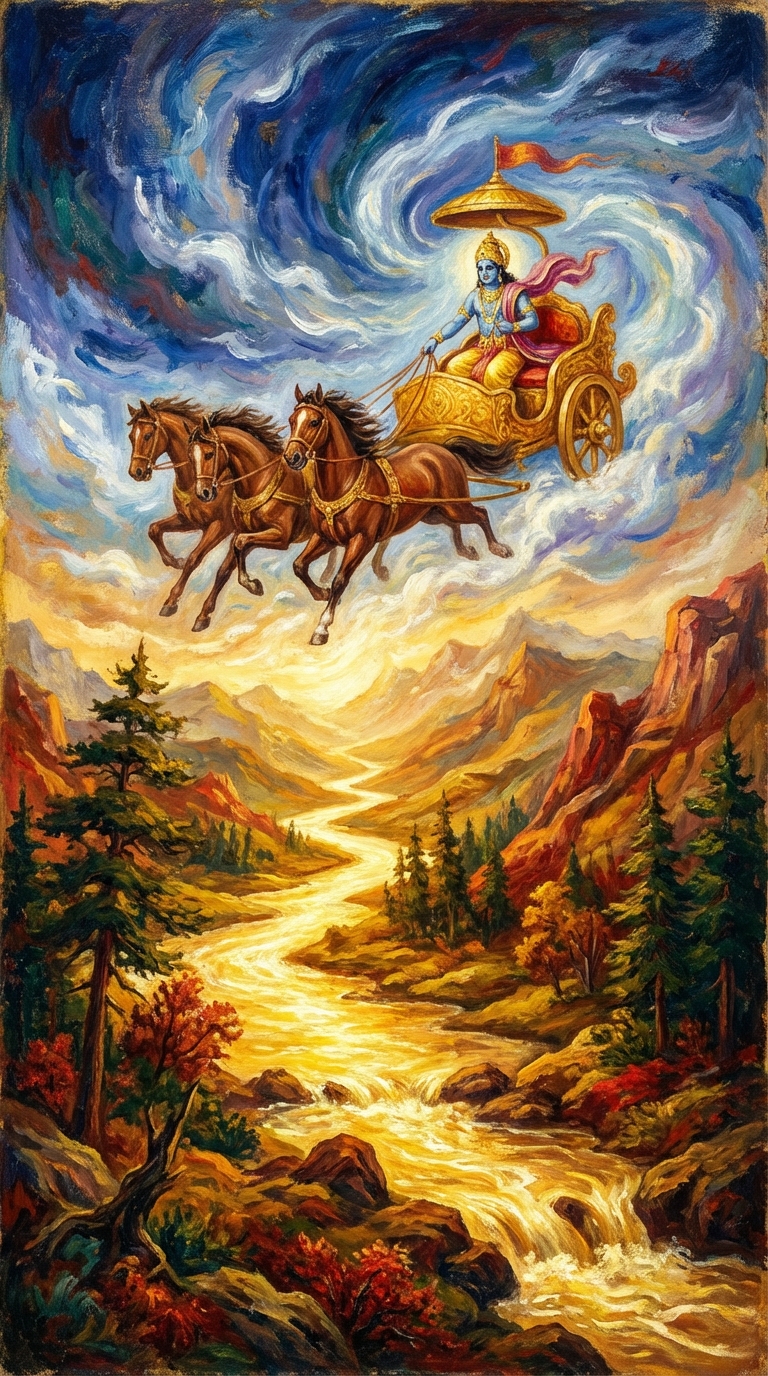
Book 1 of 10
This book is a collection of 191 hymns primarily attributed to various rishis of the Kanva family. The hymns are invocations to a wide range of Vedic deities, including Agni, Indra, Vayu, the Ashvins, Varuna, and the Maruts. The prayers seek blessings such as wealth, long life, protection from enemies, and success in sacrifices, and they frequently celebrate the heroic deeds of the gods, particularly Indra's slaying of the dragon Vṛtra.
Hymn I. Agni.
The opening hymn calls to Agni, the sacred fire, as the priest and messenger who carries human prayers to the gods. As the first Hymn of the entire Rig Veda, it establishes fire as the living bridge between the human and divine worlds, a lavisher of wealth and a radiant guard.
1 I Laud Agni, the chosen Priest, God, minister of sacrifice, > The hotar, lavishest of wealth. > 2 Worthy is Agni to be praised by living as by ancient seers. > He shall bring hitherward the Gods. > 3 Through Agni man obtaineth wealth, yea, plenty waxing day by day, > Most rich in heroes, glorious. > 4 Agni, the perfect sacrifice which thou encompassest about > Verily goeth to the Gods. > 5 May Agni, sapient-minded Priest, truthful, most gloriously great, > The God, come hither with the Gods. > 6 Whatever blessing, Agni, thou wilt grant unto thy worshipper, > That, Aṅgiras, is indeed thy truth. > 7 To thee, dispeller of the night, O Agni, day by day with prayer > Bringing thee reverence, we come > 8 Ruler of sacrifices, guard of Law eternal, radiant One, > Increasing in thine own abode. > 9 Be to us easy of approach, even as a father to his son: > Agni, be with us for our weal.
Hymn II. Vāyu.
Vāyu, the wind-god, arrives second in the collection — swift, invisible, first among the gods to taste the pressed Soma juice. The Hymn addresses him with the urgency of an invitation that cannot wait, often calling him in partnership with the great god Indra.
1 BEAUTIFUL Vāyu, come, for thee these Soma drops have been > prepared: > Drink of them, hearken to our call. > 2 Knowing the days, with Soma juice poured forth, the singers glorify > Thee, Vāyu, with their hymns of praise. > 3 Vāyu, thy penetrating stream goes forth unto the worshipper, > Far-spreading for the Soma draught. > 4 These, Indra-Vāyu, have been shed; come for our offered dainties’ > sake: > The drops are yearning for you both. > 5 Well do ye mark libations, ye Vāyu and Indra, rich in spoil! > So come ye swiftly hitherward. > 6 Vāyu and Indra, come to what the Soma-presser hath prepared: > Soon, Heroes, thus I make my prayer. > 7 Mitra, of holy strength, I call, and foe-destroying Varuṇa, > Who make the oil-fed rite complete. > 8 Mitra and Varuṇa, through Law, lovers and cherishers of Law, > Have ye obtained your might power > 9 Our Sages, Mitra-Varuṇa, wide dominion, strong by birth, > Vouchsafe us strength that worketh well.
Hymn III. Aśvins
This hymn is a composite invitation to several deities for the sacrifice, weaving a tapestry of divine presences to bless the ritual. It calls first the nimble-handed Aśvins (divine twins), then the bright god Indra, the Viśvedevas (All-Gods), and finally the mighty river-goddess Sarasvatī.
1 YE Aśvins, rich in treasure, Lords of splendour, having nimble hands, > Accept the sacrificial food. > 2 Ye Aśvins, rich in wondrous deeds, ye heroes worthy of our praise, > Accept our songs with mighty thought. > 3 Nāsatyas, wonder-workers, yours are these libations with clipt grass: > Come ye whose paths are red with flame. > 4 O Indra marvellously bright, come, these libations long for thee, > Thus by fine fingers purified. > 5 Urged by the holy singer, sped by song, come, Indra, to the prayers, > Of the libation-pouring priest. > 6 Approach, O Indra, hasting thee, Lord of Bay Horses, to the prayers. > In our libation take delight. > 7 Ye Viśvedevas, who protect, reward, and cherish men, approach > Your worshipper's drink-offering. > 8 Ye Viśvedevas, swift at work, come hither quickly to the draught, > As milch-kine hasten to their stalls. > 9 The Viśvedevas, changing shape like serpents, fearless, void of guile, > Bearers, accept the sacred draught > 10 Wealthy in spoil, enriched with hymns, may bright Sarasvatī desire, > With eager love, our sacrifice. > 11 Inciter of all pleasant songs, inspirer of all gracious thought, > Sarasvatī accept our rite > 12 Sarasvatī, the mighty flood,—she with her light illuminates, > She brightens every pious thought.
Hymn IV. Indra
A straightforward and powerful invocation to Indra, the king of the gods, for assistance and favor. The singer likens their call to a cow eager for milking, emphasizing a relationship of need and abundant provision from the god of wondrous deeds.
1 As a good cow to him who milks, we call the doer of fair deeds, > To our assistance day by day. > 2 Come thou to our libations, drink of Soma; Soma-drinker thou! > The rich One's rapture giveth kine. > 3 So may we be acquainted with thine innermost benevolence: > Neglect us not, come hitherward. > 4 Go to the wise unconquered One, ask thou of Indra, skilled in song, > Him who is better than thy friends. > 5 Whether the men who mock us say, Depart unto another place, > Ye who serve Indra and none else; > 6 Or whether, God of wondrous deeds, all our true people call us blest, > Still may we dwell in Indra's care. > 7 Unto the swift One bring the swift, man-cheering, grace of sacrifice, > That to the Friend gives wings and joy. > 8 Thou, Śatakratu, drankest this and wast the Vṛtras’ slayer; thou > Helpest the warrior in the fray. > 9 We strengthen, Śatakratu, thee, yea, thee the powerful in fight, > That, Indra, we may win us wealth. > 10 To him the mighty stream of wealth, prompt friend of him who pours > the juice, > Yea, to this Indra sing your song.
Hymn V. Indra.
Companions gather to sing praises to Indra, the lord of treasures, as they pour the Soma juice. The hymn is a communal call for Indra's strength and protection in times of need, seeking his presence with his iconic pair of tawny horses.
1 O COME ye hither, sit ye down: to Indra sing ye forth, your song, > companions, bringing hymns of praise. > 2 To him the richest of the rich, the Lord of treasures excellent, > Indra, with Soma juice outpoured. > 3 May he stand by us in our need and in abundance for our wealth: > May he come nigh us with his strength. > 4 Whose pair of tawny horses yoked in battles foemen challenge not: > To him, to Indra sing your song. > 5 Nigh to the Soma-drinker come, for his enjoyment, these pure drops, > The Somas mingled with the curd. > 6 Thou, grown at once to perfect strength, wast born to drink the Soma > juice, > Strong Indra, for preëminence. > 7 O Indra, lover of the song, may these quick Somas enter thee: > May they bring bliss to thee the Sage. > 8 Our chants of praise have strengthened thee, O Śatakratu, and our > lauds > So strengthen thee the songs we sing. > 9 Indra, whose succour never fails, accept these viands thousandfold, > Wherein all manly powers abide. > 10 O Indra, thou who lovest song, let no man hurt our bodies, keep > Slaughter far from us, for thou canst.
Hymn VI. Indra.
This hymn uses cosmic and vivid imagery to call Indra, describing the harnessing of his bright red steed and his birth alongside the Dawns. It's a call from the sacrificer for Indra's presence, invoking his power to break down strongholds and find hidden wealth.
1 They who stand round him as he moves harness the bright, the ruddy > Steed > The lights are shining in the sky. > 2 On both sides to the car they yoke the two bay coursers dear to him, > Bold, tawny, bearers of the Chief. > 3 Thou, making light where no light was, and form, O men: where form > was not, > Wast born together with the Dawns. > 4 Thereafter they, as is their wont, threw off the state of babes unborn, > Assuming sacrificial names. > 5 Thou, Indra, with the Tempest-Gods, the breakers down of what is > firm, > Foundest the kine even in the cave. > 6 Worshipping even as they list, singers laud him who findeth wealth, > The far-renowned, the mighty One. > 7 Mayest thou verily be seen coming by fearless Indra's side: > Both joyous, equal in your sheen. > 8 With Indra's well beloved hosts, the blameless, hastening to heaven, > The sacrificer cries aloud. > 9 Come from this place, O Wanderer, or downward from the light of > heaven: > Our songs of praise all yearn for this. > 10 Indra we seek to give us help, from here, from heaven above the earth, > Or from the spacious firmament.
Hymn VII. Indra.
A concise hymn glorifying Indra as the thunder-armed god who raised the Sun into the heavens. The singers call on him for help in battles where a thousand spoils are to be won, seeking his exclusive favor as their own special protector.
1 INDRA the singers with high praise, Indra reciters with their lauds, > Indra the choirs have glorified. > 2 Indra hath ever close to him his two bay steeds and word-yoked car, > Indra the golden, thunder-armed. > 3 Indra hath raised the Sun on high in heaven, that he may see afar: > He burst the mountain for the kine. > 4 Help us, O Indra, in the frays, yea, frays, where thousand spoils are > gained, > With awful aids, O awful One. > 5 In mighty battle we invoke Indra, Indra in lesser fight, > The Friend who bends his bolt at fiends. > 6 Unclose, our manly Hero, thou for ever bounteous, yonder cloud, > For us, thou irresistible. > 7 Still higher, at each strain of mine, thunder-armed Indra's praises rise: > I find no laud worthy of him. > 8 Even as the bull drives on the herds, he drives the people with his > might, > The Ruler irresistible: > 9 Indra who rules with single sway men, riches, and the fivefold race > Of those who dwell upon the earth. > 10 For your sake from each side we call Indra away from other men: > Ours, and none others’, may he be.
Hymn VIII. Indra.
The singers invoke Indra for wealth that is both delightful and victorious in battle. The hymn swells with images of Indra's power, his belly like an ocean swelling with Soma, ready to bestow his gifts upon the worshipper like a ripe, fruit-laden branch.
1 INDRA, bring wealth that gives delight, the victor's ever-conquering > wealth, > Most excellent, to be our aid; > 2 By means of which we may repel our foes in battle hand to hand, > By thee assisted with the car. > 3 Aided by thee, the thunder-armed, Indra, may we lift up the bolt, > And conquer all our foes in fight. > 4 With thee, O India, for ally with missile-darting heroes, may > We conquer our embattled foes. > 5 Mighty is Indra, yea supreme; greatness be his, the Thunderer: > Wide as the heaven extends his power > 6 Which aideth those to win them sons, who come as heroes to the fight, > Or singers loving holy thoughts. > 7 His belly, drinking deepest draughts of Soma, like an ocean swells, > Like wide streams from the cope of heaven. > 8 So also is his excellence, great, vigorous, rich in cattle, like > A ripe branch to the worshipper. > 9 For verily thy mighty powers, Indra, are saving helps at once > Unto a worshipper like me. > 10 So are his lovely gifts; let lauds and praises be to Indra sung, > That he may drink the Soma juice.
Hymn IX. Indra.
A direct plea to Indra to come and enjoy the Soma feast, with repeated calls for him to grant wealth, fame, and strength. The hymn positions the singer as one who praises the praiseworthy, deserving of the god's bounteous rewards and manifold gifts.
1 COME, Indra, and delight thee with the juice at all the Soma feasts, > Protector, mighty in thy strength. > 2 To Indra pour ye forth the juice, the active gladdening juice to him > The gladdening, omnific God. > 3 O Lord of all men, fair of cheek, rejoice thee in the gladdening lauds, > Present at these drink-offerings. > 4 Songs have outpoured themselves to thee, Indra, the strong, the > guardian Lord, > And raised themselves unsatisfied. > 5 Send to us bounty manifold, O Indra, worthy of our wish, > For power supreme is only thine. > 6 O Indra, stimulate thereto us emulously fain for wealth, > And glorious, O most splendid One. > 7 Give, Indra, wide and lofty fame, wealthy in cattle and in strength, > Lasting our life-time, failing not. > 8 Grant us high fame, O Indra, grant riches bestowing thousands, those > Fair fruits of earth borne home in wains. > 9 Praising with songs the praise-worthy who cometh to our aid, we call > Indra, the Treasure-Lord of wealth. > 10 To lofty Indra, dweller by each libation, the pious man > Sings forth aloud a strengthening hymn.
Hymn X. Indra.
The hymn describes the priests raising Indra up "like a pole," a vivid image of exalting the god through ritual and song. It is a friendly and direct appeal to the powerful deity, asking him to come in his chariot and make the sacrifice successful.
1 THE chanters hymn thee, they who say the word of praise magnify > thee. > The priests have raised thee up on high, O Śatakratu, like a pole. > 2 As up he clomb from ridge to ridge and looked upon the toilsome task, > Indra observes this wish of his, and the Rain hastens with his troop. > 3 Harness thy pair of strong bay steeds, long-maned, whose bodies fill > the girths, > And, Indra, Soma-drinker, come to listen to our songs of praise. > 4 Come hither, answer thou the song, sing in approval, cry aloud. > Good Indra, make our prayer succeed, and prosper this our sacrifice. > 5 To Indra must a laud be said, to strengthen him who freely gives, > That Śakra may take pleasure in our friendship and drink-offerings. > 6 Him, him we seek for friendship, him for riches and heroic might. > For Indra, he is Śakra, he shall aid us while he gives us wealth. > 7 Easy to turn and drive away, Indra, is spoil bestowed by thee. > Unclose the stable of the kine, and give us wealth O Thunder-armed > 8 The heaven and earth contain thee not, together, in thy wrathful mood. > Win us the waters of the sky, and send us kine abundantly. > 9 Hear, thou whose ear is quick, my call; take to thee readily my songs > O Indra, let this laud of mine come nearer even than thy friend. > 10 We know thee mightiest of all, in battles hearer of our cry. > Of thee most mighty we invoke the aid that giveth thousandfold. > 11 O Indra, Son of Kuśika, drink our libation with delight. > Prolong our life anew, and cause the seer to win a thousand gifts. > 12 Lover of song, may these our songs on every side encompass thee: > Strengthening thee of lengthened life, may they be dear delights to thee.
Hymn XI. Indra.
This hymn magnifies Indra as a god expansive as the sea, the crusher of forts, and the lord of strength. It recounts his legendary deeds, such as bursting the cave of Vala, and calls on him for abundant gifts and protection from all fear.
1 ALL sacred songs have magnified Indra expansive as the sea, > The best of warriors borne on cars, the Lord, the very Lord of strength. > 2 Strong in thy friendship, Indra, Lord of power and might, we have no > fear. > We glorify with praises thee, the never-conquered conqueror. > 3 The gifts of Indra from of old, his saving succours, never fail, > When to the praise-singers he gives the boon of substance rich in kine. > 4 Crusher of forts, the young, the wise, of strength unmeasured, was he > born > Sustainer of each sacred rite, Indra, the Thunderer, much-extolled. > 5 Lord of the thunder, thou didst burst the cave of Vala rich in cows. > The Gods came pressing to thy side, and free from terror aided thee, > 6 I, Hero, through thy bounties am come to the flood addressing thee. > Song-lover, here the singers stand and testify to thee thereof. > 7 The wily Śuṣṇa, Indra! thou o’erthrewest with thy wondrous powers. > The wise beheld this deed of thine: now go beyond their eulogies. > 8 Our songs of praise have glorified Indra who ruleth by his might, > Whose precious gifts in thousands come, yea, even more abundantly.
Hymn XII. Agni.
Returning to Agni, this hymn calls upon him as the divine messenger and herald, the lord of the house. It is a simple, clear invocation for him to bring the other gods to the sacrifice and burn away the worshippers' enemies whom fiends protect.
1 WE choose Agni the messenger, the herald, master of all wealth, > Well skilled in this our sacrifice. > 2 With callings ever they invoke Agni, Agni, Lord of the House, > Oblation-bearer, much beloved. > 3 Bring the Gods hither, Agni, born for him who strews the sacred grass: > Thou art our herald, meet for praise. > 4 Wake up the willing Gods, since thou, Agni, performest embassage: > Sit on the sacred grass with Gods. > 5 O Agni, radiant One, to whom the holy oil is poured, burn up > Our enemies whom fiends protect. > 6 By Agni Agni is inflamed, Lord of the House, wise, young, who bears > The gift: the ladle is his mouth. > 7 Praise Agni in the sacrifice, the Sage whose ways are ever true, > The God who driveth grief away. > 8 God, Agni, be his strong defence who lord of sacrificial gifts, > Worshippeth thee the messenger. > 9 Whoso with sacred gift would fain call Agni to the feast of Gods, > O Purifier, favour him. > 10 Such, Agni, Purifier, bright, bring hither to our sacrifice, > To our oblation bring the Gods. > 11 So lauded by our newest song of praise bring opulence to us, > And food, with heroes for our sons. > 12 O Agni, by effulgent flame, by all invokings of the Gods, > Show pleasure in this laud of ours.
Hymn XIII. Agni
This hymn presents a litany of divine powers associated with the sacrifice, invoked to attend the rite. Agni is the primary recipient, but the call extends to Narāśaṁsa (Praise of Men), the Divine Doors, Night and Dawn, and other personified elements of the ritual, asking all to be present.
1 AGNI, well-kindled, bring the Gods for him who offers holy gifts. > Worship them, Purifier, Priest. > 2 Son of Thyself, present, O Sage, our sacrifice to the Gods today. > Sweet to the taste, that they may feast. > 3 Dear Narāśaṁsa, sweet of tongue, the giver of oblations, I > Invoke to this our sacrifice. > 4 Agni, on thy most easy car, glorified, hither bring the Gods: > Manu appointed thee as Priest. > 5 Strew, O ye wise, the sacred grass that drips with oil, in order due, > Where the Immortal is beheld. > 6 Thrown open be the Doors Divine, unfailing, that assist the rite, > For sacrifice this day and now. > 7 I call the lovely Night and Dawn to seat them on the holy grass > At this our solemn sacrifice. > 8 The two Invokers I invite, the wise, divine and sweet of tongue, > To celebrate this our sacrifice. > 9 Iḷā, Sarasvatī, Mahī, three Goddesses who bring delight, > Be seated, peaceful, on the grass. > 10 Tvaṣṭar I call, the earliest born, the wearer of all forms at will: > May he be ours and ours alone. > 11 God, Sovran of the Wood, present this our oblation to the Gods, > And let the giver be renowned. > 12 With Svāhā pay the sacrifice to Indra in the offerer's house: > Thither I call the Deities.
Hymn XIV. Viśvedevas.
The "All-Gods" (Viśvedevas) are invited by Agni to come and drink the Soma that gladdens and exhilarates. The hymn lists many of the primary gods—Indra, Vāyu, Bṛhaspati, Mitra—uniting them as guests at the communal offering prepared by the sons of Kaṇva.
1 To drink the Soma, Agni, come, to our service and our songs. > With all these Gods; and worship them. > 2 The Kaṇvas have invoked thee; they, O Singer, sing thee songs of praise > Agni, come hither with the Gods; > 3 Indra, Vāyu, Bṛhaspati, Mitra, Agni, Pūṣan, Bhaga, > Ādityas, and the Marut host. > 4 For you these juices are poured forth that gladden and exhilarate, > The meath-drops resting in the cup. > 5 The sons of Kaṇva fain for help adore thee, having strewn the grass, > With offerings and all things prepared. > 6 Let the swift steeds who carry thee, thought-yoked and dropping holy > oil, > Bring the Gods to the Soma draught. > 7 Adored, the strengtheners of Law, unite them, Agni, with their Dames: > Make them drink meath, O bright of tongue. > 8 Let them, O Agni, who deserve worship and praise drink with thy > tongue > The meath in solemn sacrifice. > 9 Away, from the Sun's realm of light, the wise invoking Priest shall > bring > All Gods awaking with the dawn. > 10 With all the Gods, with Indra, with Vāyu, and Mitra's splendours, > drink, > Agni, the pleasant Soma juice. > 11 Ordained by Manu as our Priest, thou sittest, Agni, at each rite: > Hallow thou this our sacrifice. > 12 Harness the Red Mares to thy car, the Bays, O God, the flaming ones: > With those bring hitherward the Gods.
Hymn XV. Ṛtu.
This hymn addresses the Ṛtus, or the personified Seasons, inviting them to drink the Soma in their proper order. It calls various gods—Indra, Maruts, Mitra, Varuṇa—to partake in the sacrifice according to this seasonal sequence, linking the ritual to the eternal cycle of time.
1 O INDRA drink the Soma juice with Ṛtu; let the cheering drops > Sink deep within, which settle there. > 2 Drink from the Purifier's cup, Maruts, with Ṛtu; sanctify > The rite, for ye give precious gifts. > 3 O Neṣṭar, with thy Dame accept our sacrifice; with Ṛtu drink, > For thou art he who giveth wealth. > 4 Bring the Gods, Agni; in the three appointed places set them down: > Surround them, and with Ṛtu drink. > 5 Drink Soma after the Ṛtus, from the Brāhmaṇa's bounty: undissolved, > O Indra, is thy friendship's bond. > 6 Mitra, Varuṇa, ye whose ways are firm—a Power that none deceives—, > With Ṛtu ye have reached the rite. > 7 The Soma-pressers, fain for wealth, praise the Wealth-giver in the rite, > In sacrifices praise the God. > 8 May the Wealth-giver grant to us riches that shall be far renowned. > These things we gain, among the Gods. > 9 He with the Ṛtu fain would drink, Wealth-giver, from the Neṣṭar's > bowl. > Haste, give your offering, and depart. > 10 As we this fourth time, Wealth-giver, honour thee with the Ṛtus, be > A Giver bountiful to us. > 11 Drink ye the meath, O Aśvins bright with flames, whose acts are pure, > who with > Ṛtus accept the sacrifice. > 12 With Ṛtu, through the house-fire, thou, kind Giver, guidest sacrifice: > Worship the Gods for the pious man.
Hymn XVI. Indra.
A simple and direct invitation to Indra, calling for his Bay Steeds to bring him swiftly to the Soma offering. The hymn is a pure and joyful call, likening the thirsty god to a stag eager for water, and asking for the fulfillment of all wishes.
1 LET thy Bay Steeds bring thee, the Strong, hither to drink the Soma > draught— > Those, Indra, who are bright as suns. > 2 Here are the grains bedewed with oil: hither let the Bay Coursers bring > Indra upon his easiest car. > 3 Indra at early morn we call, Indra in course of sacrifice, > Indra to drink the Soma juice. > 4 Come hither, with thy long-maned Steeds, O Indra, to he draught we > pour > We call thee when the juice is shed. > 5 Come thou to this our song of praise, to the libation poured for thee > Drink of it like a stag athirst. > 6 Here are the drops of Soma juice expressed on sacred grass: thereof > Drink, Indra, to increase thy might. > 7 Welcome to thee be this our hymn, reaching thy heart, most excellent: > Then drink the Soma juice expressed. > 8 To every draught of pressed-out juice Indra, the Vṛtra-slayer, comes, > To drink the Soma for delight. > 9 Fulfil, O Śatakratu, all our wish with horses and with kine: > With holy thoughts we sing thy praise.
Hymn XVII. Indra-Varuṇa
This hymn addresses the dual deities Indra and Varuṇa, the Imperial Lords, asking for their combined favor and protection. It is a prayer for wealth, victory, and a close relationship with these powerful guardians of men.
1 I CRAVE help from the Imperial Lords, from Indra-Varuṇa; may they > Both favour one of us like me. > 2 Guardians of men, ye ever come with ready succour at the call > Of every singer such as I. > 3 Sate you, according to your wish, O Indra-Varuṇa, with wealth: > Fain would we have you nearest us. > 4 May we be sharers of the powers, sharers of the benevolence > Of you who give strength bounteously. > 5 Indra and Varuṇa, among givers of thousands, meet for praise, > Are Powers who merit highest laud. > 6 Through their protection may we gain great store of wealth, and heap it > up > Enough and still to spare, be ours. > 7 O Indra-Varuṇa, on you for wealth in many a form I call: > Still keep ye us victorious. > 8 O Indra-Varuṇa, through our songs that seek to win you to ourselves, > Give us at once your sheltering help. > 9 O Indra-Varuṇa, to you may fair praise which I offer come, > Joint eulogy which ye dignify.
Hymn XVIII. Brahmaṇaspati.
A hymn to Brahmaṇaspati, the lord of prayer, asking him to make the Soma-presser glorious and to protect him from curses. It also calls upon Indra and Soma, celebrating the power of sacred speech to bring the gods near.
1 O BRĀHMAṆASPATI, make him who presses Soma glorious, > Even Kakṣīvān Auśija. > 2 The rich, the healer of disease, who giveth wealth, increaseth store, > The prompt,—may he be with us still. > 3 Let not the foeman's curse, let not a mortal's onslaught fall on us > Preserve us, Brahmaṇaspati. > 4 Ne’er is the mortal hero harmed whom Indra, Brahmaṇaspati, > And Soma graciously inspire. > 5 Do, thou, O Brahmaṇaspati, and Indra, Soma, Dakṣiṇā, > Preserve that mortal from distress. > 6 To the Assembly's wondrous Lord, to Indra's lovely Friend who gives > Wisdom, have I drawn near in prayer. > 7 He without whom no sacrifice, e’en of the wise man, prospers; he > Stirs up the series of thoughts. > 8 He makes the oblation prosper, he promotes the course of sacrifice: > Our voice of praise goes to the Gods. > 9 I have seen Narāśaṁsa, him most resolute, most widely famed, > As ’twere the Household Priest of heaven.
Hymn XIX. Agni, Maruts.
A litany-like hymn repeatedly calling Agni to come to the sacrifice in the company of the Maruts, the storm gods. The verses describe the terrible, brilliant, and mighty nature of the Maruts, inviting Agni to bring their combined power to the rite.
1 To this fair sacrifice to drink the milky draught thou art invoked: > O Agni, with the Maruts come. > 2 No mortal man, no God exceeds thy mental power, O Mighty one: > O Agni, with the Maruts come: > 3 All Gods devoid of guile, who know the mighty region of mid-air: > O Agni, with those Maruts come. > 4 The terrible, who sing their song, not to be overcome by might: > O Agni, with those Maruts come. > 5 Brilliant, and awful in their form, mighty, devourers of their foes: > O Agni, with those Maruts come. > 6 Who sit as Deities in heaven, above the sky-vault's luminous sphere: > O Agni, with those Maruts come. > 7 Who scatter clouds about the sky, away over the billowy sea: > O Agni, with those Maruts come. > 8 Who with their bright beams spread them forth over the ocean in their > might > O Agni, with those Maruts come. > 9 For thee, to be thine early draught, I pour the Soma-mingled meath: > O Agni, with the Maruts come.
Hymn XX. Ṛbhus.
This hymn praises the Ṛbhus, divine artisans who achieved immortality through their exceptional skill. It recounts their famous deeds: fashioning Indra's horses, the Aśvins' chariot, a nectar-yielding cow, and even making their parents young again, earning them a share in the sacrifice.
1 FOR the Celestial Race this song of praise which gives wealth lavishly > Was made by singers with their lips. > 2 They who for Indra, with their mind, formed horses harnessed by a > word, > Attained by works to sacrifice. > 3 They for the two Nāsatyas wrought a light car moving every way: > They formed a nectar-yielding cow. > 4 The Ṛbhus with effectual prayers, honest, with constant labour, made > Their Sire and Mother young again. > 5 Together came your gladdening drops with Indra by the Maruts girt, > With the Ādityas, with the Kings. > 6 The sacrificial ladle, wrought newly by the God Tvaṣṭar's hand— > Four ladles have ye made thereof. > 7 Vouchsafe us wealth, to him who pours thrice seven libations, yea, to > each > Give wealth, pleased with our eulogies. > 8 As ministering Priests they held, by pious acts they won themselves, > A share in sacrifice with Gods.
Hymn XXI. Indra-Agni.
A joint invocation to Indra and Agni, celebrated as the two chief Soma-drinkers of the pantheon. The hymn is a straightforward call for their presence at the libation, asking them to come together, crush fiends, and bring bliss.
1 INDRA and Agni I invoke fain are we for their song of praise: > Chief Soma-drinkers are they both. > 2 Praise ye, O men, and glorify Indra-Agni in the holy rites: > Sing praise to them in sacred songs. > 3 Indra and Agni we invite, the Soma-drinkers, for the fame > Of Mitra, to the Soma-draught. > 4 Strong Gods, we bid them come to this libation that stands ready here: > Indra and Agni, come to us. > 5 Indra and Agni, mighty Lords of our assembly, crush the fiends: > Childless be the devouring ones. > 6 Watch ye, through this your truthfulness, there in the place of spacious > view > Indra and Agni, send us bliss.
Hymn XXII. Aśvins and Others
This hymn is a collection of invocations to various deities, beginning with the Aśvins and their honey-dropping whip. It then calls upon Savitar, the wives of the Gods, Heaven and Earth, and finally Viṣṇu, whose three great strides encompass the universe.
1 WAKEN the Aśvin Pair who yoke their car at early morn: may they > Approach to drink this Soma juice. > 2 We call the Aśvins Twain, the Gods borne in a noble car, the best > Of charioteers, who reach the heavens. > 3 Dropping with honey is your whip, Aśvins, and full of pleasantness > Sprinkle therewith the sacrifice. > 4 As ye go thither in your car, not far, O Aśvins, is the home > Of him who offers Soma juice. > 5 For my protection I invoke the golden-handed Savitar. > He knoweth, as a God, the place. > 6 That he may send us succour, praise the Waters’ Offspring Savitar: > Fain are we for his holy ways. > 7 We call on him, distributer of wondrous bounty and of wealth, > On Savitar who looks on men. > 8 Come hither, friends, and seat yourselves Savitar, to be praised by us, > Giving good gifts, is beautiful. > 9 O Agni, hither bring to us the willing Spouses of the Gods, > And Tvaṣṭar, to the Soma draught. > 10 Most youthful Agni, hither bring their Spouses, Hotrā, Bhāratī, > Varūtrī, Dhiṣaṇā, for aid. > 11 Spouses of Heroes, Goddesses, with whole wings may they come to us > With great protection and with aid. > 12 Indrāṇī, Varuṇānī, and Agnāyī hither I invite, > For weal, to drink the Soma juice. > 13 May Heaven and Earth, the Mighty Pair, bedew for us our sacrifice, > And feed us full with nourishments. > 14 Their water rich with fatness, there in the Gandharva's steadfast > place, > The singers taste through sacred songs. > 15 Thornless be thou, O Earth, spread wide before us for a dwelling place: > Vouchsafe us shelter broad and sure. > 16 The Gods be gracious unto us even from the place whence Viṣṇu > strode > Through the seven regions of the earth! > 17 Through all this world strode Viṣṇu; thrice his foot he planted, and the > whole > Was gathered in his footstep's dust. > 18 Viṣṇu, the Guardian, he whom none deceiveth, made three steps; > thenceforth > Establishing his high decrees. > 19 Look ye on Viṣṇu's works, whereby the Friend of Indra, close-allied, > Hath let his holy ways be seen. > 20 The princes evermore behold that loftiest place where Viṣṇu is, > Laid as it were an eye in heaven. > 21 This, Viṣṇu's station most sublime, the singers, ever vigilant, > Lovers of holy song, light up.
Hymn XXIII. Vāyu and Others.
Another composite hymn, this one invites Vāyu and Indra, Mitra and Varuṇa, the Maruts, and the Waters to the Soma offering. The verses move from pleas for divine aid against foes to a description of the life-giving and purifying power of the Waters, which hold all medicines.
1 STRONG are the Somas; come thou nigh; these juices have been mixt > with milk: > Drink, Vāyu, the presented draughts. > 2 Both Deities who touch the heaven, Indra and Vāyu we invoke > To drink of this our Soma juice. > 3 The singers' for their aid, invoke Indra and Vāyu, swift as mind, > The thousand-eyed, the Lords of thought. > 4 Mitra and Varuṇa, renowned as Gods of consecrated might, > We call to drink the Soma juice. > 5 Those who by Law uphold the Law, Lords of the shining light of Law, > Mitra I call, and Varuṇa. > 6 Let Varuṇa be our chief defence, let Mitra guard us with all aids > Both make us rich exceedingly. > 7 Indra, by Maruts girt, we call to drink the Soma juice: may he > Sate him in union with his troop. > 8 Gods, Marut hosts whom Indra leads, distributers of Pūṣan's gifts, > Hearken ye all unto my cry. > 9 With conquering Indra for ally, strike Vṛtra down, ye bounteous Gods > Let not the wicked master us. > 10 We call the Universal Gods, and Maruts to the Soma draught, > For passing strong are Pṛśni's Sons. > 11 Fierce comes the Maruts’ thundering voice, like that of conquerors, > when ye go > Forward to victory, O Men. > 12 Born of the laughing lightning. may the Maruts guard us everywhere > May they be gracious unto Us. > 13 Like some lost animal, drive to us, bright Pūṣan, him who bears up > heaven, > Resting on many-coloured grass. > 14 Pūṣan the Bright has found the King, concealed and hidden in a cave, > Who rests on grass of many hues. > 15 And may he. duly bring to me the six bound closely, through these > drops, > As one who ploughs with steers brings corn. > 16 Along their paths the Mothers go, Sisters of priestly ministrants, > Mingling their sweetness with the milk. > 17 May Waters gathered near the Sun, and those wherewith the Sun is > joined, > Speed forth this sacrifice of ours. > 18 I call the Waters, Goddesses, wherein our cattle quench their thirst; > Oblations to the Streams be given. > 19 Amrit is in the Waters in the Waters there is healing balm > Be swift, ye Gods, to give them praise. > 20 Within the Waters—Soma thus hath told me—dwell all balms that > heal, > And Agni, he who blesseth all. The Waters hold all medicines. > 21 O Waters, teem with medicine to keep my body safe from harm, > So that I long may see the Sun. > 22 Whatever sin is found in me, whatever evil I have wrought. > If I have lied or falsely sworn, Waters, remove it far from me. > 23 The Waters I this day have sought, and to their moisture have we > come: > O Agni, rich in milk, come thou, and with thy splendour cover me. > 24 Fill me with splendour, Agni; give offspring and length of days; the > Gods > Shall know me even as I am, and Indra with the Ṛṣis, know.
Hymn XXIV. Varuṇa and Others.
A deeply personal and moving hymn that begins with a question of restoration and forgiveness. It calls on various gods, but focuses on Varuṇa, whose cosmic laws govern the universe, and contains the famous plea of Śunaḥśepa, bound to the sacrificial pillars and praying for release.
1 WHO now is he, what God among Immortals, of whose auspicious > name we may bethink us? > Who shall to mighty Aditi restore us, that I may see my Father and my > Mother? > 2 Agni the God the first among the Immortals,—of his auspicious name > let us bethink us. > He shall to mighty Aditi restore us, that I may see my Father and my > Mother. > 3 To thee, O Savitar, the Lord of precious things, who helpest us > Continually, for our share we come— > 4 Wealth, highly lauded ere reproach hath fallen on it, which is laid, > Free from all hatred, in thy hands > 5 Through thy protection may we come to even the height of affluence > Which Bhaga hath dealt out to us. > 6 Ne’er have those birds that fly through air attained to thy high > dominion or thy might or spirit; > Nor these the waters that flow on for ever, nor hills, abaters of the wind's > wild fury. > 7 Varuṇa, King, of hallowed might, sustaineth erect the Tree's stem in the > baseless region. > Its rays, whose root is high above, stream downward. Deep may they sink > within us, and be hidden. > 8 King Varuṇa hath made a spacious pathway, a pathway for the Sun > wherein to travel. > Where no way was he made him set his footstep, and warned afar > whate’er afflicts the spirit. > 9 A hundred balms are thine, O King, a thousand; deep and wide reaching also be thy favours. > Far from us, far away drive thou Destruction. Put from us e’en the sin we > have committed. > 10 Whither by day depart the constellations that shine at night, set high > in heaven above us? > Varuṇa's holy laws remain unweakened, and through the night the Moon > moves on in splendor > 11 I ask this of thee with my prayer adoring; thy worshipper craves this > with his oblation. > Varuṇa, stay thou here and be not angry; steal not our life from us, O > thou Wide-Ruler. > 12 Nightly and daily this one thing they tell me, this too the thought of > mine own heart repeateth. > May he to whom prayed fettered Śunaḥśepa, may he the Sovran Varuṇa > release us. > 13 Bound to three pillars captured Śunaḥśepa thus to the Āditya made > his supplication. > Him may the Sovran Varuṇa deliver, wise, ne’er deceived, loosen the > bonds that bind him. > 14 With bending down, oblations, sacrifices, O Varuṇa, we deprecate > thine anger: > Wise Asura, thou King of wide dominion, loosen the bonds of sins by us > committed. > 15 Loosen the bonds, O Varuṇa, that hold me, loosen the bonds above, > between, and under. > So in thy holy law may we made sinless belong to Aditi, O thou Āditya.
Hymn XXV. Varuṇa.
A profound hymn of supplication to Varuṇa, acknowledging human frailty and the violation of his sacred laws. The singer seeks to gain the god's mercy through hymns, praising him as the omniscient sovran of the sea, the sky, and all creation.
1 WHATEVER law of thine, O God, O Varuṇa, as we are men, > Day after day we violate. > 2 give us not as a prey to death, to be destroyed by thee in wrath, > To thy fierce anger when displeased. > 3 To gain thy mercy, Varuṇa, with hymns we bind thy heart, as binds > The charioteer his tethered horse. > 4 They flee from me dispirited, bent only on obtaining wealth, > As to their nests the birds of air. > 5 When shall we bring, to be appeased, the Hero, Lord of warrior might, > Him, the far-seeing Varuṇa? > 6 This, this with joy they both accept in common: never do they fail > The ever-faithful worshipper. > 7 He knows the path of birds that fly through heaven, and, Sovran of the > sea, > He knows the ships that are thereon. > 8 True to his holy law, he knows the twelve moons with their progeny: > He knows the moon of later birth. > 9 He knows the pathway of the wind, the spreading, high, and mighty > wind: > He knows the Gods who dwell above. > 10 Varuṇa, true to holy law, sits down among his people; he, > Most wise, sits there to govern all. > 11 From thence perceiving he beholds all wondrous things, both what > hath been, > And what hereafter will be done. > 12 May that Āditya, very wise, make fair paths for us all our days: > May he prolong our lives for us. > 13 Varuṇa, wearing golden mail, hath clad him in a shining robe. > His spies are seated found about. > 14 The God whom enemies threaten not, nor those who tyrannize o’er > men, > Nor those whose minds are bent on wrong. > 15 He who gives glory to mankind, not glory that is incomplete, > To our own bodies giving it. > 16 Yearning for the wide-seeing One, my thoughts move onward unto > him, > As kine unto their pastures move. > 17 Once more together let us speak, because my meath is brought: priest like > Thou eatest what is dear to thee. > 18 Now saw I him whom all may see, I saw his car above the earth: > He hath accepted these my songs. > 19 Varuṇa, hear this call of mine: be gracious unto us this day > Longing for help I cried to thee. > 20 Thou, O wise God, art Lord of all, thou art the King of earth and > heaven > Hear, as thou goest on thy way. > 21 Release us from the upper bond, untie the bond between, and loose > The bonds below, that I may live.
Hymn XXVI. Agni.
A simple and heartfelt hymn to Agni, calling upon him to sit as the chosen priest at the sacrifice. The singer positions their relationship with the god as that of a son to a father, asking him to bring the great gods Varuṇa, Mitra, and Aryaman to the sacred grass.
1 O WORTHY of oblation, Lord of prospering powers, assume thy robes, > And offer this our sacrifice. > 2 Sit ever to be chosen, as our Priest, most youthful, through our hymns, > O Agni, through our heavenly word. > 3 For here a Father for his son, Kinsman for kinsman worshippeth, > And Friend, choice-worthy, for his friend. > 4 Here let the foe-destroyers sit, Varuṇa, Mitra, Aryaman, > Like men, upon our sacred grass. > 5 O ancient Herald, be thou glad in this our rite and fellowship: > Hearken thou well to these our songs. > 6 Whate’er in this perpetual course we sacrifice to God and God, > That gift is offered up in thee > 7 May he be our dear household Lord, Priest, pleasant and, choice- > worthy may > We, with bright fires, be dear to him. > 8 The Gods, adored with brilliant fires. have granted precious wealth to > us > So, with bright fires, we pray to thee. > 9 And, O Immortal One, so may the eulogies of mortal men > Belong to us and thee alike. > 10 With all thy fires, O Agni, find pleasure in this our sacrifice, > And this our speech, O Son of Strength.
Hymn XXVII. Agni.
A hymn of praise to Agni, likened to a powerful, far-striding steed and an imperial lord. The singer asks Agni to act as messenger, announcing their offerings to the gods and granting the worshipper strength in battle and a share of divine gifts.
1 WITH worship will I glorify thee, Agni, like a long-tailed steed, > Imperial Lord of sacred rites. > 2 May the far-striding Son of Strength, bringer of great felicity, > Who pours his gifts like rain, be ours. > 3 Lord of all life, from near; from far, do thou, O Agni evermore > Protect us from the sinful man. > 4 O Agni, graciously announce this our oblation to the Gods, > And this our newest song of praise. > 5 Give us a share of strength most high, a share of strength that is below, > A share of strength that is between. > 6 Thou dealest gifts, resplendent One; nigh, as with waves of Sindhu, > thou > Swift streamest to the worshipper. > 7 That man is lord of endless strength whom thou protectest in the fight, > Agni, or urgest to the fray. > 8 Him, whosoever he may be, no man may vanquish, mighty One: > Nay, very glorious power is his. > 9 May he who dwells with all mankind bear us with war-steeds through > the fight, > And with the singers win the spoil. > 10 Help, thou who knowest lauds, this work, this eulogy to Rudra, him > Adorable in every house. > 11 May this our God, great, limitless, smoke-bannered excellently bright, > Urge us to strength and holy thought. > 12 Like some rich Lord of men may he, Agni the banner of the Gods, > Refulgent, hear us through our lauds. > 13 Glory to Gods, the mighty and the lesser glory to Gods the younger > and the elder! > Let us, if we have power, pay the God worship: no better prayer than > this, ye Gods, acknowledge.
Hymn XXVIII. Indra, Etc.
This hymn vividly personifies the implements of the Soma sacrifice, addressing the mortar, pestle, and pressing stones directly. Each is called a "Sovran of the Forest" and implored to press the juice for Indra's drink, with each verse inviting Indra to a different stage of the process.
1 THERE where the broad-based stone raised on high to press the juices > out, > O Indra, drink with eager thirst the droppings which the mortar sheds. > 2 Where, like broad hips, to hold the juice the platters of the press are > laid, > O Indra, drink with eager thirst the droppings which the mortar sheds. > 3 There where the woman marks and leans the pestle's constant rise and > fall, > O Indra, drink with eager thirst the droppings which the mortar sheds. > 4 Where, as with reins to guide a horse, they bind the churning-staff with > cords, > O Indra, drink with eager thirst the droppings which the mortar sheds. > 5 If of a truth in every house, O Mortar thou art set for work, > Here give thou forth thy clearest sound, loud as the drum of conquerors. > 6 O Sovran of the Forest, as the wind blows soft in front of thee, > Mortar, for Indra press thou forth the Soma juice that he may drink. > 7 Best strength-givers, ye stretch wide jaws, O Sacrificial Implements, > Like two bay horses champing herbs. > 8 Ye Sovrans of the Forest, both swift, with swift pressers press to-day > Sweet Soma juice for Indra's drink. > 9 Take up in beakers what remains: the Soma on the filter pour, > and on the ox-hide set the dregs.
Hymn XXIX. Indra.
A repeating litany calls upon Indra, the "most wealthy One," for hope and material blessings. Each verse describes Indra's power to quell discord and destroy evil, followed by the refrain asking for beauteous horses and kine in the thousands.
1 O SOMA DRINKER, ever true, utterly hopeless though we be, > Do thou, O Indra, give us hope of beauteous horses and of kine, > In thousands, O most wealthy One. > 2 O Lord of Strength, whose jaws are strong, great deeds are thine, the > powerful: > Do thou, O Indra, give us hope of beauteous horses and of kine, > In thousands, O most wealthy One. > 3 Lull thou asleep, to wake no more, the pair who on each other look > Do thou, O Indra, give us hope of beauteous horses and of kine, > In thousands, O most wealthy One. > 4 Hero, let hostile spirits sleep, and every gentler genius wake: > Do thou, O Indra, give us hope of beauteous horses and of kine, > In thousands, O most wealthy One. > 5 Destroy this ass, O Indra, who in tones discordant brays to thee: > Do thou, O Indra, give us hope of beauteous horses and of kine, > In thousands, O most wealthy One. > 6 Far distant on the forest fall the tempest in a circling course! > Do thou, O Indra, give us hope of beauteous horses and of kine, > In thousands, O most wealthy One. > 7 Slay each reviler, and destroy him who in secret injures us: > Do thou, O Indra, give us hope of beauteous horses and of kine > In thousands, O most wealthy One.
Hymn XXX. Indra.
This hymn is a friendly and familiar call to Indra, the hero and lord of a hundred powers. It also addresses the Aśvins and Dawn, weaving a series of short, potent invocations for strength, treasure, and divine company at the sacrifice.
1 WE seeking strength with Soma-drops fill full your Indra like a well, > Most liberal, Lord of Hundred Powers, > 2 Who lets a hundred of the pure, a thousand of the milk-blent draughts > Flow, even as down a depth, to him; > 3 When for the strong, the rapturous joy he in this manner hath made > room > Within his belly, like the sea. > 4 This is thine own. Thou drawest near, as turns a pigeon to his mate: > Thou carest too for this our prayer. > 5 O Hero, Lord of Bounties, praised in hymns, may power and joyfulness > Be his who sings the laud to thee. > 6 Lord of a Hundred Powers, stand up to lend us succour in this fight > In others too let us agree. > 7 In every need, in every fray we call as friends to succour us > Indra the mightiest of all. > 8 If he will hear us let him come with succour of a thousand kinds, > And all that strengthens, to our call. > 9 I call him mighty to resist, the Hero of our ancient home, > Thee whom my sire invoked of old. > 10 We pray to thee, O much-invoked, rich in all precious gifts, O Friend, > Kind God to those who sing thy praise. > 11 O Soma-drinker, Thunder-armed, Friend of our lovely-featured dames > And of our Soma-drinking friends. > 12 Thus, Soma-drinker, may it be; thus, Friend, who wieldest thunder, > act > To aid each wish as we desire. > 13 With Indra splendid feasts be ours, rich in all strengthening things > wherewith, > Wealthy in food, we may rejoice. > 14 Like thee, thyself, the singers' Friend, thou movest, as it were, > besought, > Bold One, the axle of the car. > 15 That, Śatakratu, thou to grace and please thy praisers, as it were, > Stirrest the axle with thy strength. > 16 With champing, neighing loudly-snorting horses Indra hath ever won > himself great treasures > A car of gold hath he whose deeds are wondrous received from us, and > let us too receive it. > 17 Come, Aśvins, with enduring strength wealthy in horses and in kine, > And gold, O ye of wondrous deeds. > 18 Your chariot yoked for both alike, immortal, ye of mighty acts, > Travels, O Aśvins, in the sea. > 19 High on the forehead of the Bull one chariot wheel ye ever keep, > The other round the sky revolves. > 20 What mortal, O immortal Dawn, enjoyeth thee? Where lovest thou? > To whom, O radiant, dost thou go? > 21 For we have had thee in our thoughts whether anear or far away, > Red-hued and like a dappled mare. > 22 Hither, O Daughter of the Sky, come thou with these thy > strengthenings, > And send thou riches down to us.
Hymn XXXI. Agni.
A powerful hymn that positions Agni as the first Aṅgiras, a primordial seer and friend of the gods. It recounts his role in creation and his aid to ancient figures, celebrating him as a father, brother, and spring of life to his worshippers.
1 Thou, Agni, wast the earliest Aṅgiras, a Seer; thou wast, a God thyself, > the Gods’ auspicious Friend. > After thy holy ordinance the Maruts, sage, active through wisdom, with > their glittering spears, were born. > 2 O Agni, thou, the best and earliest Aṅgiras, fulfillest as a Sage the holy > law of Gods. > Sprung from two mothers, wise, through all existence spread, resting in > many a place for sake of living man. > 3 To Mātariśvan first thou, Agni, wast disclosed, and to Vivasvān > through thy noble inward power. > Heaven and Earth, Vasu! shook at the choosing of the Priest: the burthen > thou didst bear, didst worship mighty Gods. > 4 Agni thou madest heaven to thunder for mankind; thou, yet more > pious, for pious Purūravas. > When thou art rapidly freed from thy parents, first eastward they bear > thee round, and, after, to the west. > 5 Thou, Agni, art a Bull who makes our store increase, to be invoked by > him who lifts the ladle up. > Well knowing the oblation with the hallowing word, uniting all who live, > thou lightenest first our folk > 6 Agni, thou savest in the synod when pursued e’en him, farseeing One! > who walks in evil ways. > Thou, when the heroes fight for spoil which men rush, round, slayest in > war the many by the hands of few. > 7 For glory, Agni, day by day, thou liftest up the mortal man to highest > immortality, > Even thou who yearning for both races givest them great bliss, and to the > prince grantest abundant food. > 8 O Agni, highly lauded, make our singer famous that he may win us > store of riches: > May we improve the rite with new performance. O Earth and Heaven, > with all the Gods, protect us. > 9 O blameless Agni lying in thy Parents' lap, a God among the Gods, be > watchful for our good. > Former of bodies, be the singer's Providence: all good things hast thou > sown for him, auspicious One! > 10 Agni, thou art our Providence, our Father thou: we are thy brethren > and thou art our spring of life. > In thee, rich in good heroes, guard of high decrees, meet hundred, > thousand treasures, O infallible! > 11 Thee, Agni, have the Gods made the first living One for living man, > Lord of the house of Nahuṣa. > Iḷā they made the teacher of the sons of men, what time a Son was born > to the father of my race. > 12 Worthy to be revered, O Agni, God, preserve our wealthy patrons with > thy succours, and ourselves. > Guard of our seed art thou, aiding our cows to bear, incessantly > protecting in thy holy way. > 13 Agni, thou art a guard close to the pious man; kindled art thou, four eyed! for him who is unarmed. > With fond heart thou acceptest e’en the poor man's prayer, when he hath > brought his gift to gain security. > 14 Thou, Agni gainest for the loudly-praising priest the highest wealth, > the object of a man's desire. > Thou art called Father, caring even for the weak, and wisest, to the > simple one thou teachest lore. > 15 Agni, the man who giveth guerdon to the priests, like well-sewn > armour thou guardest on every side. > He who with grateful food shows kindness in his house, an offerer to the > living, is the type of heaven. > 16 Pardon, we pray, this sin of ours, O Agni,—the path which we have > trodden, widely straying, > Dear Friend and Father, caring for the pious, who speedest nigh and who > inspirest mortals. > 17 As erst to Manus, to Yayāti, Aṅgiras, so Aṅgiras! pure Agni! come thou > to our hall. > Bring hither the celestial host and seat them here upon the sacred grass, > and offer what they love. > 18 By this our prayer be thou, O Agni, strengthened, prayer made by us > after our power and knowledge. > Lead thou us, therefore, to increasing riches; endow us with thy > strength-bestowing favour.
Hymn XXXII. Indra.
A foundational hymn recounting the primary heroic deed of Indra, the thunder-wielder. It tells the story of how he slew the great dragon Vṛtra, who lay upon the mountains and held back the waters, thereby releasing the seven rivers to flow across the land. This act establishes Indra as the preeminent warrior god and king of all that moves.
1 I WILL declare the manly deeds of Indra, the first that he achieved, the > Thunder-wielder. > He slew the Dragon, then disclosed the waters, and cleft the channels of > the mountain torrents. > 2 He slew the Dragon lying on the mountain: his heavenly bolt of > thunder Tvaṣṭar fashioned. > Like lowing kine in rapid flow descending the waters glided downward to > the ocean. > 3 Impetuous as a bull, he chose the Soma and in three sacred beakers > drank the juices. > Maghavan grasped the thunder for his weapon, and smote to death this > firstborn of the dragons. > 4 When, Indra, thou hadst slain the dragon's firstborn, and overcome the > charms of the enchanters, > Then, giving life to Sun and Dawn and Heaven, thou foundest not one > foe to stand against thee. > 5 Indra with his own great and deadly thunder smote into pieces Vṛtra, > worst of Vṛtras. > As trunks of trees, what time the axe hath felled them, low on the earth > so lies the prostrate Dragon. > 6 He, like a mad weak warrior, challenged Indra, the great impetuous > many-slaying Hero. > He, brooking not the clashing of the weapons, crushed—Indra's foe—the > shattered forts in falling. > 7 Footless and handless still he challenged Indra, who smote him with > his bolt between the shoulders. > Emasculate yet claiming manly vigour, thus Vṛtra lay with scattered > limbs dissevered. > 8 There as he lies like a bank-bursting river, the waters taking courage > flow above him. > The Dragon lies beneath the feet of torrents which Vṛtra with his > greatness had encompassed. > 9 Then humbled was the strength of Vṛtra's mother: Indra hath cast his > deadly bolt against her. > The mother was above, the son was under and like a cow beside her calf > lay Danu. > 10 Rolled in the midst of never-ceasing currents flowing without a rest > for ever onward. > The waters bear off Vṛtra's nameless body: the foe of Indra sank to > during darkness. > 11 Guarded by Ahi stood the thralls of Dāsas, the waters stayed like kine > held by the robber. > But he, when he had smitten Vṛtra, opened the cave wherein the floods > had been imprisoned. > 12 A horse's tail wast thou when he, O Indra, smote on thy bolt; thou, > God without a second, > Thou hast won back the kine, hast won the Soma; thou hast let loose to > flow the Seven Rivers. > 13 Nothing availed him lightning, nothing thunder, hailstorm or mist > which had spread around him: > When Indra and the Dragon strove in battle, Maghavan gained the > victory for ever. > 14 Whom sawest thou to avenge the Dragon, Indra, that fear possessed > thy heart when thou hadst slain him; > That, like a hawk affrighted through the regions, thou crossedst nine and-ninety flowing rivers? > 15 Indra is King of all that moves and moves not, of creatures tame and > horned, the Thunder-wielder. > Over all living men he rules as Sovran, containing all as spokes within > the felly.
Hymn XXXIII. Indra.
A hymn that celebrates Indra as a warrior who fights for his worshippers against the riteless Dasyus. The singers call to him for booty, recounting how he drove the wealthy and godless to destruction, burning them from heaven and earth. Indra's power is shown to be absolute, and alliance with him is the only path to victory.
1 Come, fain for booty let us seek to Indra: yet more shall he increase his > care that guides us. > Will not the Indestructible endow us with perfect knowledge of this > wealth, of cattle? > 2 I fly to him invisible Wealth-giver as flies the falcon to his cherished > eyrie, > With fairest hymns of praise adoring Indra, whom those who laud him > must invoke in battle. > 3 Mid all his host, he bindeth on the quiver: he driveth cattle from what > foe he pleaseth: > Gathering up great store of riches, Indra. be thou no trafficker with us, > most mighty. > 4 Thou slewest with thy bolt the wealthy Dasyu, alone, yet going with thy > helpers, Indra! > Far from the floor of heaven in all directions, the ancient riteless ones > fled to destruction. > 5 Fighting with pious worshippers, the riteless turned and fled, Indra! > with averted faces. > When thou, fierce Lord of the Bay Steeds, the Stayer, blewest from earth > and heaven and sky the godless. > 6 They met in fight the army of the blameless: then the Navagvas put > forth all their power. > They, like emasculates with men contending, fled, conscious, by steep > paths from Indra, scattered. > 7 Whether they weep or laugh, thou hast o’erthrown them, O Indra, on > the sky's extremest limit. > The Dasyu thou hast burned from heaven, and welcomed the prayer of > him who pours the juice and lauds thee. > 8 Adorned with their array of gold and jewels, they o’er the earth a > covering veil extended. > Although they hastened, they o’ercame not Indra: their spies he > compassed with the Sun of morning. > 9 As thou enjoyest heaven and earth, O Indra, on every side surrounded > with thy greatness, > So thou with priests hast blown away the Dasyu, and those who worship > not with those who worship. > 10 They who pervaded earth's extremest limit subdued not with their > charms the Wealth-bestower: > Indra, the Bull, made his ally the thunder, and with its light milked cows > from out the darkness. > 11 The waters flowed according to their nature; he raid the navigable > streams waxed mighty. > Then Indra, with his spirit concentrated, smote him for ever with his > strongest weapon. > 12 Indra broke through Ilībiśa's strong castles, and Śuṣṇa with his horn > he cut to pieces: > Thou, Maghavan, for all his might and swiftness, slewest thy fighting > foeman with thy thunder > 13 Fierce on his enemies fell Indra's weapon: with. his sharp bull he rent > their forts in pieces. > He with his thunderbolt dealt blows on Vṛtra; and conquered, executing > all his purpose. > 14 Indra, thou helpest Kutsa whom thou lovedst, and guardedst brave > Daśadyu when he battled, > The dust of trampling horses rose to heaven, and Śvitrā's son stood up > again for conquest. > 15 Śvitrā's mild steer, O Maghavan thou helpest in combat for the land, > mid Tugra's houses. > Long stood they there before the task was ended: thou wast the master of > the foemen's treasure.
Hymn XXXIV. Aśvins.
A hymn to the Aśvins built around the sacred number three, reflecting the triple nature of their chariot and their journey. The singer repeatedly invokes them three times for aid, wealth, and heavenly medicine, asking them to come thrice by day and thrice by night.
1 Ye who observe this day be with us even thrice: far-stretching is you > bounty, Aśvins and your course. > To you, as to a cloak in winter, we cleave close: you are to be drawn nigh > unto us by the wise. > 2 Three are the fellies in your honey-bearing car, that travels after > Soma's loved one, as all know. > Three are the pillars set upon it for support: thrice journey ye by night, O > Aśvins, thrice by day. > 3 Thrice in the self-same day, ye Gods who banish want, sprinkle ye > thrice to-day our sacrifice with meath; > And thrice vouchsafe us store of food with plenteous strength, at > evening, O ye Aśvins, and at break of day. > 4 Thrice come ye to our home, thrice to the righteous folk, thrice triply > aid the man who well deserves your help. > Thrice, O ye Aśvins, bring us what shall make us glad; thrice send us > store of food as nevermore to fail. > 5 Thrice, O ye Aśvins, bring to us abundant wealth: thrice in the Gods’ > assembly, thrice assist our thoughts. > Thrice, grant ye us prosperity, thrice grant us fame; for the Sun's > daughter hath mounted your three-wheeled car. > 6 Thrice, Aśvins, grant to us the heavenly medicines, thrice those of earth > and thrice those that the waters hold, > Favour and health and strength bestow upon my son; triple protection, > Lords of Splendour, grant to him. > 7 Thrice are ye to be worshipped day by day by us: thrice, O ye Aśvins, ye > travel around the earth. > Car-borne from far away, O ye Nāsatyas, come, like vital air to bodies, > come ye to the three. > 8 Thrice, O ye Aśvins, with the Seven Mother Streams; three are the jars, > the triple offering is prepared. > Three are the worlds, and moving on above the sky ye guard the firm-set > vault of heaven through days and nights. > 9 Where are the three wheels of your triple chariot, where are the three > seats thereto firmly fastened? > When will ye yoke the mighty ass that draws it, to bring you to our > sacrifice. Nāsatyas? > 10 Nāsatyas, come: the sacred gift is offered up; drink the sweet juice > with lips that know the sweetness well. > 11 Come, O Nāsatyas, with the thrice-eleven Gods; come, O ye Aśvins, to > the drinking of the meath. > Make long our days of life, and wipe out all our sins: ward off our > enemies; be with us evermore. > 12 Borne in your triple car, O Aśvins, bring us present prosperity with > noble offspring. > I cry to you who hear me for protection be ye our helpers where men win > the booty.
Hymn XXXV. Savitar.
A hymn to Savitar, the god of impulse and the rising sun, whose golden chariot advances through the dusky firmament. He is celebrated as the divine being who lays all creatures to rest, chases away distress, and maintains order between heaven and earth. The singer asks this gentle, far-seeing leader for protection and blessing.
1 AGNI I first invoke for our prosperity; I call on Mitra, Varuṇa, to aid us > here. > I call on Night who gives rest to all moving life; I call on Savitar the God > to lend us help. > 2 Throughout the dusky firmament advancing, laying to rest the > immortal and the mortal, > Borne in his golden chariot he cometh, Savitar, God who looks on every > creature. > 3 The God moves by the upward path, the downward; with two bright > Bays, adorable, he journeys. > Savitar comes, the God from the far distance, and chases from us all > distress and sorrow. > 4 His chariot decked with pearl, of various colours, lofty, with golden > pole, the God hath mounted, > The many-rayed One, Savitar the holy, bound, bearing power and might, > for darksome regions. > 5 Drawing the gold-yoked car his Bays, white-footed, have manifested > light to all the peoples. > Held in the lap of Savitar, divine One, all men, all beings have their place > for ever. > 6 Three heavens there are; two Savitar's, adjacent: in Yama's world is > one, the home of heroes, > As on a linch-pin, firm, rest things immortal: he who hath known it let > him here declare it. > 7 He, strong of wing, hath lightened up the regions, deep-quivering > Asura, the gentle Leader. > Where now is Sūrya, where is one to tell us to what celestial sphere his > ray hath wandered? > 8 The earth's eight points his brightness hath illumined, three desert > regions and the Seven Rivers. > God Savitar the gold-eyed hath come hither, giving choice treasures unto > him who worships. > 9 The golden-handed Savitar, far-seeing, goes on his way between the > earth and heaven, > Drives away sickness, bids the Sun approach us, and spreads the bright > sky through the darksome region. > 10 May he, gold-handed Asura, kind Leader, come hither to us with his > help and favour. > Driving off Rākṣasas and Yātudhānas, the God is present, praised in > hymns at evening. > 11 O Savitar, thine ancient dustless pathways are well established in the > air's mid-region: > O God, come by those paths so fair to travel, preserve thou us from harm > this day, and bless us.
Hymn XXXVI. Agni.
A comprehensive hymn of praise to Agni, the omniscient priest and men's messenger. He is chosen to bring the other gods—Varuṇa, Mitra, Aryaman—to the sacrifice, for all divine decrees meet in him. The singer asks the youthful, ever-bright god to preserve his worshippers from harm and smite down their wicked foes.
1 WITH words sent forth in holy hymns, Agni we supplicate, the Lord > Of many families who duly serve the Gods, yea, him whom others also > praise. > 2 Men have won Agni, him who makes their strength abound: we, with > oblations, worship thee. > Our gracious-minded Helper in our deeds of might, be thou, O Excellent, > this day. > 3 Thee for our messenger we choose, thee, the Omniscient, for our Priest. > The flames of thee the mighty are spread wide around: thy splendour > reaches to the sky. > 4 The Gods enkindle thee their ancient messenger,—Varuṇa, Mitra, > Aryaman. > That mortal man, O Agni, gains through thee all wealth, who hath > poured offerings unto thee. > 5 Thou, Agni, art a cheering Priest, Lord of the House, men's messenger: > All constant high decrees established by the Gods, gathered together, > meet in thee. > 6 In thee, the auspicious One, O Agni, youthfullest, each sacred gift is > offered up: > This day, and after, gracious, worship thou our Gods, that we may have > heroic sons. > 7 To him in his own splendour bright draw near in worship the devout. > Men kindle Agni with their sacrificial gifts, victorious o’er the enemies. > 8 Vṛtra they smote and slew, and made the earth and heaven and > firmament a wide abode. > The glorious Bull, invoked, hath stood at Kaṇva's side: loud neighed the > Steed in frays for kine. > 9 Seat thee, for thou art mighty; shine, best entertainer of the Gods. > Worthy of sacred food, praised Agni! loose the smoke, ruddy and > beautiful to see. > 10 Bearer of offerings, whom, best sacrificing Priest, the Gods for Manu's > sake ordained; > Whom Kaṇva, whom Medhyātithi made the source of wealth, and Vṛṣan > and Upastuta. > 11 Him, Agni, whom Medhyātithi, whom Kaṇva kindled for his rite, > Him these our songs of praise, him, Agni, we extol: his powers shine out > preeminent. > 12 Make our wealth perfect thou, O Agni, Lord divine: for thou hast > kinship with the Gods. > Thou rulest as a King o’er widely-famous strength: be good to us, for > thou art great. > 13 Stand up erect to lend us aid, stand up like Savitar the God: > Erect as strength-bestower we call aloud, with unguents and with priests, > on thee. > 14 Erect, preserve us from sore trouble; with thy flame burn thou each > ravening demon dead. > Raise thou us up that we may walk and live: so thou shalt find our > worship mid the Gods. > 15 Preserve us, Agni, from the fiend, preserve us from malicious wrong. > Save us from him who fain would injure us or slay, Most Youthful, thou > with lofty light. > 16 Smite down as with a club, thou who hast fire for teeth, smite thou the > wicked, right and left. > Let not the man who plots against us in the night, nor any foe prevail o’er > us. > 17 Agni hath given heroic might to Kaṇva, and felicity: > Agni hath helped our friends, hath helped Medhyātithi, hath helped > Upastuta to win. > 18 We call on Ugradeva, Yadu, Turvaśa, by means of Agni, from afar; > Agni, bring Navavāstva and Bṛhadratha, Turvīti, to subdue the foe. > 19 Manu hath stablished thee a light, Agni, for all the race of men: > Sprung from the Law, oil-fed, for Kaṇva hast thou blazed, thou whom the > people reverence. > 20 The flames of Agni full of splendour and of might are fearful, not to be > approached. > Consume for ever all demons and sorcerers, consume thou each > devouring fiend.
Hymn XXXVII. Maruts.
A song for the unassailable band of Maruts, the fierce and self-luminous storm gods. Born together with spotted deer, spears, and glittering swords, they shake the earth and mountains as they race across the sky. The hymn, from the Kaṇva family of seers, is a vigorous praise of their terrible and beautiful power.
1 SING forth, O Kaṇvas, to your band of Maruts unassailable, > Sporting, resplendent on their car > 2 They who, self-luminous, were born together, with the spotted deer, > Spears, swords, and glittering ornaments. > 3 One hears, as though ’twere close at hand, the cracking of the whips > they hold > They gather glory on their way. > 4 Now sing ye forth the God-given hymn to your exultant Marut host, > The fiercely-vigorous, the strong. > 5 Praise ye the Bull among the cows; for ’tis the Maruts’ sportive band: > It strengthened as it drank the rain. > 6 Who is your mightiest, Heroes, when, O shakers of the earth and > heaven, > Ye shake them like a garment's hem? > 7 At your approach man holds him down before the fury of your wrath: > The rugged-jointed mountain yields. > 8 They at whose racings forth the earth, like an age-weakened lord of > men, > Trembles in terror on their ways. > 9 Strong is their birth: vigour have they to issue from their Mother; > strength, > Yea, even twice enough, is theirs. > 10 And these, the Sons, the Singers, in their racings have enlarged the > bounds, > So that the kine must walk knee-deep. > 11 Before them, on the ways they go, they drop this offspring of the > cloud, > Long, broad, and inexhaustible. > 12 O Maruts, as your strength is great, so have ye cast men down on > earth, > So have ye made the mountains fall. > 13 The while the Maruts pass along, they talk together on the way: > Doth any hear them as they speak? > 14 Come quick with swift steeds, for ye have worshippers among Kaṇva's > sons > May you rejoice among them well. > 15 All is prepared for your delight. We are their servants evermore, > To live as long as life may last.
Hymn XXXVIII. Maruts.
An intimate address to the Maruts, asking when they will show their favor and where their high felicities are to be found. The singer imagines what it would be like if these sons of Pṛśni were mortal, and expresses a deep reverence for their power, which shakes the earth and makes the lightning low like a cow.
1 WHAT now? When will ye take us by both hands, as a dear sire his son, > Gods, for whom sacred grass is clipped? > 2 Now whither? To what goal of yours go ye in heaven, and not on earth? > Where do your cows disport themselves? > 3 Where are your newest favours shown? Where, Maruts, your > prosperity? > Where all your high felicities? > 4 If, O ye Maruts, ye the Sons whom Pṛśni bore, were mortal, and > Immortal he who sings your praise. > 5 Then never were your praiser loathed like a wild beast in pasture-land, > Nor should he go on Yama's path. > 6 Let not destructive plague on plague hard to be conquered, strike its > down: > Let each, with drought, depart from us. > 7 Truly, they the fierce and mighty Sons of Rudra send their windless > Rain e’en on the desert places. > 8 Like a cow the lightning lows and follows, motherlike, her youngling, > When their rain-flood hath been loosened. > 9 When they inundate the earth they spread forth darkness e’en in day > time, > With the water-laden rain-cloud. > 10 O Maruts, at your voice's sound this earthly habitation shakes, > And each man reels who dwells therein. > 11 O Maruts, with your strong-hoofed steeds, unhindered in their > courses, haste > Along the bright embanked streams. > 12 Firm be the fellies of your wheels, steady your horses and your cars, > And may your reins be fashioned well. > 13 Invite thou hither with this song, for praise, Agni the Lord of Prayer, > Him who is fair as Mitra is. > 14 Form in thy mouth the hymn of praise expand thee like, a rainy cloud > Sing forth the measured eulogy. > 15 Sing glory to the Marut host, praiseworthy, tuneful, vigorous: > Here let the Strong Ones dwell with us.
Hymn XXXIX Maruts.
A hymn to the warrior might of the Maruts, who move like flame and overthrow every ponderous thing. They are the sons of Rudra, consumers of foes who make the mountains rock and reel. The singer, terrified by their power, desires their succor for the frightened Kaṇva.
1 WHEN thus, like flame, from far away, Maruts, ye cast your measure > forth, > To whom go Ye, to whom, O shakers of the earth, moved by whose > wisdom, whose design? > 2 Strong let your weapons be to drive away your foes, firm for resistance > let them be. > Yea, passing glorious must be your warrior might, not as a guileful > mortal's strength. > 3 When what is strong ye overthrow, and whirl about each ponderous > thing, > Heroes, your course is through the forest trees of earth, and through the > fissures of the rocks. > 4 Consumers of your foes, no enemy of yours is found in heaven or on > the earth: > Ye Rudras, may the strength, held in this bond, be yours, to bid defiance > even now. > 5 They make the mountains rock and reel, they rend the forest-kings > apart. > Onward, ye Maruts, drive, like creatures drunk with wine, ye, Gods with > all your company. > 6 Ye to your chariot have yoked the spotted deer: a red deer, as a leader, > draws. > Even the Earth herself listened as ye came near, and men were sorely > terrified. > 7 O Rudras, quickly we desire your succour for this work of ours. > Come to us with your aid as in the days of old, so now for frightened > Kaṇva's sake. > 8 Should any monstrous foe, O Maruts, sent by you or sent by mortals > threaten us, > Tear ye him from us with your power and with your might, and with the > succours that are yours. > 9 For ye, the worshipful and wise, have guarded Kaṇva perfectly. > O Maruts, come to us with full protecting help, as lightning flashes seek > the rain. > 10 Whole strength have ye, O Bounteous Ones; perfect, earth-shakers, is > your might. > Maruts, against the poet's wrathful enemy send ye an enemy like a dart.
Hymn XL. Brahmaṇaspati
A hymn to Brahmaṇaspati, the divine lord of prayer, asking for his presence at the sacrifice. He is called in the company of the Maruts and Indra, and is celebrated as the one who brings felicity and utters the solemn hymn wherein all the gods dwell.
1 O BRAHMAṆASPATI, stand up: God-serving men we pray to thee. > May they who give good gifts, the Maruts, come to us. Indra, most swift, > be thou with them. > 2 O Son of Strength, each mortal calls to thee for aid when spoil of battle > waits for him. > O Maruts, may this man who loves you well obtain wealth of good steeds > and hero might. > 3 May Brahmaṇaspati draw nigh, may Sūnṛtā the Goddess come, > And Gods bring to this rite which gives the five-fold gift the Hero, lover > of mankind. > 4 He who bestows a noble guerdon on the priest wins fame that never > shall decay. > For him we offer sacred hero-giving food, peerless and conquering easily. > 5 Now Brahmaṇaspati speaks forth aloud the solemn hymn of praise, > Wherein Indra and Varuṇa, Mitra, Aryaman, the Gods, have made their > dwelling place. > 6 May we in holy synods, Gods! recite that hymn, peerless, that brings > felicity. > If you, O Heroes, graciously accept this word, may it obtain all bliss from > you. > 7 Who shall approach the pious? who the man whose sacred grass is > trimmed? > The offerer with his folk advances more and more: he fills his house with > precious things. > 8 He amplifies his lordly might, with kings he slays: e’en mid alarms he > dwells secure > In great or lesser fight none checks him, none subdues,—the wielder of > the thunderbolt.
Hymn XLI. Varuṇa, Mitra, Aryaman.
This hymn seeks the protection of the great Ādityas: Varuṇa, Mitra, and Aryaman, the excellently wise guardians. The singer praises their law, which provides a thornless and easy path for the righteous. It is a prayer for prosperity, children, and safety from all enemies.
1 NE’ER is he injured whom the Gods Varuṇa, Mitra, Aryaman, > The excellently wise, protect. > 2 He prospers ever, free from scathe, whom they, as with full hands, > enrich, > Whom they preserve from every foe. > 3 The Kings drive far away from him his troubles and his enemies, > And lead him safely o’er distress. > 4 Thornless, Ādityas, is the path, easy for him who seeks the Law: > With him is naught to anger you. > 5 What sacrifice, Ādityas, ye Heroes guide by the path direct,— > May that come nigh unto your thought. > 6 That mortal, ever unsubdued, gains wealth and every precious thing, > And children also of his own. > 7 How, my friends, shall we prepare Aryaman's and Mitra's laud, > Glorious food of Varuṇa? > 8 I point not out to you a man who strikes the pious, or reviles: > Only with hymns I call you nigh. > 9 Let him not love to speak ill words: but fear the One who holds all four > Within his hand, until they fall.
Hymn XLII. Pūṣan.
A hymn to Pūṣan, the pathfinder and guardian of travelers, asking him to clear the way of obstructions. He is called upon to drive away the wicked wolf and the guileful robber, making the path pleasant and easy to tread. It is a prayer for safe passage and prosperity from the "Wonder-Worker."
1 SHORTEN our ways, O Pūṣan, move aside obstruction in the path: > Go close before us, cloud-born God. > 2 Drive, Pūṣan, from our road the wolf, the wicked inauspicious wolf, > Who lies in wait to injure us. > 3 Who lurks about the path we take, the robber with a guileful heart: > Far from the road chase him away. > 4 Tread with thy foot and trample out the firebrand of the wicked one, > The double-tongued, whoe’er he be. > 5 Wise Pūṣan, Wonder-Worker, we claim of thee now the aid wherewith > Thou furtheredst our sires of old. > 6 So, Lord of all prosperity, best wielder of the golden sword, > Make riches easy to be won. > 7 Past all pursuers lead us, make pleasant our path and fair to tread: > O Pūṣan, find thou power for this. > 8 Lead us to meadows rich in grass: send on our way no early heat: > O Pūṣan, find thou power for this. > 9 Be gracious to us, fill us full, give, feed us, and invigorate: > O Pūṣan, find thou power for this. > 10 No blame have we for Pūṣan; him we magnify with songs of praise: > We seek the Mighty One for wealth.
Hymn XLIII. Rudra.
This hymn seeks the favor of Rudra, the strong and bounteous god, for joy, health, and strength. He is praised as shining like the sun and asked to grant well-being to men, women, and all their livestock. The hymn also includes a short prayer to Soma for glory and renown.
1 WHAT shall we sing to Rudra, strong, most bounteous, excellently > wise, > That shall be dearest to his heart? > 2 That Aditi may grant the grace of Rudra to our folk, our kine, > Our cattle and our progeny; > 3 That Mitra and that Varuṇa, that Rudra may remember us, > Yea, all the Gods with one accord. > 4 To Rudra Lord of sacrifice, of hymns and balmy medicines, > We pray for joy and health and strength. > 5 He shines in splendour like the Sun, refulgent as bright gold is he, > The good, the best among the Gods. > 6 May he grant health into our steeds, wellbeing to our rams and ewes, > To men, to women, and to kine. > 7 O Soma, set thou upon us the glory of a hundred men, > The great renown of mighty chiefs. > 8 Let not malignities, nor those who trouble Soma, hinder us. > Indu, give us a share of strength. > 9 Soma! head, central point, love these; Soma! know these as serving > thee, > Children of thee Immortal, at the highest place of holy law.
Hymn XLIV. Agni.
A hymn to Agni, the immortal messenger, who is invoked at dawn to bring the waking gods to the sacrifice. He is praised as the charioteer of the rite, the smoke-bannered glory who shines forth and fulfills the mission of the gods. The singer asks this deathless nourisher to carry their praise to the Heavenly Host.
1 IMMORTAL Jātavedas, thou many-hued fulgent gift of Dawn, > Agni, this day to him who pays oblations bring the Gods who waken with > the morn. > 2 For thou art offering-bearer and loved messenger, the charioteer of > sacrifice: > Accordant with the Aśvins and with Dawn grant us heroic strength and > lofty fame. > 3 As messenger we choose to-day Agni the good whom many love, > Smoke-bannered spreader of the light, at break of day glory of sacrificial > rites. > 4 Him noblest and most youthful, richly worshipped guest, dear to the > men who offer gifts, > Him, Agni Jātavedas, I beseech at dawn that he may bring the Gods to > us. > 5 Thee, Agni, will I glorify, deathless nourisher of the world, > Immortal, offering-bearer, meet for sacred food, preserver, best at > sacrifice. > 6 Tell good things to thy praiser, O most youthful God, as richly > worshipped, honey-tongued, > And, granting to Praskaṇva lengthened days of life, show honour to the > Heavenly Host. > 7 For the men, Agni, kindle thee as all possessor and as Priest; > So Agni, much-invoked, bring hither with all speed the Gods, the > excellently wise, > 8 At dawn of day, at night, Uṣas and Savitar, the Aśvins, Bhaga, Agni's > self: > Skilled in fair rites, with Soma poured, the Kaṇvas light thee, the > oblation-wafting God. > 9 For, Agni, Lord of sacrifice and messenger of men art thou: > Bring thou the Gods who wake at dawn who see the light, this day to > drink the Soma juice. > 10 Thou shonest forth, O Agni, after former dawns, all visible, O rich in > light. > Thou art our help in battle-strife, the Friend of man, the great high priest > in sacrifice. > 11 Like Manu, we will stablish thee, Agni, performer of the rite, > Invoker, ministering Priest, exceeding wise, the swift immortal > messenger. > 12 When as the Gods’ High Priest, by many loved, thou dost their > mission as their nearest Friend, > Then, like the far-resounding billows of the flood, thy flames, O Agni, > roar aloud. > 13 Hear, Agni, who hast ears to hear, with all thy train of escort Gods; > Let Mitra, Aryaman, seeking betimes our rite, seat them upon the sacred > grass. > 14 Let those who strengthen Law, who bountifully give, the life-tongued > Maruts, hear our praise. > May Law-supporting Varuṇa with the Aśvins twain and Uṣas, drink the > Soma juice.
Hymn XLV. Agni.
A hymn that calls on Agni, the lord of red steeds, to bring the thirty-three gods to the sacrifice. The sons of Priyamedha, skilled in praise, ask the flame-haired god to hearken to their eulogies as he did for ancient seers like Atri and Aṅgiras. The hymn is a request for Agni, the best finder of wealth, to hasten to the feast.
1 WORSHIP the Vasus, Agni! here, the Rudras, the Ādityas, all > Who spring from Manu, those who know fair rites, who pour their > blessings down. > 2 Agni, the Gods who understand give ear unto the worshipper: > Lord of Red Steeds, who lovest song, bring thou those Three-and-Thirty > Gods. > 3 O Jātavedas, great in act, hearken thou to Praskaṇva's call, > As Priyamedha erst was heard, Atri, Virūpa, Aṅgiras. > 4 The sons of Priyamedha skilled in lofty praise have called for help > On Agni who with fulgent flame is Ruler of all holy rites. > 5 Hear thou, invoked with holy oil, bountiful giver of rewards, > These eulogies, whereby the sons of Kaṇva call thee to their aid. > 6 O Agni, loved by many, thou of fame most wondrous, in their homes > Men call on thee whose hair is flame, to be the bearer of their gifts. > 7 Thee, Agni, best to find out wealth, most widely famous, quick to hear, > Singers have stablished in their rites Herald and ministering Priest. > 8 Singers with Soma pressed have made thee, Agni, hasten to the feast, > Great light to mortal worshipper, what time they bring the sacred gift. > 9 Good, bounteous, Son of Strength, this day seat here on sacred grass > the Gods > Who come at early morn, the host of heaven, to drink the Soma juice > 10 Bring with joint invocations thou, O Agni, the celestial host: > Here stands the Soma, bounteous Gods drink this expressed ere > yesterday.
Hymn XLVI. Aśvins.
A hymn to the Aśvins, the sons of the sea, whose chariot is praised as morning shines forth. Their giant coursers fly with winged speed across the sky, and their wide vessel waits on the shore of the cosmic flood. The hymn asks them to drink the Soma and approve the solemn rites.
1 Now Morning with her earliest light shines forth, dear Daughter of the > Sky: > High, Aśvins, I extol your praise, > 2 Sons of the Sea, mighty to save discoverers of riches, ye > Gods with deep thought who find out wealth. > 3 Your giant coursers hasten on over the region all in flames, > When your car flies with winged steeds. > 4 He, liberal, lover of the flood, Lord of the House, the vigilant, > Chiefs! with oblations feeds you full. > 5 Ye have regard unto our hymns, Nāsatyas, thinking of our words: > Drink boldly of the Soma juice. > 6 Vouchsafe to us, O Aśvin Pair, such strength as, with attendant light, > May through the darkness carry us. > 7 Come in the ship of these our hymns to bear you to the hither shore > O Aśvins, harness ye the car. > 8 The heaven's wide vessel is your own on the flood's shore your chariot > waits > Drops, with the hymn, have been prepared. > 9 Kaṇvas, the drops are in the heaven; the wealth is at the waters' place: > Where will ye manifest your form? > 10 Light came to lighten up the branch, the Sun appeared as it were gold: > And with its tongue shone forth the dark. > 11 The path of sacrifice was made to travel to the farther goal: > The road of heaven was manifest. > 12 The singer of their praise awaits whatever grace the Aśvins give, > who save when Soma gladdens them. > 13 Ye dwellers with Vivasvān come, auspicious, as to Manu erst; > come to the Soma and our praise. > 14 O circumambient Aśvins, Dawn follows the brightness of your way: > Approve with beams our solemn rites. > 15 Drink ye of our libations, grant protection, O ye Aśvins Twain, > With aids which none may interrupt.
Hymn XLVII. Aśvins.
A sweet and potent Soma has been prepared for the Aśvins, strengtheners of eternal Law. The singers, the Kaṇvas, call upon the divine twins to come in their beautiful triple-seated car and drink the juice. The hymn asks for riches and the same protection they once gave to Sudās and other ancient figures.
1 AŚVINS, for you who strengthen Law this sweetest Soma hath been > shed. > Drink this expressed ere yesterday and give riches to him who offers it. > 2 Come, O ye Aśvins, mounted on your triple car three-seated, beautiful > of form > To you at sacrifice the Kaṇvas send the prayer: graciously listen to their > call. > 3 O Aśvins, ye who strengthen Law, drink ye this sweetest Soma juice. > Borne on your wealth-fraught car come ye this day to him who offers, ye > of wondrous deeds. > 4 Omniscient Aśvins, on the thrice-heaped grass bedew with the sweet > juice the sacrifice. > The sons of Kaṇva, striving heavenward, call on you with draughts of > Soma juice out-poured. > 5 O Aśvins, with those aids wherewith ye guarded Kaṇva carefully, > Keep us, O Lords of Splendour: drink the Soma juice, ye strengtheners of > holy law. > 6 O Mighty Ones, ye gave Sudās abundant food, brought on your > treasure-laden car; > So now vouchsafe to us the wealth which many crave, either from heaven > or from the sea. > 7 Nāsatyas, whether ye be far away or close to Turvaśa, > Borne on your lightly-rolling chariot come to us, together with the > sunbeams come. > 8 So let your coursers, ornaments of sacrifice, bring you to our libations > here. > Bestowing food on him who acts and gives aright, sit, Chiefs, upon the > sacred grass. > 9 Come, O Nāsatyas, on your car decked with a sunbright canopy, > Whereon ye ever bring wealth to the worshipper, to drink the Soma's > pleasant juice. > 10 With lauds and songs of praise we call them down to us, that they, > most rich, may succour us; > For ye have ever in the Kaṇvas' well-loved house, O Aśvins, drunk the > Soma juice.
Hymn XLVIII. Dawn.
A hymn to Uṣas, the Dawn, daughter of the sky and lady of the light. She is called a bounteous one who arrives with prosperity, rousing all living creatures and sending them to their pursuits. Borne on a hundred chariots, she shines with radiant light, bringing great riches to her worshippers.
1 DAWN on us with prosperity, O Uṣas, Daughter of the Sky, > Dawn with great glory, Goddess, Lady of the Light, dawn thou with > riches, Bounteous One. > 2 They, bringing steeds and kine, boon-givers of all wealth, have oft sped > forth to lighten us. > O Uṣas, waken up for me the sounds of joy: send us the riches of the > great. > 3 Uṣas hath dawned, and now shall dawn, the Goddess, driver forth of > cars > Which, as she cometh nigh, have fixed their thought on her, like glory seekers on the flood. > 4 Here Kaṇva, chief of Kaṇva's race, sings forth aloud the glories of the > heroes’ names,— > The. princes who, O Uṣas, as thou comest near, direct their thoughts to > liberal gifts. > 5 Like a good matron Uṣas comes carefully tending everything: > Rousing all life she stirs all creatures that have feet, and makes the birds > of air fly up. > 6 She sends the busy forth, each man to his pursuit: delay she knows not > as she springs. > O rich in opulence, after thy dawning birds that have flown forth no > longer rest. > 7 This Dawn hath yoked her steeds afar, beyond the rising of the Sun: > Borne on a hundred chariots she, auspicious Dawn, advances on her way > to Men. > 8 To meet her glance all living creatures bend them down: Excellent One, > she makes the light. > Uṣas, the Daughter of the Sky, the opulent, shines foes and enmities > away. > 9 Shine on us with thy radiant light, O Uṣas, Daughter of the Sky, > Bringing to us great store of high felicity, and beaming on our solemn > rites. > 10 For in thee is each living creature's breath and life, when, Excellent! > thou dawnest forth. > Borne on thy lofty car, O Lady of the Light, hear, thou of wondrous > wealth, our call. > 11 O Uṣas, win thyself the strength which among men is wonderful. > Bring thou thereby the pious unto holy rites, those who as priests sing > praise to thee. > 12 Bring from the firmament, O Uṣas, all the Gods, that they may drink > our Soma juice, > And, being what thou art, vouchsafe us kine and steeds, strength meet > for praise and hero might. > 13 May Uṣas whose auspicious rays are seen resplendent round about, > Grant us great riches, fair in form, of all good things, wealth which light > labour may attain. > 14 Mighty One, whom the Ṛṣis of old time invoked for their protection > and their help, > O Uṣas, graciously answer our songs of praise with bounty and with > brilliant light. > 15 Uṣas, as thou with light to day hast opened the twin doors of heaven, > So grant thou us a dwelling wide and free from foes. O Goddess, give us > food with kine. > 16 Bring us to wealth abundant, sent in every shape, to plentiful > refreshing food, > To all-subduing splendour, Uṣas, Mighty One, to strength, thou rich in > spoil and wealth.
Hymn XLIX. Dawn.
A short and radiant hymn to the Dawn, Uṣas, whose red steeds bear her fair chariot from the sky's bright realm. She illuminates the world with her beams as all quadrupeds and bipeds stir to life. The singers of the Kaṇva family call to her for aid and noble fame.
1 E'EN from above the sky's bright realm come, Uṣas, by auspicious > ways: > Let red steeds bear thee to the house of him who pours the Soma, juice. > 2 The chariot which thou mountest, fair of shape, O Uṣas light to move,— > Therewith, O Daughter of the Sky, aid men of noble fame today. > 3 Bright Uṣas, when thy times return, all quadrupeds and bipeds stir, > And round about flock winged birds from all the boundaries of heaven. > 4 Thou dawning with thy beams of light illumest all the radiant realm. > Thee, as thou art, the Kaṇvas, fain for wealth, have called with sacred > songs.
Hymn L. Sūrya.
A hymn to Sūrya, the Sun, whose bright rays bear him up so all may see him. He is the all-beholding god, maker of light, before whom the constellations pass away like thieves. The hymn contains a personal prayer to remove jaundice, asking Sūrya to take away the "yellow hue."
1 HIS bright rays bear him up aloft, the God who knoweth all that lives, > Sūrya, that all may look on him. > 2 The constellations pass away, like thieves, together with their beams, > Before the all-beholding Sun. > 3 His herald rays are seen afar refulgent o’er the world of men, > Like flames of fire that burn and blaze. > 4 Swift and all beautiful art thou, O Sūrya, maker of the light, > Illuming all the radiant realm. > 5 Thou goest to the hosts of Gods, thou comest hither to mankind, > Hither all light to be beheld. > 6 With that same eye of thine wherewith thou lookest brilliant Varuṇa, > Upon the busy race of men, > 7 Traversing sky and wide mid-air, thou metest with thy beams our days, > Sun, seeing all things that have birth. > 8 Seven Bay Steeds harnessed to thy car bear thee, O thou farseeing One, > God, Sūrya, with the radiant hair. > 9 Sūrya hath yoked the pure bright Seven, the daughters of the car; with > these, > His own dear team, he goeth forth. > 10 Looking upon the loftier light above the darkness we have come > To Sūrya, God among the Gods, the light that is most excellent. > 11 Rising this day, O rich in friends, ascending to the loftier heaven, > Sūrya remove my heart's disease, take from me this my yellow hue. > 12 To parrots and to starlings let us give away my yellowness, > Or this my yellowness let us transfer to Haritāla trees. > 13 With all his conquering vigour this Āditya hath gone up on high, > Giving my foe into mine hand: let me not be my foeman's prey.
Hymn LI. Indra.
A hymn that glorifies Indra, the sea of wealth, through a recitation of his heroic deeds. The singer recounts how Indra, with the help of the artisan Ṛbhus, disclosed the stall of kine, raised the sun in heaven, and slew dragons and enchanters like Vṛtra and Śuṣṇa.
1 MAKE glad with songs that Ram whom many men invoke, worthy of > songs of praise, Indra, the sea of wealth; > Whose gracious deeds for men spread like the heavens abroad: sing > praise to him the Sage, most liberal for our good. > 2 As aids the skilful Ṛbhus yearned to Indra strong to save, who fills mid air, encompassed round with might, > Rushing in rapture; and o’er Śatakratu came the gladdening shout that > urged him on to victory. > 3 Thou hast disclosed the kine's stall for the Aṅgirases, and made a way > for Atri by a hundred doors. > On Vimada thou hast bestowed both food and wealth, making thy bolt > dance in the sacrificer's fight. > 4 Thou hast unclosed the prisons of the waters; thou hast in the > mountain seized the treasure rich in gifts. > When thou hadst slain with might the dragon Vṛtra, thou, Indra, didst > raise the Sun in heaven for all to see. > 5 With wondrous might thou blewest enchanter fiends away, with > powers celestial those who called on thee in jest. > Thou, hero-hearted, hast broken down Pipru's forts, and helped Ṛjiśvan > when the Dasyus were struck dead. > 6 Thou savedst Kutsa when Śuṣṇa was smitten down; to Atithigva gavest > Śambara for a prey. > E’en mighty Arbuda thou troddest under foot: thou from of old wast > born to strike the Dasyus dead. > 7 All power and might is closely gathered up in thee; thy bounteous spirit > joys in drinking Soma juice. > Known is the thunderbolt that lies within thine arms: rend off therewith > all manly prowess of our foe. > 8 Discern thou well Āryas and Dasyus; punishing the lawless give them > up to him whose grass is strewn. > Be thou the sacrificer's strong encourager all these thy deeds are my > delight at festivals. > 9 Indra gives up the lawless to the pious man, destroying by the Strong > Ones those who have no strength. > Vamra when glorified destroyed the gathered piles of the still waxing > great one who would reach the heaven. > 10 The might which Uśanā hath formed for thee with might rends in its > greatness and with strength both worlds apart. > O Hero-souled, the steeds of Vāta, yoked by thought, have carried thee to > fame while thou art filled with power. > 11 When Indra hath rejoiced with Kāvya Uśanā, he mounts his steeds > who swerve wider and wider yet. > The Strong hath loosed his bolt with the swift rush of rain, and he hath > rent in pieces Śuṣṇa's firm-built forts. > 12 Thou mountest on thy car amid strong Soma draughts: Śāryāta > brought thee those in which thou hast delight. > Indra, when thou art pleased with men whose Soma flows thou risest to > unchallenged glory in the sky. > 13 To old Kakṣīvān, Soma-presser, skilled in song, O Indra, thou didst > give the youthful Vṛcayā. > Thou, very wise, wast Menā, Vrsanśva's child: those deeds of thine must > all be told at Soma feasts. > 14 The good man's refuge in his need is Indra, firm as a doorpost, > praised among the Pajras. > Indra alone is Lord of wealth, the Giver, lover of riches, chariots, kine, > and horses. > 15 To him the Mighty One, the self-resplendent, verily strong and great, > this praise is uttered. > May we and all the heroes, with the princes, be, in this fray, O Indra, in > thy keeping.
Hymn LII. Indra.
A hymn to Indra, the "Ram who finds the light of heaven," praising his unmovable strength and his heroic deeds. The singer calls on him with thought and skilled activity, celebrating how he, strengthened by Soma, forced open the clouds and slew Vṛtra. The verses highlight the role of other gods, like Tvaṣṭar and the Maruts, who aided Indra in his great cosmic battles.
1 I GLORIFY that Ram who finds the light of heaven, whose hundred > nobly-natured ones go forth with him. > With hymns may I turn hither Indra to mine aid,—the Car which like a > strong steed hasteth to the call. > 2 Like as a mountain on firm basis, unremoved, he, thousandfold > protector, waxed in mighty strength, > When Indra, joying in the draughts of Soma juice, forced the clouds, > slaying Vṛtra stayer of their flow. > 3 For he stays e’en the stayers, spread o’er laden cloud, rooted in light, > strengthened in rapture by the wise. > Indra with thought, with skilled activity, I call, most liberal giver, for he > sates him with the juice. > 4 Whom those that flow in heaven on sacred grass, his own assistants, > nobly-natured, fill full like the sea,— > Beside that Indra when he smote down Vṛtra stood his helpers, straight > in form, mighty, invincible. > 5 To him, as in wild joy he fought with him who stayed the rain, his > helpers sped like swift streams down a slope, > When Indra, thunder-armed, made bold by Soma draughts, as Tṛta > cleaveth Vala's fences, cleft him through. > 6 Splendour encompassed thee, forth shone thy warrior might: the rain obstructer lay in mid-air's lowest deep, > What time, O Indra, thou didst cast thy thunder down upon the jaws of > Vṛitra hard to be restrained. > 7 The hymns which magnify thee, Indra, reach to thee even as water brooks flow down and fill the lake. > Tvaṣṭar gave yet more force to thine appropriate strength, and forged thy > thunderbolt of overpowering might. > 8 When, Indra, thou whose power is linked with thy Bay Steeds hadst > smitten Vṛtra, causing floods to flow for man, > Thou heldst in thine arms the metal thunderbolt, and settest in the > heaven the Sun for all to see. > 9 In fear they raised the lofty self-resplendent hymn, praise giving and > effectual, leading up to heaven, > When Indra's helpers fighting for the good of men, the Maruts, faithful > to mankind, joyed in the light. > 10 Then Heaven himself, the mighty, at that Dragon's roar reeled back in > terror when, Indra, thy thunderbolt > In the wild joy of Soma had struck off with might the head of Vṛtra, > tyrant of the earth and heaven. > 11 O Indra, were this earth extended forth tenfold, and men who dwell > therein multiplied day by day, > Still here thy conquering might, Maghavan, would be famed: it hath > waxed vast as heaven in majesty and power. > 12 Thou, bold of heart, in thine own native might, for help, upon the > limit of this mid-air and of heaven, > Hast made the earth to be the pattern of thy strength: embracing flood > and light thou reachest to the sky. > 13 Thou art the counterpart of earth, the Master of lofty heaven with all > its mighty Heroes: > Thou hast filled all the region with thy greatness: yea, of a truth there is > none other like thee. > 14 Whose amplitude the heaven and earth have not attained, whose > bounds the waters of mid-air have never reached,— > Not, when in joy he fights the stayer of the rain: thou, and none else, hast > made all things in order due. > 15 The Maruts sang thy praise in this encounter, and in thee all the > Deities delighted, > What time thou, Indra, with thy spiky weapon, thy deadly bolt, smotest > the face of Vṛtra.
Hymn LIII. Indra.
A hymn presenting fair praise to Indra, the giver of horses, kine, and barley. The singers invoke his aid as a friend of old, well-pleased with their Soma drops and ready to scatter the wealth of the Dasyu. It ends with a hope for long life and prosperous friendship under the protection of the gods.
1 WE will present fair praise unto the Mighty One, our hymns to Indra in > Vivasvān's dwelling-place; > For he hath ne’er found wealth in those who seem to sleep: those who > give wealth to men accept no paltry praise. > 2 Giver of horses, Indra, giver, thou, of kine, giver of barley, thou art > Lord and guard of wealth: > Man's helper from of old, not disappointing hope, Friend of our friends, > to thee as such we sing this praise. > 3 Indra, most splendid, powerful, rich in mighty deeds, this treasure > spread around is known to be thine own. > Gather therefrom, O Conqueror, and bring to us: fail not the hope of him > who loves and sings to thee. > 4 Well pleased with these bright flames and with these Soma drops, take > thou away our poverty with seeds and kine. > With Indra scattering the Dasyu through these drops, freed from their > hate may we obtain abundant food. > 5 Let us obtain, O Indra, plenteous wealth and food, with strength > exceeding glorious, shining to the sky: > May we obtain the Goddess Providence, the strength of heroes, special > source of cattle, rich in steeds. > 6 These our libations strength-inspiring, Soma draughts, gladdened thee > in the fight with Vṛtra, Hero Lord, > What time thou slewest for the singer with trimmed grass ten thousand > Vṛtras, thou resistless in thy might. > 7 Thou goest on from fight to fight intrepidly, destroying castle after > castle here with strength. > Thou, Indra, with thy friend who makes the foe bow down, slewest from > far away the guileful Namuci. > 8 Thou hast struck down in death Karañja, Parṇaya, in Atithigva's very > glorious going forth. > Unyielding, when Ṛjiśvan compassed them with siege, thou hast > destroyed the hundred forts of Vaṅgṛida. > 9 With all-outstripping chariot-wheel, O Indra, thou far-famed, hast > overthrown the twice ten Kings of men, > With sixty thousand nine-and-ninety followers, who came in arms to > fight with friendless Suśravas. > 10 Thou hast protected Suśravas with succour, and Tūrvayāṇa with thine > aid, O Indra. > Thou madest Kutsa, Atithigva, Āyu, subject unto this King, the young, > the mighty. > 11 May we protected by the Gods hereafter remain thy very prosperous > friends, O Indra. > Thee we extol, enjoying through thy favour life long and joyful and with > store of heroes.
Hymn LIV. Indra.
A hymn magnifying Indra as the bold, resolute, and powerful king of heaven and earth. The singers praise him as a Bull whose daring might shakes the heavens, and who smote the sorcerer Śambara. It is a call for Indra's strength-bestowing aid, asking him to satisfy their longing for treasure.
1 URGE us not, Maghavan, to this distressful fight, for none may > comprehend the limit of thy strength. > Thou with fierce shout hast made the woods and rivers roar: did not men > run in crowds together in their fear? > 2 Sing hymns of praise to Śakra, Lord of power and might; laud thou and > magnify Indra who heareth thee, > Who with his daring might, a Bull exceeding strong in strength, maketh > him master of the heaven and earth. > 3 Sing forth to lofty Dyaus a strength-bestowing song, the Bold, whose > resolute mind hath independent sway. > High glory hath the Asura, compact of strength, drawn on by two Bay > Steeds: a Bull, a Car is he. > 4 The ridges of the lofty heaven thou madest shake; thou, daring, of > thyself smotest through Śambara, > When bold with gladdening juice, thou warredst with thy bolt, sharp and > two-edged, against the banded sorcerers. > 5 When with a roar that fills the woods, thou forcest down on wind's > head the stores which Śuṣṇa kept confined, > Who shall have power to stay thee firm and eager-souled from doing still > this day what thou of old hast done? > 6 Thou helpest Narya, Turvaśa, and Yadu, and Vayya's son Turvīti, > Śatakratu! > Thou helpest horse and car in final battle thou breakest down the nine and-ninety castles. > 7 A hero-lord is he, King of a mighty folk, who offers free oblations and > promotes the Law, > Who with a bounteous guerdon welcomes hymns of praise: for him flows > down the abundant stream below the sky. > 8 His power is matchless, matchless is his wisdom; chief, through their > work, be some who drink the Soma, > Those, Indra, who increase the lordly power, the firm heroic strength of > thee the Giver. > 9 Therefore for thee are these abundant beakers Indra's drink, stone pressed juices held in ladles. > Quaff them and satisfy therewith thy longing; then fix thy mind upon > bestowing treasure. > 10 There darkness stood, the vault that stayed the waters’ flow: in Vṛtra's > hollow side the rain-cloud lay concealed. > But Indra smote the rivers which the obstructer stayed, flood following > after flood, down steep declivities. > 11 So give us, Indra, bliss-increasing glory give us great sway and > strength that conquers people. > Preserve our wealthy patrons, save our princes; vouchsafe us wealth and > food with noble offspring.
Hymn LV. Indra.
A hymn that declares Indra's greatness to be beyond compare, vaster than heaven and earth. Awful and mighty, he whets his thunderbolt like a bull, ready to destroy the artfully made dwellings of his foes. He is celebrated as the warrior who makes the lights of heaven shine forth and the floods flow for his worshippers.
1 THOUGH e’en this heaven's wide space and earth have spread them > out, nor heaven nor earth may be in greatness Indra's match. > Awful and very mighty, causing woe to men, he whets his thunderbolt for > sharpness, as a bull. > 2 Like as the watery ocean, so doth he receive the rivers spread on all > sides in their ample width. > He bears him like a bull to drink of Soma juice, and will, as Warrior from > of old, be praised for might. > 3 Thou swayest, Indra, all kinds of great manly power, so as to bend, as’t > were, even that famed mountain down. > Foremost among the Gods is he through hero might, set in the van, the > Strong One, for each arduous deed. > 4 He only in the wood is praised by worshippers, when he shows forth to > men his own fair Indra-power. > A friendly Bull is he, a Bull to be desired when Maghavan auspiciously > sends forth his voice. > 5 Yet verily the Warrior in his vigorous strength stirreth up with his > might great battles for mankind; > And men have faith in Indra, the resplendent One, what time he hurleth > down his bolt, his dart of death. > 6 Though, fain for glory, and with strength increased on earth, he with > great might destroys the dwellings made with art, > He makes the lights of heaven shine forth secure, he bids, exceeding > wise, the floods flow for his worshipper. > 7 Drinker of Soma, let thy heart incline to give; bring thy Bays > hitherward, O thou who hearest praise. > Those charioteers of thine, best skilled to draw the rein, the rapid > sunbeams, Indra, lead thee not astray. > 8 Thou bearest in both hands treasure that never fails; the famed One in > his body holds unvanquished might. > O Indra, in thy members many powers abide, like wells surrounded by > the ministering priests.
Hymn LVI. Indra.
A hymn that portrays Indra as a victorious, mountain-like god, whose might is unstained by the dust of battle. The singer celebrates him for fettering the wily demon Śuṣṇa and for fixing the heavens firmly in place. The verses are a plea to this great god, gladdened by Soma, who broke Vṛtra's stony fences and set the waters free.
1 FOR this man's full libations held in ladles, he hath roused him, eager, > as a horse to meet the mare. > He stays his golden car, yoked with Bay Horses, swift, and drinks the > Soma juice which strengthens for great deeds. > 2 To him the guidance-following songs of praise flow full, as those who > seek gain go in company to the flood. > To him the Lord of power, the holy synod's might, as to a hill, with speed, > ascend the loving ones. > 3 Victorious, great is he; in manly battle shines, unstained with dust, his > might, as shines a mountain peak; > Wherewith the iron one, fierce e’en against the strong, in rapture, > fettered wily Śushṇa fast in bonds. > 4 When Strength the Goddess, made more strong for help by thee, waits > upon Indra as the Sun attends the Dawn, > Then. he who with his might unflinching kills the gloom stirs up the dust > aloft, with joy and triumphing. > 5 When thou with might, upon the framework of the heaven, didst fix, > across, air's region firmly, unremoved, > In the light-winning war, Indra, in rapturous joy, thou smotest Vṛtra > dead and broughtest floods of rain. > 6 Thou with thy might didst grasp, the holder-up of heaven, thou who art > mighty also in the seats of earth. > Thou, gladdened by the juice, hast set the waters free, and broken Vṛtra's > stony fences through and through.
Hymn LVII. Indra.
A hymn to Indra, the lofty lord of lofty wealth, whose checkless bounty flows like water down a slope. The singer brings their song as a gift, declaring their trust in his help. The verses celebrate Indra's power, to which both heaven and earth have bowed.
1 To him most liberal, lofty Lord of lofty wealth, verily powerful and > strong, I bring my hymn,— > Whose checkless bounty, as of waters down a slope, is spread abroad for > all that live, to give them strength. > 2 Now all this world, for worship, shall come after thee—the offerer's > libations like floods to the depth, > When the well-loved one seems to rest upon the hill, the thunderbolt of > Indra, shatterer wrought of gold. > 3 To him the terrible, most meet for lofty praise, like bright Dawn, now > bring gifts with reverence in this rite, > Whose being, for renown, yea, Indra-power and light, have been created, > like bay steeds, to move with speed. > 4 Thine, Indra, praised by many, excellently rich! are we who trusting in > thy help draw near to thee. > Lover of praise, none else but thou receives our laud: as earth loves all > her creatures, love thou this our hymn. > 5 Great is thy power, O Indra, we are thine. Fulfil, O Maghavan, the wish > of this thy worshipper. > After thee lofty heaven hath measured out its strength: to thee and to thy > power this earth hath bowed itself. > 6 Thou, who hast thunder for thy weapon, with thy bolt hast shattered > into pieces this broad massive cloud. > Thou hast sent down the obstructed floods that they may flow: thou hast, > thine own for ever, all victorious might.
Hymn LVIII. Agni.
A hymn praising the immortal Agni, who is born as Vivasvān's messenger. He is a roaring, flame-toothed bull who spreads through the dry wood with a mighty roar, his black path glittering with waves of fire. The singer celebrates this beauteous and powerful god, established by the ancient Bhṛgus for all mankind.
1 NE’ER waxeth faint the Immortal, Son of Strength, since he, the > Herald, hath become Vivasvān's messenger. > On paths most excellent he measured out mid-air: he with oblation calls > to service of the Gods. > 2 Never decaying, seizing his appropriate food, rapidly, eagerly through > the dry wood he spreads. > His back, as he is sprinkled, glistens like a horse: loud hath he roared > and shouted like the heights of heaven? > 3 Set high in place o’er all that Vasus, Rudras do, immortal, Lord of > riches, seated as High Priest; > Hastening like a car to men, to those who live, the God without delay > gives boons to be desired. > 4 Urged by the wind be spreads through dry wood as he lists, armed with > his tongues for sickles, with a mighty roar. > Black is thy path, Agni, changeless, with glittering waves! when like a > bull thou rushest eager to the trees. > 5 With teeth of flame, wind-driven, through the wood he speeds, > triumphant like a bull among the herd of cows, > With bright strength roaming to the everlasting air: things fixed, things > moving quake before him as he flies. > 6 The Bhṛgus established thee among mankind for men, like as a > treasure, beauteous, easy to invoke; > Thee, Agni, as a herald and choice-worthy guest, as an auspicious Friend > to the Celestial Race. > 7 Agni, the seven tongues' deftest Sacrificer, him whom the priests elect > at solemn worship, > The Herald, messenger of all the Vasus, I serve with dainty food, I ask for > riches. > 8 Grant, Son of Strength, thou rich in friends, a refuge without a flaw this > day to us thy praisers. > O Agni, Son of Strength, with forts of iron preserve thou from distress > the man who lauds thee. > 9 Be thou a refuge, Bright One, to the singer, a shelter, Bounteous Lord, > to those who worship. > Preserve the singer from distress, O Agni. May he, enriched with prayer, > come soon and early.
Hymn LIX. Agni.
A hymn to Agni in his form as Vaiśvānara, the fire that belongs to all men. He is praised as the forehead of the sky and the center of the earth, a light for the Āryan people. The singer recounts how Vaiśvānara struck down the Dasyu Śambara and shattered his fences, asserting his greatness over all.
1 THE other fires are, verily, thy branches; the Immortals all rejoice in > thee, O Agni. > Centre art thou, Vaiśvānara, of the people, sustaining men like a deep founded pillar. > 2 The forehead of the sky, earth's centre, Agni became the messenger of > earth and heaven. > Vaiśvānara, the Deities produced thee, a God, to be a light unto the Ārya. > 3 As in the Sun firm rays are set for ever, treasures are in Vaiśvānara, in > Agni. > Of all the riches in the hills, the waters, the herbs, among mankind, thou > art the Sovran. > 4 As the great World-halves, so are their Son's praises; skilled, as a man, > to act, is he the Herald. > Vaiśvānara, celestial, truly mighty, most manly One, hath many a > youthful consort. > 5 Even the lofty heaven, O Jātavedas Vaiśvānara, hath not attained thy > greatness. > Thou art the King of lands where men are settled, thou hast brought > comfort to the Gods in battle. > 6 Now will I tell the greatness of the Hero whom Pūru's sons follow as > Vṛtra's slayer: > Agni Vaiśvānara struck down the Dasyu, cleave Śambara through and > shattered down his fences. > 7 Vaiśvānara, dwelling by his might with all men, far-shining, holy mid > the Bharadvājas, > Is lauded, excellent, with hundred praises by Purūṇītha, son of Śatavani.
Hymn LX. Agni.
A heart-born hymn from the Gotama family of seers, praising Agni as a glorious priest and good protector. He is described as a child of two births, the swiftly moving envoy whom gods and men obey. The singers extol him as their household lord and guardian of their riches.
1 As ’twere Some goodly treasure Mātariśvan brought, as a gift, the > glorious Priest to Bhṛgu, > Banner of sacrifice, the good Protector, child of two births, the swiftly > moving envoy. > 2 Both Gods and men obey this Ruler's order, Gods who are worshipped, > men who yearn and worship. > As Priest he takes his seat ere break of morning, House-Lord, adorable > with men, Ordainer. > 3 May our fair praise, heart-born, most recent, reach him whose tongue, > e’en at his birth, is sweet as honey; > Whom mortal priests, men, with their strong endeavour, supplied with > dainty viands, have created. > 4 Good to mankind, the yearning Purifier hath among men been placed > as Priest choice-worthy. > May Agni be our Friend, Lord of the Household, protector of the riches > in the dwelling. > 5 As such we Gotamas with hymns extol thee, O Agni, as the guardian > Lord of riches, > Decking thee like a horse, the swift prizewinner. May he, enriched with > prayer, come soon and early.
Hymn LXI. Indra.
A most excellent hymn, offered like dainty viands to the swift and strong Indra. The singer, Nodhas of the Gotama family, decks his song like a horse, reverencing the hero who destroys castles. He recounts Indra's great deeds, including the slaying of the Dragon and the victorious aid he gave to Turvīti.
1 EVEN to him, swift, strong and high. exalted, I bring my song of praise > as dainty viands, > My thought to him resistless, praise-deserving, prayers offered most > especially to Indra. > 2 Praise, like oblation, I present, and utter aloud my song, my fair hymn > to the Victor. > For Indra, who is Lord of old, the singers have decked their lauds with > heart and mind and spirit. > 3 To him then with my lips mine adoration, winning heaven's light, most > excellent, I offer, > To magnify with songs of invocation and with fair hymns the Lord, most > bounteous Giver. > 4 Even for him I frame a laud, as fashions the wright a chariot for the > man who needs it,— > Praises to him who gladly hears our praises, a hymn well-formed, all moving, to wise Indra. > 5 So with my tongue I deck, to please that Indra, my hymn, as ’twere a > horse, through love of glory, > To reverence the Hero, bounteous Giver, famed far and wide, destroyer > of the castles. > 6 Even for him hath Tvaṣṭar forged the thunder, most deftly wrought, > celestial, for the battle, > Wherewith he reached the vital parts of Vṛtra, striking-the vast, the > mighty with the striker. > 7 As soon as, at libations of his mother, great Viṣṇu had drunk up the > draught, he plundered. > The dainty cates, the cooked mess; but One stronger transfixed the wild > boar, shooting through the mountain. > 8 To him, to Indra, when he slew the Dragon, the Dames, too, Consorts > of the Gods, wove praises. > The mighty heaven and earth hath he encompassed: thy greatness > heaven and earth, combined, exceed not. > 9 Yea, of a truth, his magnitude surpasseth the magnitude of earth, mid air, and heaven. > Indra, approved by all men, self-resplendent, waxed in his home, loud voiced and strong for battle. > 10 Through his own strength Indra with bolt of thunder cut piece-meal > Vṛtra, drier up of waters. > He let the floods go free, like cows imprisoned, for glory, with a heart > inclined to bounty. > 11 The rivers played, through his impetuous splendour, since with his > bolt he compassed them on all sides. > Using his might and favouring him who worshipped, he made a ford, > victorious, for Turvīti. > 12 Vast, with thine ample power, with eager movement, against this > Vṛtra cast thy bolt of thunder. > Rend thou his joints, as of an ox, dissevered, with bolt oblique, that > floods of rain may follow. > 13 Sing with new lauds his exploits wrought aforetime, the deeds of him, > yea, him who moveth swiftly, > When, hurling forth his weapons in the battle, he with impetuous wrath > lays low the foemen. > 14 When he, yea, he, comes forth the firm. Set mountains and the whole > heaven and earth, tremble for terror. > May Nodhas, ever praising the protection of that dear Friend, gain > quickly strength heroic. > 15 Now unto him of these things hath been given what he who rules > alone o’er much, electeth. > Indra hath helped Etaśa, Soma-presser, contending in the race of steeds > with Sūrya. > 16 Thus to thee, Indra, yoker of Bay Coursers, the Gotamas have brought > their prayers to please thee. > Bestow upon them thought, decked with all beauty. May he, enriched > with prayer, come soon and early.
Hymn LXII. Indra.
A gladdening hymn to Indra, likening the singers to the ancient Aṅgirases who, by their praises, found the cattle. It recounts how Bṛhaspati cleft the mountain and Saramā found the food for her offspring, a triumph shared by Indra and the seven singers. This is a song of cosmic creation, where Indra, praised by seers, sets the world in order.
1. LIKE Aṅgiras a gladdening laud we ponder to him who loveth song, > exceeding mighty. > Let us sing glory to the far-famed Hero who must be praised with fair > hymns by the singer. > 2 Unto the great bring ye great adoration, a chant with praise to him > exceeding mighty, > Through whom our sires, Aṅgirases, singing praises and knowing well > the places, found the cattle. > 3 When Indra and the Aṅgirases desired it, Saramā found provision for > her offspring. > Bṛhaspati cleft the mountain, found the cattle: the heroes shouted with > the kine in triumph. > 4 Mid shout, loud shout, and roar, with the Navagvas, seven singers, hast > thou, heavenly, rent the mountain; > Thou hast, with speeders, with Daśagvas, Indra, Śakra, with thunder rent > obstructive Vala. > 5 Praised by Aṅgirases, thou, foe-destroyer, hast, with the Dawn, Sun, > rays, dispelled the darkness. > Thou Indra, hast spread out the earth's high ridges, and firmly fixed the > region under heaven. > 6 This is the deed most worthy of all honour, the fairest marvel of the > Wonder-Worker, > That, nigh where heaven bends down, he made four rivers flow full with > waves that carry down sweet water. > 7 Unwearied, won with lauding hymns, he parted of old the ancient Pair, > united ever. > In highest sky like Bhaga, he the doer of marvels set both Dames and > earth and heaven. > 8 Still born afresh, young Dames, each in her manner, unlike in hue, the > Pair in alternation > Round heaven and earth from ancient time have travelled, Night with > her dark limbs, Dawn with limbs of splendour. > 9 Rich in good actions, skilled in operation, the Son with might > maintains his perfect friendship. > Thou in the raw cows, black of hue or ruddy, storest the ripe milk glossy > white in colour. > 10 Their paths, of old connected, rest uninjured; they with great might > preserve the immortal statutes. > For many thousand holy works the Sisters wait on the haughty Lord like > wives and matrons. > 11 Thoughts ancient, seeking wealth, with adoration, with newest lauds > have sped to thee, O Mighty. > As yearning wives cleave to their yearning husband, so cleave our hymns > to thee, O Lord most potent. > 12 Strong God, the riches which thy hands have holden from days of old > have perished not nor wasted. > Splendid art thou, O Indra, wise, unbending: strengthen us with might, > O Lord of Power. > 13 O mighty Indra, Gotama's son Nodhas hath fashioned this new prayer > to thee Eternal, > Sure leader, yoker of the Tawny Coursers. May he, enriched with prayer, > come soon and early.
Hymn LXIII. Indra.
A hymn to the Mighty One, Indra, whose power terrified both heaven and earth at his birth. The singer, Nodhas, offers prayers from the Gotama family, asking the god who moves round about to feed them with plentiful food and bring them abundant riches in his noble chariot.
1. THOU art the Mighty One; when born, O Indra, with power thou > terrifiedst earth and heaven; > When, in their fear of thee, all firm-set mountains and monstrous > creatures shook like dust before thee. > 2 When thy two wandering Bays thou drawest hither, thy praiser laid > within thine arms the thunder, > Wherewith, O Much-invoked, in will resistless, thou smitest foemen > down and many a castle. > 3 Faithful art thou, these thou defiest, Indra; thou art the Ṛbhus' Lord, > heroic, victor. > Thou, by his side, for young and glorious Kutsa, with steed and car in > battle slewest Śuṣṇa, > 4 That, as a friend, thou furtheredst, O Indra, when, Thunderer, strong > in act, thou crushedst Vṛtra; > When, Hero, thou, great-souled, with easy conquest didst rend the > Dasyus in their > distant dwelling. > 5 This doest thou, and art not harmed, O Indra, e’en in the anger of the > strongest mortal. > Lay thou the race-course open for our horses: as with a club, slay, > Thunder-armed! our foemen. > 6 Hence men invoke thee, Indra, in the tumult of battle, in the light bestowing conflict. > This aid of thine, O Godlike One, was ever to be implored in deeds of > might in combat. > 7 Warring for Purukutsa thou, O Indra, Thunder-armed! breakest down > the seven castles; > Easily, for Sudās, like grass didst rend them, and out of need, King, > broughtest gain to Pūru. > 8 O Indra, God who movest round about us, feed us with varied food > plenteous as water— > Food wherewithal, O Hero, thou bestowest vigour itself to flow to us for > ever. > 9 Prayers have been made by Gotamas, O Indra, addressed to thee, with > laud for thy Bay Horses. > Bring us in noble shape abundant riches. May he, enriched with prayer, > come soon and early.
Hymn LXIV. Maruts.
A pure and majestic gift of song, offered by Nodhas to the manly host of Maruts. They are praised as the divine youths of Rudra, self-strong and beautiful as antelopes, who roar like lions and eat the forests like wild elephants. The hymn is a powerful adoration of their wild, glittering, and terrifying beauty.
1. BRING for the manly host, wise and majestical, O Nodhas, for the > Maruts bring thou a pure gift. > I deck my songs as one deft-handed, wise in mind prepares the water > that hath power in solemn rites. > 2 They spring to birth, the lofty Ones, the Bulls of Heaven, divine, the > youths of Rudra, free from spot and stain; > The purifiers, shining brightly even as suns, awful of form like giants, > scattering rain-drops down. > 3 Young Rudras, demon-slayers, never growing old, they have waxed, > even as mountains, irresistible. > They make all beings tremble with their mighty strength, even the very > strongest, both of earth and heaven. > 4 With glittering ornaments they deck them forth for show; for beauty on > their breasts they bind their chains of gold. > The lances on their shoulders pound to pieces; they were born together, > of themselves, the Men of Heaven. > 5 Loud roarers, giving strength, devourers of the foe, they make the > winds, they make the lightnings with their powers. > The restless shakers drain the udders of the sky, and ever wandering > round fill the earth full with milk. > 6 The bounteous Maruts with the fatness dropping milk fill full the > waters which avail in solemn rites. > They lead, as ’twere, the Strong Horse forth, that it may rain: they milk > the thundering, the never-failing spring. > 7 Mighty, with wondrous power and marvellously bright, selfstrong like > mountains, ye glide swiftly on your way. > Like the wild elephants ye eat the forests up when ye assume your > strength among the bright red flames. > 8 Exceeding wise they roar like lions mightily, they, all-possessing, are > beauteous as antelopes; > Stirring the darkness with lances and spotted deer, combined as priests, > with serpents' fury through their might. > 9 Heroes who march in companies, befriending man, with serpents' ire > through strength, ye greet the earth and heaven. > Upon the seats, O Maruts, of your chariots, upon the cars stands > lightning visible as light. > 10 Lords of all riches, dwelling in the home of wealth, endowed with > mighty vigour, singers loud of voice, > Heroes, of powers infinite, armed with strong men's rings, the archers, > they have laid the arrow on their arms. > 11 They who with golden fellies make the rain increase drive forward the > big clouds like wanderers on the way. > Self-moving, brisk, unwearied, they o’erthrow the firm; the Maruts with > bright lances make all things to reel. > 12 The progeny of Rudra we invoke with prayer, the brisk, the bright, the > worshipful, the active Ones > To the strong band of Maruts cleave for happiness, the chasers of the > sky, impetuous, vigorous. > 13 Maruts, the man whom ye have guarded with your help, he verily in > strength surpasseth all mankind. > Spoil with his steeds he gaineth, treasure with his men; he winneth > honourable strength and prospereth. > 14 O Maruts, to the worshippers give glorious strength invincible in > battle, brilliant, bringing wealth, > Praiseworthy, known to all men. May we foster well, during a hundred > winters, son and progeny. > 15 Will ye then, O ye Maruts, grant us riches, durable, rich in men, > defying onslaught. > A hundred, thousandfold, ever increasing? May he, enriched with prayer, > come soon and early.
Hymn LXV. Agni.
A hymn to Agni, who is tracked like a thief to his hiding place in the dark cave. The singer praises the divine babe, born nobly in the womb of Law, who pants like a swan in the floods and shears the hair of the earth as he eats the woods.
1. ONE-MINDED, wise, they tracked thee like a thief lurking in dark cave > with a stolen cow: > Thee claiming worship, bearing it to Gods: there nigh to thee sate all the > Holy Ones. > 2 The Gods approached the ways of holy Law; there was a gathering vast > as heaven itself. > The waters feed with praise the growing Babe, born nobly in the womb, > the seat of Law. > 3 Like grateful food, like some wide dwelling place, like a fruit-bearing > hill, a wholesome stream. > Like a steed urged to run in swift career, rushing like Sindhu, who may > check his course? > 4 Kin as a brother to his sister floods, he eats the woods as a King eats > the rich. > When through the forest, urged by wind, he spreads, verily Agni shears > the hair of earth. > 5 Like a swan sitting in the floods he pants wisest in mind mid men he > wakes at morn. > A Sage like Soma, sprung from Law, he grew like some young creature, > mighty, shining far.
Hymn LXVI. Agni.
A hymn of similes, this verse likens Agni to a series of powerful and gentle things. He is like the sun's glance, a swift bird, ripened corn, and a gold-decked car thundering to battle. The singer calls to this multifaceted god, whose rays rise to the fair place of heaven.
1. LIKE the Sun's glance, like wealth of varied sort, like breath which is > the life, like one's own son, > Like a swift bird, a cow who yields her milk, pure and refulgent to the > wood he speeds. > 2 He offers safety like a pleasant home, like ripened corn, the Conqueror > of men. > Like a Seer lauding, famed among the folk; like a steed friendly he > vouchsafes us power. > 3 With flame insatiate, like eternal might; caring for each one like a > dame at home; > Bright when he shines forth, whitish mid the folk, like a car, gold-decked, > thundering to the fight. > 4 He strikes with terror like a dart shot forth, e’en like an archer's arrow > tipped with flame; > Master of present and of future life, the maidens’ lover and the matrons’ > Lord. > 5 To him lead all your ways: may we attain the kindled God as cows their > home at eve. > He drives the flames below as floods their swell: the rays rise up to the > fair place of heaven.
Hymn LXVII. Agni.
A hymn to Agni, the victorious friend among men, who claims obedience as a king. He is portrayed as a god of manly might who once crouched in a cavern, striking fear into the other gods. The singer praises this unborn one who holds up the broad earth and fixes the sky.
1. VICTORIOUS in the wood, Friend among men, ever he claims > obedience as a King. > Gracious like peace, blessing like mental power, Priest was he, offering bearer, full of thought. > 2 He, bearing in his hand all manly might, crouched in the cavern, struck > the Gods with fear. > Men filled with understanding find him there, when they have sting > prayers formed within their heart. > 3 He, like the Unborn, holds the broad earth up; and with effective > utterance fixed the sky. > O Agni, guard the spots which cattle love: thou, life of all, hast gone from > lair to lair. > 4 Whoso hath known him dwelling in his lair, and hath approached the > stream of holy Law,— > They who release him, paying sacred rites,—truly to such doth he > announce great wealth. > 5 He who grows mightily in herbs, within each fruitful mother and each > babe she bears, > Wise, life of all men, in the waters’ home,—for him have sages built as > ’twere a seat.
Hymn LXVIII. Agni.
A praise-song to the restless, commingling Agni who ascends the sky and unveils the night. Joyful is his power, for he is born from the dry wood, and he alone is lord of all treasures. The singer asks this House-Friend, who has decked the heavens with stars, to unbar his wealth.
1. COMMINGLING, restless, he ascends the sky, unveiling nights and all > that stands or moves, > As he the sole God is preeminent in greatness among all these other > Gods. > 2 All men are joyful in thy power, O God, that living from the dry wood > thou art born. > All truly share thy Godhead while they keep, in their accustomed ways, > eternal Law. > 3 Strong is the thought of Law, the Law's behest; all works have they > performed; he quickens all. > Whoso will bring oblation, gifts to thee, to him, bethinking thee, > vouchsafe thou wealth. > 4 Seated as Priest with Manu's progeny, of all these treasures he alone is > Lord. > Men yearn for children to prolong their line, and are not disappointed in > their hope. > 5 Eagerly they who hear his word fulfil his wish as sons obey their sire's > behest. > He, rich in food, unbars his wealth like doors: he, the House-Friend, > hath decked heaven's vault with stars.
Hymn LXIX. Agni.
A hymn to the bright and splendid Agni, who, like Dawn's lover, has filled the two worlds with light. Born of two mothers, he is paradoxically both the Father of the gods and their Son. The singer praises this bliss-giver, who sits graciously in the middle of the house.
1. BRIGHT, splendid, like Dawn's lover, he hath filled the two joined > worlds as with the light of heaven. > When born, with might thou hast encompassed them: Father of Gods, > and yet their Son wast thou. > 2 Agni, the Sage, the humble, who discerns like the cow's udder, the > sweet taste of food, > Like a bliss-giver to be drawn to men, sits gracious in the middle of the > house. > 3 Born in the dwelling like a lovely son, pleased, like a strong steed, he > bears on the folk. > What time the men and I, with heroes, call, may Agni then gain all > through Godlike power. > 4 None breaks these holy laws of thine when thou hast granted audience > to these chieftains here. > This is thy boast, thou smotest with thy peers, and joined with heroes > dravest off disgrace. > 5 Like the Dawn's lover, spreading light, well-known as hued like morn, > may he remember me. > They, bearing of themselves, unbar the doors: they all ascend to the fair > place of heaven.
Hymn LXX. Agni.
A hymn that praises Agni as the observer of divine and mortal laws, born from the germ of waters and woods. The singer asks this immortal one, who is lord of riches, to pervade each act with fair light. Men have served him in many places, the hymn notes, like heirs parting an aged father's wealth.
1. MAY we, the pious, win much food by prayer, may Agni with fair light > pervade each act,— > He the observer of the heavenly laws of Gods, and of the race of mortal > man. > 2 He who is germ of waters, germ of woods, germ of all things that move > not and that move,— > To him even in the rock and in the house: Immortal One, he cares for all > mankind. > 3 Agni is Lord of riches for the man who serves him readily with sacred > songs. > Protect these beings thou with careful thought, knowing the races both of > Gods and men. > 4 Whom many dawns and nights, unlike, make strong, whom, born in > Law, all things that move and stand,— > He hath been won, Herald who sits in light, making effectual all our holy > works. > 5 Thou settest value on our cows and woods: all shall bring tribute to us > to the light. > Men have served thee in many and sundry spots, parting, as ’twere, an > aged father's wealth. > 6 Like a brave archer, like one skilled and bold, a fierce avenger, so he > shines in fight.
Hymn LXXI. Agni.
A hymn that recounts the deeds of the ancient Aṅgirases, who with their praises burst open the firm-set mountain fortress. They found day, light, and the beams of morning, making a path to heaven. The song celebrates Agni as their companion, a god who shines bright and redly, loving as a husband and as a sister loves.
1. LOVING the loving One, as wives their husband, the sisters of one > home have urged him forward, > Bright-coloured, even, as the cows love morning, dark, breaking forth to > view, and redly beaming. > 2 Our sires with lauds burst e’en the firm-set fortress, yea, the Aṅgirases, > with roar, the mountain. > They made for us a way to reach high heaven, they found us day, light, > day's sign, beams of morning. > 3 They stablished order, made his service fruitful; then parting them > among the longing faithful, > Not thirsting after aught, they come, most active, while with sweet food > the race of Gods they strengthen. > 4 Since Mātariśvan, far-diffused, hath stirred him, and he in every house > grown bright and noble, > He, Bhṛgu-like I hath gone as his companion, as on commission to a > greater Sovran. > 5 When man poured juice to Heaven, the mighty Father, he knew and > freed himself from close embracement. > The archer boldly shot at him his arrow, and the God threw his > splendour on his Daughter. > 6 Whoso, hath flames for thee within his dwelling, or brings the worship > which thou lovest daily, > Do thou of double might increase his substance: may he whom thou > incitest meet with riches. > 7 All sacrificial viands wait on Agni as the Seven mighty Rivers seek the > ocean. > Not by our brethren was our food discovered: find with the Gods care for > us, thou who knowest. > 8 When light hath filled the Lord of men for increase, straight from the > heaven descends the limpid moisture. > Agni hath brought to light and filled with spirit the youthful host > blameless and well providing. > 9 He who like thought goes swiftly on his journey, the Sun, alone is ever > Lord of riches. > The Kings with fair hands, Varuṇa and Mitra, protect the precious nectar > in our cattle. > 10 O Agni, break not our ancestral friendship, Sage as thou art, endowed > with deepest knowledge. > Old age, like gathering cloud, impairs the body: before that evil be come > nigh protect me.
Hymn LXXII. Agni.
A hymn that speaks of the gods searching for the infant Agni, the dear Babe hidden from them. Weary from the search, they finally found him in his highest home, and the holy ones served him with oil for three autumn seasons. The song is a mythical account of Agni's discovery and his establishment as the immortal offering-bearer.
1. THOUGH holding many gifts for men, he humbleth the higher powers > of each wise ordainer. > Agni is now the treasure-lord of treasures, for ever granting all immortal > bounties. > 2 The Gods infallible all searching found not him, the dear Babe who still > is round about us. > Worn weary, following his track, devoted, they reached the lovely highest > home of Agni. > 3 Because with holy oil the pure Ones, Agni, served thee the very pure > three autumn seasons, > Therefore they won them holy names for worship, and nobly born they > dignified their bodies. > 4 Making them known to spacious earth and heaven, the holy Ones > revealed the powers of Rudra. > The mortal band, discerning in the distance, found Agni standing in the > loftiest station. > 5 Nigh they approached, one-minded, with their spouses, kneeling to > him adorable paid worship. > Friend finding in his own friend's eye protection, they made their own > the bodies which they chastened. > 6 Soon as the holy beings had discovered the thrice-seven mystic things > contained within thee, > With these, one-minded, they preserve the Amṛta: guard thou the life of > all their plants and cattle. > 7 Thou, Agni, knower of men's works, hast sent us good food in constant > course for our subsistence: > Thou deeply skilled in paths of Gods becamest an envoy never wearied, > offering-bearer. > 8 Knowing the Law, the seven strong floods from heaven, full of good > thought, discerned the doors of riches. > Saramā found the cattle's firm-built prison whereby the race of man is > still supported. > 9 They who approached all noble operations making a path that leads to > life immortal, > To be the Bird's support, the spacious mother, Aditi, and her great Sons > stood in power. > 10 When Gods immortal made both eyes of heaven, they gave to him the > gift of beauteous glory. > Now they flow forth like rivers set in motion: they knew the Red Steeds > coming down, O Agni.
Hymn LXXIII. Agni.
A hymn that compares Agni to a series of powerful and beneficial forces in the world. He is like patrimonial riches, a wise man's instruction, a king surrounded by friends, and a blameless dame dear to her husband. The singer asks this god, dear to all men, to bring prosperity and long life to his worshippers.
1. HE who gives food, like patrimonial riches and guides aright like some > wise man's instruction, > Loved like a guest who lies in pleasant lodging,—may he, as Priest, > prosper his servant's dwelling. > 2 He who like Savitar the God, true-minded protecteth with his power. > all acts of vigour, > Truthful, like splendour, glorified by many, like breath joy-giving,—all > must strive to win him. > 3 He who on earth dwells like a king surrounded by faithful friends, like > a God all-sustaining, > Like heroes who preside, who sit in safety: like as a blameless dame dear > to her husband. > 4 Thee, such, in settlements secure, O Agni, our men serve ever kindled > in each dwelling. > On him have they laid splendour in abundance: dear to all men, bearer > be he of riches. > 5 May thy rich worshippers win food, O Agni, and princes gain long life > who bring oblation. > May we get booty from our foe in battle, presenting to the Gods their > share for glory. > 6 The cows of holy law, sent us by Heaven, have swelled with laden > udders, loudly lowing; > Soliciting his favour, from a distance the rivers to the rock have flowed > together. > 7 Agni, with thee, soliciting thy favour, the holy Ones have gained glory > in heaven. > They made the Night and Dawn of different colours, and set the black > and purple hues together. > 8 May we and those who worship be the mortals whom thou, O Agni, > leadest on to riches. > Thou hast filled earth and heaven and air's mid-region, and followest the > whole world like a shadow. > 9 Aided by thee, O Agni, may we conquer steeds with steeds, men with > men, heroes with heroes, > Lords of the wealth transmitted by our fathers: and may our princes live > a hundred winters. > 10 May these our hymns of praise, Agni, Ordainer, be pleasant to thee in > thy heart and spirit. > May we have power to hold thy steeds of riches, laying on thee the God sent gift of glory.
Hymn LXXIV. Agni.
A simple hymn of praise to Agni, the envoy who hears his worshippers even from afar. The singer asks the fair-shining one to bring the gods to the sacrifice, granting splendid and heroic strength to those who offer gifts.
1. As forth to sacrifice we go, a hymn to a hymn let us say, > Who hears us even when afar; > 2 Who, from of old, in carnage, when the people gathered, hath > preserved > His household for the worshipper. > 3 And let men say, Agni is born, e’en he who slayeth Vṛtra, he > Who winneth wealth in every fight. > 4 Him in whose house an envoy thou lovest to taste his offered gifts, > And strengthenest his sacrifice, > 5 Him, Aṅgiras, thou Son of Strength, all men call happy in his God, > His offerings, and his sacred grass. > 6 Hitherward shalt thou bring these Gods to our laudation and to taste. > These offered gifts, fair-shining One. > 7 When, Agni, on thine embassage thou goest not a sound is heard of > steed or straining of thy car. > 8 Aided by thee uninjured, strong, one after other, goes he forth: > Agni, the offerer forward steps. > 9 And splendid strength, heroic, high, Agni, thou grantest from the Gods, > Thou God, to him who offers gifts.
Hymn LXXV. Agni.
A short, direct hymn to Agni, the best and wisest Aṅgiras, pouring out praise as an offering into his mouth. The singer acknowledges Agni as the kinsman and well-beloved friend of mankind. The hymn concludes by asking him to bring Mitra and Varuṇa to the sacrifice.
1. ACCEPT our loudest-sounding hymn, food most delightful to the > Gods, > Pouring our offerings in thy mouth. > 2 Now, Agni, will we say to thee, O wisest and best Aṅgiras, > Our precious, much-availing prayer. > 3 Who, Agni, is thy kin, of men? who is thy worthy worshipper? > On whom dependent? who art thou? > 4 The kinsman, Agni, of mankind, their well beloved Friend art thou, > A Friend whom friends may supplicate. > 5 Bring to us Mitra, Varuṇa, bring the Gods to mighty sacrifice. > Bring them, O Agni, to thine home.
Hymn LXXVI. Agni.
A hymn that seeks the blessing of Agni by asking how best to please him through song and sacrifice. The singer calls on Agni to be their leader, to burn away the demons, and to bring the Lord of Soma to the feast. The hymn is a request for the truth-telling Invoker to make the rite successful.
1. How may the mind draw nigh to please thee, Agni? What hymn of > praise shall bring us greatest blessing? > Or who hath gained thy power by sacrifices? or with what mind shall we > bring thee oblations? > 2 Come hither, Agni; sit thee down as Hotar; be thou who never wast > deceived our leader. > May Heaven and Earth, the all-pervading, love thee: worship the Gods to > win for us their favour. > 3 Burn thou up all the Rākṣasas, O Agni; ward thou off curses from our > sacrifices. > Bring hither with his Bays the Lord of Soma: here is glad welcome for the > Bounteous Giver. > 4 Thou Priest with lip and voice that bring us children hast been invoked. > Here with the Gods be seated. > Thine is the task of Cleanser and Presenter: waken us, Wealth-bestower > and Producer. > 5 As with oblations of the priestly Manus thou worshippedst the Gods, a > Sage with sages, > So now, O truthfullest Invoker Agni, worship this day with joy-bestowing > ladle.
Hymn LXXVII. Agni.
A hymn from the Gotama family that asks how to pay proper oblation to the refulgent Agni. He is praised as the perfect herald, the friend-like bringer of wondrous things. The singers ask that their lauds may augment his splendor and vigor.
1. How shall we pay oblation unto Agni? What hymn, Godloved, is said to > him refulgent? > Who, deathless, true to Law, mid men a herald, bringeth the Gods as best > of sacrificers? > 2 Bring him with reverence hither, most propitious in sacrifices, true to > Law, the herald; > For Agni, when he seeks the Gods for mortals, knows them full well and > worships them in spirit. > 3 For he is mental power, a man, and perfect; he is the bringer, friend like, of the wondrous. > The pious Āryan tribes at sacrifices address them first to him who doeth > marvels. > 4 May Agni, foe-destroyer, manliest Hero, accept with love our hymns > and our devotion. > So may the liberal lords whose strength is strongest, urged by their > riches, stir our thoughts with vigour. > 5 Thus Agni Jātavedas, true to Order, hath by the priestly Gotamas been > lauded. > May he augment in them splendour and vigour: observant, as he lists, he > gathers increase.
Hymn LXXVIII. Agni.
A five-verse litany from the Gotamas, with each verse ending in the refrain, "We laud thee for thy glories' sake." The singers, desiring wealth, call on Agni as the best winner of spoil and the greatest slayer of Vṛtra. It is a focused and powerful hymn of praise.
1. O JĀTAVEDAS, keen and swift, we Gotamas with sacred song exalt > thee for thy glories' sake. > 2 Thee, as thou art, desiring wealth Gotama worships with his song: > We laud thee for thy glories' sake. > 3 As such, like Aṅgiras we call on thee best winner of the spoil: > We laud thee for thy glories' sake. > 4 Thee, best of Vṛtra-slayers, thee who shakest off our Dasyu foes: > We laud thee for thy glories' sake. > 5 A pleasant song to Agni we, sons of Rahūgaṅa, have sung: > We laud thee for thy glories' sake.
Hymn LXXIX. Agni.
A hymn that paints Agni as a golden-tressed, raging serpent who moves like the tempest. The black Bull of the storm bellows around him as the clouds utter thunder. The singer, Gotama, asks this thousand-eyed god to chase away the demons and grant renown.
1. HE in mid-air's expanse hath golden tresses; a raging serpent, like the > rushing tempest: > Purely refulgent, knowing well the morning; like honourable dames, > true, active workers. > 2 Thy well-winged flashes strengthen in their manner, when the black > Bull hath bellowed round about us. > With drops that bless and seem to smile he cometh: the waters fall, the > clouds utter their thunder. > 3 When he comes streaming with the milk of worship, conducting by > directest paths of Order > Aryaman, Mitra, Varuṇa, Parijman fill the hide full where lies the nether > press-stone. > 4 O Agni, thou who art the lord of wealth in kine, thou Son of Strength, > Vouchsafe to us, O Jātavedas, high renown. > 5 He, Agni, kindled, good and wise, must be exalted in our song: > Shine, thou of many forms, shine radiantly on us. > 6 O Agni, shining of thyself by night and when the morning breaks, > Burn, thou whose teeth are sharp, against the Rākṣasas. > 7 Adorable in all our rites, favour us, Agni, with thine aid, > When the great hymn is chanted forth. > 8 Bring to us ever-conquering wealth, wealth, Agni, worthy of our choice, > In all our frays invincible. > 9 Give us, O Agni, through thy grace wealth that supporteth all our life, > Thy favour so that we may live. > 10 O Gotama, desiring bliss present thy songs composed with care > To Agni of the pointed flames. > 11 May the man fall, O Agni, who near or afar assaileth us: > Do thou increase and prosper us. > 12 Keen and swift Agni, thousand-eyed, chaseth the Rākṣasas afar: > He singeth, herald meet for lauds.
Hymn LXXX. Indra.
A powerful hymn in which the Brahman, in the wild joy of Soma, exalts Indra. With each verse ending in the triumphant refrain, "lauding thine own imperial sway," the singer recounts Indra's cosmic victory over the dragon Vṛtra. The hymn is a great song of praise for the god's world-ordering power.
1. THUS in the Soma, in wild joy the Brahman hath exalted thee: > Thou, mightiest thunder-armed, hast driven by force the Dragon from > the earth, lauding thine own imperial sway. > 2 The mighty flowing Soma-draught, brought by the Hawk, hath > gladdened thee, > That in thy strength, O Thunderer, thou hast struck down Vṛtra from the > floods, lauding thine own imperial sway. > 3 Go forward, meet the foe, be bold; thy bolt of thunder is not checked. > Manliness, Indra, is thy might: stay Vṛtra, make the waters thine, lauding > thine own imperial sway. > 4 Thou smotest Vṛtra from the earth, smotest him, Indra, from the sky. > Let these life-fostering waters flow attended by the Marut host, lauding > thine own imperial sway. > 5 The wrathful Indra with his bolt of thunder rushing on the foe, > Smote fierce on trembling Vṛtra's back, and loosed the waters free to run, > lauding his own imperial sway. > 6 With hundred-jointed thunderbolt Indra hath struck him on the back, > And, while rejoicing in the juice, seeketh prosperity for friends, lauding > his own imperial sway. > 7 Indra, unconquered might is thine, Thunderer, Caster of the Stone; > For thou with thy surpassing power smotest to death the guileful beast, > lauding thine own imperial sway. > 8 Far over ninety spacious floods thy thunderbolts were cast abroad: > Great, Indra, is thy hero might, and strength is seated in thine arms, > lauding thine own imperial sway. > 9 Laud him a thousand all at once, shout twenty forth the hymn of > praise. > Hundreds have sung aloud to him, to Indra hath the prayer been raised, > lauding his own imperial sway. > 10 Indra hath smitten down the power of Vṛtra,—might with stronger > might. > This was his manly exploit, he slew Vṛtra and let loose the floods, lauding > his own imperial sway. > 11 Yea, even this great Pair of Worlds trembled in terror at thy wrath, > When, Indra, Thunderer, Marut-girt, thou slewest Vṛtra in thy strength, > lauding thine own imperial sway. > 12 But Vṛtra scared not Indra with his shaking or his thunder roar. > On him that iron thunderbolt fell fiercely with its thousand points, > lauding his own imperial sway. > 13 When with the thunder thou didst make thy dart and Vṛtra meet in > war, > Thy might, O Indra, fain to slay the Dragon, was set firm in heaven, > lauding thine own imperial sway. > 14 When at thy shout, O Thunder-armed, each thing both fixed and > moving shook, > E’en Tvaṣṭar trembled at thy wrath and quaked with fear because of thee, > lauding thine own imperial sway. > 15 There is not, in our knowledge, one who passeth Indra in his strength: > In him the Deities have stored manliness, insight, power and might, > lauding his own imperial sway. > 16 Still as of old, whatever rite Atharvan, Manus sire of all, > Dadhyach performed, their prayer and praise united in that Indra meet, > lauding his own imperial sway.
Hymn LXXXI. Indra.
A hymn that lifts up Indra as the great warrior and giver of abundant spoil. The singer praises him as the one who strengthens even the feeble and fills the atmosphere and heavens with his might. The hymn is a call for Indra's aid, asking the strong-jawed, righteous-hearted god to sharpen his people and bring them wealth.
1. THE men have lifted Indra up, the Vṛtra slayer, to joy and strength: > Him, verily, we invocate in battles whether great or small: be he our aid > in deeds of might. > 2 Thou, Hero, art a warrior, thou art giver of abundant spoil. > Strengthening e’en the feeble, thou aidest the sacrificer, thou givest the > offerer ample wealth. > 3 When war and battles are on foot, booty is laid before the bold. > Yoke thou thy wildly-rushing Bays. Whom wilt thou slay and whom > enrich? Do thou, O Indra, make us rich. > 4 Mighty through wisdom, as he lists, terrible, he hath waxed in strength. > Lord of Bay Steeds, strong-jawed, sublime, he in joined hands for glory's > sake hath grasped his iron thunderbolt. > 5 He filled the earthly atmosphere and pressed against the lights in > heaven. > None like thee ever hath been born, none, Indra, will be born like thee. > Thou hast waxed mighty over all. > 6 May he who to the offerer gives the foeman's man-sustaining food, > May Indra lend his aid to us. Deal forth—abundant is thy wealth—that in > thy bounty I may share. > 7 He, righteous-hearted, at each time of rapture gives us herds of kine. > Gather in both thy hands for us treasures of many hundred sorts. > Sharpen thou us, and bring us wealth. > 8 Refresh thee, Hero, with the juice outpoured for bounty and for > strength. > We know thee Lord of ample store, to thee have sent our hearts' desires: > be therefore our Protector thou. > 9 These people, Indra, keep for thee all that is worthy of thy choice. > Discover thou, as Lord, the wealth of men who offer up no gifts: bring > thou to us this wealth of theirs.
Hymn LXXXII. Indra.
A hymn of friendly and intimate invitation to Indra, calling him with holy prayer to yoke his long-maned Bay Steeds. The singers, luminous sages, praise the fair-cheeked god, asking him to draw near to his beloved spouse. The hymn is a joyful call to the Thunderer who has rejoiced with Pūṣan and his wife.
1. GRACIOUSLY listen to our songs, Maghavan, be not negligent. > As thou hast made us full of joy and lettest us solicit thee, now, Indra, > yoke thy two Bay Steeds. > 2 Well have they eaten and rejoiced; the friends have risen and passed > away. > The sages luminous in themselves have. praised thee with their latest > hymn. Now, Indra, yoke thy two Bay Steeds. > 3 Maghavan, we will reverence thee who art so fair to look upon. > Thus praised, according to our wish come now with richly laden car. > Now, Indra, yoke thy two Bay Steeds. > 4 He will in very truth ascend the powerful car that finds the kine, > Who thinks upon the well-filled bowl, the Tawny Coursers' harnesser. > Now, Indra, yoke thy two Bay Steeds. > 5 Let, Lord of Hundred Powers, thy Steeds be harnessed on the right and > left. > Therewith in rapture of the juice, draw near to thy beloved Spouse. Now, > Indra, yoke thy two Bay Steeds. > 6 With holy prayer I yoke thy long-maned pair of Bays: come > hitherward; thou holdest them in both thy hands. > The stirring draughts of juice outpoured have made thee glad: thou, > Thunderer, hast rejoiced with Pūṣan and thy Spouse.
Hymn LXXXIII. Indra.
This hymn praises Indra as a protector whose aid allows a mortal to go foremost in wealth of horses and kine. The verses recount the primordial deeds of the Aṅgirases and Atharvan, who laid the paths of sacrifice and found the hidden wealth of the Paṇis. The singer asks for the praiseworthy blessing that Indra lays upon those who serve him.
1. INDRA, the mortal man well guarded by thine aid goes foremost in the > wealth of horses and of kine. > With amplest wealth thou fillest him, as round about the waters clearly > seen afar fill Sindhu full. > 2 The heavenly Waters come not nigh the priestly bowl: they but look > down and see how far mid-air is spread: > The Deities conduct the pious man to them: like suitors they delight in > him who loveth prayer. > 3 Praiseworthy blessing hast thou laid upon the pair who with uplifted > ladle serve thee, man and wife. > Unchecked he dwells and prospers in thy law: thy power brings blessing > to the sacrificer pouring gifts. > 4 First the Aṅgirases won themselves vital power, whose fires were > kindled through good deeds and sacrifice. > The men together found the Paṇi's hoarded wealth, the cattle, and the > wealth in horses and in kine. > 5 Atharvan first by sacrifices laid the paths then, guardian of the Law, > sprang up the loving Sun. > Uśanā Kāvya straightway hither drove the kine. Let us with offerings > honour Yama's deathless birth. > 6 When sacred grass is trimmed to aid the auspicious work, or the hymn > makes its voice of praise sound to the sky. > Where the stone rings as ’twere a singer skilled in laud,—Indra in truth > delights when these come near to him.
Hymn LXXXIV. Indra.
An eager hymn calling the mightiest and boldest Indra to the pressed Soma. The singer asks the slayer of Vṛtra to mount his car and let the pressing-stone draw his attention hitherward. It is a prayer for the aid of Indra, the ruler of resistless power who alone bestows great gifts on mortals.
1. The Soma hath been pressed for thee, O Indra; mightiest, bold One, > come. > May Indra-vigour fill thee full, as the Sun fills mid-air with rays. > 2 His pair of Tawny Coursers bring Indra of unresisted might > Hither to Ṛṣis’ songs of praise and sacrifice performed by men. > 3 Slayer of Vṛtra, mount thy car; thy Bay Steeds have been yoked by > prayer. > May, with its voice, the pressing-stone draw thine attention hitherward. > 4 This poured libation, Indra, drink, immortal, gladdening, excellent. > Streams of the bright have flowed to thee here at the seat of holy Law. > 5 Sing glory now to Indra, say to him your solemn eulogies. > The drops poured forth have made him glad: pay reverence to his might > supreme. > 6 When, Indra, thou dost yoke thy Steeds, there is no better charioteer: > None hath surpassed thee in thy might, none with good steeds o’ertaken > thee. > 7 He who alone bestoweth on mortal man who offereth gifts, > The ruler of resistless power, is Indra, sure. > 8 When will he trample, like a weed, the man who hath no gift for him? > When, verily, will Indra hear our songs of praise? > 9 He who with Soma juice prepared amid the many honours thee,— > Verily Indra gains thereby tremendous might. > 10 The juice of Soma thus diffused, sweet to the taste, the bright cows > drink, > Who for the sake of splendour close to mighty Indra's side rejoice, good > in their own supremacy. > 11 Craving his touch the dappled kine mingle the Soma with their milk. > The milch-kine dear to Indra send forth his death-dealing thunderbolt, > good in their own supremacy. > 12 With veneration, passing wise, honouring his victorious might, > They follow close his many laws to win them due preeminence, good in > their > own supremacy. > 13 With bones of Dadhyach for his arms, Indra, resistless in attack, > Struck nine-and-ninety Vṛtras dead. > 14 He, searching for the horse's head, removed among the mountains, > found > At Śaryaṇāvān what he sought. > 15 Then verily they recognized the essential form of Tvaṣṭar's Bull, > Here in the mansion of the Moon. > 16 Who yokes to-day unto the pole of Order the strong and passionate > steers of checkless spirit, > With shaft-armed mouths, heart-piercing, health-bestowing? > Long shall he live who richly pays their service. > 17 Who fleeth forth? who suffereth? who feareth? Who knoweth Indra > present, Indra near us? > Who sendeth benediction on his offspring, his household, wealth and > person, and the People? > 18 Who with poured oil and offering honours Agni, with ladle worships > at appointed seasons? > To whom to the Gods bring oblation quickly? What offerer, God favoured, knows him thoroughly? > 19 Thou as a God, O Mightiest, verily blessest mortal man. > O Maghavan, there is no comforter but thou: Indra, I speak my words to > thee. > 20 Let not thy bounteous gifts, let not thy saving help fail us, good Lord, > at any time; > And measure out to us, thou lover of mankind, all riches hitherward > from men.
Hymn LXXXV. Maruts.
A hymn to the Maruts, Rudra's Sons, who are like women, mighty, and swift racers. They have made heaven and earth increase, and their song is a generation of might. The singer asks Gotama, the thirsty one, to be nourished by their divine fountain.
1. THEY who are glancing forth, like women, on their way, doers of > mighty deeds, swift racers, Rudra's Sons, > The Maruts have made heaven and earth increase and grow: in sacrifices > they delight, the strong and wild. > 2 Grown to their perfect strength greatness have they attained; the > Rudras have established their abode in heaven. > Singing their song of praise and generating might, they have put glory > on, the Sons whom Pṛśni bare. > 3 When, Children of the Cow, they shine in bright attire, and on their fair > limbs lay their golden ornaments, > They drive away each adversary from their path, and, following their > traces, fatness floweth down, > 4 When, mighty Warriors, ye who glitter with your spears, o’erthrowing > with your strength e’en what is ne’er o’erthrown, > When, O ye Maruts, ye the host that send the rain, had harnessed to your > cars the thought-fleet spotted deer. > 5 When ye have harnessed to your cars the spotted deer, urging the > thunderbolt, O Maruts, to the fray, > Forth rush the torrents of the dark red stormy cloud, and moisten, like a > skin, the earth with water-floods. > 6 Let your swift-gliding coursers bear you hitherward with their fleet > pinions. Come ye forward with your arms. > Sit on the grass; a wide seat hath been made for you: delight yourselves, > O Maruts, in the pleasant food. > 7 Strong in their native strength to greatness have they grown, stepped to > the firmament and made their dwelling wide. > When Viṣṇu saved the Soma bringing wild delight, the Maruts sate like > birds on their dear holy grass. > 8 In sooth like heroes fain for fight they rush about, like combatants > fame-seeking have they striven in war. > Before the Maruts every creature is afraid: the men are like to Kings, > terrible to behold. > 9 When Tvaṣṭar deft of hand had turned the thunderbolt, golden, with > thousand edges, fashioned more skilfully, > Indra received it to perform heroic deeds. Vṛtra he slew, and forced the > flood of water forth. > 10 They with their vigorous strength pushed the well up on high, and > clove the cloud in twain though it was passing strong. > The Maruts, bounteous Givers, sending forth their voice, in the wild joy > of Soma wrought their glorious deeds. > 11 They drave the cloud transverse directed hitherward, and poured the > fountain forth for thirsting Gotama. > Shining with varied light they come to him with help: they with their > might fulfilled the longing of the sage. > 12 The shelters which ye have for him who lauds you, bestow them > threefold on the man who offers. > Extend the same boons unto us, ye Maruts. Give us, O Heroes, wealth > with noble offspring.
Hymn LXXXVI. Maruts.
A direct address to the Maruts, giants of the sky, whose favor brings stables rich in kine. The singer asks these strong and adorable heroes to hearken to their call and create the light for which they long. The hymn is a prayer for their loving help and protection from demons.
1. THE best of guardians hath that man within whose dwelling place ye > drink, > O Maruts, giants of the sky. > 2 Honoured with sacrifice or with the worship of the sages’ hymns, > O Maruts, listen to the call. > 3 Yea, the strong man to whom ye have vouchsafed to give a sage, shall > move > Into a stable rich in kine. > 4 Upon this hero's sacred grass Soma is poured in daily rites: > Praise and delight are sung aloud. > 5 Let the strong Maruts hear him, him surpassing all men: strength be > his > That reaches even to the Sun. > 6 For, through the swift Gods’ loving help, in many an autumn, Maruts, > we > Have offered up our sacrifice. > 7 Fortunate shall that mortal be, O Maruts most adorable, > Whose offerings ye bear away. > 8 O Heroes truly strong, ye know the toil of him who sings your praise, > The heart's desire of him who loves. > 9 O ye of true strength, make this thing manifest by your greatness: > strike > The demon with your thunderbolt. > 10 Conceal the horrid darkness, drive far from us each devouring fiend. > Create the light for which we long.
Hymn LXXXVII. Maruts.
A hymn praising the loud-singing, immovable, and impetuous Maruts. They are a self-moving, youthful band armed with glittering spears, who admire their own mightiness. The singer, descended from a primeval sire, speaks to them as a protector of their prayers.
1. LOUD Singers, never humbled, active, full of strength, immovable, > impetuous, manliest, best-beloved, > They have displayed themselves with glittering ornaments, a few in > number only, like the heavens with stars. > 2 When, Maruts, on the steeps ye pile the moving cloud, ye are like birds > on whatsoever path it be. > Clouds everywhere shed forth the rain upon your cars. Drop fatness, > honey-hued, for him who sings your praise. > 3 Earth at their racings trembles as if weak and worn, when on their > ways they yoke their cars for victory. > They, sportive, loudly roaring, armed with glittering spears, shakers of > all, themselves admire their mightiness. > 4 Self-moving is that youthful band, with spotted steeds; thus it hath > lordly sway, endued with power and might. > Truthful art thou, and blameless, searcher out of sin: so thou, Strong > Host, wilt be protector of this prayer. > 5 We speak by our descent from our primeval Sire; our tongue, when we > behold the Soma, stirs itself. > When, shouting, they had joined Indra in toil of fight, then only they > obtained their sacrificial names. > 6 Splendours they gained for glory, they who wear bright rings; rays they > obtained, and men to celebrate their praise. > Armed with their swords, impetuous and fearing naught, they have > possessed the Maruts’ own beloved home.
Hymn LXXXVIII. Maruts.
An urgent call to the Maruts to come on their lightning-laden cars, winged with steeds. The singer, Gotama, recalls a hymn of old, when he saw them as wild boars rushing with tusks of iron. He offers them a freshening draught of Soma, hoping to stir them with this memory.
1. COME hither, Maruts, on your lightning laden cars, sounding with > sweet songs, armed with lances, winged with steeds. > Fly unto us with noblest food, like birds, O ye of mighty power. > 2 With their red-hued or, haply, tawny coursers which speed their > chariots on, they come for glory. > Brilliant like gold is he who holds the thunder. Earth have they smitten > with the chariot's felly. > 3 For beauty ye have swords upon your bodies. As they stir woods so may > they stir our spirits. > For your sake, O ye Maruts very mighty and well-born, have they set the > stone, in motion. > 4 The days went round you and came back O yearners, back, to this > prayer and to this solemn worship. > The Gotamas making their prayer with singing have pushed the well's lid > up to drink the water. > 5 No hymn way ever known like this aforetime which Gotama sang forth > for you, O Maruts, > What time upon your golden wheels he saw you, wild boars rushing > about with tusks of iron. > 6 To you this freshening draught of Soma rusheth, O Maruts, like the > voice of one who prayeth. > It rusheth freely from our hands as these libations wont to flow.
Hymn LXXXIX. Viśvedevas.
A hymn to the "All-Gods," invoking auspicious powers to come from every side. It is a prayer for the friendship of the gods, for a long life, and for the bounty of the righteous ones. The verses express a deep desire to live according to the divine order, to see good, hear good, and attain the full term of life appointed by the gods.
1. MAY powers auspicious come to us from every side, never deceived, > unhindered, and victorious, > That the Gods ever may be with us for our gain, our guardians day by day > unceasing in their care. > 2 May the auspicious favour of the Gods be ours, on us descend the > bounty of the righteous Gods. > The friendship of the Gods have we devoutly sought: so may the Gods > extend our life that we may live. > 3 We call them hither with a hymn of olden time, Bhaga, the friendly > Dakṣa, Mitra, Aditi, > Aryaman, Varuṇa, Soma, the Aśvins. May Sarasvatī, auspicious, grant > felicity. > 4 May the Wind waft to us that pleasant medicine, may Earth our > Mother give it, and our Father Heaven, > And the joy-giving stones that press the Soma's juice. Aśvins, may ye, for > whom our spirits long, hear this. > 5 Him we invoke for aid who reigns supreme, the Lord of all that stands > or moves, inspirer of the soul, > That Pūṣan may promote the increase of our wealth, our keeper and our > guard infallible for our good. > 6 Illustrious far and wide, may Indra prosper us: may Pūṣan prosper us, > the Master of all wealth. > May Tārkṣya with uninjured fellies prosper us: Bṛhaspati vouchsafe to us > prosperity. > 7 The Maruts, Sons of Pṛśni, borne by spotted steeds, moving in glory, oft > visiting holy rites, > Sages whose tongue is Agni, brilliant as the Sun,—hither let all the Gods > for our protection come. > 8 Gods, may we with our ears listen to what is good, and with our eyes > see what is good, ye Holy Ones. > With limbs and bodies firm may we extolling you attain the term of life > appointed by the Gods. > 9 A hundred autumns stand before us, O ye Gods, within whose space ye > bring our bodies to decay; > Within whose space our sons become fathers in turn. Break ye not in the > midst our course of fleeting life. > 10 Aditi is the heaven, Aditi is mid-air, Aditi is the Mother and the Sire > and Son. > Aditi is all Gods, Aditi five-classed men, Aditi all that hath been born and > shall be born.
Hymn XC. Viśvedevas.
A short hymn to the All-Gods, asking for their straight guidance and protection. The verses are a prayer for a life of sweetness, in which the winds, rivers, plants, and all of nature are filled with grace. It is a beautiful plea for harmony with the divine order.
1. MAY Varuṇa with guidance straight, and Mitra lead us, he who knows, > And Aryaman in accord with Gods. > 2 For they are dealers forth of wealth, and, not deluded, with their might > Guard evermore the holy laws. > 3 Shelter may they vouchsafe to us, Immortal Gods to mortal men, > Chasing our enemies away. > 4 May they mark out our paths to bliss, Indra, the Maruts, Pūṣan, > and Bhaga, the Gods to be adored. > 5 Yea, Pūṣan, Viṣṇu, ye who run your course, enrich our hymns with > kine; > Bless us with all prosperity. > 6 The winds waft sweets, the rivers pour sweets for the man who keeps > the Law > So may the plants be sweet for us. > 7 Sweet be the night and sweet the dawns, sweet the terrestrial > atmosphere; > Sweet be our Father Heaven to us. > 8 May the tall tree be full of sweets for us, and full of sweets the Sun: > May our milch-kine be sweet for us. > 9 Be Mitra gracious unto us, and Varuṇa and Aryaman: > Indra, Bṛhaspati be kind, and Viṣṇu of the mighty stride.
Hymn XCI. Soma.
A long and comprehensive hymn to Soma, praising him as preeminent in wisdom and the leader on the straightest path. He is celebrated as the lord of heroes, the Vṛtra-slayer, and the praise-loving lord of plants. The singer asks this glorious, all-possessing god to be a good friend, to heal disease, and to grant a long and happy life.
1. Thou, Soma, art preeminent for wisdom; along the straightest path > thou art our leader. > Our wise forefathers by thy guidance, Indu, dealt out among the Gods > their share of treasure. > 2 Thou by thine insight art most wise, O Soma, strong by thine energies > and all possessing, > Mighty art thou by all thy powers and greatness, by glories art thou > glorious, guide of mortals. > 3 Thine are King Varuṇa's eternal statutes, lofty and deep, O Soma, is thy > glory. > All-pure art thou like Mitra the beloved, adorable, like Aryaman, O > Soma. > 4 With all thy glories on the earth, in heaven, on mountains, in the > plants, and in the waters,— > With all of these, well-pleased and not in anger, accept, O royal Soma, > our oblations. > 5 Thou, Soma, art the Lord of heroes, King, yea, Vṛtra-slayer thou: > Thou art auspicious energy. > 6 And, Soma, let it be thy wish that we may live and may not die: > Praise-loving Lord of plants art thou. > 7 To him who keeps the law, both old and young, thou givest happiness, > And energy that he may live. > 8 Guard us, King Soma, on all sides from him who threatens us: never let > The friend of one like thee be harmed. > 9 With those delightful aids which thou hast, Soma, for the > worshipper,— > Even with those protect thou us. > 10 Accepting this our sacrifice and this our praise, O Soma, come, > And be thou nigh to prosper us. > 11 Well-skilled in speech we magnify thee, Soma, with our sacred songs: > Come thou to us, most gracious One. > 12 Enricher, healer of disease, wealth-finder, prospering our store, > Be, Soma, a good Friend to us. > 13 Soma, be happy in our heart, as milch-kine in the grassy meads, > As a young man in his own house. > 14 O Soma, God, the mortal man who in thy friendship hath delight, > Him doth the mighty Sage befriend. > 15 Save us from slanderous reproach, keep us., O Soma, from distress: > Be unto us a gracious Friend. > 16 Soma, wax great. From every side may vigorous powers unite in thee: > Be in the gathering-place of strength. > 17 Wax, O most gladdening Soma, great through all thy rays of light, and > be > A Friend of most illustrious fame to prosper us. > 18 In thee be juicy nutriments united, and powers and mighty foe subduing vigour, > Waxing to immortality, O Soma: win highest glories for thyself in > heaven. > 19 Such of thy glories as with poured oblations men honour, may they all > invest our worship. > Wealth-giver, furtherer with troops of heroes, sparing the brave, come, > Soma, to our houses. > 20 To him who worships Soma gives the milch-cow, a fleet steed and a > man of active knowledge, > Skilled in home duties, meet for holy synod, for council meet, a glory to > his father. > 21 Invincible in fight, saver in battles, guard of our camp, winner of light > and water, > Born amid hymns, well-housed, exceeding famous, victor, in thee will we > rejoice, O Soma. > 22 These herbs, these milch-kine, and these running waters, all these, O > Soma, thou hast generated. > The spacious firmament hast thou expanded, and with the light thou > hast dispelled the darkness. > 23 Do thou, God Soma, with thy Godlike spirit, victorious, win for us a > share of riches. > Let none prevent thee: thou art Lord of valour. Provide for both sides in > the fray for booty.
Hymn XCII. Dawn.
A hymn of praise to the Dawns, who raise their banner in the east like heroes preparing for war. They are the Mother Cows, whose purple beams have shot up, bringing distinct perception to the world. Like women active in their tasks, they come from afar, bringing refreshment and wondrous gifts to the worshipper.
1. THESE Dawns have raised their banner; in the eastern half of the mid air they spread abroad their shining light. > Like heroes who prepare their weapons for the war, onward they come > bright red in hue, the Mother Cows. > 2 Readily have the purple beams of light shot up; the Red Cows have they > harnessed, easy to be yoked. > The Dawns have brought distinct perception as before: red-hued, they > have attained their fulgent brilliancy. > 3 They sing their song like women active in their tasks, along their > common path hither from far away, > Bringing refreshment to the liberal devotee, yea, all things to the > worshipper who pours the juice. > 4 She, like a dancer, puts her broidered garments on: as a cow yields her > udder so she bares her breast. > Creating light for all the world of life, the Dawn hath laid the darkness > open as the cows their stall. > 5 We have beheld the brightness of her shining; it spreads and drives > away the darksome monster. > Like tints that deck the Post at sacrifices, Heaven's Daughter hath > attained her wondrous splendour. > 6 We have o’erpast the limit of this darkness; Dawn breaking forth again > brings clear perception. > She like a flatterer smiles in light for glory, and fair of face hath wakened > to rejoice us. > 7 The Gotamas have praised Heaven's radiant Daughter, the leader of the > charm of pleasant voices. > Dawn, thou conferrest on us strength with offspring and men, > conspicuous with kine and horses. > 8 O thou who shinest forth in wondrous glory, urged onward by thy > strength, auspicious Lady, > Dawn, may I gain that wealth, renowned and ample, in brave sons, > troops of slaves, far-famed for horses. > 9 Bending her looks on all the world, the Goddess shines, widely > spreading with her bright eye westward. > Waking to motion every living creature, she understands the voice of > each adorer. > 10 Ancient of days, again again born newly, decking her beauty with the > self-same raiment. > The Goddess wastes away the life of mortals, like a skilled hunter cutting > birds in pieces. > 11 She hath appeared discovering heaven's borders: to the far distance > she drives off her Sister. > Diminishing the days of human creatures, the Lady shines with all her > lover's splendour. > 12 The bright, the blessed One shines forth extending her rays like kine, > as a flood rolls his waters. > Never transgressing the divine commandments, she is beheld visible > with the sunbeams. > 13 O Dawn enriched with ample wealth, bestow on us the wondrous gift > Wherewith we may support children and children's sons. > 14 Thou radiant mover of sweet sounds, with wealth of horses and of > kine > Shine thou on us this day, O Dawn auspiciously. > 15 O Dawn enriched with holy rites, yoke to thy car thy purple steeds, > And then bring thou unto us all felicities. > 16 O Aśvins wonderful in act, do ye unanimous direct > Your chariot to our home wealthy in kine and gold. > 17 Ye who brought down the hymn from heaven, a light that giveth light > to man, > Do ye, O Aśvins, bring strength hither unto us. > 18 Hither may they who wake at dawn bring, to drink Soma both the > Gods > Health-givers Wonder-Workers, borne on paths of gold.
Hymn XCIII. Agni-Soma.
A mighty hymn to the divine pair, Agni and Soma, whose combined prowess is legendary. The singer recounts their great deed of stealing the kine from the demon Paṇi, finding the one true light for all. The hymn is a request for their powerful protection and a plea for health, riches, and heroic strength.
1 AGNI and Soma, mighty Pair, graciously hearken to my call, > Accept in friendly wise my hymn, and prosper him who offers gifts. > 2 The man who honours you to-day, Agni and Soma, with this hymn, > Bestow on him heroic strength, increase of kine, and noble steeds. > 3 The man who offers holy oil and burnt oblations unto you, > Agni and Soma, shall enjoy great strength, with offspring, all his life. > 4 Agni and Soma, famed is that your. prowess wherewith ye stole the > kine, his food, from Paṇi. > Ye caused the brood of Bṛsaya to perish; ye found the light, the single > light for many. > 5 Agni and Soma, joined in operation ye have set up the shining lights in > heaven. > From curse and from reproach, Agni and Soma, ye freed the rivers that > were bound in fetters. > 6 One of you Mātariśvan brought from heaven, the Falcon rent the other > from the mountain. > Strengthened by holy prayer Agni and Soma have made us ample room > for sacrificing. > 7 Taste, Agni, Soma, this prepared oblation; accept it, Mighty Ones, and > let it please you. > Vouchsafe us good protection and kind favour: grant to the sacrificer > health and riches. > 8 Whoso with oil and poured oblation honours, with God-devoted heart, > Agni and Soma,— > Protect his sacrifice, preserve him from distress, grant to the sacrificer > great felicity. > 9 Invoked together, mates in wealth, Agni-Soma, accept our hymns: > Together be among the Gods. > 10 Agni and Soma, unto him who worships you with holy oil > Shine forth an ample recompense. > 11 Agni and Soma, be ye pleased with these oblations brought to you, > And come, together, nigh to us. > 12 Agni and Soma, cherish well our horses, and let our cows be fat who > yield oblations. > Grant power to us and to our wealthy patrons, and cause our holy rites to > be successful.
Hymn XCIV. Agni
A hymn of refuge, structured as a repeating prayer to Agni. The singer asks for protection from harm through the divine friendship of the fire god, with each verse expressing a desire for safety and prosperity. It is a litany of trust in Agni's power as herald, protector, and friend.
1 FOR Jātavedas worthy of our praise will we frame with our mind this > eulogy as ’twere a car. > For good, in his assembly, is this care of ours. Let us not, in thy > friendship, Agni, suffer harm. > 2 The man for whom thou sacrificest prospereth, dwelleth without a foe, > gaineth heroic might. > He waxeth strong, distress never approacheth him. Let us not, in thy > friendship, Agni, suffer harm. > 3 May we have power to kindle thee. Fulfil our thoughts. In thee the > Gods eat the presented offering, > Bring hither the Ādityas, for we long for them. Let us not in thy > friendship, Agni, suffer harm. > 4 We will bring fuel and prepare burnt offerings, reminding thee at each > successive festival. > Fulfil our thought that so we may prolong our lives. Let us not in thy > friendship, Agni, suffer harm. > 5 His ministers move forth, the guardians of the folk, protecting > quadruped and biped with their rays. > Mighty art thou, the wondrous herald of the Dawn. Let us not in thy > friendship, Agni, suffer harm. > 6 Thou art Presenter and the chief Invoker, thou Director, Purifier, great > High Priest by birth. > Knowing all priestly work thou perfectest it, Sage. Let us not in thy > friendship, Agni, suffer harm. > 7 Lovely of form art thou, alike on every side; though far, thou shinest > brightly as if close at hand. > O God, thou seest through even the dark of night. Let us not in thy > friendship, Agni, suffer harm. > 8 Gods, foremost be his car who pours libations out, and let our hymn > prevail o’er evil-hearted men. > Attend to this our speech and make it prosper well. Let us not in thy > friendship, Agni, suffer harm. > 9 Smite with thy weapons those of evil speech and thought, devouring > demons, whether near or tar away. > Then to the singer give free way for sacrifice. Let us not in thy friendship, > Agni, suffer harm. > 10 When to thy chariot thou hadst yoked two red steeds and two ruddy > steeds, wind-sped, thy roar was like a bull's. > Thou with smoke-bannered flame attackest forest trees. Let us not in thy > friendship, Agni, suffer harm. > 11 Then at thy roar the very birds are terrified, when, eating-up the grass, > thy sparks fly forth abroad. > Then is it easy for thee and thy car to pass. Let us not in thy friendship, > Agni, suffer harm. > 12 He hath the Power to soothe Mitra and Varuṇa: wonderful is the > Maruts’ wrath when they descend. > Be gracious; let their hearts he turned to us again. Let us not in thy > friendship, Agni, suffer harm. > 13 Thou art a God, thou art the wondrous Friend of Gods, the Vasu of the > Vasus, fair in sacrifice. > Under, thine own most wide protection may we dwell. Let us not in thy > friendship, Agni, suffer harm. > 14 This is thy grace that, kindled in thine own abode, invoked with Soma > thou soundest forth most benign, > Thou givest wealth and treasure to the worshipper. Let us not in thy > friendship, Agni, suffer harm. > 15 To whom thou, Lord of goodly riches, grantest freedom from every sin > with perfect wholeness, > Whom with good strength thou quickenest, with children and wealth— > may we be they, Eternal Being. > 16 Such, Agni, thou who knowest all good fortune, God, lengthen here > the days of our existence. > This prayer of ours may Varuṇa grant, and Mitra, and Aditi and Sindhu, > Earth and Heaven.
Hymn XCV. Agni
A hymn that speaks of Agni in riddles, a secret one whose ten youthful daughters (the fingers) bring him to life. He is the infant who brings forth his own mothers, the lion to whom both worlds turn in reverence. The singer praises this mighty god who grows in brightness in the lap of the waving waters.
1. To fair goals travel Two unlike in semblance: each in succession > nourishes an infant. > One bears a Godlike Babe of golden colour; bright and fair-shining, is he > with the other. > 2 Tvaṣṭar's ten daughters, vigilant and youthful, produced this Infant > borne to sundry quarters. > They bear around him whose long flames are pointed, fulgent among > mankind with native splendour. > 3. Three several places of his birth they honour, in mid-air, in the > heaven, and in the waters. > Governing in the east of earthly regions, the seasons hath he stablished > in their order. > 4 Who of you knows this secret One? The Infant by his own nature hath > brought forth his Mothers. > The germ of many, from the waters' bosom he goes forth, wise and great, > of Godlike nature. > 5 Visible, fair, he grows in native brightness uplifted in the lap of waving > waters. > When he was born both Tvaṣṭar's worlds were frightened: they turn to > him and reverence the Lion. > 6 The Two auspicious Ones, like women, tend him: like lowing cows they > seek him in their manner. > He is the Lord of Might among the mighty; him, on the right, they balm > with their oblations. > 7 Like Savitar his arms with might he stretches; awful, he strives > grasping the world's two borders. > He forces out from all a brilliant vesture, yea, from his Mothers draws he > forth new raiment. > 8 He makes him a most noble form of splendour, decking him in his > home with milk and waters. > The Sage adorns the depths of air with wisdom: this is the meeting where > the Gods are worshipped. > 9 Wide through the firmament spreads forth triumphant the far resplendent strength of thee the Mighty. > Kindled by us do thou preserve us, Agni, with all thy self-bright > undiminished succours. > 10 In dry spots he makes stream, and course, and torrent, and inundates > the earth with floods that glisten. > All ancient things within his maw he gathers, and moves among the new > fresh-sprouting grasses. > 11 Fed with our fuel, purifying Agni, so blaze to us auspiciously for glory. > This prayer of ours may Varuṇa grant, and Mitra, and Aditi and Sindhu, > Earth and Heaven.
Hymn XCVI. Agni.
A hymn to Agni, the wealth-bestower, who is possessed by the gods. He is engendered in the ancient way, a friendly and well-tended Son of Strength. The singer praises this constant giver, the banner of sacrifice, whose immortal life the gods preserve.
1. HE in the ancient way by strength engendered, lo! straight hath taken > to himself all wisdom. > The waters and the bowl have made him friendly. The Gods possessed > the wealth bestowing Agni. > 2 At Āyu's ancient call he by his wisdom gave all this progeny of men > their being, > And, by refulgent light, heaven and the waters. The Gods possessed the > wealth. bestowing Agni. > 3 Praise him, ye Āryan folk, as chief performer of sacrifice adored and > ever toiling, > Well-tended, Son of Strength, the Constant Giver. The Gods possessed > the wealth bestowing Agni. > 4 That Mātariśvan rich in wealth and treasure, light-winner, finds a > pathway for his offspring. > Guard of our folk, Father of earth and heaven. The Gods possessed the > wealth bestowing Agni. > 5 Night and Dawn, changing each the other's colour, meeting together > suckle one same Infant: > Golden between the heaven and earth he shineth. The Gods possessed > the wealth bestowing Agni. > 6 Root of wealth, gathering-place of treasures, banner of sacrifice, who > grants the suppliant's wishes: > Preserving him as their own life immortal, the Gods possessed the > wealth-bestowing Agni. > 7 Now and of old the home of wealth, the mansion of what is born and > what was born aforetime, > Guard of what is and what will be hereafter,—the Gods possessed the > wealth bestowing Agni. > 8 May the Wealth-Giver grant us conquering riches; may the Wealth Giver grant us wealth with heroes. > May the Wealth-Giver grant us food with offspring, and length of days > may the Wealth-Giver send us. > 9 Fed with our fuel, purifying Agni, so blaze to us auspiciously for glory. > This prayer of ours may Varuṇa grant, and Mitra, and Aditi and Sindhu, > Earth and Heaven.
Hymn XCVII. Agni.
A simple and powerful litany to Agni, with each of the eight verses ending with the refrain, "May his light chase our sin away." The hymn is a prayer for good fields, pleasant homes, and wealth, asking the fire god to bear the worshippers past their foes as a ship across the flood.
1. CHASING with light our sin away, O Agni, shine thou wealth on us. > May his light chase our sin away. > 2 For goodly fields, for pleasant homes, for wealth we sacrifice to thee. > May his light chase our sin away. > 3 Best praiser of all these be he; foremost, our chiefs who sacrifice. > May his light chase our sin away. > 4 So that thy worshippers and we, thine, Agni, in our sons may live. > May his light chase our sin away. > 5 As ever-conquering Agni's beams of splendour go to every side, > May his light chase our sin away. > 6 To every side thy face is turned, thou art triumphant everywhere. > May his light chase our sin away. > 7 O thou whose face looks every way, bear us past foes as in a ship. > May his light chase our sin away. > 8 As in a ship, convey thou us for our advantage o’er the flood. > May his light chase our sin away.
Hymn XCVIII. Agni.
A short but powerful hymn to Agni in his all-present form as Vaiśvānara. He is the supreme king over all living things, whose grace the singers wish to continue in. The hymn affirms his rivalry with Sūrya, the sun, and asks for his protection day and night.
1. STILL in Vaiśvānara's grace may we continue: yea, he is King supreme > o’er all things living. > Sprung hence to life upon this All he looketh. Vaiśvānara hath rivalry > with Sūrya. > 2 Present in heaven, in earth, all-present Agni,—all plants that grow on > ground hath he pervaded. > May Agni, may Vaiśvānara with vigour, present, preserve us day and > night from foemen. > 3 Be this thy truth, Vaiśvānara, to us-ward: let wealth in rich abundance > gather round us. > This prayer of ours may Varuṇa grant, and Mitra, and Aditi and Sindhu, > Earth and Heaven.
Hymn XCIX. Agni.
A brief, single-verse hymn to Agni Jātavedas. The singer presses the Soma and asks the fire god to consume the wealth of the malignant. Agni is called upon to carry his worshippers through all their troubles, like a boat crossing a river.
1. FOR Jātavedas let us press the Soma: may he consume the wealth of > the malignant. > May Agni carry us through all our troubles, through grief as in a boat > across the river.
Hymn C. Indra.
A powerful litany calling for Indra, girt by his Marut companions, to be the people's succor. His paths are resistless, his might triumphant, and he is praised as the king of earth and heaven. The hymn is a series of strong invocations for his aid.
1. MAY he who hath his home with strength, the Mighty, the King > supreme of earth and spacious heaven, > Lord of true power, to he invoked in battles,—may Indra, girt by Maruts, > be our succour. > 2 Whose way is unattainable like Sūrya's: he in each fight is the strong > Vṛtra-slayer, > Mightiest with his Friends in his own courses. May Indra, girt by Maruts, > be our succour. > 3 Whose paths go forth in their great might resistless, forthmilking, as it > were, heaven's genial moisture. > With manly strength triumphant, foe-subduer,—may Indra, girt by > Maruts, be our succour. > 4 Among Aṅgirases he was the chiefest, a Friend with friends, mighty > amid the mighty. > Praiser mid praisers, honoured most of singers. May Indra, girt by > Maruts, be our succour. > 5 Strong with the Rudras as with his own children, in manly battle > conquering his foemen ' > With his close comrades doing deeds of glory,—may Indra, girt by > Maruts, be our succour. > 6 Humbler of pride, exciter of the conflict, the Lord of heroes, God > invoked of many, > May he this day gain with our men the sunlight. May Indra, girt by > Maruts, be our succour. > 7 His help hath made him cheerer in the battle, the folk have made him > guardian of their comfort. > Sole Lord is he of every holy service. May Indra, girt by Maruts, be our > succour. > 8 To him the Hero, on high days of prowess, heroes for help and booty > shall betake them. > He hath found light even in the blinding darkness. May Indra, girt by > Maruts, be our succour. > 9 He with his left hand checketh even the mighty, and with his right > hand gathereth up the booty. > Even with the humble he acquireth riches. May Indra, girt by Maruts, be > our succour. > 10 With hosts on foot and cars he winneth treasures: well is he known > this day by all the people. > With manly might he conquereth those who hate him. May Indra, girt by > Maruts, be our succour. > 11 When in his ways with kinsmen or with strangers he speedeth to the > fight, invoked of many, > For gain of waters, and of sons and grandsons, may Indra, girt by > Maruts, be our succour. > 12 Awful and fierce, fiend-slayer, thunder-wielder, with boundless > knowledge, hymned by hundreds, mighty, > In strength like Soma, guard of the Five Peoples, may Indra, girt by > Maruts, be our succour. > 13 Winning the light, hitherward roars his thunder like the terrific > mighty voice of Heaven. > Rich gifts and treasures evermore attend him. May Indra, girt by Maruts, > be our succour. > 14 Whose home eternal through his strength surrounds him on every > side, his laud, the earth and heaven, > May he, delighted with our service, save us. May Indra, girt by Maruts, > be our succour. > 15 The limit of whose power not Gods by Godhead, nor mortal men have > reached, nor yet the Waters. > Both Earth and Heaven in vigour he surpasseth. May Indra, girt by > Maruts, he our succour. > 16 The red and tawny mare, blaze-marked, high standing, celestial who, > to bring Ṛjrāśva riches, > Drew at the pole the chariot yoked with stallions, joyous, among the > hosts of men was noted. > 17 The Vārṣāgiras unto thee, O Indra, the Mighty One, sing forth this > laud to please thee, > Ṛjrāśva with his fellows, Ambarīṣa, Surādhas, Sahadeva, Bhayamāna. > 18 He, much invoked, hath slain Dasyus and Śimyus, after his wont, and > laid them low with arrows. > The mighty Thunderer with his fair-complexioned friends won the land, > the sunlight, and the waters. > 19 May Indra evermore be our protector, and unimperilled may we win > the booty. > This prayer of ours may Varuṇa grant, and Mitra, and Aditi and Sindhu, > Earth and Heaven.
Hymn CI. Indra.
A hymn invoking Indra, girt by his Marut companions, as a friend. The verses recount his mighty deeds: slaying the demons Vyaṁsa, Śambara, and Pipru, establishing the cosmic law, and casting the Dasyus down. The singer calls on this far-renowned god to come from his lofty or lowly dwelling to be their ally.
1. SING, with oblation, praise to him who maketh glad, who with Ṛjiśvan > drove the dusky brood away. > Fain for help, him the strong whose right hand wields the bolt, him girt > by Maruts we invoke to be our Friend. > 2 Indra, who with triumphant wrath smote Vyaṁsa down, and Śambara, > and Pipru the unrighteous one; > Who extirpated Śuṣṇa the insatiate,—him girt by Maruts we invoke to be > our Friend. > 3 He whose great work of manly might is heaven and earth, and Varuṇa > and Sūrya keep his holy law; > Indra, whose law the rivers follow as they flow,—him girt by Maruts we > invoke to be our Friend. > 4 He who is Lord and Master of the steeds and kine, honoured—the firm > and sure—at every holy act; > Stayer even of the strong who pours no offering out,—him girt by Maruts > we invoke to be our Friend. > 5 He who is Lord of all the world that moves and breathes, who for the > Brahman first before all found the Cows; > Indra who cast the Dasyus down beneath his feet,—him girt by Maruts > we invoke to be our Friend. > 6 Whom cowards must invoke and valiant men of war, invoked by those > who conquer and by those who flee; > Indra, to whom all beings turn their constant thought,—him girt by > Maruts we invoke to be our Friend. > 7 Refulgent in the Rudras’ region he proceeds, and with the Rudras > through the wide space speeds the Dame. > The hymn of praise extols Indra the far-renowned: him girt by Maruts > we invoke to be our Friend. > 8 O girt by Maruts, whether thou delight thee in loftiest gathering-place > or lowly dwelling, > Come thence unto our rite, true boon-bestower: through love of thee > have we prepared oblations. > 9 We, fain for thee, strong Indra, have pressed Soma, and, O thou sought > with prayer, have made oblations. > Now at this sacrifice, with all thy Maruts, on sacred grass, O team-borne > God, rejoice thee. > 10 Rejoice thee with thine own Bay Steeds, O Indra, unclose thy jaws and > let thy lips be open. > Thou with the fair cheek, let thy Bay Steeds bring thee: gracious to us, he > pleased with our oblation. > 11 Guards of the camp whose praisers are the Maruts, may we through > Indra, get ourselves the booty. > This prayer of ours may Varuṇa grant, and Mitra, and Aditi and Sindhu, > Earth and Heaven.
Hymn CII. Indra.
A hymn to the mighty Indra, whose glory is borne far and wide by the Seven Rivers. The singer praises his comely form, displayed in heaven and sky and earth, and asks for his conquering car to win spoil in battle. It is a prayer for joy, felicity, and shelter from the powerful Maghavan.
1. To thee the Mighty One I bring this mighty hymn, for thy desire hath > been gratified by my laud. > In Indra, yea in him victorious through his strength, the Gods have joyed > at feast and when the Soma flowed. > 2 The Seven Rivers bear his glory far and wide, and heaven and sky and > earth display his comely form. > The Sun and Moon in change alternate run their course, that we, O > Indra, may behold and may have faith. > 3 Maghavan, grant us that same car to bring us spoil, thy conquering car > in which we joy in shock of fight. > Thou, Indra, whom our hearts praise highly in the war, grant shelter, > Maghavan, to us who love thee well. > 4 Encourage thou our side in every fight: may we, with thee for our ally, > conquer the foeman's host. > Indra, bestow on us joy and felicity break down, O Maghavan, the vigour > of our foes. > 5 For here in divers ways these men invoking thee, holder of treasures, > sing hymns to win thine aid. > Ascend the car that thou mayest bring spoil to us, for, Indra, thy fixt > winneth the victory. > 6 His arms win kine, his power is boundless in each act best, with a > hundred helps, waker of battle's din > Is Indra: none may rival him in mighty strength. Hence, eager for the > spoil the people call on him. > 7 Thy glory, Maghavan, exceeds a hundred yea, more than a hundred, > than a thousand mid the folk, > The great bowl hath inspirited thee boundlessly: so mayst thou slay the > Vṛtras, breaker-down of forts! > 8 Of thy great might there is a three counterpart, the three earths, Lord > men and the three realms of light. > Above this whole world, Indra, thou hast waxen great: without a foe art > thou, nature, from of old. > 9 We invocate thee first among the Deities: thou hast become a mighty > Conquer in fight. > May Indra fill with spirit this our singer's heart, and make our car > impetuous, foremost in attack. > 10 Thou hast prevailed, and hast not kept the booty back, in trifling > battles in those of great account. > We make thee keen, the Mighty One, succour us: inspire us, Maghavan, > when we defy the foe. > 11 May Indra evermore be our Protector, and unimperilled may we win > the booty. > This prayer of ours may Varuṇa grant and Mitra, and Aditi and Sindhu, > Earth and Heaven.
Hymn CIII. Indra.
A hymn celebrating the distant and mysterious power of Indra, which he shares with his worshippers. The singer recounts his deeds: spreading the earth, smiting Ahi, and shattering the forts of the Dāsas. It is a praise-song to the Thunderer who increases the might and glory of the Āryan people.
1. THAT highest Indra-power of thine is distant: that which is here sages > possessed aforetime. > This one is on the earth, in heaven the other, and both unite as flag with > flag in battle. > 2 He spread the wide earth out and firmly fixed it, smote with his > thunderbolt and loosed the waters. > Maghavan with his puissance struck down Ahi, rent Rauhiṇa to death > and slaughtered Vyaṁsa. > 3 Armed with his bolt and trusting in his prowess he wandered > shattering the forts of Dāsas. > Cast thy dart, knowing, Thunderer, at the Dasyu; increase the Ārya's > might and glory, Indra. > 4 For him who thus hath taught these human races, Maghavan, bearing a > fame-worthy title, > Thunderer, drawing nigh to slay the Dasyus, hath given himself the > name of Son for glory. > 5 See this abundant wealth that he possesses, and put your trust in > Indra's hero vigour. > He found the cattle, and he found the horses, he found the plants, the > forests and the waters. > 6 To him the truly strong, whose deeds are many, to him the strong Bull > let us pour the Soma. > The Hero, watching like a thief in ambush, goes parting the possessions > of the godless. > 7 Well didst thou do that hero deed, O Indra, in waking with thy bolt the > slumbering Ahi. > in thee, delighted, Dames divine rejoiced them, the flying Maruts and all > Gods were joyful. > 8 As thou hast smitten Śuṣṇa, Pipru, Vṛtra and Kuyava, and Śambara's > forts, O Indra. > This prayer of ours may Varuṇa grant, and Mitra, and Aditi and Sindhu, > Earth and Heaven.
Hymn CIV. Indra.
A dark and mysterious hymn that alludes to the myth of the Dāsa Kuyava and his two wives. The singer calls on Indra for assistance, praying that the god will quell the fury of the Dāsa. He asks that Kuyava's wives, who bathed in milk, be drowned in the depths of the river Śiphā.
1. THE altar hath been made for thee to rest on: come like a panting > courser and be seated. > Loosen thy flying Steeds, set free thy Horses who bear thee swiftly nigh > at eve and morning. > 2 These men have come to Indra for assistance: shall he not quickly > come upon these pathways? > May the Gods quell the fury of the Dāsa, and may they lead our folk to > happy fortune. > 3 He who hath only wish as his possession casts on himself, casts foam > amid the waters. > Both wives of Kuyava in milk have bathed them: may they be drowned > within the depth of Śiphā. > 4 This hath his kinship checked who lives beside us: with ancient > streams forth speeds and rules the Hero, > Añjasī, Kuliśī, and Virapatnī, delighting him, bear milk upon their > waters. > 5 Soon as this Dasyu's traces were discovered, as she who knows her > home, he sought the dwelling. > Now think thou of us, Maghavan, nor cast us away as doth a profligate > his treasure. > 6 Indra, as such, give us a share of sunlight, of waters, sinlessness, and > reputation. > Do thou no harm to our yet unborn offspring: our trust is in thy mighty > Indra-power. > 7 Now we, I think, in thee as such have trusted: lead us on, Mighty One, > to ample riches. > In no unready house give us, O Indra invoked of many, food and drink > when hungry. > 8 Slay us not, Indra; do not thou forsake us: steal not away the joys > which we delight in. > Rend not our unborn brood, strong Lord of Bounty! our vessels with the > life that is within them. > 9 Come to us; they have called thee Soma-lover: here is the pressed juice. > Drink thereof for rapture. > Widely-capacious, pour it down within thee, and, invocated, hear us like > a Father.
Hymn CV. Viśvedevas.
A long and complex hymn structured as a series of cries, each ending with the refrain, "Mark this my woe, ye Earth and Heaven." The singer, Tṛta Āptya, describes his suffering and isolation, feeling as though he is buried in a well, consumed by cares like a thirsty deer assailed by a wolf. He calls upon the gods to witness his plight and uphold the cosmic law.
1. WITHIN the waters runs the Moon, he with the beauteous wings in > heaven. > Ye lightnings with your golden wheels, men find not your abiding-place. > Mark this my woe, ye Earth and Heaven. > 2 Surely men crave and gain their wish. Close to her husband clings the > wife. > And, in embraces intertwined, both give and take the bliss of love. Mark > this my woe, ye Earth and Heaven. > 3 O never may that light, ye Gods, fall from its station in the sky. > Ne’er fail us one like Soma sweet, the spring of our felicity. Mark this my > woe, ye Earth and Heaven. > 4 I ask the last of sacrifice. As envoy he shall tell it forth. > Where is the ancient law divine? Who is its new diffuser now? Mark this > my woe, ye Earth and Heaven. > 5 Ye Gods who yonder have your home in the three lucid realms of > heaven, > What count ye truth and what untruth? Where is mine ancient call on > you? Mark this my woe, ye Earth and Heaven. > 6 What is your firm support of Law? What Varuṇa's observant eye? > How may we pass the wicked on the path of mighty Aryaman? Mark this > my woe, ye Earth and Heaven. > 7 I am the man who sang of old full many a laud when Soma flowed. > Yet torturing cares consume me as the wolf assails the thirsty deer. Mark > this my woe, ye Earth and Heaven. > 8 Like rival wives on every side enclosing ribs oppress me sore. > O Śatakratu, biting cares devour me, singer of thy praise, as rats devour > the weaver's threads. Mark this my woe, ye Earth and Heaven. > 9 Where those seven rays are shining, thence my home and family > extend. > This Tṛta Āptya knoweth well, and speaketh out for brotherhood. Mark > this my woe, ye Earth and Heaven. > 10 May those five Bulls which stand on high full in the midst of mighty > heaven, > Having together swiftly borne my praises to the Gods, return. Mark this > my woe, ye Earth and Heaven. > 11 High in the mid ascent of heaven those Birds of beauteous pinion sit. > Back from his path they drive the wolf as he would cross the restless > floods. Mark this my woe, ye Earth and Heaven. > 12 Firm is this new-wrought hymn of praise, and meet to be told forth, O > Gods. > The flowing of the floods is Law, Truth is the Sun's extended light. Mark > this my woe, ye Earth and Heaven. > 13 Worthy of laud, O Agni, is that kinship which thou hast with Gods. > Here seat thee like a man: most wise, bring thou the Gods for sacrifice. > Mark this my woe, ye Earth and Heaven. > 14 Here seated, man-like as a priest shall wisest Agni to the Gods > Speed onward our oblations, God among the Gods, intelligent. Mark this > my woe, ye Earth and Heaven. > 15 Varuṇa makes the holy prayer. To him who finds the path we pray. > He in the heart reveals his thought. Let sacred worship rise anew. Mark > this my woe, ye Earth and Heaven. > 16 That pathway of the Sun in heaven, made to be highly glorified, > Is not to be transgressed, O Gods. O mortals, ye behold it not. Mark this > my woe, ye Earth and Heaven. > 17 Tṛta, when buried in the well, calls on the Gods to succour him. > That call of his Bṛhaspati heard and released him from distress. Mark > this my woe, ye Earth and Heaven. > 18 A ruddy wolf beheld me once, as I was faring on my path. > He, like a carpenter whose back is aching crouched and slunk away. > Mark this my woe, ye Earth and Heaven. > 19 Through this our song may we, allied with Indra, with all our heroes > conquer in the battle. > This prayer of ours may Varuṇa grant, and Mitra, and Aditi and Sindhu, > Earth and Heaven.
Hymn CVI. Viśvedevas.
A hymn structured around a repeating plea for rescue from all distress, "Even as a chariot from a difficult ravine." The singer calls upon a host of gods for aid: Indra, Mitra, Varuṇa, the Maruts, the Fathers, Pūṣan, and Bṛhaspati. The hymn concludes with the story of the Ṛṣi Kutsa, who, sunk in a pit, called to Indra and was saved.
1. CALL we for aid on Indra, Mitra, Varuṇa and Agni and the Marut host > and Aditi. > Even as a chariot from a difficult ravine, bountiful Vasus, rescue us from > all distress. > 2 Come ye Ādityas for our full prosperity, in conquests of the foe, ye > Gods, bring joy to us. > Even as a chariot from a difficult ravine, bountiful Vasus, rescue us from > all distress. > 3 May the most glorious Fathers aid us, and the two Goddesses, Mothers > of the Gods, who strengthen Law. > Even as a chariot from a difficult ravine, bountiful Vasus, rescue us from > all distress. > 4 To mighty Narāśaṁsa, strengthening his might, to Pūṣan, ruler over > men, we pray with hymns. > Even as a chariot from a difficult ravine, bountiful Vasus, rescue us from > all distress. > 5 Bṛhaspati, make us evermore an easy path: we crave what boon thou > hast for men in rest and stir. > Like as a chariot from a difficult ravine, bountiful Vasus, rescue us from > all distress. > 6 Sunk in the pit the Ṛṣi Kutsa called, to aid, Indra the Vṛtra-slayer, Lord > of power and might. > Even as a chariot from a difficult ravine, bountiful Vasus, rescue us from > all distress. > 7 May Aditi the Goddess guard us with the Gods: may the protecting God > keep us with ceaseless care. > This prayer of ours may Varuṇa grant, and Mitra, and Aditi and Sindhu, > Earth and Heaven.
Hymn CVII. Viśvedevas.
A short hymn to the All-Gods, asking them to be graciously inclined to the sacrifice. The singer, following the tradition of the Aṅgirases, asks for the protection of Indra, the Maruts, and Aditi. The hymn is a simple prayer for the favor of the gods to find their laud pleasant.
1. THE sacrifice obtains the Gods’ acceptance: be graciously inclined to > us, Ādityas. > Hitherward let your favour be directed, and be our best deliverer from > trouble. > 2 By praise-songs of Aṅgirases exalted, may the Gods come to us with > their protection. > May Indra with his powers, Maruts with Maruts, Aditi with Ādityas grant > us shelter. > 3 This laud of ours may Varuṇa and Indra, Aryaman Agni, Savitar find > pleasant. > This prayer of ours may Varuṇa grant, and Mitra, and Aditi and Sindhu, > Earth and Heaven.
Hymn CVIII. Indra-Agni.
A hymn inviting Indra and Agni to come together on their wondrous car and drink the flowing Soma. The singer celebrates their joint victory over Vṛtra and their ancient, auspicious friendship. The hymn is a wide-ranging invitation, asking them to come from whatever realm they inhabit to share in the libation.
1. ON that most wondrous car of yours, O Indra and Agni, which looks > round on all things living, > Take ye your stand and come to us together, and drink libations of the > flowing Soma. > 2 As vast as all this world is in its compass, deep as it is, with its far stretching surface, > So let this Soma be, Indra and Agni, made for your drinking till your soul > be sated. > 3 For ye have won a blessed name together: yea, with one aim ye strove, > O Vṛtra-slayers. > So Indra-Agni, seated here together, pour in, ye Mighty Ones, the mighty > Soma. > 4 Both stand adorned, when fires are duly kindled, spreading the sacred > grass, with lifted ladles. > Drawn by strong Soma juice poured forth around us, come, Indra-Agni, > and display your favour. > 5 The brave deeds ye have done, Indra and Agni, the forms ye have > displayed and mighty exploits, > The ancient and auspicious bonds of friendship,—for sake of these drink > of the flowing Soma. > 6 As first I said when choosing you, in battle we must contend with > Asuras for this Soma. > So came ye unto this my true conviction, and drank libations of the > flowing Soma. > 7 If in your dwelling, or with prince or Brahman, ye, Indra-Agni, Holy > Ones, rejoice you, > Even from thence, ye mighty Lords, come hither, and drink libation of > the flowing Soma. > 8 If with, the Yadus, Turvaśas, ye sojourn, with Druhyus, Anus, Pūrus, > Indra-Agni! > Even from thence, ye mighty Lords, come hither, and drink libations of > the flowing Soma. > 9 Whether, O Indra-Agni, ye be dwelling in lowest earth, in central, or in > highest. > Even from thence, ye mighty Lords, come hither, and drink libations of > the flowing Soma. > 10 Whether, O Indra-Agni, ye be dwelling in highest earth, in central, or > in lowest, > Even from thence, ye mighty Lords, come hither, and drink libations of > the flowing Soma. > 11 Whether ye be in heaven, O Indra-Agni, on earth, on mountains, in > the herbs, or waters, > Even from thence, ye mighty Lords, come hither, and drink libations of > the flowing Soma. > 12 If, when the Sun to the mid-heaven hath mounted, ye take delight in > food, O Indra-Agni, > Even from thence, ye mighty Lords, come hither, and drink libations of > the flowing Soma. > 13 Thus having drunk your fill of our libation, win us all kinds of wealth, > Indra and Agni. > This prayer of ours may Varuṇa grant, and Mitra, and Aditi and Sindhu, > Earth and Heaven.
Hymn CIX. Indra-Agni.
A hymn to Indra and Agni, born of a personal and spiritual longing for kinsmen and brothers. The singer has heard that these two gods give wealth more freely than any earthly relation, and so he offers them a new hymn with the Soma draught. The hymn asks for the mighty power and wealth that these thunder-wielding gods command.
1. LONGING for weal I looked around, in spirit, for kinsmen, Indra-Agni, > or for brothers. > No providence but yours alone is with me so have I wrought for you this > hymn for succour. > 2 For I have heard that ye give wealth more freely than worthless son-in law or spouse's brother. > So offering to you this draught of Soma, I make you this new hymn, > Indra and Agni, > 3 Let us not break the cords: with this petition we strive to gain the > powers of our forefathers. > For Indra-Agni the strong drops are joyful, for here in the bowl's lap are > both the press-stones. > 4 For you the bowl divine, Indra and Agni, presses the Soma gladly to > delight you. > With hands auspicious and fair arms, ye Aśvins, haste, sprinkle it with > sweetness in the waters. > 5 You, I have heard, were mightiest, Indra-Agni, when Vṛtra fell and > when the spoil was parted. > Sit at this sacrifice, ye ever active, on the strewn grass, and with the juice > delight you. > 6 Surpassing all men where they shout for battle, ye Twain exceed the > earth and heaven in greatness. > Greater are ye than rivers and than mountains, O Indra-Agni, and all > things beside them. > 7 Bring wealth and give it, ye whose arms wield thunder: Indra and Agni, > with your powers protect us. > Now of a truth these be the very sunbeams wherewith our fathers were of > old united. > 8 Give, ye who shatter forts, whose hands wield thunder: Indra and Agni, > save us in our battles. > This prayer of ours may Varuṇa grant, and Mitra, and Aditi and Sindhu, > Earth and Heaven.
Hymn CX. Ṛbhus.
A hymn to the Ṛbhus, divine craftsmen and sons of Sudhanvan, who wandered from afar to the home of Savitar. There, through their great skill in making the single sacrificial chalice fourfold, they earned immortality and a share in the sacrifice. The singer offers them a hymn like oil in a ladle, praising their wondrous journey to heaven.
1. THE holy work I wrought before is wrought again: my sweetest hymn > is sung to celebrate your praise. > Here, O ye Ṛbhus, is this sea for all the Gods: sate you with Soma offered > with the hallowing word. > 2 When, seeking your enjoyment onward from afar, ye, certain of my > kinsmen, wandered on your way, > Sons of Sudhanvan, after your long journeying, ye came unto the home > of liberal Savitar. > 3 Savitar therefore gave you immortality, because ye came proclaiming > him whom naught can hide; > And this the drinking-chalice of the Asura, which till that time was one, > ye made to be fourfold. > 4 When they had served with zeal at sacrifice as priests, they, mortal as > they were, gained immortality. > The Ṛbhus, children of Sudhanvan, bright as suns, were in a year's > course made associate with prayers. > 5 The Ṛbhus, with a rod measured, as ’twere a field, the single sacrificial > chalice. wide of mouth, > Lauded of all who saw, praying for what is best, desiring glorious fame > among Immortal Gods. > 6 As oil in ladles, we through knowledge will present unto the Heroes of > the firmament our hymn,— > The Ṛbhus who came near with this great Father's speed, and rose to > heaven's high sphere to eat the strengthening food. > 7 Ṛbhu to us is Indra freshest in his might, Ṛbhu with powers and wealth > is giver of rich gifts. > Gods, through your favour may we on the happy day quell the attacks of > those who pour no offerings forth. > 8 Out of a skin, O Ṛbhus, once ye formed a cow, and brought the mother > close unto her calf again. > Sons of Sudhanvan, Heroes, with surpassing skill ye made your aged > Parents youthful as before. > 9 Help us with strength where spoil is won, O Indra: joined with the > Ṛbhus give us varied bounty. > This prayer of ours may Varuṇa grant, and Mitra, and Aditi and Sindhu, > Earth and Heaven.
Hymn CXI. Ṛbhus.
A hymn celebrating the skillful works of the Ṛbhus, who wrought the rolling car, Indra's bay horses, and made their parents young again. The singer calls on these heroes, along with Indra, the Vājas, and the Maruts, for prosperity in cars, steeds, and victorious battles.
1. WORKING with skill they wrought the lightly rolling car: they wrought > the Bays who bear Indra and bring great gifts. > The Ṛbhus for their Parents made life young again; and fashioned for the > calf a mother by its side. > 2 For sacrifice make for us active vital power for skill and wisdom food > with noble progeny. > Grant to our company this power most excellent, that with a family all heroic we may dwell. > 3 Do ye, O Ṛbhus, make prosperity for us, prosperity for car, ye Heroes, > and for steed. > Grant us prosperity victorious evermore, > conquering foes in battle, strangers or akin. > 4 Indra, the Ṛbhus' Lord, I invocate for aid, the Ṛbhus, Vājas, Maruts to > the Soma draught. > Varuṇa, Mitra, both, yea, and the Aśvins Twain: let them speed us to > wealth, wisdom, and victory. > 5 May Ṛbhu send prosperity for battle, may Vāja conquering in the fight > protect us. > This prayer of ours may Varuṇa grant, and Mitra, and Aditi and Sindhu, > Earth and Heaven.
Hymn CXII. Aśvins.
A long litany of praise to the Aśvins, recounting their many miraculous deeds of rescue and aid. Each verse describes a different act of salvation—saving Rebha from the waters, making the barren cow give milk, comforting Karkandhu—and ends with the refrain, "Come hither unto us, O Aśvins, with those aids."
1 To give first thought to them, I worship Heaven and Earth, and Agni, > fair bright glow, to hasten their approach. > Come hither unto us, O Aśvins, with those aids wherewith in fight ye > speed the war-cry to the spoil. > 2 Ample, unfailing, they have mounted as it were an eloquent car that ye > may think of us and give. > Come hither unto us, O Aśvins, with those aids wherewith ye help our > thoughts to further holy acts. > 3 Ye by the might which heavenly nectar giveth you are in supreme > dominion Lords of all these folk. > Come hither unto us, O Aśvins, with those aids wherewith ye, Heroes, > made the barren cow give milk. > 4 The aids wherewith the Wanderer through his offspring's might, or the > Two-Mothered Son shows swiftest mid the swift; > Wherewith the sapient one acquired his triple lore,—Come hither unto > us, O Aśvins, with those aids. > 5 Wherewith ye raised from waters, prisoned and fast bound, Rebha, and > Vandana to look upon the light; > Wherewith ye succoured Kaṇva as he strove to win,—Come hither unto > us, O Aśvins, with those aids. > 6 Wherewith ye rescued Antaka when languishing deep in the pit, and > Bhujyu with unfailing help. > And comforted Karkandhu, Vayya, in their woe,—Come hither unto us, O > Aśvins, with those aids. > 7 Wherewith ye gave Śucanti wealth and happy home, and made the fiery > pit friendly for Atri's sake; > Wherewith ye guarded Purukutsa, Pṛśnigu,—Come hither unto us, O > Aśvin;, with those aids. > 8 Mighty Ones, with what powers ye gave Parāvṛj aid what time ye made > the blind and lame to see and walk; > Wherewith ye set at liberty the swallowed quail,—Come hither unto us, O > Aśvins, with those aids. > 9 Wherewith ye quickened the most sweet exhaustless flood, and > comforted Vasiṣṭha, ye who ne’er decay; > And to Śrutarya, Kutsa, Narya gave your help,—Come hither unto us, O > Aśvins, with those aids. > 10 Wherewith ye helped, in battle of a thousand spoils, Viśpalā seeking > booty, powerless to move. > Wherewith ye guarded friendly Vaśa, Aśva's son,—Come hither unto us, > O Aśvins, with those aids. > 11 Whereby the cloud, ye Bounteous Givers, shed sweet rain for > Dīrghaśravas, for the merchant Auśija, > Wherewith ye helped Kakṣīvān, singer of your praise,—Come hither unto > us, O Aśvins, with those aids. > 12 Wherewith ye made Rasā swell full with water-floods, and urged to > victory the car without a horse; > Wherewith Triśoka drove forth his recovered cows,—Come hither unto > us, O Aśvins, with those aids. > 13 Wherewith ye, compass round the Sun when far away, strengthened > Mandhātar in his tasks as lord of lands, > And to sage Bharadvāja gave protecting help,—Come hither unto us, O > Aśvins, with those aids. > 14 Wherewith, when Śambara was slain, ye guarded well great Atithigva, > Divodāsa, Kaśoju, > And Trasadasyu when the forts were shattered down,—Come hither unto > us, O Aśvins, with those aids. > 15 Wherewith ye honoured the great drinker Vamra, and Upastuta and > Kali when he gained his wife, > And lent to Vyaśva and to Pṛthi favouring help,—Come hither unto us, O > Aśvins, with those aids. > 16 Wherewith, O Heroes, ye vouchsafed deliverance to Śayu, Atri, and to > Manu long ago; > Wherewith ye shot your shafts in Syūmaraśmi's cause.—Come hither > unto us, O Aśvins, with those aids. > 17 Wherewith Paṭharvā, in his majesty of form, shone in his course like to > a gathered kindled fire; > Wherewith ye helped Śāryāta in the mighty fray,—Come hither unto us, > O Aśvins, with those aids. > 18 Wherewith, Aṅgirases! ye triumphed in your heart, and onward went > to liberate the flood of milk; > Wherewith ye helped the hero Manu with new strength,—Come hither > unto us, O Aśvins, with those aids. > 19 Wherewith ye brought a wife for Vimada to wed, wherewith ye freely > gave the ruddy cows away; > Wherewith ye brought the host of kind Gods to Sudās—Come hither unto > us, O Aśvins, with those aids. > 20 Wherewith ye bring great bliss to him who offers gifts, wherewith ye > have protected Bhujyu, Adhrigu, > And good and gracious Subharā and Ṛtastup,—Come hither unto us, O > Aśvins, with those