Chapter 37 of 126
The ultimate weight of the sovereign's word, detailing the laws in the court of justice that turn the King's decree into the people's reality.
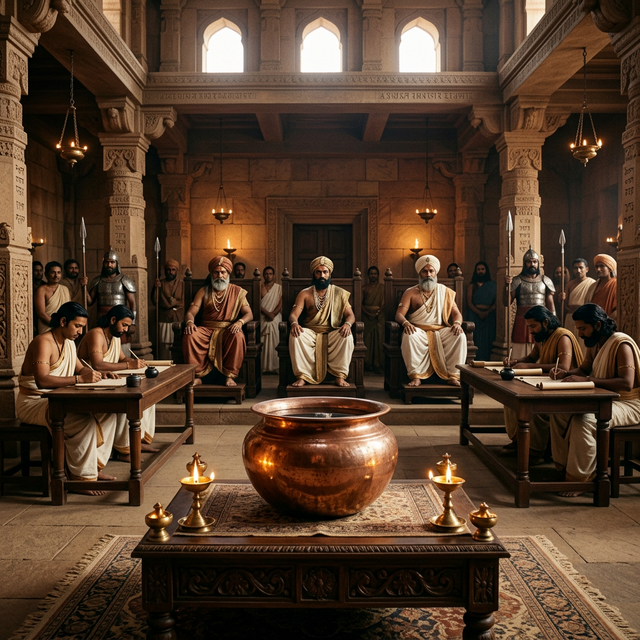
The courts of justice in the Mauryan capital are a world of heavy teak benches, the sharp, clean scent of sacred incense, and the rhythmic scratch of three reporters’ styluses. Here, the Prince and Kautilya enter the Dharmasthiya, the Hall of Law, where the messy reality of human interaction is distilled into the forensic precision of the decree. This is "The Weight of the Word," a place where the state’s internal armor is forged not in iron, but in the sanctity of the agreement. Kautilya leads the Prince past the high, carved benches where three Dharmasthas, the judges, sit in silent, unblinking judgment, their faces weathered and grave. In this court, the state does not just rule the subject; it anchors the truth. The "four legs of the law" are the measure of the state’s intellectual and moral control.
A single copper vessel of water, its surface perfectly still and reflecting the flickering light of the court’s lamps, rests on a central altar between the judges and the litigants. This object is the stake of the empire’s control over the "chaos of deceit": it is the "Vessel of the Oath." Kautilya explains that the state is the ultimate master of the "determination of the law." He points to the systematic hierarchy of truth: "Sacred Law (Dharma), Evidence (Vyavahára), History (Charitra), and the King’s Edict (Rájasásana)." To Kautilya, a contract is not just a promise but a "forensic anchor of the state." The stability of the Maurya realm is built upon this "legal ledger." A judge who cannot distinguish a "valid agreement" from one made under "anxiety, provocation, or intoxication" is a man who is rusting the King’s sword.
The action of the court is a forensic scrutiny of existence and intent. Kautilya walks the Prince through the mapping of the "valid agreement," explaining that the state recognizes only the "word of the authorized." They watch as the judges examine a merchant’s claim, weighing it against the "custom of the association" and the "history of the land." It is a world of total informational liability: any agreement entered into in "seclusion" or "by unauthorized persons" is void, for the law cannot inhabit the shadows. They observe the "reporters" (Lipikaras) recording every word, ensuring that the "proceedings of the court" are as enduring as the stone of the palace.
It is a technical, moral discipline: the state measures the "integrity of the witness" as precisely as it measures the "depth of the coffer," ensuring that the realm is a source of justice as much as profit.
But the court is also a center of total strategic sovereignty. Kautilya points to the "King’s Edict," explaining that while dharma and custom are the roots, the "Order of the Crown" is the ultimate branch that can override all else in the name of the state’s survival. The Prince realizes that "The Weight of the Word" is the ultimate expression of the "Concerning Law"—the place where the state’s power to "define and enforce" is literalized in the sealing of a scroll. The King’s power is the power to "ascertain the forms of agreements" and to ensure that the "determination of legal disputes" is as regulated as the weight of a gold pana. "The Weight of the Word" is the cognitive conscience of the state, captured in the "oaths of the litigants" that bind the citizen to the throne.
Sacred law is settled in the truth; evidence is in the witnesses; history is in the custom of the people; and the edict is the order of kings... Whenever there is a conflict between history and sacred law, or between evidence and sacred law, then the matter shall be decided by the sacred law. But whenever sacred law is in conflict with a rational edict... then the edict shall be held authoritative.
This is the rule of the total legality, the documentation for a world where "anarchy" is the enemy of the state. It says that the "Court of Justice" must be a scientist of logic, and that the "registration of a debt" is as strategic as the arming of a chariot. It recognizes that "sacred incense" and "copper water-vessels" are the nodes of a network of integrity that connects the King to "The Weight of the Word." The court hall, with its "unblinking judges" and its "scrupulous reporters," is the physical evidence of this discipline. The men who need such a rule are those who have understood that the state's strength is first defined, then defended.
The logic of the law is the logic of the "Concerning Law." It completes the transition from the physical superintendents of Book II to the intellectual infrastructure of the empire. It assumes that if you can master the "forms of agreements" and the "forensic precision of the judicial record," you can master the fate of any civilization in the world. The state is no longer a master of the resource; it is a master of the contract.
The canto concludes on the image of a witness slowly lowering their hand to rest on the cool, copper rim of the water-vessel, their palm steady as they prepare to speak. The judges watch with eyes that have seen a thousand lies, their styluses poised over their scrolls like drawn daggers. The silence of the hall is a resonant, heavy vibration that echoes the collective weight of the kingdom’s conscience. Kautilya looks at the "net balance" of the day’s decrees and sees the resilient reach of the Mauryas written in the sanctity of the word.
Outside, the bustle of the capital continues, a world of commerce and movement. But inside "The Weight of the Word," the world is scrutinized, weighed, and secure. The Prince walks back from the court, his mind full of pillars and edicts. He has seen the judges’ benches, and he has heard the scratch of the reporters. He now knows that the empire is held together not just by gold or iron, but by the "uniform texture" of the law and the unblinking eye of the man who knows exactly what it means to keep his word in the King's court.