Chapter 36 of 126
The master of the capital—the sentinel who ensures that the city's peace is maintained through a complex web of permits and night-watches.
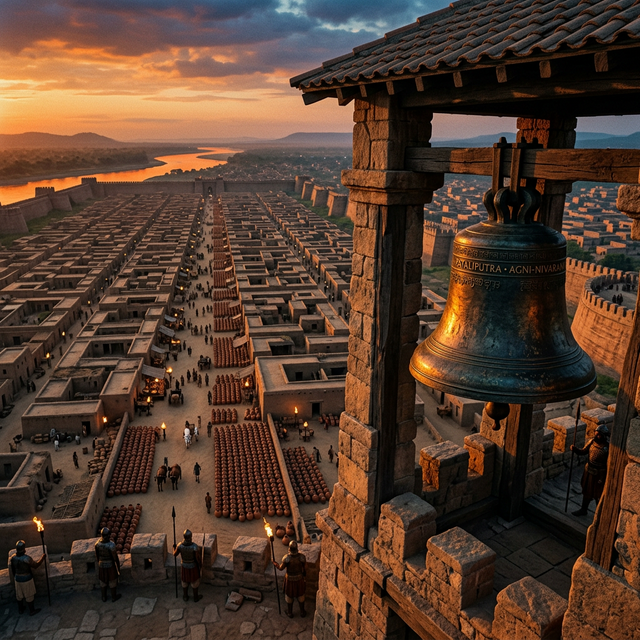
The gates of Pataliputra at sunset are a world of resonant, metallic finality and the long, stretching shadows of the municipal walls. Here, the Nágaraka, the City Superintendent, presides over an environment where the urban pulse is strictly audited. This is "The Sentinel of the Capital," a place where the King’s order is literalized in the ringing of a bell. Kautilya leads the Prince up the stone steps of the outer ramparts as the city floor below begins to flicker with the first street lanterns, the air thick with the scent of evening cooking fires and the cool, damp breath of the river Gange. In this capital, the state does not just house the subject; it regulates the night. The "standard of the six-nadika curfew" is the measure of the state’s forensic and municipal control.
A massive bronze municipal bell, its surface cold and its tone deep enough to vibrate in the lungs of every citizen, hangs in a central watchtower. This object is the stake of the empire’s control over the "chaos of the dark": it is the "Vessel of Order." Kautilya explains that the state is the ultimate master of the "city’s heartbeat." He points to the systematic safety requirements: "five water-pots (pancha ghatínám), a ladder, an axe, and a hook" outside every dwelling. To Kautilya, a house is not just a shelter but a "fire-containment unit." The stability of the Maurya capital is built upon this "municipal ledger." A superintendent who cannot account for the "newcomers in the inns" or the "readiness of the fire-watch" is a man who is inviting the collapse of the King’s peace.
The action of the city is a forensic monitoring of movement and safety. Kautilya walks the Prince along the ramparts, overlooking the quarters where "Gopas" track every household’s metabolic data. They observe the "turyapreksha," the strict night curfew where anyone moving without a lamp or authority is arrested. It is a world of total urban liability: every vintner and physician must report "spendthrifts and the secret treatment of ulcers." They see the "fire-prevention" in action: the rows of water-filled vessels in thousands along the streets. It is a technical, protective discipline: the state measures the "rhythm of the curfew" as precisely as it measures the "depth of the coffer," ensuring that the capital is a source of prestige as much as security.
But the city is also a center of royal grace and administrative closure. Kautilya points to the "release of prisoners," explaining that during the birth of a prince or the installation of an heir, the state expresses its mercy through the "emptying of the jails." The Prince realizes that "The Sentinel of the Capital" is the ultimate expression of the "Duties of Government Superintendents"—the place where the state’s power to "order and forgive" is literalized in the sound of a trumpet. The King’s power is the power to "sanctify the new country" and to ensure that the "readiness for the future" is as regulated as the price of wood. "The Sentinel of the Capital" is the enduring conscience of the state, captured in the "silence of the sleeping city" that binds the subject to the crown.
Kindling of fire shall be prohibited... Five water-pots, a kumbha, a dróna, a ladder, an axe... shall be kept in thousands in a row... Whenever a new country is conquered, when an heir apparent is installed... prisoners are usually set free. Thus ends the Second Book "The Duties of Government Superintendents."
This is the rule of the urban regulation, the documentation for a world where "disorder" is the enemy of the state. It says that the "City Superintendent" must be a scientist of the night, and that the "registration of every soul" is as strategic as a mountain pass. It recognizes that "municipal bells" and "fire-pots" are the nodes of a network of peace that connects the King to "The Sentinel of the Capital." The state capital, with its "unblinking sentinels" and its "City Superintendent," is the physical evidence of this discipline. The men who need such a rule are those who have understood that the state's strength is first ordered, then celebrated.
The logic of the city is the logic of the "Duties of Government Superintendents." It completes the transition from the architecture of the district ledger to the architecture of the imperial triumph. It assumes that if you can master the "nadika of the curfew" and the "forensic precision of the municipal fire-watch," you can master the destiny of any civilization in the world. The state is no longer a master of the life; it is a master of the civilization.
The canto concludes on the image of the City Superintendent standing high on the palace ramparts, overlooking the sleeping capital bathed in the silver light of a full moon. Below, the city is a perfectly functioning machine, its thousands of water-pots glinting and its streets silent and secure. In the distance, the first trumpet of the dawn sounds, and the heavy prison gates are unbarred to release those granted the King's mercy. A resonant, rhythmic vibration of the municipal bell marks the start of a new day. Kautilya looks at the "net balance" of the book’s duties and sees the resilient reach of the Mauryas written in the peace of the capital.
Outside, the dawn of a new era breaks over India. But inside "The Sentinel of the Capital," the world is categorized, ordered, and secure. The Prince walks back from the ramparts, his mind full of bells and water-pots. He has seen the sentinel's watch, and he has heard the release of the prisoners. He now knows that the empire is held together not just by gold or iron, but by the "uniform texture" of the order and the unblinking eye of the man who knows exactly what it means to be a city in the King's service. With this, the "Duties of Government Superintendents" are complete.