Chapter 83 of 126
The terms of the soil—the strategic acquisition of land, where the quality of the earth defines the long-term strength of the throne.
A vast, fertile plain at high noon, where the shimmering heat dances over endless fields of green grain and the only sound is the rhythmic, heavy thud of an iron-tipped mallet driving a boundary stake into the dark earth as a line of surveyors stretches a long, knotted rope across the horizon, is a world of forensic expansion and the sight of a new province being literalized in the soil. Here, the Prince and Kautilya observe the forensic logic of "The Terms of the Soil," where the state’s body is literalized in the acquisition of the land. This is a place where the social pulse is measured in the fertility of the landscape.
Kautilya leads the Prince past the irrigation-ditches to where the chief surveyor determines the "integrity of the soil" and the state-spy ensures the "purity of the territorial contract." In this forensic sphere, the state does not just conquer; it anchors the absolute liability of the land. The "suppression of the land thorn" is the measure of the state’s geographic and moral control.
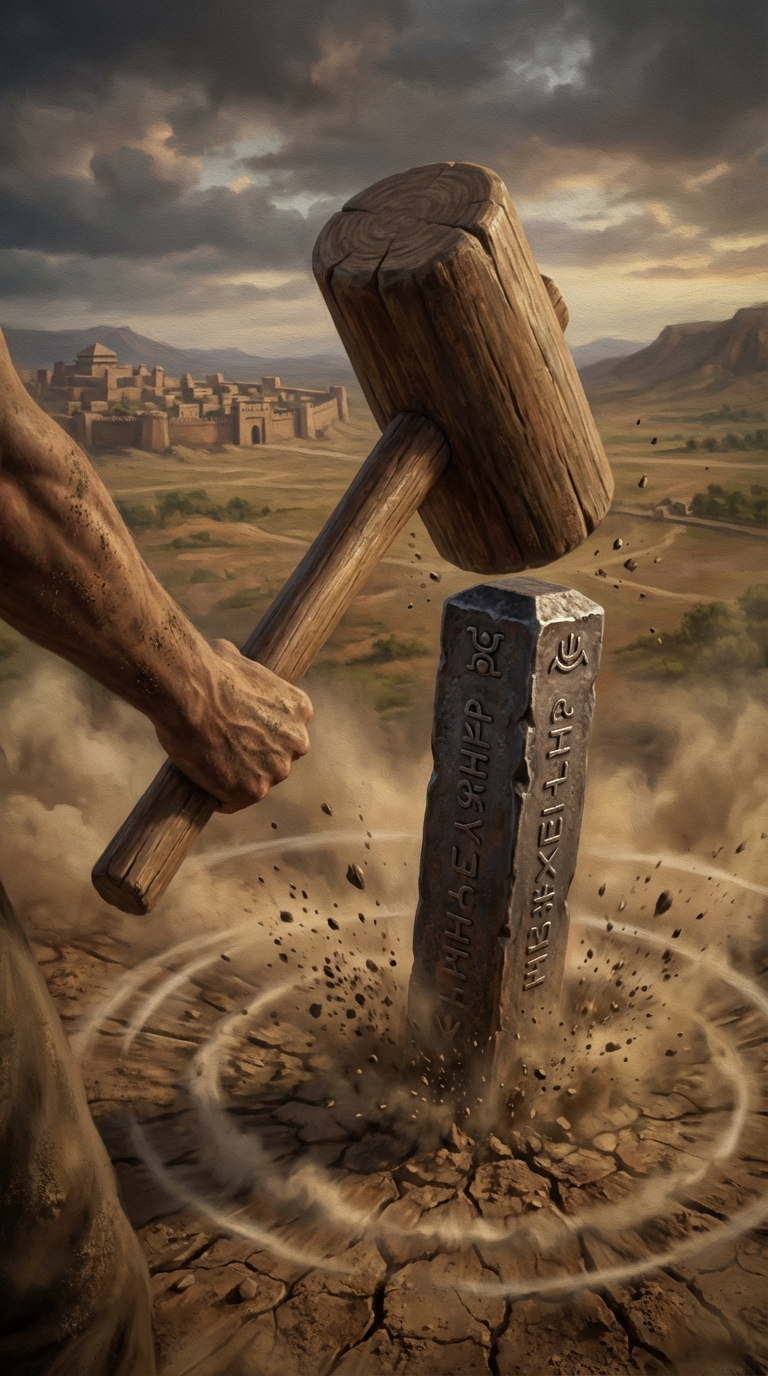
A heavy iron boundary stake, its head flattened from the mallet's strikes and its tip buried deep in the earth, stands as a solitary marker in the center of the field. This object is the stake of the empire’s control over the "chaos of the unmapped": it is the "Vessel of the Bhúmi-samudayam." Kautilya explains that the state is the ultimate master of "Territorial Acquisition" (Bhúmi-samudayam). He points to the rope: "Land is the body of the six-fold policy... we do not merely seize ground; we evaluate the strategic qualities of the fortresses—whether they be river-bound or mountain-guarded—and we ensure that the terms of the acquisition are as unchangeable as the earth itself." To Kautilya, an uncalculated territory is not just a burden but a "forensic drain" that invites the state's own decay.
The stability of the Maurya machine is built upon this "geographic accounting." A King who "claims land without the means to defend its forts" or an ally who "cedes barren soil in a treaty of peace" is a man who is rusting his own internal strength.
The action of the plain is a forensic monitoring of terrain and defense. Kautilya walks the Prince through the mapping of the "legal annexation," explaining the precise rules for "agreements for the acquisition of land" and the "distinction between forts surrounded by rivers vs. those on mountains." They watch as a surveyor evaluates the "integrity of the water-supply," noting the "accessibility of the elephant-bridge" alongside the "facilities for throwing down stone and trees." It is a world of total informational liability: the law details the "penalties for misrepresenting a land's fertility" and the precise "rights of the state to seize land from those who fight on plains vs. those on low grounds." They observe the "rules of the ditch," ensuring that the "integrity of the sovereign border" is as respected as the King’s own standard.
It is a technical, territorial discipline: the state measures the "stretch of the rope" as precisely as it measures the "depth of the treasury," ensuring that the subject remains a source of security as much as service.
But the terms of the soil are also a center of total strategic dominance. Kautilya points to the "Land Ledger," explaining that the state must ensure that the "engines of the expansion" are never paralyzed by the "friction of the indefensible." The Prince realizes that "The Terms of the Soil" is the ultimate expression of the "End of the Six-fold Policy"—the place where the state’s power to "map and master" is literalized in the driving of the stake. The King’s power is the power to "ascertain the honesty of the soil" and to ensure that the "determination of the geographic truth" is as regulated as the weight of a gold coin. "The Terms of the Soil" is the enduring conscience of the state, captured in the "boundary ropes" that bind the kingdom to the fertile peace.
Bhúmi-samudayam (Acquisition of Land)... Of two kings, one owning a fort surrounded by a river, and another having mountainous fortifications, seizing the former's land is better... a fort in the centre of a river can be assailed by a bridge formed of elephants... whereas a fort on a mountain is of a self-defensive nature... Seizing land from those who fight on low grounds is easier... Whoever wrests land from such enemies will outshine his allies.
This is the rule of the territorial regulation, the documentation for a world where "geographic precision" is the security of the kingdom. It says that the "Ledger of the Mandala" must be a scientist of soil, and that the "protection of the state's boundaries" is as strategic as the defense of a state-owned fort. It recognizes that "surveyor's ropes" and "iron stakes" are the nodes of a network of power that connects the King to "The Terms of the Soil." The plain, with its "vows of unyielding expansion" and its "scrupulous terrain-keeping," is the physical evidence of this discipline. The men who need such a rule are those who have understood that the state's strength is first measured, then secured.
The logic of the soil is the logic of the "End of the Six-fold Policy." It completes the transition from the contract of the economic foundations to the contract of the territorial mastery. It assumes that if you can master the "form of the landscape" and the "forensic precision of the land record," you can master the stability of any civilization in the world. The state is no longer a master of the Gold; it is a master of the Earth.
The canto concludes on the image of a heavy iron boundary stake being driven with a final, resonant strike into the earth, while the sound of the mallet echoes across the now-claimed plain. The sight of the stake standing firm against the horizon is a visual, final anchor that echoes the collective stabilization of the kingdom's territorial foundations. Kautilya looks at the "net balance" of the book’s initial land syntheses and sees the resilient reach of the Mauryas written in the depth of the soil.
Outside, the sun begins to set over the newly claimed province, where the first furrows are being turned by the King's plows. But inside "The Terms of the Soil," the world is categorized, mapped, and secure. The Prince walks back from the fields, his mind full of ropes and stakes. He has seen the stake driven, and he has heard the mallet strike. He now knows that the empire is held together not just by laws or walls, but by the "uniform texture" of the earth and the unblinking eye of the man who knows exactly what it means to be fertile in the King's account.