Chapter 82 of 126
The bond of gold—the strategic accumulation of wealth through diplomacy, proving that the King's peace is often bought before it is fought.
A deep, secure state treasury chamber in the foundations of the palace at Pataliputra at sunset, where the low, golden light of oil lamps reflects off the surface of massive, stacked bullion bars and the only sound is the rhythmic, heavy clanking of giant bronze scales being adjusted by a line of silent treasury officials, is a world of forensic wealth and the sight of a single, flawless gold brick being methodically weighed. Here, the Prince and Kautilya observe the forensic logic of "The Bond of Gold," where the state’s dominance is literalized in the accumulation of the metal. This is a place where the social pulse is measured in the liquidity of the state.
Kautilya leads the Prince past the iron-bound chests to where the chief treasurer determines the "integrity of the acquisition" and the state-spy ensures the "purity of the ally's gold-terms." In this forensic sphere, the state does not just hoard; it anchors the absolute liability of the wealth. The "suppression of the gold thorn" is the measure of the state’s economic and moral control.
A massive bronze scale, its pans large enough to hold a grown man and its central pivot polished to a mirror-shine, stands in the center of the hall. This object is the stake of the empire’s control over the "chaos of the unfinanced": it is the "Vessel of the Hiranya-samudayam." Kautilya explains that the state is the ultimate master of "Wealth Acquisition" (Hiranya-samudayam). He points to the bars: "Gold is the blood of the six-fold policy... we do not merely acquire treasure; we evaluate the qualities of the friend who provides it—whether they are long-standing, submissive, or immutable—and we ensure that the terms of the acquisition are as unchangeable as the metal itself." To Kautilya, an uncalculated wealth is not just a surplus but a "forensic imbalance" that invites the state's own decay.
The stability of the Maurya machine is built upon this "bullion accounting." A King who "accepts gold without a clear contract" or an ally who "withholds his treasury in the hour of need" is a man who is rusting his own internal strength.
The action of the treasury is a forensic monitoring of value and motive. Kautilya walks the Prince through the mapping of the "legal enrichment," explaining the precise rules for "agreements for the acquisition of gold" and the "distinction between friends who are enjoyable by one, by two, or by all." They watch as a treasurer evaluates the "integrity of the newly arrived shipment," noting the "magnanimity of the ally's help" alongside the "readiness of the compliance." It is a world of total informational liability: the law details the "penalties for failing to meet the gold-terms" and the precise "rights of the state to demand a higher share if the risk was greater." They observe the "rules of the bullion," ensuring that the "integrity of the sovereign wealth" is as respected as the King’s own standard.
It is a technical, lucrative discipline: the state measures the "clinking of the metal" as precisely as it measures the "depth of the border," ensuring that the subject remains a source of security as much as service.
But the bond of gold is also a center of total strategic sovereignty. Kautilya points to the "Wealth Ledger," explaining that the state must ensure that the "engines of the treasury" are never paralyzed by the "friction of the dishonest." The Prince realizes that "The Bond of Gold" is the ultimate expression of the "End of the Six-fold Policy"—the place where the state’s power to "acquire and allocate" is literalized in the movement of the heavy pans. The King’s power is the power to "ascertain the honesty of the gold" and to ensure that the "determination of the financial truth" is as regulated as the weight of a gold coin. "The Bond of Gold" is the enduring conscience of the state, captured in the "gold bricks" that bind the kingdom to the liquid peace.
Hiranya-samudayam (Acquisition of Gold)... When the friends are equally rich in gold, they may yet differ in qualities such as readiness to comply with requests, magnanimous and munificent help, and accessibility at any time... Long standing, submissive, easy to be roused... powerful, and never of a contradictory nature, is a good friend... That friend who maintains friendship with disinterested motives... is the highest... The End of all such acquisition is the stability of the element of wealth.
This is the rule of the economic regulation, the documentation for a world where "financial precision" is the security of the kingdom. It says that the "Ledger of the Mandala" must be a scientist of bullion, and that the "protection of the state's liquidity" is as strategic as the defense of a state-owned fort. It recognizes that "massive scales" and "iron-bound chests" are the nodes of a network of power that connects the King to "The Bond of Gold." The treasury, with its "vows of unyielding enrichment" and its "scrupulous bullion-keeping," is the physical evidence of this discipline. The men who need such a rule are those who have understood that the state's strength is first weighed, then secured.
The logic of the gold is the logic of the "End of the Six-fold Policy." It completes the transition from the contract of the logistical power to the contract of the economic foundations. It assumes that if you can master the "form of the bullion" and the "forensic precision of the financial record," you can master the stability of any civilization in the world. The state is no longer a master of the Steel; it is a master of the Gold.
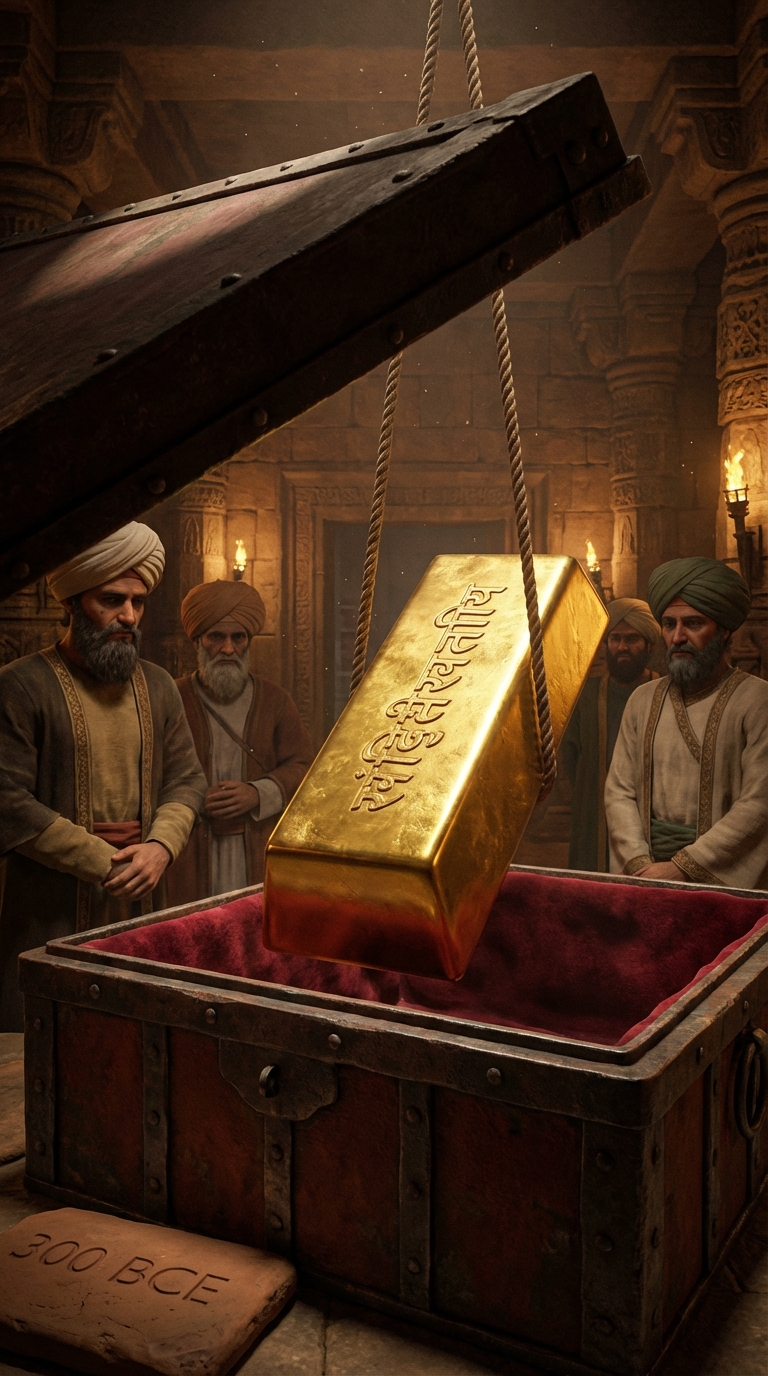
The canto concludes on the image of a single, massive gold bar being slowly placed into a heavy, velvet-lined iron chest, while the shadow of the lid falls across the faces of the treasury officials. The sound of the lock clicking shut is a resonant, final sound that echoes the collective stabilization of the kingdom's financial foundations. Kautilya looks at the "net balance" of the book’s initial wealth syntheses and sees the resilient reach of the Mauryas written in the light of the gold.
Outside, the stars begin to appear over the capital, where the wheels of commerce turn in the shadow of the state. But inside "The Bond of Gold," the world is categorized, weighed, and secure. The Prince walks back from the treasury, his mind full of scales and bars. He has seen the gold weighed, and he has heard the chest lock. He now knows that the empire is held together not just by laws or walls, but by the "uniform texture" of the wealth and the unblinking eye of the man who knows exactly what it means to be rich in the King's account.