Chapter 77 of 126
The targeted state—the strategic identification of the vulnerable neighbor, proving that an empire grows by the consumption of the weak.
A dusty, wind-swept frontier outpost on the border of a neighboring, crumbling kingdom at high noon, where the dry heat creates a shimmering distortion over the cracked earth and the only sound is the rhythmic, mournful creak of a heavy iron gate swaying in the wind, is a world of forensic vulnerability and the sight of a lone vulture circling lazily above a dried-out, weed-choked moat. Here, the Prince and Kautilya observe the forensic logic of "The Targeted State," where the empire’s expansion is literalized in the scouting of the decay. This is a place where the social pulse is measured in the instability of the wall.
Kautilya leads the Prince past the abandoned watchtower to where the chief scout determines the "integrity of the target" and the state-spy ensures the "purity of the enemy's unpopularity." In this forensic sphere, the state does not just attack; it anchors the absolute liability of the weakness. The "suppression of the target thorn" is the measure of the state’s offensive and moral control.
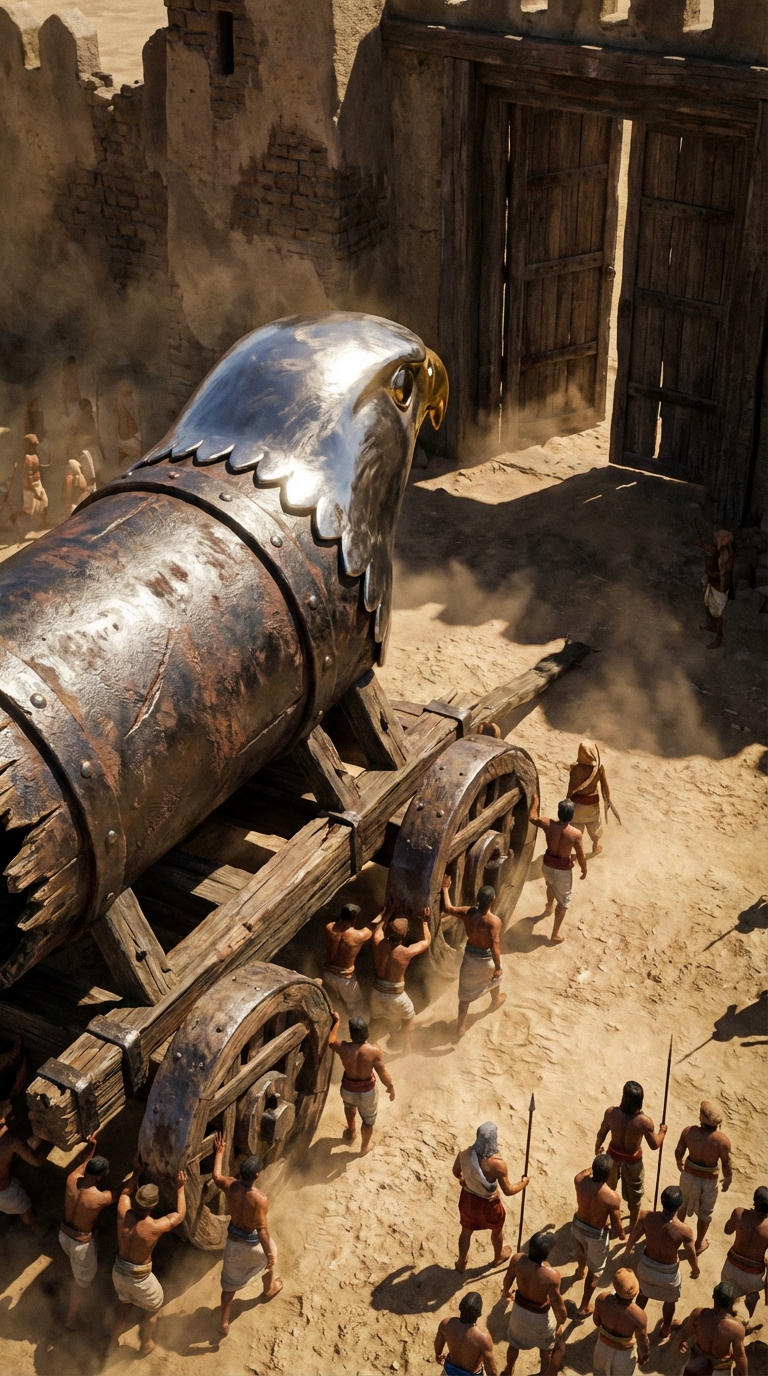
A heavy iron battering ram, its head carved into the shape of a predatory hawk and its massive wooden frame reinforced with bronze bands, sits ready at the edge of the outpost. This object is the stake of the empire’s control over the "chaos of the vulnerable": it is the "Vessel of the Vigrahyánuyogah." Kautilya explains that the state is the ultimate master of "The Characteristics of the State to be Attacked" (Vigrahyánuyogah). He points to the bird of prey: "The state must be a scout of structural rot...
we do not attack an enemy of equal strength or popular support, but we strike the state that is in decay, whose treasury is empty, whose people are oppressed, and whose walls are crumbling from within." To Kautilya, a state in "Kshaya" (decay) is not just a neighbor but a "forensic opportunity" that must be consolidated. The stability of the Maurya machine is built upon this "vulnerability accounting." An enemy who "taxes beyond the people's patience" or a King who "neglects his forts for the sake of luxury" is a man who is rusting his own internal strength.
The action of the outpost is a forensic monitoring of collapse and timing. Kautilya walks the Prince through the mapping of the "legal target," explaining the precise rules for "identifying an unpopular ruler" and the "rules for the evaluation of an enemy's internal friction." They watch as a scout evaluates the "integrity of the moat's collapse," noting the "unpopularity of the local garrison" alongside the "depletion of the town's granaries." It is a world of total informational liability: the law details the "penalties for attacking a strong and popular state" and the precise "rights of the state to use 'silent' means to accelerate the decay of a chosen target." They observe the "rules of the ram," ensuring that the "integrity of the sovereign expansion" is as respected as the King’s own standard.
It is a technical, aggressive discipline: the state measures the "rhythm of the vulture" as precisely as it measures the "depth of the border," ensuring that the subject remains a source of security as much as service.
But the targeted state is also a center of total strategic expansion. Kautilya points to the "Target Ledger," explaining that the state must ensure that the "engines of expansion" are never paralyzed by the "friction of the overextended." The Prince realizes that "The Targeted State" is the ultimate expression of the "End of the Six-fold Policy"—the place where the state’s power to "see and seize" is literalized in the movement of a ram. The King’s power is the power to "ascertain the honesty of the vulnerability" and to ensure that the "determination of the target truth" is as regulated as the weight of a gold coin. "The Targeted State" is the enduring conscience of the state, captured in the "battering ram" that binds the kingdom to the expanding peace.
Vigrahyánuyogah (Attacking an Enemy)... An enemy whose subjects are impoverished and greedy is easy to attack... An enemy in the condition of decay (Kshaya) shall be attacked; if in stagnation (Sthana), he shall be harassed; if in progress (Vriddhi), peace shall be made with him... A King whose people are oppressed or who lacks the elements of sovereignty (Swámyadi-prakriti) is a target for the righteous conqueror... The end of all such evaluation is the growth of one's own power.
This is the rule of the aggressive regulation, the documentation for a world where "vulnerability assessment" is the survival of the state. It says that the "Ledger of the Gap" must be a scientist of decay, and that the "protection of the national reach" is as strategic as the defense of a state-owned fort. It recognizes that "iron rams" and "circling vultures" are the nodes of a network of power that connects the King to "The Targeted State." The outpost, with its "vows of scrupulous scouting" and its "scrupulous target-keeping," is the physical evidence of this discipline. The men who need such a rule are those who have understood that the state's strength is first targeted, then secured.
The logic of the target is the logic of the "End of the Six-fold Policy." It completes the transition from the contract of the sovereign judgment to the contract of the imperial reach. It assumes that if you can master the "form of the vulnerability" and the "forensic precision of the target record," you can master the stability of any civilization in the world. The state is no longer a master of the Will; it is a master of the Void.
The canto concludes on the image of a heavy iron battering ram, its hawk-head gleaming in the harsh noon sun, being slowly and methodically wheeled forward across the dusty ground toward the long shadow cast by a crumbling, wooden fortress gate. The sound of the wheels on the dry earth is a resonant, final sound that echoes the collective stabilization of the kingdom's expanded foundations. Kautilya looks at the "net balance" of the book’s initial offensive syntheses and sees the resilient reach of the Mauryas written in the movement of the ram.
Outside, the desert wind continues to howl. But inside "The Targeted State," the world is categorized, targeted, and secure. The Prince walks back from the outpost, his mind full of gates and rams. He has seen the ram wheeled, and he has heard the gate creak. He now knows that the empire is held together not just by laws or walls, but by the "uniform texture" of the void and the unblinking eye of the man who knows exactly what it means to be targeted in the King's account.