Chapter 76 of 126
The choice of war—the forensic analysis of the moment when diplomacy fails and the lethal mechanics of the army must be deployed.
A roaring, soot-stained forge deep within the state armory at Pataliputra, where the heat from the blast furnaces creates a shimmering haze in the air and the sound of heavy iron hammers beating red-hot bronze into the sharp points of spearheads echoes against the stone walls, is a world of forensic conflict and the sight of a thousand finished weapons being methodically stacked in the armory’s cool shadows. Here, the Prince and Kautilya observe the forensic logic of "The Choice of War," where the state’s survival is literalized in the tempering of the metal. This is a place where the social pulse is measured in the heat of the forge.
Kautilya leads the Prince past the sharpening wheels to where the chief strategist determines the "integrity of the decision" and the state-marshal ensures the "purity of the conflict's necessity." In this forensic sphere, the state does not just fight; it anchors the absolute liability of the war. The "suppression of the peace-war thorn" is the measure of the state’s industrial and moral control.
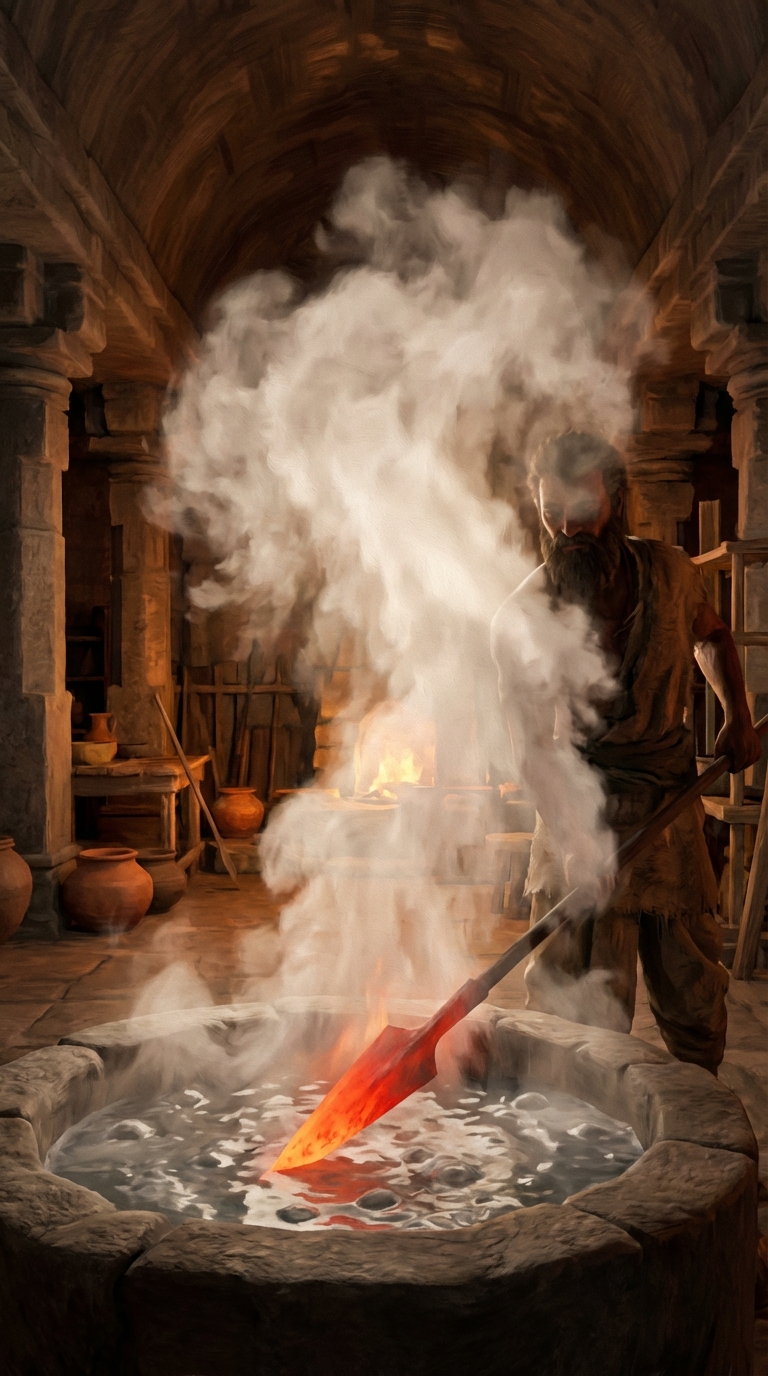
A single, red-hot spearhead, its surface glowing with a terrifying intensity, is held steady in a pair of heavy iron tongs before being plunged into a massive vat of cold, dark water. This object is the stake of the empire’s control over the "chaos of the ill-chosen": it is the "Vessel of the Sandhivigraha." Kautilya explains that the state is the ultimate master of "The Selection of Policy" (Sandhivigrahayoh-sakti). He points to the rising steam: "The state must be a scientist of conflict...
we choose between peace and war not by whim, but by the cold calculation of power, place, and time—if peace brings the same gain as war, we choose peace, for war is a waste of the King's wealth and men." To Kautilya, a war fought without a "net gain inProgress" is not just a tragedy but a "forensic failure" that invitations invasion. The stability of the Maurya machine is built upon this "calculative accounting." A King who "seeks glory through fruitless war" or an advisor who "clings to peace while the enemy grows" is a man who is rusting the King’s internal strength.
The action of the forge is a forensic monitoring of resolve and utility. Kautilya walks the Prince through the mapping of the "legal aggression," explaining the precise rules for "evaluating the three-fold power—of counsel, of mastery, and of energy" and the "rules for determining the moment when war becomes more profitable than peace." They watch as a marshal evaluates the "integrity of the sharpened edge," noting the "completion of the army's muster" alongside the "readiness of the supply lines." It is a world of total informational liability: the law details the "penalties for strategic indecision" and the precise "rights of the state to mobilize every last resource when the forensic balance shifts toward war." They observe the "rules of the choice," ensuring that the "integrity of the national progress" is as respected as the King’s own standard.
It is a technical, decisive discipline: the state measures the "rhythm of the hammer" as precisely as it measures the "depth of the border," ensuring that the subject remains a source of security as much as service.
But the choice of war is also a center of total strategic necessity. Kautilya points to the "Conflict Ledger," explaining that the state must ensure that the "engines of conflict" are never paralyzed by the "friction of the uncertain." The Prince realizes that "The Choice of War" is the ultimate expression of the "End of the Six-fold Policy"—the place where the state’s power to "assess and attack" is literalized in the quenching of a spear. The King’s power is the power to "ascertain the honesty of the necessity" and to ensure that the "determination of the strategic truth" is as regulated as the weight of a gold coin. "The Choice of War" is the enduring conscience of the state, captured in the "spearhead" that binds the kingdom to the decisive peace.
Sandhivigrahayoh-sakti (Selection of Peace or War)... Whoever thinks 'by making peace with my neighbor, I shall grow in power and wealth, while he will perish,' shall make peace... Whoever thinks 'by making war, I shall be able to weaken my enemy's power and increase my own,' shall wage war... If the gain from peace and war be equal, peace is to be preferred; for in war there are various losses... The power of state is three-fold: the power of counsel (Mantrasakti), the power of mastery of the treasury and army (Prabhavasakti), and the power of energy (Utsahasakti)... The end of all such selection is Progress (Vriddhi).
This is the rule of the decisive regulation, the documentation for a world where "conflict precision" is the security of the state. It says that the "Ledger of the Strike" must be a scientist of gain, and that the "protection of the national progress" is as strategic as the defense of a state-owned fort. It recognizes that "bronze spearheads" and "iron tongs" are the nodes of a network of power that connects the King to "The Choice of War." The armory, with its "vows of unyielding resolve" and its "scrupulous conflict-keeping," is the physical evidence of this discipline. The men who need such a rule are those who have understood that the state's strength is first judged, then secured.
The logic of the choice is the logic of the "End of the Six-fold Policy." It completes the transition from the contract of the shared existence to the contract of the sovereign judgment. It assumes that if you can master the "form of the conflict" and the "forensic precision of the strategic record," you can master the stability of any civilization in the world. The state is no longer a master of the Synergy; it is a master of the Will.
The canto concludes on the image of a single, red-hot spearhead being quenched in a vat of cold water, sending up a massive, blinding cloud of white steam that momentarily obscures the entire forge. The sound of the hiss is a resonant, final sound that echoes the collective stabilization of the kingdom's military foundations. Kautilya looks at the "net balance" of the book’s decisive syntheses and sees the resilient reach of the Mauryas written in the steam of the spear.
Outside, the army stands ready for the tomorrow's command. But inside "The Choice of War," the world is categorized, judged, and secure. The Prince walks back from the forge, his mind full of heat and steam. He has seen the spear quenched, and he has heard the steam rise. He now knows that the empire is held together not just by laws or walls, but by the "uniform texture" of the will and the unblinking eye of the man who knows exactly what it means to be decisive in the King's account.