Chapter 60 of 126
The silent witness—a deep dive into the use of informants and spies to ensure the King knows the secrets of the people.
A cool, dimly lit chamber deep within the thick granite foundations of the city’s municipal hall, where the air is heavy with the medicinal scent of mustard oil and the faint, coppery tang of recent mortality, is a world of forensic anatomy and the sight of a stone examination table being scrubbed with a mixture of salt and vinegar. Here, the Prince and Kautilya observe the forensic logic of "The Silent Witness," where the state’s pursuit of justice is literalized in the interrogation of the dead. This is a place where the social pulse is measured in the stillness of the lungs.
Kautilya leads the Prince past the shelves of apothecary jars to where the examiner smears a cold, silent form with oil and the collector-general ensures the "purity of the verdict." In this forensic sphere, the state does not just bury; it anchors the absolute accountability of the end. The "suppression of the mortal thorn" is the measure of the state’s investigative and moral control.
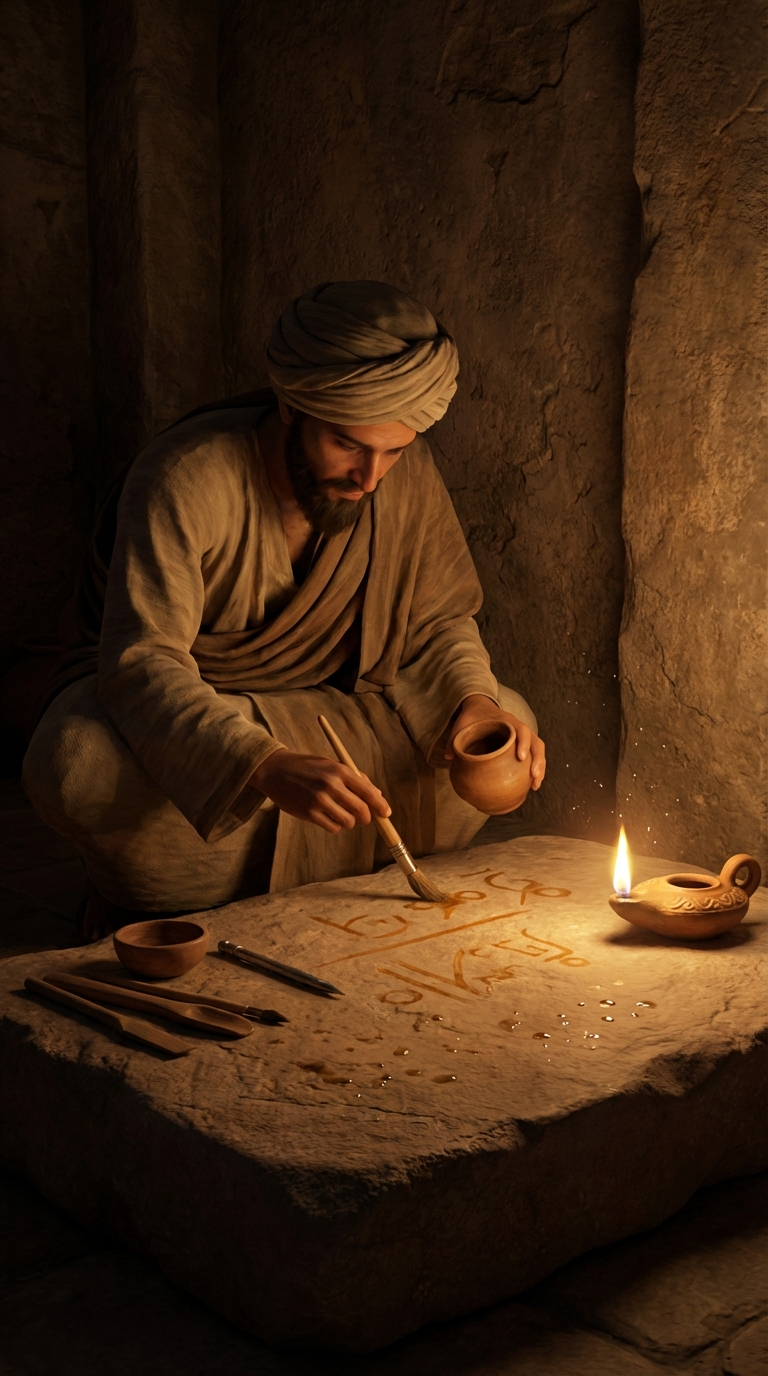
A stone examination table, its surface polished to a dark, non-porous sheen by generations of forensic work and its edges grooved for the drainage of ceremonial and medicinal fluids, stands in the center of the chamber. This object is the stake of the empire’s control over the "chaos of the hidden murder": it is the "Vessel of the Verdict." Kautilya explains that the state is the ultimate master of "Examination of Sudden Death" (Áśumritaka-paríkshá). He points to the systematic regulation of the autopsy: "The examiner shall smear the corpse with oil to reveal the marks... mucus from the mouth indicates strangulation, while a dark, swollen tongue suggests the work of poison." To Kautilya, a silent body is not just a tragedy but a "forensic record" of a violation.
The stability of the Maurya law is built upon this "biological accounting." A death that is "staged as a suicide" or a murder "hidden by an insect bite" is a death that is rusting the King’s internal strength.
The action of the chamber is a forensic monitoring of skin and bone. Kautilya walks the Prince through the mapping of the "legal cause," explaining the precise signs for "drowning indicated by a swollen stomach" and the "rules for identifying death by beating through broken limbs." They watch as a medical expert evaluates the "integrity of the skin," looking for the "blue marks of the toxicant." It is a world of total informational liability: the law details the "prohibitions against immediate cremation" and the precise "rights of the state to drag a fake suicide through the streets." They observe the "rules of the examination," ensuring that the "integrity of the forensic truth" is as respected as the King’s own standard.
It is a technical, anatomical discipline: the state measures the "rhythm of the wound" as precisely as it measures the "depth of the coffer," ensuring that the subject remains a source of clarity even in the grave.
But the silent witness is also a center of total strategic exposure. Kautilya points to the "Examiner's Ledger," explaining that the state must ensure that the "engines of life" are never paralyzed by the "friction of the secret killer." The Prince realizes that "The Silent Witness" is the ultimate expression of the "Removal of Thorns"—the place where the state’s power to "see and speak for the dead" is literalized in the washing of a table. The King’s power is the power to "ascertain the honesty of the end" and to ensure that the "determination of the malice" is as regulated as the weight of a gold coin. "The Silent Witness" is the enduring conscience of the state, captured in the "stone table" that binds the citizen to the forensic peace.
Áśumritaka-paríkshá (Examination of Sudden Death)... Any case of sudden death shall be investigated by smearing the body with oil... Markers for strangulation, hanging, drowning, and beating shall be recorded... Poisoning shall be identified by localized discoloration and internal swelling... Indirect clues from clothes, wounds, and local witnesses shall be integrated... Those who fail to report a death or attempt to conceal a murder shall be heavily penalized... The state shall ensure that no 'thorn' remains hidden in the silence of mortality.
This is the rule of the autopsy regulation, the documentation for a world where "unexplained end" is the enemy of the state. It says that the "Ledger of the Fallen" must be a scientist of the body, and that the "protection of the deceased's story" is as strategic as the defense of a state-owned granary. It recognizes that "stone tables" and "birch-bark scrolls" are the nodes of a network of truth that connects the King to "The Silent Witness." The forensic chamber, with its "vows of objectivity" and its "scrupulous marker-keeping," is the physical evidence of this discipline. The men who need such a rule are those who have understood that the state's strength is first examined, then secured.
The logic of the witness is the logic of the "Removal of Thorns." It completes the transition from the contract of the monitoring to the contract of the legacy. It assumes that if you can master the "form of the marker" and the "forensic precision of the post-mortem record," you can master the stability of any civilization in the world. The state is no longer a master of the Presence; it is a master of the Memory.
The canto concludes on the image of the stone examination table being washed clean by a focused attendant, the water spiraling into the drainage channel, while the forensic examiner records the final cause of death on a fresh birch-bark scroll with a sharp copper stylus. The sound of the water is a resonant, purifying sound that echoes the collective stabilization of the kingdom's truth. Kautilya looks at the "net balance" of the day’s investigations and sees the resilient reach of the Mauryas written in the silence of the ledger.
Outside, the city moves with the noise of the living. But inside "The Silent Witness," the world is categorized, examined, and secure. The Prince walks back from the chamber, his mind full of oil and marks. He has seen the table washed, and he has heard the stylus scratch. He now knows that the empire is held together not just by laws or walls, but by the "uniform texture" of the forensic and the unblinking eye of the man who knows exactly what it means to be silent in the King's account.