Chapter 59 of 126
The seizure of the wicked—the strategic use of the secret service to neutralize the threats that live within the heart of the empire.
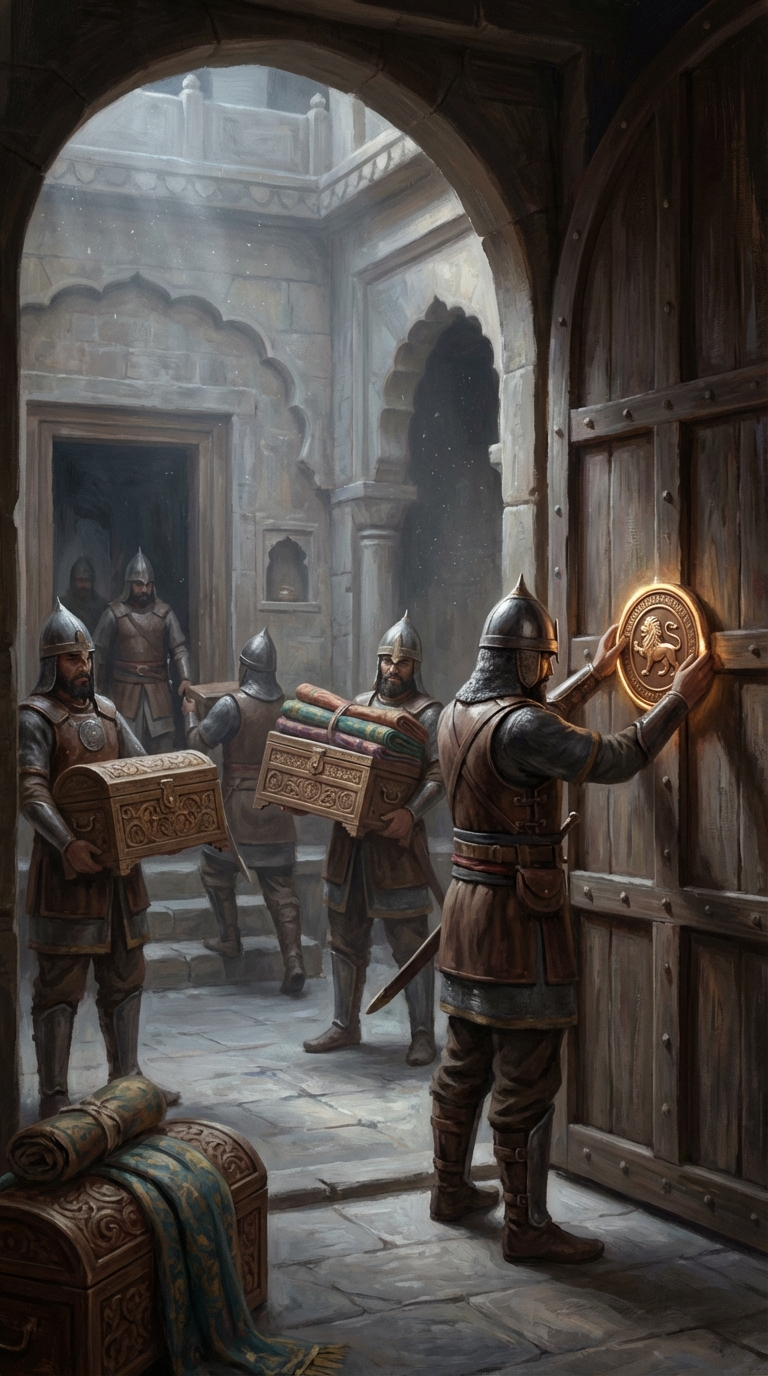
The shadow of the great western gate of Pataliputra at the cusp of the final night-watch, where the air is sharp with the scent of wet stone and the rhythmic, metallic scrape of iron-shod boots on cobblestones, is a world of forensic interception and the sight of a massive brass-bound book being opened by a night-watch officer under the flickering light of a pitch torch. Here, the Prince and Kautilya observe the forensic logic of "The Seizure of the Wicked," where the state’s internal security is literalized in the monitoring of the movement. This is a place where the social pulse is measured in the heartbeat of the suspect.
Kautilya leads the Prince past the barred checkpoints to where the Nagarakas identify the "signs of fear" and the Sthanikas ensure the "purity of the night." In this forensic sphere, the state does not just arrest; it anchors the absolute vigilance of the urban space. The "suppression of the interceptive thorn" is the measure of the state’s preventive and moral control.
A massive brass-bound book, its leather covers reinforced with heavy studs and its pages thick with the names of the detained and the description of their suspicious movements, rests on a stone podium at the gate-station. This object is the stake of the empire’s control over the "chaos of the internal thief": it is the "Vessel of the Seizure." Kautilya explains that the state is the ultimate master of "Seizure of Criminals" (Vaidehakasodhana-yukti). He points to the systematic regulation of the suspicion: "Those who loiter in the dark, purchase rare articles at suspicious times, or show undue agitation with pale faces and indistinct voices... shall be suspected as murderers or robbers." To Kautilya, a man who "pants in fear while sitting alone" is not just an anxious subject but a "forensic signature" of a crime.
The stability of the Maurya city is built upon this "operational accounting." A man who "loiters behind walls" or "commands a company of armed men without cause" is a man who is rusting the King’s internal strength.
The action of the gatehouse is a forensic monitoring of line and pulse. Kautilya walks the Prince through the mapping of the "legal intercept," explaining the precise criteria for "suspicious change of ancestral customs" and the "rules for the seizure of those with stolen articles." They watch as a night-watchman evaluates the "integrity of the alibi," requiring a traveler to "account for the source of his jewelry." It is a world of total informational liability: the law details the "fines for failing to find a thief" and the precise "rights of the state to detain until the morning." They observe the "rules of the seizure," ensuring that the "integrity of the urban wall" is as respected as the King’s own standard.
It is a technical, physical discipline: the state measures the "rhythm of the gate" as precisely as it measures the "depth of the coffer," ensuring that the subject remains a source of safety as much as duty.
But the seizure of the wicked is also a center of total strategic deterrence. Kautilya points to the "Constant Vigilance," explaining that the state must ensure that the "engines of the city" are never paralyzed by the "friction of the predatory." The Prince realizes that "The Seizure of the Wicked" is the ultimate expression of the "Removal of Thorns"—the place where the state’s power to "detect and detain" is literalized in the marking of a book. The King’s power is the power to "ascertain the honesty of the movement" and to ensure that the "determination of the suspicion" is as regulated as the weight of a gold coin. "The Seizure of the Wicked" is the enduring conscience of the state, captured in the "brass-bound book" that binds the citizen to the secure peace.
Vaidehakasodhana-yukti (Seizure of Criminals)... Those loitering in the dark or showing undue agitation shall be suspected... Criteria for suspicion include possession of suspicious articles, lack of clear avocation, or sudden profligate spending... The night-watch and district officers shall cooperate to detect internal and external thieves... Fines for failure to arrest or unlawful detention shall be strictly enforced... The state shall maintain constant vigilance within fortified towns to ensure the safety of the citizens.
This is the rule of the urban regulation, the documentation for a world where "internal predators" are the enemy of the state. It says that the "Ledger of the Detained" must be a scientist of surveillance, and that the "protection of a dark alley" is as strategic as the defense of a state-owned gate. It recognizes that "brass-bound books" and "iron boots" are the nodes of a network of safety that connects the King to "The Seizure of the Wicked." The gate-station, with its "vows of vigilance" and its "scrupulous pulse-keeping," is the physical evidence of this discipline. The men who need such a rule are those who have understood that the state's strength is first intercepted, then secured.
The logic of the seizure is the logic of the "Removal of Thorns." It completes the transition from the contract of the prevention to the contract of the monitoring. It assumes that if you can master the "form of the suspicion" and the "forensic precision of the arrest record," you can master the security of any civilization in the world. The state is no longer a master of the Truth; it is a master of the Presence.
The canto concludes on the image of the city gate being heavily barred for the night, the massive iron bolts sliding into place with a final, echoing thud, while a guard meticulously records the names of the day’s detained in the brass-bound ledger. The sound of the bolts is a resonant, firm sound that echoes the collective stabilization of the kingdom's safety. Kautilya looks at the "net balance" of the night’s watch and sees the resilient reach of the Mauryas written in the security of the bolt.
Outside, the city lies in a tense, watched silence. But inside "The Seizure of the Wicked," the world is categorized, monitored, and secure. The Prince walks back from the gate, his mind full of signs and pulses. He has seen the book marked, and he has heard the gate barred. He now knows that the empire is held together not just by laws or walls, but by the "uniform texture" of the vigilance and the unblinking eye of the man who knows exactly what it means to be watched in the King's account.