Chapter 1 of 126
The foundational blueprint for a sovereign's life, where discipline and the pursuit of wisdom form the first line of defense for any empire.
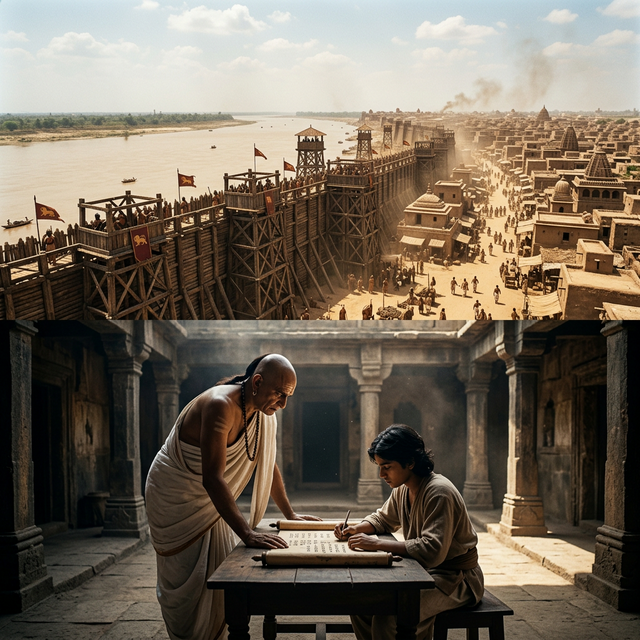
The wooden fortifications of Pataliputra do not merely enclose a city; they bind an ambition. Five hundred and seventy towers stand like silent sentinels above the Ganges, their massive timber beams smelling of river mud and saltpetre, lashed together by iron bolts that sweat in the humid heat of the monsoon. Within this grid of sixty-four gates, the air is thick with the scent of sun-baked brick and the sharp, metallic tang of the mint. The city is a machine of precise partitions, where every street is a vein for the state’s commerce and every alley a potential site for the King’s invisible eyes. It is here, in the shadow of the central palace’s wooden columns, that the science of power is stripped of its mythological garments and reduced to the cold geometry of survival.
Madhava, a junior superintendent in the registry, watches the young prince bend over a sheet of birch bark, his fingers stained with the black ink of the lipi. The student’s tonsured head is bowed low as he laboriously calculates the grain yields of a hypothetical province, his reed pen scratching out digits that translate land into leverage. The room is silent except for the rhythmic grinding of ink stones and the distant, heavy thud of a timber-hammer on the river docks. Outside, the Mauryan court is a labyrinth of procedure and protocol, but in this small, spare chamber, the world is being broken down into its elemental parts: grain, gold, and the hard logic of the sceptre.
There is no room for the poetic vagaries of the court; here, the only truth is that which can be measured, audited, and enforced.
The prince’s sacred thread, newly invested, sits like a thin, abrasive burden across his bare shoulder. It is a symbol of the Trayi, the triple Vedas that bind the heavens to the earth, but in Kautilya’s hands, even the gods are treated as civil servants with specific duties and predictable temperaments. Madhava observes the way Kautilya leans over the student, not with the warm encouragement of a teacher, but with the surgical detachment of an architect inspecting a foundation. The master’s hand is steady as he gestures toward the Hiranaya—the treasury ledger—reminding the youth that while philosophy might steady the mind, it is the tax on a bushel of rice that sustains the philosophy.
The stakes of this lesson are visible in the way the prince’s knuckles whiten as he grips his stylus; he is learning that a king’s soul is not found in his lineage, but in his ability to maintain the balance of the four sciences.
A single gesture from Kautilya—a sharp tap of a wooden ruler against the stone floor—marks the transition from theory to the brutal necessity of the Dandaniti. This staff, the Danda, is not just a physical object but the very axis of the empire’s order. If the staff falls, the social order collapses into the state of Matsyanyaya, where the big fish devour the small without mercy or end. The prince must understand that his authority is a borrowed tool, a heavy weight that must be wielded with such precision that it never needs to strike. To rule is to exist in a state of perpetual tension, where the safety of the citizens depends entirely on the king’s refusal to sleep, and where every act of mercy is weighed against the potential for future rebellion.
The debate in the hall shifts as the teachers of the competing schools—the Manavas and the Barhaspatyas—argue the necessity of their respective sciences. Kautilya moves among them like a wolf among hounds, his voice a low, dry rasp that cuts through their academic abstractions. He dismisses those who would sacrifice economics for the sake of theology, or those who think philosophy is a luxury for the idle. For him, the three Vedas and the science of economics are the twin pillars of the treasury, but they are both blind without the light of Anvikshaki, the science of logic. He watches the prince’s face, searching for the flicker of recognition that power is not a divine right but a calculated result.
The student must learn to see the world not as it is described in the hymns, but as it truly functions in the grain market and the barracks.
There is a moment of profound stillness when Kautilya demands the prince justify the existence of the varta, the science of agriculture and trade. The prince hesitates, his mind reaching for the easy piety of the priests, but Kautilya’s gaze is a cold wall. The youth eventually speaks of the grain warehouses that smell of dry husks and the treasury seals that keep the empire from bleeding out. He realizes that the king does not merely lead; he manages a vast, breathing organ of production and consumption. The lesson is not about the glory of the Mauryas, but about the specific fraud of a merchant and the exact weight of a standard measure. In this court, the highest virtue is a balanced ledger, and the greatest sin is a lapse in supervision.
As the sun climbs higher, the prince is led out of the chamber, his mind reeling from the transition from logic to the physical demands of the military arts. He must now mount the royal elephant, a massive grey beast that smells of musk and wet hay, to practice the maneuvers of the charana. The transition is seamless; the logic of the schoolroom becomes the logic of the horse-chariot and the bowstring. Kautilya watches from the shade of the gallery, his face a mask of inscrutable calculation. He is not teaching a man to be a king; he is tempering a weapon that will be used to unify a sub-continent through blood and bureaucracies. Every movement the prince makes is being recorded by the shadows in the corner, the King’s spies who are themselves part of the science they observe.
Light to all kinds of knowledge, easy means to accomplish all kinds of acts and receptacle of all kinds of virtues, is the Science of Anvikshaki ever held to be.
This is the rule that demands the king be more than a soldier or a priest; he must be a philosopher of the practical. It assumes a world where chaos is the natural state and order is a fragile, artificial construct that must be maintained through constant, intellectual effort. It says that the man who rules must possess a mind that can navigate the contradictions of the Vedas and the market with equal clarity. This logic of the Artha does not seek the divine, but the durable. It is a prescription for a ruler who knows that his greatest enemy is not the foreign invader, but his own lack of foresight and the slow, eroding rot of institutional neglect.
The science of logic sits at the centre because it is the filter through which all other knowledge must pass. Kautilya’s world is one of extreme transparency for the ruled and impenetrable secrets for the ruler. The rule acknowledges that power, without the stabilizing force of reason, is merely a blunt instrument that will eventually break the hand that holds it. It requires the king to be his own internal auditor, a man who tests his every impulse against the cold requirements of the state’s well-being. In this world, the king’s interiority is the final line of defense against the abyss of incompetence.
The canto leaves behind the image of the prince standing alone in the center of the training field, the midday sun casting a sharp, black shadow at his feet. He holds a wooden practice sword, its edge blunt but its weight very real. In the distance, the wooden gates of Pataliputra groan on their hinges as a caravan of grain-carts enters the city, the dust of the road rising in a fine, golden haze. The prince does not look at the horizon; he looks down at his shadow, realizing that he is no longer just a boy, but the living point of a sceptre that is beginning to descend upon the world.
The master, Kautilya, turns away from the gallery and disappears into the cool, dark corridors of the palace, his footsteps silent on the stone floors. He leaves the student with the heavy silence of the four sciences, a burden that will grow with every year of his reign. Somewhere in the city, an official presses a hot wax seal onto a scroll, the soft hiss of the heat marking another grain of power added to the Mauryan treasury. The empire is no longer an idea; it is a procedure, and the procedure has begun.