Chapter 2 of 126
A rigorous guide to mastering the internal storm, proving that a king who cannot conquer his own senses will never truly rule his subjects.
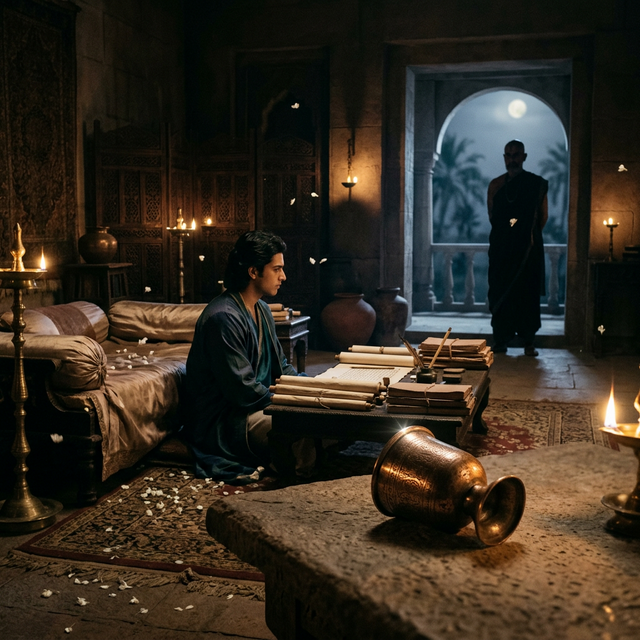
The palace at night is not a sanctuary; it is a theatre of shadows where the six enemies wait in the flickering torchlight. Beyond the wooden screens of the royal apartments, the city of Pataliputra is a distant hum of industry, but here, in the heavy, perfumed air of the inner court, the world shrinks to the radius of a single lamp. The scent of sandalwood oil and jasmine hangs thick, a sensory trap designed to soften the resolve of the man who holds the sceptre. In this dim periphery, the lines between necessity and desire begin to blur, and the mind's natural steadfastness is tested by the silence.
It is in these hours, when the councils are dismissed and the registers are closed, that the empire is most at risk—not from external invaders, but from the slow, internal rot of an undisciplined mind.
Prince Madhavavarman stands by the balcony, his eyes fixed on a single, ornate drinking vessel of polished copper that catches the light. This cup, cold to the touch but capable of carrying the fire of fermented grape-juice, is the stake of tonight’s lesson. It represents the first of the six enemies: Kama, the lust that begins as a ripple and ends as a flood. To the prince, it is a simple object of luxury, but as Kautilya enters the room, his footsteps silent as a hunter’s, the vessel becomes a symbol of a dynasty's collapse. The master does not speak of morality or soul-saving; he speaks of the mechanical failure of a state when its driver is blinded by his own appetites.
A king who cannot command his own senses is a king who has already surrendered his borders to the highest bidder.
"Listen to the ghosts," Kautilya says, his voice a low, dry rasp that seems to come from the floorboards themselves. He begins to recite the litany of the fallen, a rhythmic catalog of kings who treated their power as a servant to their pleasure. He speaks of Bhoja of Dandakya, whose lust for a Brahmana girl turned his kingdom into a wasteland of ash. He mentions Karala of Vaideha, whose vanity was a slow poison that dissolved the loyalty of his own ministers. These names are not mere legends; they are case studies in the science of failure. The prince listens as the names of Janamejaya and Talajangha are added to the list, each one a testament to the fact that anger, greed, and pride are not just personal vices, but strategic vulnerabilities.
To Kautilya, a king’s anger is a crack in the fortification wall, and his greed is a leak in the treasury.
The room grows colder as the names of Ravana and Duryodhana are invoked—the great titans who fell because they could not distinguish their own vanity from the state’s requirements. Kautilya’s gaze is a cold wall, forcing the prince to look at the polished copper cup not as a luxury, but as a potential weapon of his own destruction. The master describes the downfall of the Haihaya dynasty, where the haughty Arjuna despised all people and found himself despised by the earth itself. The litany is a precision-strike against the prince’s youthful confidence, stripping away the illusion that power is a shield. In reality, power is a magnifying glass that exposes every flaw, making the smallest lapse in discipline a matter of national catastrophe.
Kautilya gestures toward the chháyánáliká, the shadow-measuring instrument that marks the passage of the hours. Discipline, he explains, is not a state of being, but a procedure of time. It is the constant awareness of the shadow as it moves across the stone, the relentless audit of one’s own impulses. He warns that joy, too, is an enemy when it leads to the overjoy of the Vrishnis who, in their delirium, attacked the sage Dvaipayana and perished. For Kautilya, the three pursuits of life—charity, wealth, and desire—are like a tripod; if one leg is extended too far, the entire structure collapses. But it is wealth, the Artha, that remains the base, for without it, neither charity nor desire has a floor to stand upon.
The prince’s interiority is a storm of conflicting images: the opulent wealth of Pataliputra and the stark, bone-dry logic of his teacher. He realizes that to be a king is to live in a state of perpetual self-denial, where every sensory pleasure must be weighed against its cost in political capital. The conquest of the senses, Indriyajaya, is the ultimate espionage—the king spying on his own mind to detect the first stirrings of rebellion. He looks back at the copper vessel and sees it differently now: not as a source of pleasure, but as a test of his working capacity. If he cannot resist the cup, he cannot resist the bribe or the assassin’s whisper.
As the pre-dawn light begins to grey the horizon, Kautilya leads the prince toward the window. Below them, the shadows of the wooden towers are long and sharp, stretching toward the Ganges like the fingers of a giant. The master speaks of the king Nabhaga, who reigned for a long time over the earth because he had driven out the six enemies, and of Ambarisha, whose restraint of the organs of sense was a more powerful defense than any army. These are the survivors, the men who understood that the sceptre is only as steady as the hand that holds it. The prince feels the weight of his own destiny as a physical burden, a heavy, unyielding shadow that he must learn to carry without flinching.
Not violating righteousness and economy, he shall enjoy his desires. He shall never be devoid of happiness. He may enjoy in an equal degree the three pursuits of life, charity, wealth, and desire, which are inter-dependent upon each other. Any one of these three, when enjoyed to an excess, hurts not only the other two, but also itself.
This is the rule of the balanced man, the prescription for a ruler who does not seek to be a saint, but a stable machine. It assumes a world where desire is inevitable and even necessary, but where its absolute mastery is the only way to prevent it from becoming a pathogen. It says that happiness is not a goal to be pursued, but a byproduct of a precisely managed life. The men who need such a rule are those who hold the lives of millions in their hands, men for whom a single moment of "overjoy" can mean the starvation of a province or the collapse of a frontier. It is a logic that treats the human ego as a dangerous variable that must be neutralized for the good of the collective.
The logic sits as a reminder that the king is the first servant of the state’s economy. If his desires bleed the treasury or his anger disrupts the law, he has violated the very reason for his existence. The rule does not demand the abolition of pleasure, only its strict regulation within the gears of the state. It is a world of cold, calculated moderation, where the king’s personal happiness is merely one more asset to be managed alongside grain yields and silver bullion. This is the ultimate burden: to be the only man in the empire who is never truly free to be himself.
The canto ends on the image of the prince turning away from the balcony and toward the ink-stained scrolls of the morning. He ignores the copper cup, leaving it to catch the first rays of the rising sun as it stands abandoned on the stone table. Outside, the first timber-hammer blow of the day strikes the river docks, a rhythmic thud that marks the resumption of the city’s industry. The prince sits at the low table and picks up his reed stylus, his fingers steady, his mind already calculating the tax revenues of the southern territories. Kautilya is already gone, his presence replaced by the heavy, silent requirement of the law.
The morning mist rises from the Ganges, but it does not obscure the wooden towers of Pataliputra. They stand revealed in the sharp, uncompromising light, their timber frames a cage for the city, just as the prince’s discipline is a cage for his will. The empire does not need a hero; it needs a manager who has survived the war within his own skull. The morning has begun, and the Prince is ready to work.