Chapter 5 of 126
A masterclass in palace security, revealing how to protect the sovereign from the closest of threats—where even a family's embrace can hold a hidden blade.
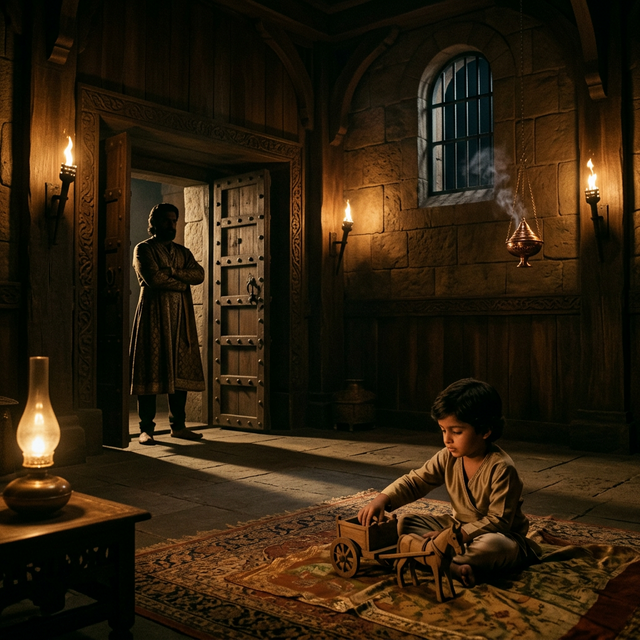
The nursery in the inner heart of the Mauryan palace is not a place of play; it is a laboratory of potential treason. Behind the heavy wooden doors, reinforced with iron bolts and guarded by silent, unblinking attendants, the young princes of the blood are raised under a regime of absolute observation. The air is thick with the scent of boiled milk and expensive incense, but beneath these domestic odors is the sharp, metallic tang of cold steel. To a stranger, this might look like a sanctuary of privilege, but to Kautilya, it is a containment zone. He watches a young boy playing with a wooden chariot, seeing not a child, but a biological clock whose every tick brings the King closer to his own obsolescence.
A single, silver rattle lies abandoned on a silk rug, its hollow ring echoing in the silence of the room. This toy is the stake of tonight’s lesson: the prize of a dynasty that is always one heartbeat away from fratricide. Kautilya leads Prince Madhavavarman to the secret council chamber—the Mantragriha—a room built with the same precision as a fortress. It is located in a secluded spot, far from the prying ears of the harem and the distractions of the court. The walls are thick, the floor is swept for tell-tale dust, and even the birds are cleared from the eaves to ensure that not a single syllable of the King’s deliberation can be harvested by the wind. In this space, the King is most sovereign, and most vulnerable.
The action moves from the sterile silence of the council to the disturbing biology of power. Kautilya invokes the metaphor of the Karkataka—the crab. He explains that princes, by their very nature, are driven to consume the one who gave them life. It is an evolutionary necessity turned into a political catastrophe. He speaks of the school of Bharadvaja, who advocated for the secret punishment of princes who lacked filial affection, and the school of Visalaksha, who warned that such cruelty was the extirpation of the race. Kautilya’s own solution is a hierarchy of containment. If a prince is an only son and refuses to learn, he must be kept in chains to prevent the kingdom from falling into the hands of a madman.
If there are many sons, the redundant ones are sent to the furthest frontiers, to the places where there is "no heir apparent," essentially exiled into the service of the state’s periphery.
The Prince watches as his master describes the methods for testing a son’s character. Spies under the disguise of fraudulent persons or highway robbers are sent to "terrify" the young men, to find the breaking point of their resolve. If a prince is found fond of liquor, he is given narcotics; if he is found fond of women, he is led into a trap of desire. These are not just punishments; they are diagnostic tools to determine which part of the "House of Crabs" is stable enough to hold the weight of the crown. Kautilya's voice is a cold scalpel, dissecting the bonds of family until they are nothing more than a series of security risks.
The Prince realizes that his own life is a performance for an invisible audience, and that his father’s love is secondary to his father’s survival.
“For,” says Bháradvája, “princes like crabs have a notorious tendency of eating up their begetter. When they are wanting in filial affection, they shall better be punished in secret (upámsudandah).” ... A king is not made by a mere wish; failure of thy attempt will bring about thy own death; success makes thee fall into hell and causes the people to lament and destroy the only clod.
This is the rule of the biological audit, the technical manual for a ruler who must treat his own DNA as a potential pathogen. It assumes a world where the closest relationships are the ones most likely to produce the assassin’s blade. It says that the survival of the state is a value that transcends the continuity of the individual, even when that individual is the King’s own flesh. The "only clod" is the prince himself—a singular, fragile entity that can be discarded if it threatens the stability of the collective. The men who need such a rule are those who have understood that power is a lonely, cold peak where the air is too thin for the warmth of ordinary human affection.
The logic of the secret council and the disciplined heir is the logic of a system that prioritizes continuity over legacy. It transforms the family into a department of the state, where the "Protection of Princes" is indistinguishable from their incarceration. This is the ultimate burden of the Mauryas: to know that your shadow is always being measured for a coffin, and that the person most likely to fill it is the one you called "father." Kautilya does not offer comfort; he offers a procedure. He teaches the Prince that to lead is to be the only person in the empire who is never allowed to be a son.
The canto concludes on the image of the King standing at the door of the nursery, watching his youngest son sleep. The torchlight flickers on the boy’s face, casting a shadow that looks briefly like a crown, and then like a cage. The King does not move; he does not reach out to touch the child. He simply watches, his eyes cold and methodical, calculating the variables of the boy’s future. He knows that one day, this boy will look at him and see only an obstacle. In the distance, the chháyánáliká marks the midnight hour, a rhythmic thud that sounds like a heart beating against a wooden box.
Outside, the timber fortifications of Pataliputra stand silent in the moonlight, a ring of iron and wood that protects the King from the world, and the world from the King. But inside the "House of Crabs," the real war is silent, and it never ends. The Prince turns away from his master and toward the dark corridor that leads to his own partitioned life. He is a Mauryan prince; he is a student of the four sciences; and he is, most importantly, a contained variable. The night is long, and the King is still awake, watching the shadows for the first sign of the crab’s claw.