Chapter 6 of 126
The relentless rhythm of the throne, partitioning the day and night into a clockwork of duty, ensuring the state never pauses in its vigilance.
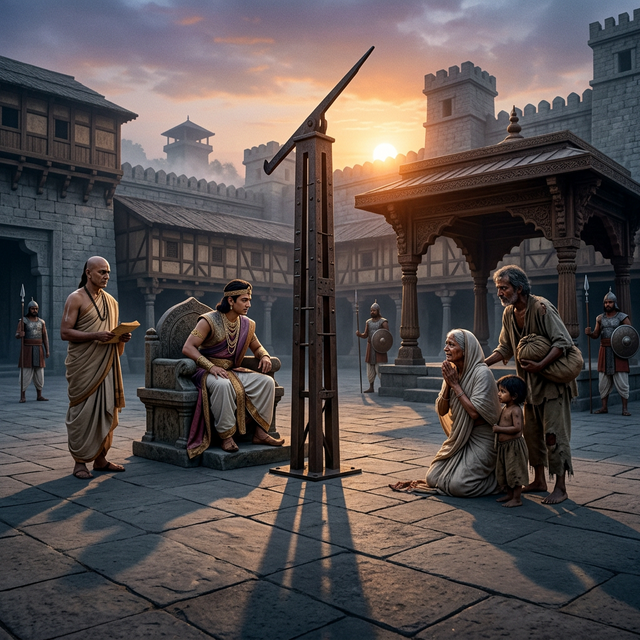
The shadow of the chhayanalika—the tall, iron-bolted gnomon that commands the palace courtyard—is a sharp, dark needle against the sun-bleached stone of Pataliputra. At the first light of dawn, when the mist still clings to the wooden towers overlooking the Ganges, the shadow is long and thin, stretching toward the western gates like a warning. To the thousands of laborers and merchants beginning their day, the clock is a convenience; to the King, it is a master. He does not wake to the song of birds, but to the rhythmic strike of the water-clock, the nalika, whose steady drip-drip in the adjacent corridor is the heartbeat of the state.
In this world of total management, time is not a flow; it is a series of sixteen distinct compartments, each one a slot in a machine that must be filled with the King’s labor.
A single, bronze bell-stroke marks the transition from the first part of the day to the second. This sound, heavy and unyielding, is the stake of the morning: it signals that the King’s personal life has ended and his function as the supreme auditor has begun. He stands in the small, austerely furnished chamber of the sacred fire, the Agnyagara, where the scent of clarified butter and burning sandalwood creates a sensory barrier between the royal apartments and the demands of the empire. Before him, a line of petitioners has already begun to form at the threshold of the court. They are the "afflicted"—the widows, the minors, the aged, and the heretics—each one a variable in the King’s responsibility.
To them, the King is a source of justice; to Kautilya, the King is a processor of urgent calls who must never let the pressure of the queue engender public disaffection.
The action of the day is a mechanical progression through the eight parts of light. In the second part, the King hears the petitions of the city and the country, his mind moving from land disputes in the southern provinces to the grievances of religious heretics. He sits in a room where the sacred fire is maintained, a physical reminder of his role as the maintainer of the Dharma. In the third part, he bathes and dines, but even his meal is a scheduled event, monitored for poison and measured for efficiency. By the fourth part, he is overseeing the collection of revenue and the appointment of superintendents, his hands moving over birch-bark and palm-leaf registers that track every grain of rice and every copper coin in the treasury.
The King is the center of a vast, informational web, and the sixteenth-part division of the day is the only thing that prevents the web from collapsing under its own weight.
As the sun passes its zenith and the shadow of the chhayanalika begins to stretch toward the eastern warehouses, the King enters the fifth and sixth parts of his day. He consults with his council of ministers in the secret garden, where the trees have been cleared of birds to prevent even the smallest eavesdropping. He receives information from his spies—the "Network of Eyes" he has built—validating the fragmented rumors of the marketplace against the cold data of the registers. In the seventh part, he reviews his cavalry, elephants, and chariots, his eyes moving over the iron-shod wheels and the muscle of the beasts, calculating the readiness of his machine for war.
Finally, in the eighth part, he considers plans of military operations with his commander-in-chief, the day ending as it began: with the cold, calculated preparation for the survival of the state.
The night is no less rigorous. It is divided into another eight parts, beginning with the receiving of secret emissaries and the dispatching of spies. The King dines and sleeps in the central parts of the night, but even his rest is a strategic asset, a necessary recovery for the engine of the state. By the seventh and eighth parts of the night, long before the sun has returned to the Ganges, he is already awake, meditating on the "sciences" and directing his ministers to their daily tasks. The Prince, watching this relentless cycle, realizes that the crown is not a trophy, but a harness. The "Duty of a King" is a 24-hour audit of the self, leaving no room for the "overjoy" or the "lustfulness" that destroyed the ghost-kings of the past.
When in the court, he shall never cause his petitioners to wait at the door, for when a king makes himself inaccessible to his people and entrusts his work to his immediate officers, he may be sure to engender confusion in business, and to cause thereby public disaffection, and himself a prey to his enemies. He shall, therefore, personally attend to the business of gods, of heretics, of Bráhmans learned in the Vedas... all this in order (of enumeration) or according to the urgency or pressure of those works.
This is the rule of the accessible sovereign, the technical documentation for a ruler who must be the most visible man in the empire. It assumes a world where "confusion in business" is a security threat, and where the King’s personal attention is the only glue that holds the disparate factions of society together. It says that the most effective way to prevent rebellion is to be the first person the people speak to when they are hurting. The "urgency or pressure" of the work is the absolute priority, a logic that treats the King’s time as a public utility. The men who need such a rule are those who know that their authority is a social contract that must be renewed every hour, in the presence of the "afflicted" and the "helpless."
The logic of the schedule and the sacred fire is the logic of a man who has become a living institution. It replaces the King’s personality with a timetable, ensuring that his behavior is as predictable as the movement of the stars. This is the cold beauty of Kautilya’s system: it protects the King from himself by locking him into a ritual of service. It says that the highest pursuit of life is not happiness, but the "business of the gods and the heretics." In this world, the King’s only freedom is the freedom to fulfill his obligations with perfect precision.
The canto concludes on an image of the King at the very end of his morning meditation, just as the first grey light begins to touch the palace spires. He leaves the chamber of the sacred fire and walks toward the royal stables. Before mounting his elephant for the morning court, he stops in the shaded courtyard where a cow and its calf are tethered. He circumambulates them slow and methodical, a gesture of respect that is both ancient and precisely timed. He then salutes a bull, his hand resting briefly on its broad, muscular neck, before stepping into the court.
Inside, the first petitioner is already waiting—a minor from a distant province who has traveled weeks to see the face of the sovereign. The King sits on his high wooden throne, the shadow of the chhayanalika now a short, blunt stump in the courtyard outside. He leans forward, his stylus ready, his mind already engaging with the boy’s problem. The clock of power has struck its first hour of the day, and the King is in his place. The industry of Pataliputra resumes its rhythmic hammer-blows at the river docks, but inside the court, the only sound is the quiet, relentless scratch of the law. The empire is functioning, and its manager is at work.