Chapter 13 of 126
The sacred geometry of the royal edict, where the precise drafting of the word becomes a binding contract between the sovereign and the universe.
The air in the scribe’s chamber is a heavy, intoxicating blend of river-charcoal and the resinous scent of high-grade birch-bark. In this room, the raw will of the Mauryan King is forged into the "geometry of the word." Here, the Lekhaka, the royal scribe, sits at a low desk of dark Shisham wood, his fingers stained with the permanent black of the ink, his face set in a mask of linguistic discipline. He does not merely record; he translates the sovereign’s impulse into a Śásana—a writ that has the weight of law and the trajectory of a spear. The room is silent, save for the dry, rhythmic whisper of the reed pen across the bark, a sound that represents the soft-tissue transition of power from the mind to the world.
A single, unblemished sheet of birch-bark, its surface as smooth as ivory and its edges as sharp as a blade, rests on the desk. This object is the stake of the empire’s reach: it is the medium through which a command issued in the heart of Pataliputra travels a thousand miles to the borders of the Seleucid West. Kautilya stands behind the scribe, his shadow falling across the blank bark. He has taught the Lekhaka that a writ is not a letter; it is an "extension of the sword." If the word is weak, if the ink fades, or if the grammar falters, the authority of the crown is already compromised. The scribe is the architect of the King’s public soul, and his blueprints must be perfect.
The action of the chapter is the construction of the "Perfect Command." Kautilya walks the Prince through the six qualities of a royal writ: Krama (Arrangement), where every word follows the logical order of the state; Sambandha (Connection), where the beginning and the end are bound in a seamless loop of authority; Paripúrnata (Completeness), which leaves no room for the enemy’s interpretation; Mádhurya (Sweetness), the diplomatic grace that masks a threat; Audārya (Exaltedness), the tone of a master who expects no reply; and Spashtatva (Lucidity), the transparency of a will that cannot be misunderstood. The scribe’s hand moves with the precision of a jeweler, ensuring that the "family, occupation, and conduct" of the enemy are commended with "due attention," even as the ink carries the stratagem of dissension.
But the writ is more than aesthetic; it is a weapon of the Upáyas. Kautilya describes the different forms of the "Geometry of the Word": the Prajñápana (Command), which directs the viceroys; the Paridána (Information), which alerts the governors; or the Pratibhaga (Writ of Reply), which discuss the form of the King’s return. Each writ is a calculation of "vast future prospects" or a "narration of mutual relationship." In these letters, negotiation is not a dialogue; it is a "praising of qualities" that prepares the ground for a "open attack." The pen is the slow-acting poison that makes the final strike of the sword unnecessary.
Arrangement (krama), connection (sambandha), completeness (paripúrnata), sweetness (mádhurya), exaltedness (audārya), and lucidity (spashtatva) are the relevant qualities of a writ... Negotiation, bribery, causing dissension, and open attack are forms of stratagem... When the family, person, occupation, conduct, learning, properties, etc., (of an enemy) are commended with due attention to their worth, it is termed praising the qualities.
This is the rule of the literate state, the documentation for a world where the signature is the ultimate boundary. It says that power is a matter of "negotiation, bribery, and dissension" captured in the fine, black script of the Isvara. It recognizes that the "family and friends" of an enemy are the friction points where the King’s word can ignite a fire. The scribe’s chamber, with its specialized inks and its racks of birch-bark, is the forge of this new, verbal power. The men who need such a rule are those who have understood that the most durable part of an empire is its archive.
The logic of the writ is the logic of the "Duties of Government Superintendents." It completes the transition from the architecture of the storehouse to the architecture of the sentence. It assumes that if you can control the "arrangement and connection" of a man’s information, you can control the man's actions. The state is no longer a bank; it is a publisher of reality.
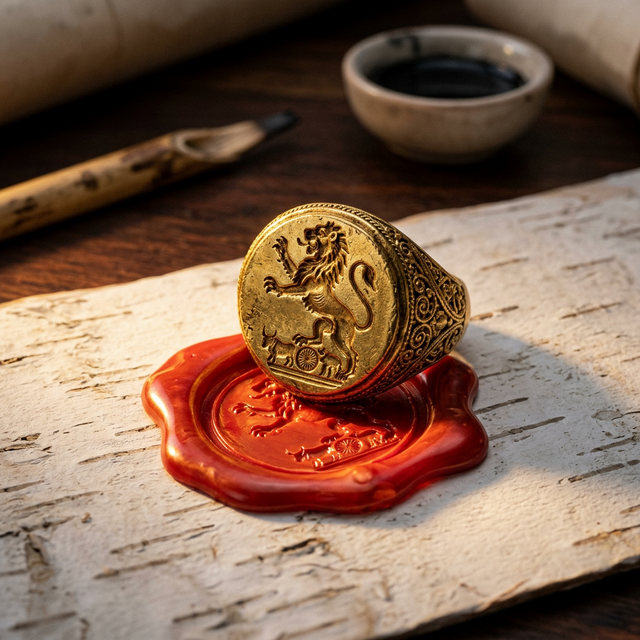
The canto concludes on the image of the seal being pressed into the hot, red wax at the bottom of the writ. The scribe picks up the Mauryan signet—a heavy ring of gold with the image of the rearing lion—and presses it down with a deliberate, rhythmic force. The wax spreads and cools, capturing the lion in a moment of permanent, silent authority. He rolls the birch-bark into a tight cylinder and hands it to the courier, who is already waiting in the shadows of the northern door.
Outside, the birds are "flying high up in the sky," their movements marked by the King’s observers. But inside the geometry of the word, the King’s purpose is already in flight, moving faster than any bird toward the "Circle of Kings." Kautilya looks at the empty desk and see the ghost of the command still lingering in the scent of the charcoal. He knows that the message has already begun to dismantle the enemy’s fortifications. The sword has not yet been drawn, but the war is already being won.