Chapter 12 of 126
The forensic management of the royal treasury, proving that the King's true power is stored in his coffers long before it is displayed in his swords.
The audit hall of the Samaharta is a place where the air itself seems thick with the smell of dust, old birch-bark, and the metallic tang of sweat. Here, under the high, unblinking glare of the Mauryan sun, the bureaucratic machine turns its gaze inward. It is a space of interrogation, where the "treasurer, the receiver, and the payer" are brought to account for every coin that has moved through their hands. Kautilya sits on a raised stone platform at the end of the hall, his face a mask of predatory patience. Beside him, the Prince watches as a low-ranking clerk fumbles with a stack of ledgers. The boy is learning that the most difficult part of statecraft is not conquering an enemy, but keeping a servant honest.
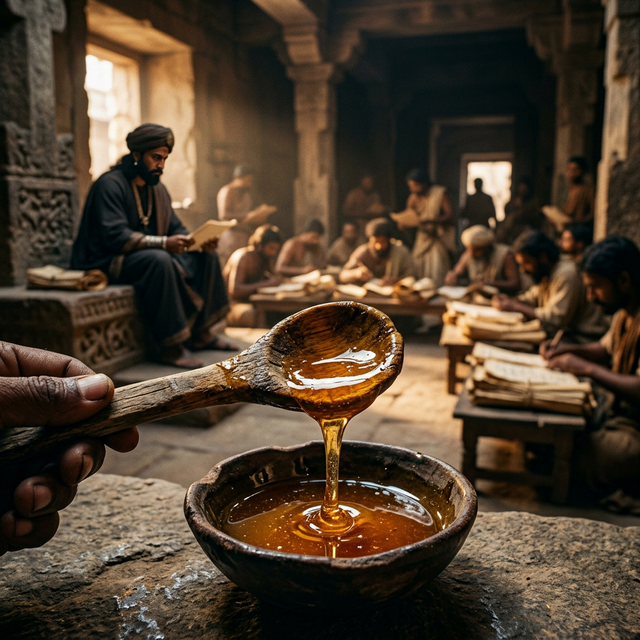
Kautilya picks up a small, ornate jar of forest honey and dips a wooden spoon into the golden liquid. "It is possible," he says, his voice a dry rasp, "for a man to have honey on the tip of his tongue and not taste it. But it is not probable." He gestures toward the clerk. "In the same way, it is impossible for a government servant not to eat up, at least in a bit, the King's revenue." He has cataloged forty distinct ways that this hunger manifests: the "misrepresentation of prices," the "use of false weights," the "deception in counting articles," and the subtle "inconsistency in dealing with fixed items." To Kautilya, greed is not a moral failing; it is a biological certainty, as inevitable as the tide of the Ganges.
The action of the audit is a forensic dissection of the official's life. Kautilya speaks of the second great metaphor: the fish in the water. Just as it is impossible to know when a fish moving under the surface is drinking, it is impossible to know when an official is siphoning off the state’s wealth. Detection, therefore, requires a simulation of omniscient sight. He describes the interrogation of the "ministerial servants," the " Yuktas," and the "prescribers." They are examined separately, their stories matched against the "standard of fineness" of the gold and silver they handled. If any one of them tells a lie, the "same punishment" as the chief-officer is applied. The audit is a pressure-cooker of "fear of betrayal," where the state’s continuity is maintained by the mutual suspicion of its parts.
The Prince watches as a high-ranking official, a man who once sat close to the throne, is brought forward. The man’s face is pale, his eyes darting toward the exits. He has been caught in a "misrepresentation of test marks," a subtle shift in the accounting of the treasury’s bullion. Proclamations have been made in public: "Whoever has suffered at the hands of this offender may come forward." The state is inviting the people to become its eyes, turning the official's own victims into his auditors. The Prince realizes that the King's power is not a single sword, but a thousand small, sharp needles of observation. To be a master of men is to be a master of their Appetites.
It is possible to mark the movements of birds flying high up in the sky; but not so is it possible to ascertain the movement of government servants of hidden purposes... Just as it is impossible not to taste the honey or the poison that finds itself on the tip of the tongue, so it is impossible for a government servant not to eat up, at least in a bit, the King's revenue. Just as fish moving under water cannot possibly be found out either as drinking or not drinking water, so government servants employed in the government work cannot be found out (while) taking money (for themselves).
This is the rule of the biological audit, the documentation for a world where "hidden purposes" are the primary threat. It says that the King must assume the worst of his servants to ensure the best for the state. It recognizes that "misrepresentation" is a technical skill that must be met with technical detection. The interrogation hall, with its separate seats and its "shelves of account-books," is the theater of this new, forensic power. The men who need such a rule are those who have understood that the treasury is the King's blood, and that every servant is a potential parasite.
The logic of the bitter honey is the logic of the "Duties of Government Superintendents." It completes the transition from the architecture of the storehouse to the psychology of the clerk. It assumes that if you can map the "forty ways" of the thief, you can build a cage that no one can leave. The state is no longer a bank; it is a trap for the greedy.
The canto concludes on the image of the disgraced official being led out of the hall through the northern door. His robes are torn, his seal of office broken. The bards in the streets are already singing of the King's "inconsistency in giving charities" to the corrupt. Kautilya turns back to the abacus on the desk, his fingers moving the sandalwood beads with the same precision he uses to move armies. He looks at the "net balance" and see the survival of the Mauryas written in the silence of the ledger.
Outside, the sun is setting, casting long, jagged shadows of the ramparts across the audit hall. The Prince looks at the spoon still dripping honey and feels a sudden, sharp pang of cynicism. He has seen the fish drinking water, and he has tasted the bitter honey of the crown. He knows now that the state is held together not by love, but by the relentless, unblinking audit of the human soul.