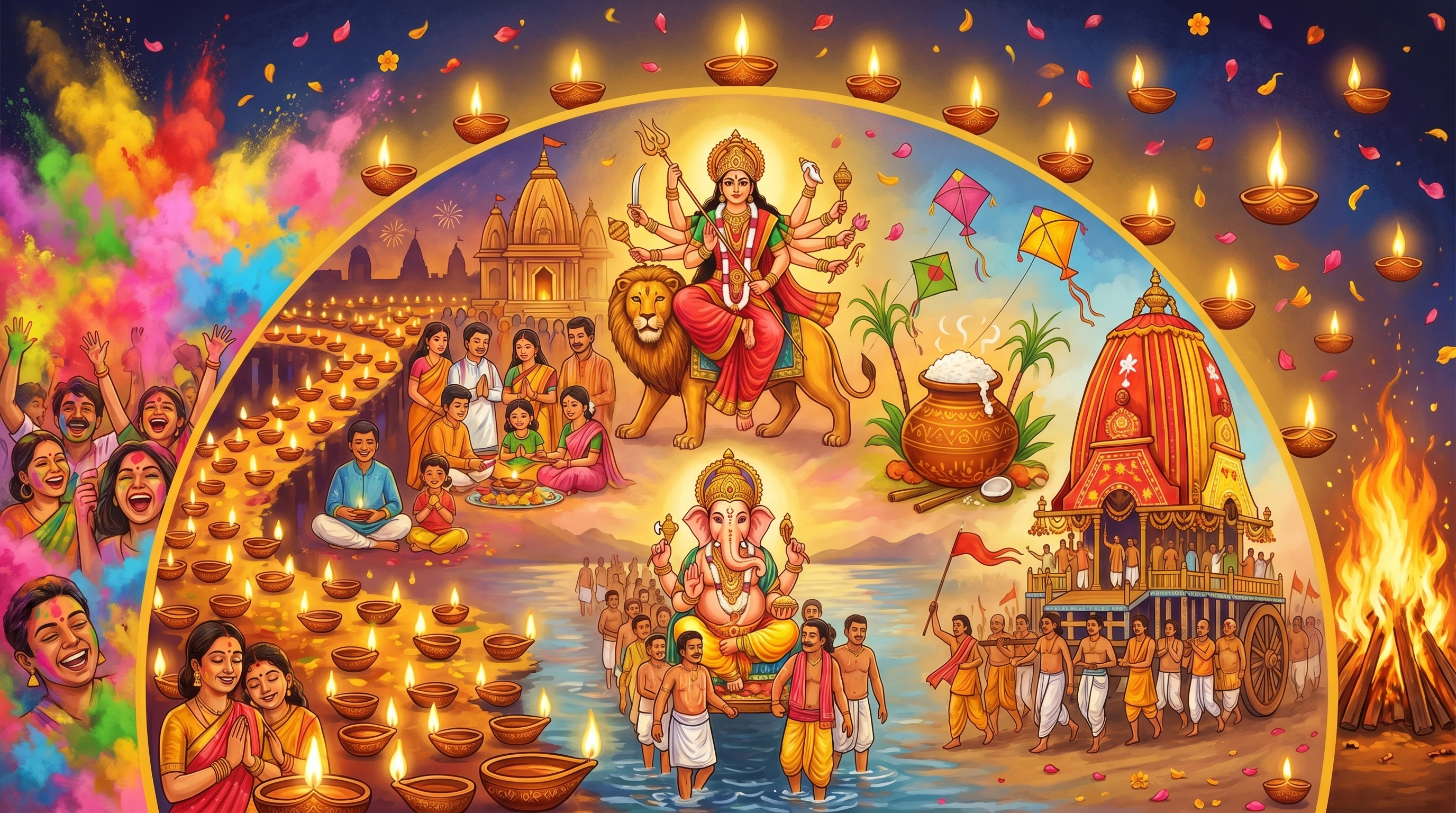
# The Hindu Year in Festivals
## A Wheel of Light and Harvest
**Narrator:**
Across one Indian year, the same handful of truths is told again and again in colour, fire, and song. Light defeats darkness. The harvest is shared. The goddess wins.
**Narrator:**
This is a guided walk through fourteen Hindu festivals — not a calendar to memorize, but a wheel that turns. Each one carries an old myth and a living celebration, and the two halves explain each other.
**Narrator:**
The festivals do not agree on dates or even on stories. A single day wears a different name in Bengal, Gujarat, Tamil Nadu, and Punjab. That disagreement is not a flaw to smooth over — it is the festival year's true shape.
## Spring — The World Begins Again
**Narrator:**
Spring opens with **Holi**, where a demon-king's pyre fails to burn a faithful boy, and the next morning the whole country throws colour. Devotion outlasts cruelty; the grey winter is drowned in pigment.
**Narrator:**
Then **Rama Navami** marks the midday birth of Rama in Ayodhya — the prince who will walk into exile and return to set the standard for every later king.
## Summer — Devotion Tested
**Narrator:**
In the heat comes **Vat Savitri**, when a woman follows Death into the forest and argues her husband back to life beneath a banyan tree. Married women still circle that tree with thread and fast.
**Narrator:**
And **Rath Yatra** rolls the lord Jagannath out of his temple at Puri onto immense wooden chariots, pulled through the streets by thousands — the one week a year God comes out to meet everyone, caste forgotten, on the open road.
## Monsoon — The Gods Come Close
**Narrator:**
The rains drive the serpents up, and **Nag Panchami** honours them — remembering the boy Krishna dancing on the poison-snake Kaliya until he yields. Then **Raksha Bandhan** ties a thread of protection between siblings, while coastal fishermen offer coconuts to a calming sea.
**Narrator:**
**Janmashtami** keeps the midnight vigil of Krishna's birth in a tyrant's prison, the chains falling open as his father carries him across the flooding river. Weeks later **Ganesh Chaturthi** brings the elephant-headed remover of obstacles home in clay, worshipped, then carried to the water and let go.
## Autumn — The Goddess and the Lamp
**Narrator:**
Autumn is the year's great crescendo. Across nine nights, **Navaratri and Durga Puja** raise the goddess who gathered every god's power into one body to kill the buffalo-demon — Bengal in its pandals, Gujarat in its spinning garba.
**Narrator:**
On the tenth day, **Dussehra** burns Ravana in effigy and parades the elephants of Mysore: evil decisively ended. Then the lamps are lit for **Diwali**, welcoming Rama home and the goddess Lakshmi in — the festival of light that half a world now keeps.
## Winter — The Turn Toward the Sun
**Narrator:**
As the sun turns north, the harvest festival arrives under many names — **Makar Sankranti and Pongal** — rice boiling over in Tamil Nadu, kites over Gujarat, bonfires in Punjab and Assam.
**Narrator:**
**Vasant Panchami** dresses in yellow for Saraswati, goddess of the first word and the first note, as children lay out their books for her blessing. And the year's vigil deepens into **Maha Shivaratri**, the great night when Shiva drank the world's poison and held it, blue-throated, in his throat.
## Why It All Rhymes
**Narrator:**
Read together, the fourteen rhyme. A demon is always overreaching; a god or goddess always answers; the people always respond with light, water, colour, or a shared meal.
**Narrator:**
What changes is the local hand that holds the festival — the pot, the kite, the lamp, the chariot rope. The myth is the country's; the celebration is the village's. Begin anywhere on the wheel.
A guided walk through fourteen Hindu festivals as one turning year — Holi's colour, the goddess's nine nights, Diwali's lamps, the harvest's many names — each an old myth joined to a living celebration.