Chapter 50 of 126
The striking hand of the law—the regulation of theft and robbery, where the King's justice is as swift as the criminal's flight.
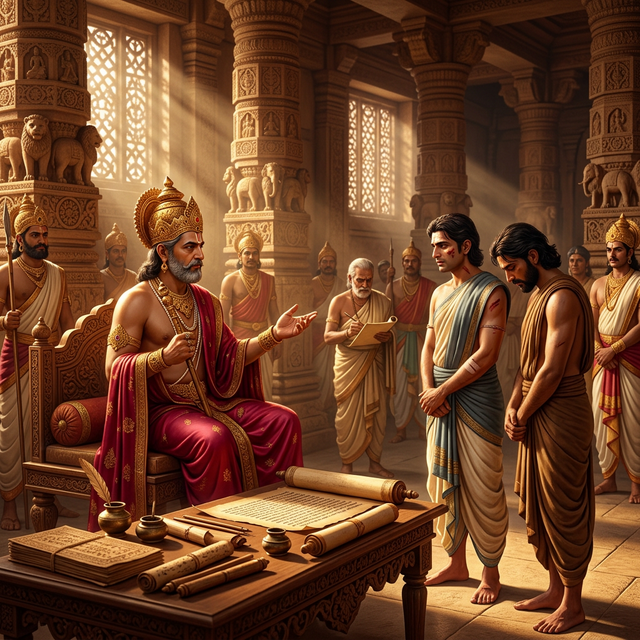
The edge of a dusty construction site near the city wall, where the air is thick with the scent of limestone and the rhythmic thud of wooden mallets, is a world of sudden physical friction and the sight of a victim clutching a bruised arm after a blow from a heavy wooden staff. Here, the Prince and Kautilya observe the forensic logic of "The Striking Hand," where the state’s bodily integrity is literalized in the regulation of physical injury. This is a place where the human pulse is measured in the restraint of the hand. Kautilya leads the Prince past the sweating laborers to where the inspectors record the "depth of the wound" and the judges ensure the "purity of the shield." In this forensic sphere, the state does not just punish; it anchors the peace of the person.
The "protection of the body" is the measure of the state’s coercive and moral control.
A thick wooden staff, its heavy grain smooth from use but now splintered at the end from a recent strike, lies in the dust. This object is the stake of the empire’s control over the "brutality of the aggressor": it is the "Vessel of the Assault." Kautilya explains that the state is the ultimate master of "assault" (Dandapárushyam). He points to the systematic regulation of the blow: "Touching, striking, or wounding shall be punished with fines varying by the degree of injury and the status of the parties... and he who causes a wound that bleeds shall pay double the fine." To Kautilya, a strike is not just a brawl but a "forensic violation" of the King's safety.
The stability of the Maurya realm is built upon this "physical accounting." A man who "lifts his hand in wrath" or a group that "gangs up on the solitary" is a man who is rusting the King’s internal strength.
The action of the site is a forensic monitoring of force and healing. Kautilya walks the Prince through the mapping of the "physical act," explaining the precise penalties for "striking with a hand, a foot, or a weapon." They watch as a judge evaluates the "severity of the bruise," requiring the aggressor to "bear the costs of the treatment" (Cikitsá). It is a world of total informational liability: the law details the "fines for pulling the hair" and the precise "compensation for broken limbs." They observe the "rules of the restraint," ensuring that the "integrity of the subject's skin" is as respected as the King’s own standard.
It is a technical, visceral discipline: the state measures the "rhythm of the strike" as precisely as it measures the "depth of the coffer," ensuring that the subject remains a source of labor as much as safety.
But the striking hand is also a center of total strategic deterrence. Kautilya points to the "repression of the violent," explaining that the state must ensure that the "engines of productivity" are never paralyzed by the "friction of the brutal." The Prince realizes that "The Striking Hand" is the ultimate expression of the "Concerning Law"—the place where the state’s power to "bind and protect" is literalized in the breaking of a staff. The King’s power is the power to "ascertain the honesty of the strength" and to ensure that the "determination of the penalty" is as regulated as the weight of a gold coin. "The Striking Hand" is the enduring conscience of the state, captured in the "cast staff" that binds the citizen to the physical peace.
Dandapárushyam (Assault)... It is the injury caused by physical force... Fines vary for touching, striking, or wounding... Group assaults are punished more severely... The aggressor shall pay for the medical treatment of the victim.
This is the rule of the force regulation, the documentation for a world where "unrestrained brutality" is the enemy of the state. It says that the "Ledger of Injuries" must be a scientist of restraint, and that the "protection of a laborer's arm" is as strategic as the defense of a granite quarry. It recognizes that "splintered staffs" and "bruised flesh" are the nodes of a network of safety that connects the King to "The Striking Hand." The construction site, with its "vows of safety" and its "scrupulous injury-keeping," is the physical evidence of this discipline. The men who need such a rule are those who have understood that the state's strength is first shielded, then secured.
The logic of the striker is the logic of the "Concerning Law." It completes the transition from the contract of the word to the contract of the body. It assumes that if you can master the "form of the strike" and the "forensic precision of the injury record," you can master the spirit of any civilization in the world. The state is no longer a master of the reputation; it is a master of the body.
The canto concludes on the image of a heavy wooden staff being broken into pieces and cast into a small fire by an officer, the dry wood crackling and popping as it burns. The sound of the flames is a resonant, low vibration that echoes the collective purification of the kingdom's law. Kautilya looks at the "net balance" of the day’s assaults and sees the resilient reach of the Mauryas written in the safety of the skin.
Outside, the site continues its heavy labor. But inside "The Striking Hand," the world is categorized, restrained, and secure. The Prince walks back from the wall, his mind full of wounds and amercements. He has seen the staff burn, and he has heard the fire crackle. He now knows that the empire is held together not just by laws or walls, but by the "uniform texture" of the body and the unblinking eye of the man who knows exactly what it means to be safe in the King's account.