Chapter 85 of 126
The shield of work—the industrial dominance of the landscape, where the King's works turn the wilderness into a productive engine of state.
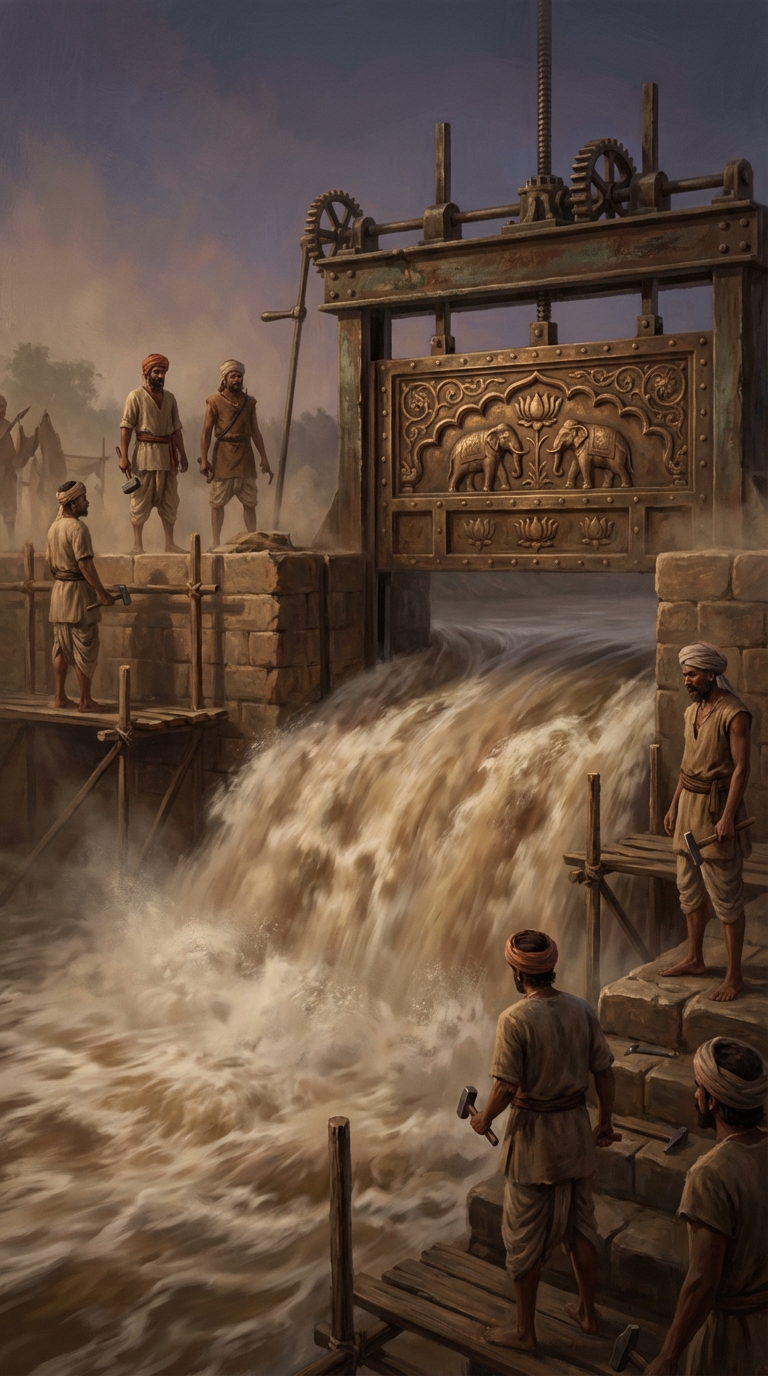
A massive, bustling construction site for a new irrigation dam on a tributary of the Ganges at dawn, where the rhythmic, heavy thud of stone-cutters' hammers competes with the sharp shouting of overseers and the sight of a lead architect consulting a large, complex site-map spread across a heavy wooden table, is a world of forensic industry and the smell of wet clay mixed with the sawdust of a thousand beams. Here, the Prince and Kautilya observe the forensic logic of "The Shield of Work," where the state’s progress is literalized in the stones of the dam. This is a place where the social pulse is measured in the output of the workforce.
Kautilya leads the Prince past the scaffolding to where the chief engineer determines the "integrity of the labor" and the state-spy ensures the "purity of the work-contract." In this forensic sphere, the state does not just build; it anchors the absolute liability of the effort. The "suppression of the work thorn" is the measure of the state’s creative and moral control.
A large, wooden site-map, its surface covered in ink-drawn lines representing canals, sluice-gates, and trade-routes, is held flat by several heavy bronze paper-weights. This object is the stake of the empire’s control over the "chaos of the unbuilt": it is the "Vessel of the Karmasu-sandhih." Kautilya explains that the state is the ultimate master of "Undertaking Works" (Karmasu-sandhih). He points to the map: "Work is the shield of the six-fold policy... we do not merely undertake projects; we evaluate the profitability of the enterprise—whether it be a cart-track to the north or a trade-route to the mines of the south—and we ensure that the output always exceeds the outlay." To Kautilya, an unprofitable work is not just a loss but a "forensic drain" that invites the state's own decay.
The stability of the Maurya machine is built upon this "industrial accounting." A King who "undertakes works productive of benefits to the enemy" or a general who "neglects the selection of trade-routes" is a man who is rusting his own internal strength.
The action of the construction site is a forensic monitoring of progress and profit. Kautilya walks the Prince through the mapping of the "legal undertaking," explaining the precise rules for "agreements for undertaking works" and the "distinction between trade-routes traversing mines vs. those frequented by people." They watch as an auditor evaluates the "integrity of the output," noting the "facilities for preparations on a large scale" alongside the "selection of routes traversed by asses or camels." It is a world of total informational liability: the law details the "penalties for an output and outlay at par" and the precise "rights of the state to avoid works of reverse nature." They observe the "rules of the sluice," ensuring that the "integrity of the sovereign industry" is as respected as the King’s own standard.
It is a technical, industrious discipline: the state measures the "cut of the stone" as precisely as it measures the "depth of the treasury," ensuring that the subject remains a source of security as much as service.
But the shield of work is also a center of total strategic creativity. Kautilya points to the "Project Ledger," explaining that the state must ensure that the "engines of the construction" are never paralyzed by the "friction of the stagnant." The Prince realizes that "The Shield of Work" is the ultimate expression of the "End of the Six-fold Policy"—the place where the state’s power to "design and deliver" is literalized in the opening of the gate. The King’s power is the power to "ascertain the honesty of the effort" and to ensure that the "determination of the industrial truth" is as regulated as the weight of a gold coin. "The Shield of Work" is the enduring conscience of the state, captured in the "site-maps" that bind the kingdom to the productive peace.
Karmasu-sandhih (Agreement for Undertaking a Work)... It is a loss for the conqueror to undertake that kind of work which is productive of benefits to the enemy... When the benefits are equal, the condition is stagnant... A work of less out-put and of a greater outlay is a loss... Of trade-routes leading to the south... that which traverses a large number of mines... is better... A cart-track is better than a foot-path... Whoever well-versed in polity acquires territory... with or without population will overreach other kings.
This is the rule of the industrial regulation, the documentation for a world where "logistical precision" is the security of the kingdom. It says that the "Ledger of the Mandala" must be a scientist of effort, and that the "protection of the state's industry" is as strategic as the defense of a state-owned fort. It recognizes that "massive wooden site-maps" and "bronze sluice-gates" are the nodes of a network of power that connects the King to "The Shield of Work." The construction site, with its "vows of unyielding progress" and its "scrupulous project-keeping," is the physical evidence of this discipline. The men who need such a rule are those who have understood that the state's strength is first designed, then secured.
The logic of the work is the logic of the "End of the Six-fold Policy." It completes the transition from the contract of the temporal sovereignty to the contract of the creative industry. It assumes that if you can master the "form of the project" and the "forensic precision of the work record," you can master the stability of any civilization in the world. The state is no longer a master of Time; it is a master of the Act.
The canto concludes on the image of the first rush of water flowing through a newly opened bronze sluice-gate, its sound a resonant, powerful roar that fills the construction site and drowns out the noise of the hammers. The sight of the water reaching the parched fields below is a visual, final anchor that echoes the collective stabilization of the kingdom's industrial foundations. Kautilya looks at the "net balance" of the book’s initial creative syntheses and sees the resilient reach of the Mauryas written in the strength of the dam.
Outside, the sun fully rises over the burgeoning industrial zone, where the future of the empire is being built stone by stone. But inside "The Shield of Work," the world is categorized, designed, and secure. The Prince walks back from the construction site, his mind full of maps and sluices. He has seen the stones cut, and he has heard the water roar. He now knows that the empire is held together not just by laws or walls, but by the "uniform texture" of the act and the unblinking eye of the man who knows exactly what it means to be productive in the King's account.