Chapter 47 of 126
The shadow of ownership—a study in the laws of property and adverse possession, ensuring that the land remains in the hands of the productive.
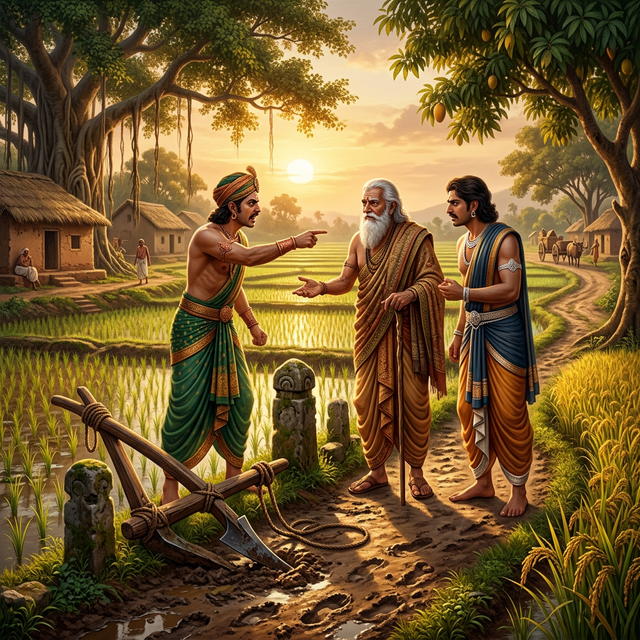
The interior of a dusty bazaar stall at the edge of the city, where the smell of damp earth and the heavy scent of unwashed livestock mingle with the sharp aroma of drying hides, is a world of disputed titles and the sight of a confused buyer holding the rope of a bull that is suddenly claimed by another. Here, the Prince and Kautilya observe the forensic logic of "The Shadow of Ownership," where the state’s property security is literalized in the proof of the acquisition. This is a place where the social pulse is measured in the validity of the title.
Kautilya leads the Prince past the tethered animals and stacked crates to where the witnesses stand ready to "vouch for the vendor" and the judges ensure the "recovery of the stolen." In this forensic sphere, the state does not just permit possession; it anchors the legality of the hold. The "protection of the owner" is the measure of the state’s economic and moral control.
A heavy iron-rimmed branding iron, its mark cold but sharp, rests on a wooden bench near the dispute. This object is the stake of the empire’s control over the "chaos of theft": it is the "Vessel of the Title." Kautilya explains that the state is the ultimate master of "sale without ownership" (Asvámivikrayah). He points to the systematic regulation of the recovery: "Any person who finds lost or stolen property shall inform the state...
and a buyer who purchases from a non-owner shall be liable if he cannot produce the seller." To Kautilya, possession is not just a physical fact but a "forensic status." The stability of the Maurya economy is built upon this "possessory accounting." A man who "sells what he does not own" or a finder who "hides the property" is a man who is rusting the King’s commercial strength.
The action of the bazaar is a forensic monitoring of line and title. Kautilya walks the Prince through the mapping of the "proof of ownership," explaining the precise roles of "householders as witnesses" and the "penalties for adverse possession" in the case of long-neglected lands. They watch as a judge mediates a dispute over a "reclaimed bull," requiring the original owner to "produce the evidence of birth or purchase." It is a world of total informational liability: the law details the "fines for fraudulent claims" and the precise "rights of the state over unclaimed goods." They observe the "rules of the recovery," ensuring that the "integrity of the title" is as respected as the King’s own standard.
It is a technical, social discipline: the state measures the "rhythm of the possession" as precisely as it measures the "depth of the coffer," ensuring that the subject remains a source of security as much as utility.
But the shadow of ownership is also a center of total strategic endurance. Kautilya points to the "finality of the claim," explaining that the state must ensure that the "engines of property" are never paralyzed by the "friction of the uncertain." The Prince realizes that "The Shadow of Ownership" is the ultimate expression of the "Concerning Law"—the place where the state’s power to "anchor and release" is literalized in the recovery of a beast. The King’s power is the power to "ascertain the honesty of the lineage" and to ensure that the "determination of the title" is as regulated as the weight of a gold coin. "The Shadow of Ownership" is the enduring conscience of the state, captured in the "reclaimed rope" that binds the citizen to the legal peace.
Asvámivikrayah (Sale Without Ownership)... Any person who finds lost or stolen property shall inform the King... A buyer should produce the seller to prove his innocence... Ownership is established by uninterrupted possession for a long time, or by valid witnesses.
This is the rule of the property regulation, the documentation for a world where "title-less sale" is the enemy of the state. It says that the "Ledger of Possession" must be a scientist of history, and that the "protection of a merchant's stock" is as strategic as the defense of a granary. It recognizes that "branding irons" and "tether-ropes" are the nodes of a network of stability that connects the King to "The Shadow of Ownership." The bazaar stall, with its "vows of title" and its "scrupulous witness-keeping," is the physical evidence of this discipline. The men who need such a rule are those who have understood that the state's strength is first owned, then secured.
The logic of the owner is the logic of the "Concerning Law." It completes the transition from the contract of the gift to the contract of the title. It assumes that if you can master the "form of the possession" and the "forensic precision of the title record," you can master the prosperity of any civilization in the world. The state is no longer a master of the honor; it is a master of the title.
The canto concludes on the image of a merchant's hand being marked with a temporary brand of shame by a municipal officer for selling a stolen bull, while the rightful owner, a farmer with a weary but relieved face, leads away the reclaimed animal into the fading light of the bazaar. The sound of the bull’s heavy hooves on the dry earth is a resonant, rhythmic sound that echoes the collective restoration of the kingdom's order. Kautilya looks at the "net balance" of the day’s recoveries and sees the resilient reach of the Mauryas written in the security of the word.
Outside, the city moves toward the night, a world of shadows and claims. But inside "The Shadow of Ownership," the world is categorized, proven, and secure. The Prince walks back from the market, his mind full of witnesses and long-possession. He has seen the bull reclaimed, and he has heard the brand hiss. He now knows that the empire is held together not just by laws or walls, but by the "uniform texture" of the title and the unblinking eye of the man who knows exactly what it means to be an owner in the King's account.