Chapter 45 of 126
The laws of rescision—the legal mechanism for correcting mistakes in trade, proving that the King's justice is as flexible as it is firm.
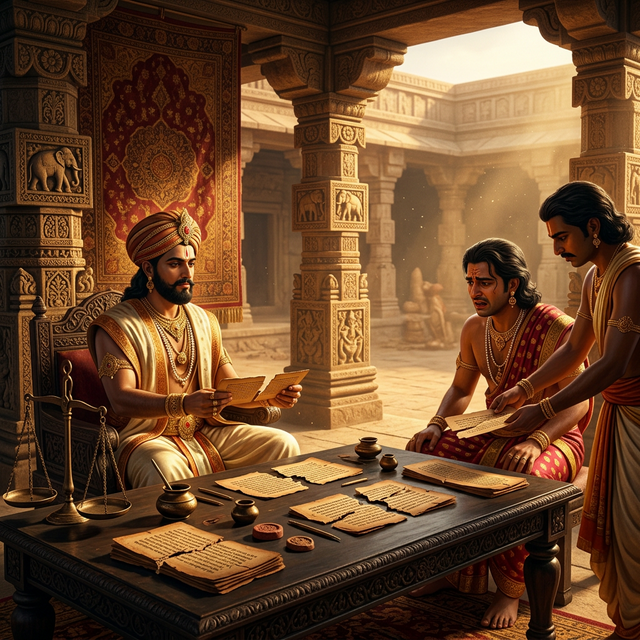
The interior of a busy retail cloth-shop in the mid-afternoon glare is a world of sharp, competitive haggling, the rustle of folded silk, and the sight of a disgruntled buyer holding up a length of indigo cloth that reveals a hidden tear under the sun. Here, the Prince and Kautilya observe the forensic logic of "The Rescision," where the state’s commercial stability is literalized in the finality of the transaction. This is a place where the retail pulse is measured in the fairness of the exchange. Kautilya leads the Prince past the stacked bolts of cotton to where the shopkeepers defend their "quality of the weave" and the judges ensure the "reversal of the fraud." In this mercantile sphere, the state does not just permit trade; it anchors the integrity of the purchase.
The "protection of the buyer" is the measure of the state’s economic and moral control.
A small bronze coin, held between the thumb and forefinger of a merchant who looks toward the judge with a mixture of annoyance and resignation, glints in the light. This object is the stake of the empire’s control over the "misrepresentation of quality": it is the "Vessel of the Reversal." Kautilya explains that the state is the ultimate master of the "rescision of purchase and sale" (Vikrayasvámisambandhah). He points to the systematic regulation of time: "One night for perishables, three nights for certain durable goods...
but a merchant who misrepresents the quality shall be fined." To Kautilya, a transaction is not just a swap of goods but a "forensic contract." The stability of the Maurya markets is built upon this "transactional accounting." A seller who "hides the defect" or a buyer who "returns the goods without cause" after the limit is a man who is rusting the King’s commercial peace.
The action of the shop is a forensic monitoring of quality and time. Kautilya walks the Prince through the mapping of the "valid rescision," explaining the precise penalties for "selling damaged items" and the "recovery of the price." They watch as a judge examines the "returned piece of silk," weighing its condition against the "recorded time of the sale." It is a world of total informational liability: the law details the "fines for breach of contract" and the precise "rights of the consumer." They observe the "rules of the market," ensuring that the "integrity of the bolt" is as respected as the King’s own standard.
It is a technical, commercial discipline: the state measures the "rhythm of the trade" as precisely as it measures the "depth of the coffer," ensuring that the subject remains a source of trust as much as expense.
But the rescision is also a center of total strategic equilibrium. Kautilya points to the "finality of the sale," explaining that the state must ensure that the "engines of commerce" are never paralyzed by the "endless flux of the indecisive." The Prince realizes that "The Rescision" is the ultimate expression of the "Concerning Law"—the place where the state’s power to "affirm and reverse" is literalized in the handing back of a coin. The King’s power is the power to "ascertain the honesty of the trade" and to ensure that the "determination of the transaction" is as regulated as the weight of a gold grain. "The Rescision" is the enduring conscience of the state, captured in the "returned scarf" that binds the citizen to the commercial peace.
Vikrayasvámisambandhah (Rescision of Purchase and Sale)... Time limits: 1 night for perishables, 3 nights for certain goods, 5 nights for others... A seller who misrepresents quality shall be fined... The state enforces the finality of the transaction.
This is the rule of the trade regulation, the documentation for a world where "unreliable exchange" is the enemy of the state. It says that the "Transaction Ledger" must be a scientist of fairness, and that the "protection of a farmer's seed-purchase" is as strategic as the defense of a royal treasury. It recognizes that "damaged cloth" and "returned coins" are the nodes of a network of stability that connects the King to "The Rescision." The retail shop, with its "vows of quality" and its "scrupulous time-keeping," is the physical evidence of this discipline. The men who need such a rule are those who have understood that the state's strength is first traded, then secured.
The logic of the rescision is the logic of the "Concerning Law." It completes the transition from the contract of the joint-venture to the contract of the single-swap. It assumes that if you can master the "form of the exchange" and the "forensic precision of the trade record," you can master the prosperity of any civilization in the world. The state is no longer a master of the collective; it is a master of the transaction.
The canto concludes on the image of a merchant reluctantly handing back a heavy silver coin to a buyer, who in turn hands back a torn silk scarf, their fingers brushing as the state-enforced reversal is completed under the watchful eye of a municipal inspector. The sound of the morning market’s clamor is a resonant, low vibration that echoes the collective integrity of the kingdom's trade. Kautilya looks at the "net balance" of the day’s reversals and sees the resilient reach of the Mauryas written in the fairness of the word.
Outside, the market thrives, a world of ambition and risk. But inside "The Rescision," the world is categorized, balanced, and secure. The Prince walks back from the shop, his mind full of nights and fine-counts. He has seen the coin return, and he has heard the scarf rustle. He now knows that the empire is held together not just by laws or walls, but by the "uniform texture" of the exchange and the unblinking eye of the man who knows exactly what it means to make a fair trade in the King's account.