Chapter 87 of 126
The recruitment of power—the strategic mobilization of the Circle of States to restore the King's presence in a time of decay.
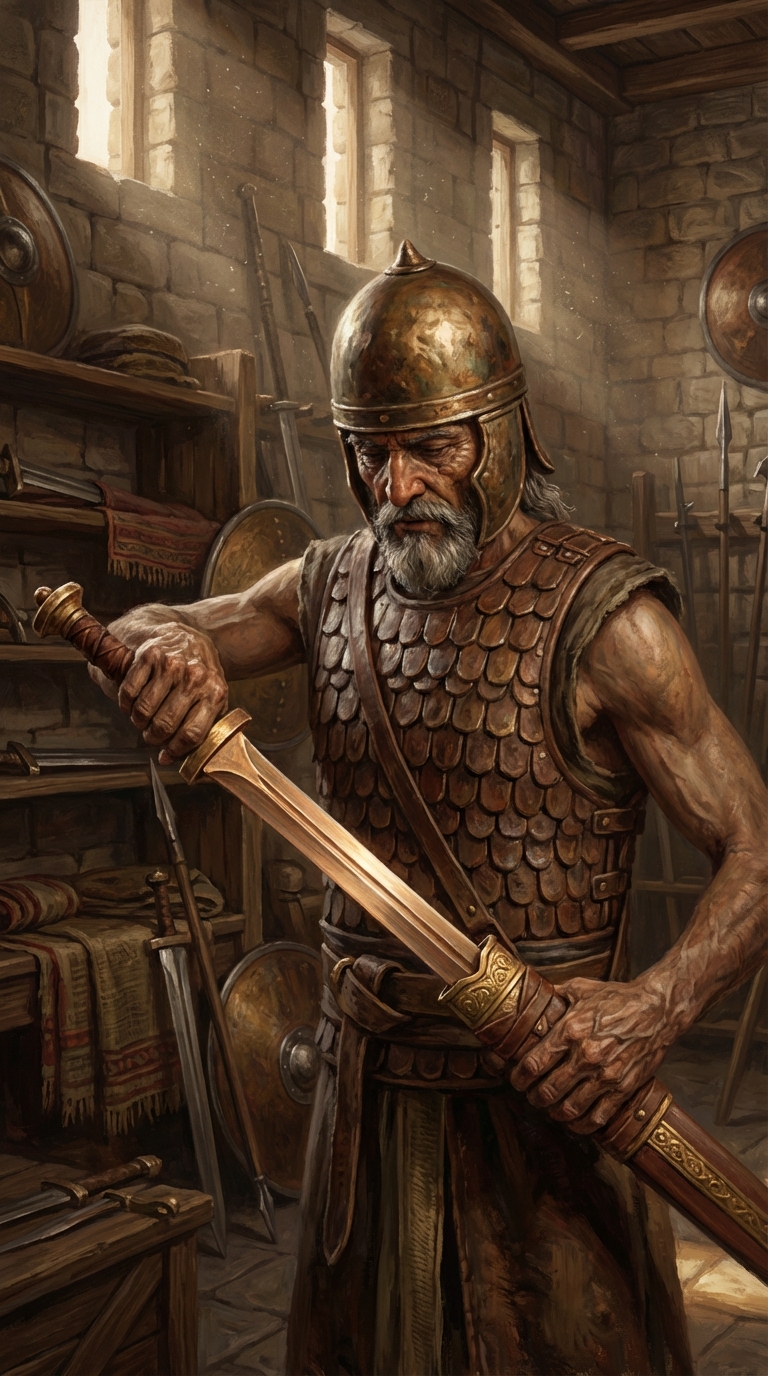
A dusty, ancient armory deep within the fortress of Pataliputra being reopened at dawn, where the low, golden light of torches illuminates the rhythmic, sharp scraping of whetstones against bronze and the smell of old oil and cold metal as a line of veteran soldiers methodically cleans rows of rusted but still sharp swords, is a world of forensic restoration and the sight of a "Recruitment of Power" being literalized in the blade. Here, the Prince and Kautilya observe the forensic logic of "The Recruitment of Power," where the state’s resurgence is literalized in the preparation of the armory. This is a place where the social pulse is measured in the noise of the whetstone.
Kautilya leads the Prince past the stacked shields to where the chief armorer determines the "integrity of the resurgence" and the state-spy ensures the "purity of the strategic recovery." In this forensic sphere, the state does not just rearm; it anchors the absolute liability of the restoration. The "suppression of the loss thorn" is the measure of the state’s resilient and moral control.
A single bronze sword, its blade freshly sharpened to a mirror-edge and its hilt inscribed with the marks of the Maurya lineage, is held up to the light by a veteran. This object is the stake of the empire’s control over the "chaos of the defeated": it is the "Vessel of the Punahsambhavah." Kautilya explains that the state is the ultimate master of "Power Restoration" (Punahsambhavah). He points to the sword: "Recovery is the rebirth of the six-fold policy... we do not merely clean weapons; we calculate the mobilization of the ákranda and the engagement of the friend's friend, and we ensure that our counsels remain as silent as the armory's stones." To Kautilya, an uncalculated defeat is not just a loss but a "forensic failure" that invites the state's own decay.
The stability of the Maurya machine is built upon this "restorative accounting." A King who "fails to provoke hostilities among the allies of his rear-enemy" or an administrator who "exposes his counsels before the resurgence is complete" is a man who is rusting his own internal strength.
The action of the armory is a forensic monitoring of rearmament and alignment. Kautilya walks the Prince through the mapping of the "legal restoration," explaining the precise rules for "recruiting lost power" and the "use of the ákranda to frustrate the rear-enemy's ally." They watch as a recovery officer evaluates the "integrity of the armaments," noting the "war between the allies of the ákranda" alongside the "frustration of the rear-enemy's designs." It is a world of total informational liability: the law details the "penalties for failing to bring the Circle under sway" and the precise "rights of the state to utilize the friend's friend." They observe the "rules of the whetstone," ensuring that the "integrity of the sovereign power" is as respected as the King’s own standard.
It is a technical, restorative discipline: the state measures the "sharpness of the edge" as precisely as it measures the "depth of the treasury," ensuring that the subject remains a source of security as much as service.
But the recruitment of power is also a center of total strategic rebirth. Kautilya points to the "Restoration Ledger," explaining that the state must ensure that the "engines of the resurgence" are never paralyzed by the "friction of the indiscreet." The Prince realizes that "The Recruitment of Power" is the ultimate expression of the "End of the Six-fold Policy"—the place where the state’s power to "sharpen and shield" is literalized in the holding of the blade. The King’s power is the power to "ascertain the honesty of the resurgence" and to ensure that the "determination of the restorative truth" is as regulated as the weight of a gold coin. "The Recruitment of Power" is the enduring conscience of the state, captured in the "bronze swords" that bind the kingdom to the resilient peace.
Punahsambhavah (Recruitment of Lost Power)... engaging their respective frontal enemies... he who destroys an enemy of deep rooted enmity gains more... The conqueror should frustrate the rear-enemy's designs... provoke hostilities between the allies of the ákranda... through the aid of his friends bring the Circle under his sway... Destroyed the strength of his enemies... counselors concealed... perishing as undoubtedly as a broken raft on the sea.
This is the rule of the restorative regulation, the documentation for a world where "resilient precision" is the security of the kingdom. It says that the "Ledger of the Mandala" must be a scientist of recovery, and that the "protection of the state's resurgence" is as strategic as the defense of a state-owned fort. It recognizes that "bronze whetstones" and "freshly-oiled blades" are the nodes of a network of power that connects the King to "The Recruitment of Power." The armory, with its "vows of unyielding restoration" and its "scrupulous power-keeping," is the physical evidence of this discipline. The men who need such a rule are those who have understood that the state's strength is first sharpened, then secured.
The logic of the recruitment is the logic of the "End of the Six-fold Policy." It completes the transition from the contract of the adversarial awareness to the contract of the restorative power. It assumes that if you can master the "form of the recovery" and the "forensic precision of the renewal record," you can master the stability of any civilization in the world. The state is no longer a master of the Unknown; it is a master of the Rebirth.
The canto concludes on the image of the veteran soldier sheathing his freshly sharpened bronze sword with a sharp, final click, while the shadows of the armory begin to fade in the growing daylight. The sight of the rows of cleaned weapons gleaming in the morning light is a visual, final anchor that echoes the collective stabilization of the kingdom's military foundations. Kautilya looks at the "net balance" of the book’s initial restorative syntheses and sees the resilient reach of the Mauryas written in the gleam of the bronze.
Outside, the sun fully breaks over the fortress, where the newly armed patrols begin their dawn march. But inside "The Recruitment of Power," the world is categorized, restored, and secure. The Prince walks back from the armory, his mind full of swords and whetstones. He has seen the blade sharpened, and he has heard the secret kept. He now knows that the empire is held together not just by laws or walls, but by the "uniform texture" of the recovery and the unblinking eye of the man who knows exactly what it means to be reborn in the King's account.