Chapter 91 of 126
The master of the circle—a final synthesis of the diplomatic wheel, where the six-fold policy turns the world into a system of mastery.
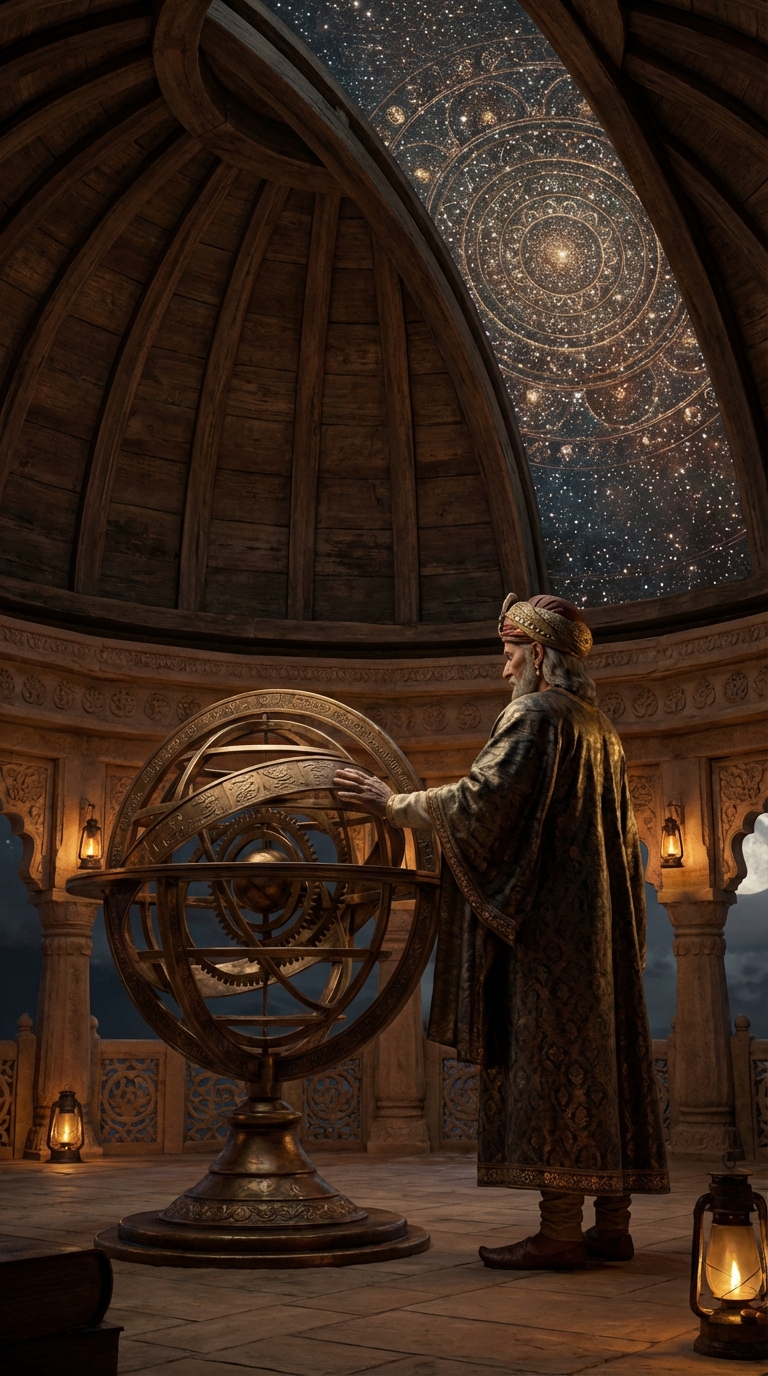
A grand, open-air astronomical observatory atop the highest tower of the palace at midnight, where the vast, crystalline vault of the sky is reflected in a series of deep, circular water-basins and the only sound is the rhythmic, metallic whisper of a massive bronze armillary sphere turning on its axis, is a world of forensic orchestration and the sight of a "Master of the Circle" being literalized in the stars. Here, the Prince and Kautilya observe the forensic logic of "The Master of the Circle," where the state’s total sway is literalized in the alignment of the heavens. This is a place where the social pulse is measured in the silence of the constellations.
Kautilya leads the Prince past the stone measurement-pillars to where the chief astronomer determines the "integrity of the Mandala" and the state-spy ensures the "purity of the strategic orbit." In this forensic sphere, the state does not just rule; it anchors the absolute liability of the universe. The "suppression of the orbit thorn" is the measure of the state’s cosmic and moral control.
A massive bronze armillary sphere, its rings inscribed with the twelve positions of the Mandala and its center containing a single, polished iron sphere representing the conqueror, turns slowly under the hand of the astronomer. This object is the stake of the empire’s control over the "chaos of the unchained": it is the "Vessel of the Mandala-sandhih." Kautilya explains that the state is the ultimate master of "Circle Conduct" (Mandala-sandhih). He points to the sphere: "Policy is a system of chains...
we do not merely negotiate; we observe the conduct of the Madhyama and the Neutral king, we subdue the friend who keeps quiet under troubles, and we ensure that the six kinds of policy are chains skillfully devised to bind the Circle around our will." To Kautilya, a strategic vacuum is not just an opening but a "forensic gap" that invites the state's own decay. The stability of the Maurya machine is built upon this "orbital accounting." A King who "fails to knowledge the interdependence of the six policies" or a ruler who "is not acquainted with the conditions of progress and deterioration" is a man who is rusting his own internal strength.
The action of the observatory is a forensic monitoring of alignment and sway. Kautilya walks the Prince through the mapping of the "legal universe," explaining the precise rules for "the conduct of a Madhyama King, a Neutral King, and the Circle of States." They watch as a celestial officer evaluates the "integrity of the alignment," noting the "help given to a friend seeking protection both from the conqueror and the enemy" alongside the "subduing of the quiet friend." It is a world of total informational liability: the law details the "penalties for failing to observe the conditions of reduction" and the precise "rights of the state to play at pleasure with kings." They observe the "rules of the stars," ensuring that the "integrity of the sovereign sway" is as respected as the King’s own standard.
It is a technical, cosmic discipline: the state measures the "rhythm of the rings" as precisely as it measures the "depth of the treasury," ensuring that the subject remains a source of security as much as service.
But the master of the circle is also a center of total strategic finality. Kautilya points to the "Circle Ledger," explaining that the state must ensure that the "engines of the heavens" are never paralyzed by the "friction of the unguided." The Prince realizes that "The Master of the Circle" is the ultimate expression of the "End of the Six-fold Policy"—the place where the state’s power to "align and anchor" is literalized in the turning of the sphere. The King’s power is the power to "ascertain the honesty of the position" and to ensure that the "determination of the final truth" is as regulated as the weight of a gold coin. "The Master of the Circle" is the enduring conscience of the state, captured in the "bronze armillary spheres" that bind the kingdom to the total peace.
The Conduct of a Madhyama King, a Neutral King and of a Circle of States... Whoever is acquainted with the science of polity should clearly observe the conditions of progress, deterioration, stagnation... whoever thus knows the interdependence of the six kinds of policy plays at his pleasure with kings, bound round, as it were, in chains skillfully devised by himself... End of Book VII, "The End of the Six-fold Policy."
This is the rule of the cosmic regulation, the documentation for a world where "strategic precision" is the security of the kingdom. It says that the "Ledger of the Mandala" must be a scientist of the orbit, and that the "protection of the state's total peace" is as strategic as the defense of a state-owned fort. It recognizes that "bronze armillary spheres" and "circular water-basins" are the nodes of a network of power that connects the King to "The Master of the Circle." The observatory, with its "vows of unyielding alignment" and its "scrupulous sway-keeping," is the physical evidence of this discipline. The men who need such a rule are those who have understood that the state's strength is first aligned, then secured.
The logic of the master is the logic of the "End of the Six-fold Policy." It completes the transition from the contract of the strategic survival to the contract of the absolute sway. It assumes that if you can master the "form of the interdependence" and the "forensic precision of the orbital record," you can master the stability of any civilization in the world. The state is no longer a master of the Now; it is a master of the Eternal.
The canto concludes on the image of the King standing alone at the edge of the observatory roof, his hand resting on the turning bronze armillary sphere as the dome above him begins to slide open to reveal the infinite, silent stars of the true Mandala. The sight of the King's shadow cast by the starlight onto the stone floor is a visual, final anchor that echoes the collective stabilization of the kingdom's final foundations. Kautilya looks at the "net balance" of the book’s total strategic syntheses and sees the resilient reach of the Mauryas written in the silence of the heavens.
Outside, the stars continue their eternal dance over the unified Mandala, but the policy is complete, and the Circle is bound. But inside "The Master of the Circle," the world is categorized, aligned, and secure. The Prince walks back from the tower, his mind full of spheres and stars. He has seen the dome open, and he has heard the music of the chains. He now knows that the empire is held together not just by laws or walls, but by the "uniform texture" of the sway and the unblinking eye of the man who knows exactly what it means to be master in the King's account.