Chapter 80 of 126
The friend in need—the forensic analysis of alignment, showing why the strategic help of another is the King's most valuable asset.
A grand but somber reception hall in the palace of a weakened ally at dusk, where the fading light casts long, distorted shadows across the polished stone floor and the only sound is the sudden, sharp clatter of a heavy silver cup falling from the trembling hand of a worried King as he receives a dust-covered messenger kneeling before him, is a world of forensic aid and the sight of a frantic plea written on a sweat-stained birch-bark scroll. Here, the Prince and Kautilya observe the forensic logic of "The Friend in Need," where the state’s mercy is literalized in the calculation of the ally’s utility. This is a place where the social pulse is measured in the desperation of the neighbor.
Kautilya leads the Prince past the anxious courtiers to where the chief diplomat determines the "integrity of the plea" and the state-spy ensures the "purity of the ally's future worth." In this forensic sphere, the state does not just help; it anchors the absolute liability of the aid. The "suppression of the friend-in-need thorn" is the measure of the state’s strategic and moral control.
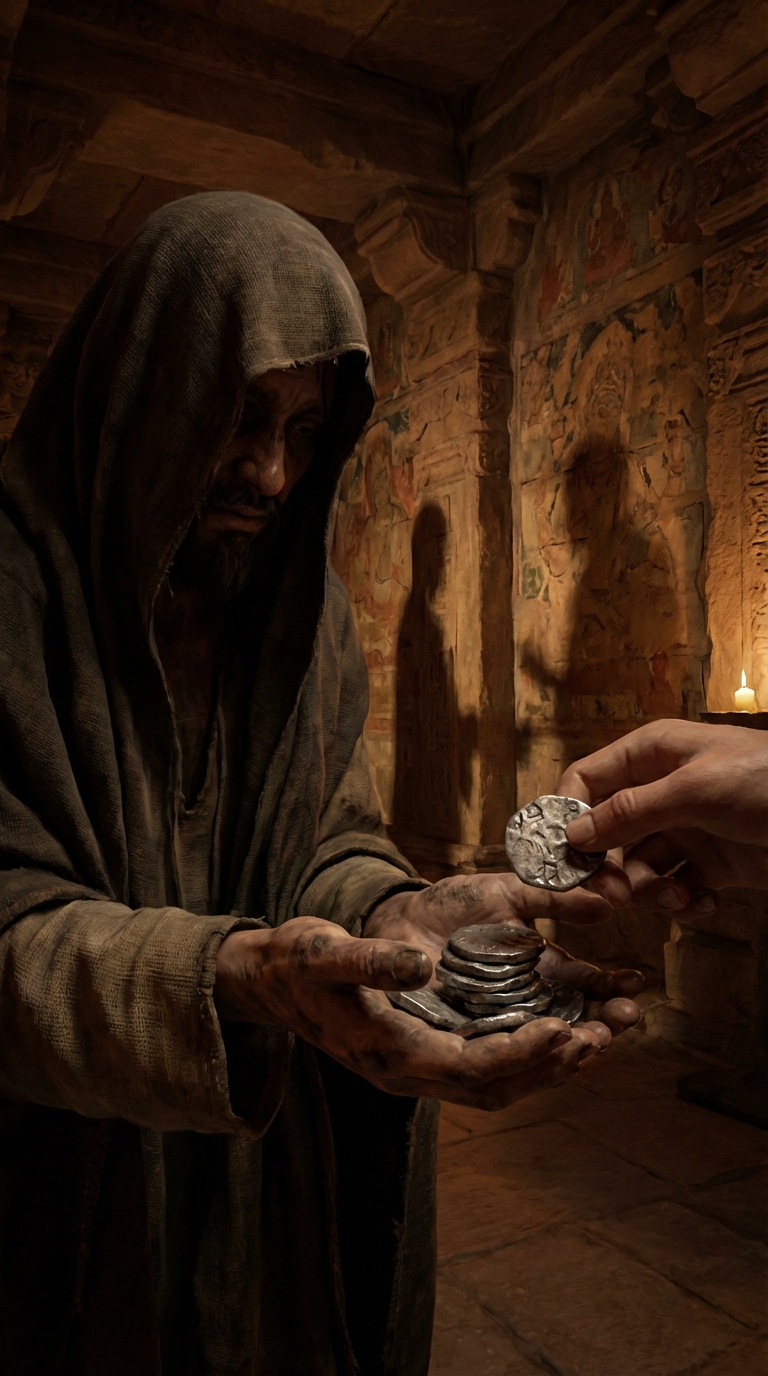
A stack of cold silver coins, neatly piled and bound in a heavy leather pouch, rests on the low table between the two monarchs. This object is the stake of the empire’s control over the "chaos of the failing": it is the "Vessel of the Sakti-pumshoh." Kautilya explains that the state is the ultimate master of "Aid and Assistance" (Sakti-pumshoh). He points to the messenger: "A friend in need is a strategic opportunity... we do not help merely out of sentiment, but to ensure that the balance of the Mandala is maintained, and that the friend we save today becomes the shield we need tomorrow." To Kautilya, a misguided aid is not just a waste but a "forensic drain" that invites the state's own decay.
The stability of the Maurya machine is built upon this "compassionate accounting." A King who "saves a friend at the cost of his own treasury" or a general who "leaves his best troops in a foreign war" is a man who is rusting his own internal strength.
The action of the hall is a forensic monitoring of stability and risk. Kautilya walks the Prince through the mapping of the "legal assistance," explaining the precise rules for "sending out the various kinds of army—hired, corporation, or wild tribes" and the "rules for the evaluation of a friend's dwindling vs.
growing power." They watch as a diplomat evaluates the "integrity of the requested force," noting the "reliability of the ally's character" alongside the "unfavorable seasons for the march." It is a world of total informational liability: the law details the "penalties for an ally's failure to return the borrowed army" and the precise "rights of the state to make peace with the ally's enemy if the risk becomes too great." They observe the "rules of the debt," ensuring that the "integrity of the sovereign support" is as respected as the King’s own standard. It is a technical, cautious discipline: the state measures the "clatter of the cup" as precisely as it measures the "depth of the border," ensuring that the subject remains a source of security as much as service.
But the friend in need is also a center of total strategic caution. Kautilya points to the "Assistance Ledger," explaining that the state must ensure that the "engines of the alliance" are never paralyzed by the "friction of the overextended." The Prince realizes that "The Friend in Need" is the ultimate expression of the "End of the Six-fold Policy"—the place where the state’s power to "preserve and protect" is literalized in the passing of the silver pouch. The King’s power is the power to "ascertain the honesty of the friend" and to ensure that the "determination of the humanitarian truth" is as regulated as the weight of a gold coin. "The Friend in Need" is the enduring conscience of the state, captured in the "silver coins" that bind the kingdom to the strategic peace.
Sakti-pumshoh (Friends that Deserve Help)... When the profit accruing to kings under an agreement... is equal to all, that agreement is termed peace (sandhi); when unequal, it is termed defeat... Either that kind of army which has the experience of all sorts of grounds... or the army of enemies or of wild tribes... shall be sent... When the ally has finished his work, he should try to get back his army... If a king achieves his object with the assistance of a friend... he shall overreach him.
This is the rule of the strategic regulation, the documentation for a world where "calculated aid" is the security of the kingdom. It says that the "Ledger of the Mandala" must be a scientist of crisis, and that the "protection of the allied element" is as strategic as the defense of a state-owned fort. It recognizes that "silver coins" and "birch-bark pleas" are the nodes of a network of power that connects the King to "The Friend in Need." The hall, with its "vows of unyielding support" and its "scrupulous risk-keeping," is the physical evidence of this discipline. The men who need such a rule are those who have understood that the state's strength is first shared, then secured.
The logic of the aid is the logic of the "End of the Six-fold Policy." It completes the transition from the contract of the multi-lateral resolution to the contract of the strategic mercy. It assumes that if you can master the "form of the plea" and the "forensic precision of the assistance record," you can master the stability of any civilization in the world. The state is no longer a master of the Mandala; it is a master of the Future.
The canto concludes on the image of a stack of cold silver coins being slowly placed into the shaking, soot-stained hands of the messenger, while the long shadows of the hall reach out to touch the cold stone walls. The sound of the coins clinking together is a resonant, final sound that echoes the collective stabilization of the kingdom's charitable foundations. Kautilya looks at the "net balance" of the book’s initial aid syntheses and sees the resilient reach of the Mauryas written in the weight of the silver.
Outside, the messenger rides back into the night, carrying the King's hope and the Maurya's terms. But inside "The Friend in Need," the world is categorized, evaluated, and secure. The Prince walks back from the shadows, his mind full of cups and coins. He has seen the coins given, and he has heard the plea answered. He now knows that the empire is held together not just by laws or walls, but by the "uniform texture" of the mandala and the unblinking eye of the man who knows exactly what it means to be a friend in the King's account.