Chapter 52 of 126
The final verdict—the laws of miscellaneous offenses, ensuring that no act of disorder is too small for the King's forensic attention.
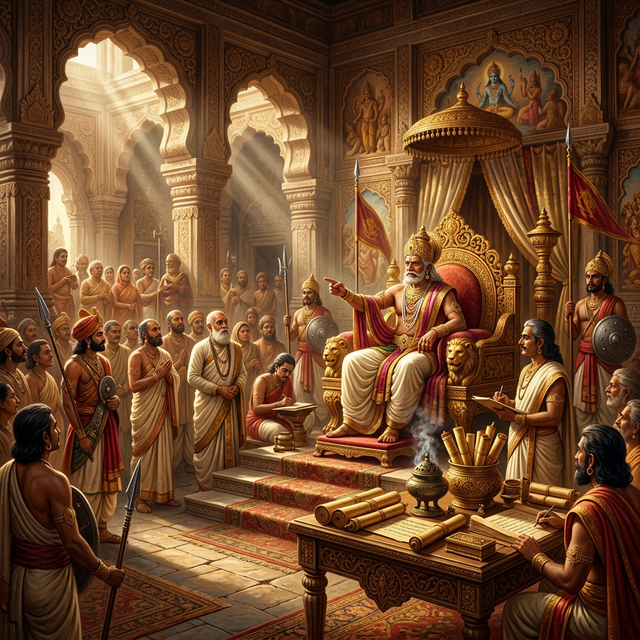
The interior of the central record hall, where the air is heavy with the scent of aged birch-bark and the low, persistent drone of scribes reading back the day’s miscellaneous infractions, is a world of administrative finality and the sight of a judge’s bronze hammer resting on a thick hide-bound district ledger. Here, the Prince and Kautilya observe the forensic logic of "The Final Verdict," where the state’s total reach is literalized in the capture of the "unaccounted." This is a place where the social pulse is measured in the closure of the claim. Kautilya leads the Prince past the stacked scrolls to where the inspectors record the "abandonment of companions" and the judges ensure the "purity of the confinement." In this forensic sphere, the state does not just adjudicate; it anchors the absolute accountability of the subject.
The "protection of the administrative order" is the measure of the state’s bureaucratic and moral control.
A heavy bronze judge’s hammer, its head polished from decades of strikes and its handle carved with the symbols of the Dharma, rests on a stone podium. This object is the stake of the empire’s control over the "residue of the lawless": it is the "Vessel of the Verdict." Kautilya explains that the state is the ultimate master of "miscellaneous offenses" (Prakínnakam). He points to the systematic regulation of the infraction: "Abandoning a companion in a forest shall be punished with the middle amercement... and illegal confinement of a citizen shall be punished with a fine of a thousand panas." To Kautilya, a minor infraction is not just a nuisance but a "forensic leak" in the King's authority.
The stability of the Maurya administration is built upon this "miscellaneous accounting." A man who "abuses the King" or a pilgrim who "violates the path" is a man who is rusting the King’s civil strength.
The action of the hall is a forensic monitoring of duty and record. Kautilya walks the Prince through the mapping of the "administrative liability," explaining the precise penalties for "failing to report a crime" and the "rules for the treatment of ascetics." They watch as a judge evaluates the "evidence of the neglect," requiring a village headman to "pay the fine for a missed report." It is a world of total informational liability: the law details the "fines for insulting the high-born" and the precise "rights of the abandoned to restoration." They observe the "rules of the verdict," ensuring that the "integrity of the state's record" is as respected as the King’s own standard.
It is a technical, final discipline: the state measures the "rhythm of the infraction" as precisely as it measures the "depth of the coffer," ensuring that the subject remains a source of order as much as duty.
But the final verdict is also a center of total strategic closure. Kautilya points to the "exhaustion of the dispute," explaining that the state must ensure that the "engines of the law" are never paralyzed by the "friction of the unresolved." The Prince realizes that "The Final Verdict" is the ultimate expression of the "Concerning Law"—the place where the state’s power to "conclude and punish" is literalized in the strike of a hammer. The King’s power is the power to "ascertain the honesty of the life" and to ensure that the "determination of the fine" is as regulated as the weight of a gold coin. "The Final Verdict" is the enduring conscience of the state, captured in the "bronze hammer" that binds the citizen to the administrative peace.
Prakínnakam (Miscellaneous)... Abandoning a companion in a forest is a crime... Illegal confinement shall be punished with heavy fines... Those who abuse the King or his officers shall be penalized... Rules for pilgrims and the diseased ensure their protection while maintaining order.
This is the rule of the final regulation, the documentation for a world where "unresolved friction" is the enemy of the state. It says that the "Ledger of Infractions" must be a scientist of closure, and that the "protection of a traveler's companionship" is as strategic as the defense of a royal treasury. It recognizes that "bronze hammers" and "hide-bound ledgers" are the nodes of a network of order that connects the King to "The Final Verdict." The record hall, with its "vows of accuracy" and its "scrupulous duty-keeping," is the physical evidence of this discipline. The men who need such a rule are those who have understood that the state's strength is first closed, then secured.
The logic of the verdict is the logic of the "Concerning Law." It completes the transition from the contract of the chance to the contract of the finality. It assumes that if you can master the "form of the infraction" and the "forensic precision of the miscellaneous record," you can master the end of any civilization in the world. The state is no longer a master of the luck; it is a master of the end.
The canto concludes on the image of a judge’s bronze hammer striking the stone podium with a heavy, final sound, the vibration traveling through the thick walls of the record hall. The sound of the strike is a resonant, deep sound that echoes the collective closure of the kingdom's law for Book III. Kautilya looks at the "net balance" of the day’s verdicts and sees the resilient reach of the Mauryas written in the finality of the word.
Outside, the city moves toward its next phase. But inside "The Final Verdict," the world is categorized, settled, and secure. The Prince walks back from the hall, his mind full of ledgers and hammers. He has seen the verdict struck, and he has heard the sound echo. He now knows that the empire is held together not just by laws or walls, but by the "uniform texture" of the finality and the unblinking eye of the man who knows exactly what it means to be settled in the King's account.