Chapter 39 of 126
The divided line of inheritance, where the precise distribution of wealth ensures the continuity of the lineage and the stability of the social order.
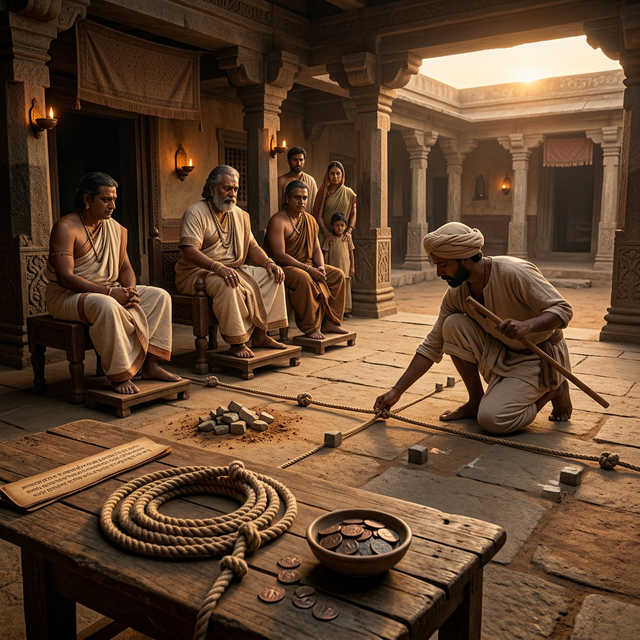
The rooms of a Mauryan household in the quiet aftermath of a patriarch’s passing are a world of long, amber shadows and the solemn, rhythmic breathing of sons gathered in a quiet hall. Here, the Prince and Kautilya observe the extinguishing of a single oil lamp, its final flicker marking the transition from the legacy of the father to the destiny of the heirs—a moment that is, in Kautilya’s forensic view, the critical test of social continuity. This is "The Divided Line," a place where the state’s order is literalized in the partitioning of the past. Kautilya leads the Prince past the mourning relatives to where three judges and a royal surveyor prepare to measure the "accounts of the ancestors." In this domestic sphere, the state does not just honor the dead; it audits the living.
The "equity of the share" is the measure of the state’s fiscal and moral control.
A long, knotted surveyor’s rope, its fibers worn from years of measuring the kingdom’s soil, rests on a table beside a pile of copper coins and grain jars. This object is the stake of the empire’s control over the "resentment of the future": it is the "Vessel of Choice." Kautilya explains that the state is the ultimate master of the "division of inheritance." He points to the systematic hierarchy of distribution: "The eldest son shall have a special share...
but the father shall make no distinction in dividing the property among his sons while he is alive." To Kautilya, an inheritance is not just a gift but a "forensic legacy." The stability of the Maurya realm is built upon this "generational accounting." A judge who cannot resolve a "dispute of the shares" or account for the "debts of the deceased" is a man who is sowing the seeds of civil strife.
The action of the division is a forensic monitoring of lineage and asset. Kautilya walks the Prince through the mapping of the property, explaining the rights of the brothers and the protection of the "strídhana" of the widow. They watch as the surveyor lays the rope across the family’s ancestral fields, marking the boundaries for each son with the precision of a temple architect.
It is a world of total ancestral liability: the law details the "retention of property" for those without heirs and the precise "priority of the creditors." They observe the "protection of the fatherless," ensuring that the youngest sons and daughters are not left "cold and without a hearth." It is a technical, familial discipline: the state measures the "rhythm of the legacy" as precisely as it measures the "depth of the coffer," ensuring that the household remains a source of loyalty as much as tax.
But the division of the past is also a center of total strategic preservation. Kautilya points to the "debts of the father," explaining that the state must ensure that the "liabilities of the dead" do not paralyze the "productivity of the living." The Prince realizes that "The Divided Line" is the ultimate expression of the "Concerning Law"—the place where the state’s power to "equate and distribute" is literalized in the stretching of a rope. The King’s power is the power to "ascertain the honesty of the heirs" and to ensure that the "determination of the shares" is as regulated as the price of salt. "The Divided Line" is the enduring conscience of the state, captured in the "surveyor’s knot" that binds the generation to the crown.
A father, distributing his property while he is alive, shall make no distinction in dividing it among his sons... Father being dead, the elder sons shall show favour to the younger ones... Of the property of a dead man, the state shall take the remainder after providing for the maintenance of his wife and family.
This is the rule of the generational regulation, the documentation for a world where "familial discord" is the enemy of the state. It says that the "Surveyor’s Rope" must be a scientist of equity, and that the "registration of a dead man's gold" is as strategic as the arming of a frontier fort. It recognizes that "extinguished lamps" and "surveyor's ropes" are the nodes of a network of peace that connects the King to "The Divided Line." The family hall, with its "vows of division" and its "scrupulous measurements," is the physical evidence of this discipline. The men who need such a rule are those who have understood that the state's strength is first inherited, then integrated.
The logic of the legacy is the logic of the "Concerning Law." It completes the transition from the contract of the marriage fire to the contract of the ancestral soil. It assumes that if you can master the "form of the division" and the "forensic precision of the inheritance record," you can master the loyalty of any subject in the world. The state is no longer a master of the life-cycle; it is a master of the history.
The canto concludes on the image of the surveyor’s rope being pulled taut across the dusty earth of a family courtyard, the knots marking the exact shares for each brother under the unblinking gaze of the royal judges. The evening breeze stirs the dust, and the silence of the brothers is a resonant, heavy vibration that echoes the collective weight of the kingdom’s future. Kautilya looks at the "net balance" of the day’s divisions and sees the resilient reach of the Mauryas written in the equity of the line.
Outside, the darkness of the transition settles over the lineages. But inside "The Divided Line," the world is categorized, measured, and secure. The Prince walks back from the hall, his mind full of shares and ropes. He has seen the final lamp go out, and he has heard the stretch of the surveyor’s cord. He now knows that the empire is held together not just by bonds or walls, but by the "uniform texture" of the past and the unblinking eye of the man who knows exactly what it means to be an heir in the King's account.