Chapter 62 of 126
The department's purity—the strategic audit of the state's own servants, ensuring that the machine of government is never rusted by corruption.
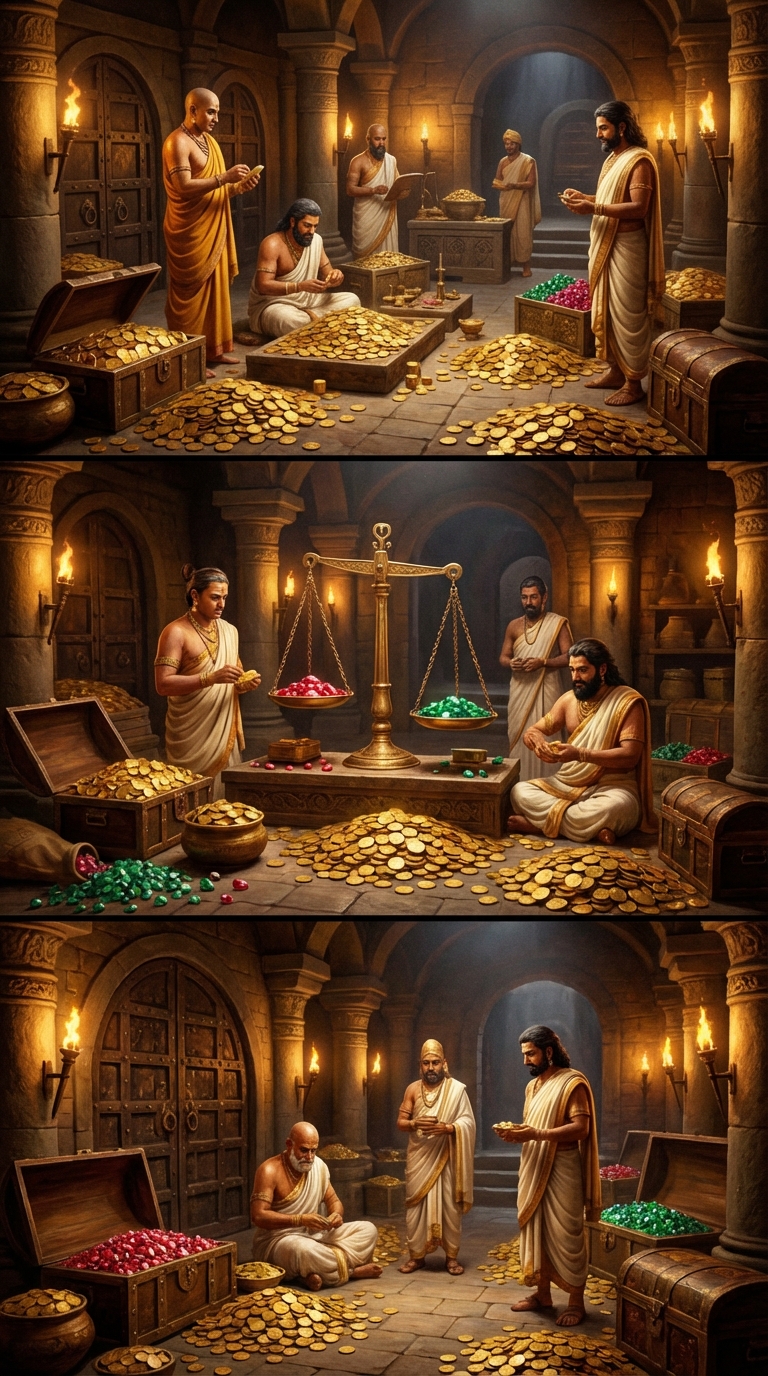
The vast, silent expanse of the central administrative archive in Pataliputra, where the air is dry with the scent of old birch-bark and the slow, rhythmic scratch of a hundred scribes' brushes on scrolls creates a background hum of bureaucratic life, is a world of forensic oversight and the sight of a government seal being pressed into hot, red wax by a senior auditor. Here, the Prince and Kautilya observe the forensic logic of "The Department's Purity," where the state’s internal health is literalized in the integrity of the record. This is a place where the social pulse is measured in the accuracy of the account.
Kautilya leads the Prince past the mountain of tax-registers to where the inspectors detect the "administrative parasite" and the collector-general ensures the "purity of the civil service." In this forensic sphere, the state does not just govern; it anchors the absolute liability of the office. The "suppression of the bureaucratic thorn" is the measure of the state’s fiscal and moral control.
A bronze-bound box for official seals, its surface engraved with the royal crest and its lid secured by a complex locking mechanism that requires two separate keys to open, rests on the senior auditor’s desk. This object is the stake of the empire’s control over the "chaos of the corrupt": it is the "Vessel of the Purity." Kautilya explains that the state is the ultimate master of "Protection of Government Departments" (Sarvádhikaraṇarakshaṇam). He points to the systematic regulation of the audit: "Spies shall monitor the conduct of superintendents and their subordinates... any misappropriation of state funds or bribery shall be punished with the highest amercement to ensure the integrity of the treasury." To Kautilya, an embezzling official is not just a thief but a "forensic leak" in the national body.
The stability of the Maurya machine is built upon this "administrative accounting." A superintendent who "issues unauthorized orders" or a judge who "threatens a disputant in his court" is a man who is rusting the King’s internal strength.
The action of the archive is a forensic monitoring of line and levy. Kautilya walks the Prince through the mapping of the "legal audit," explaining the precise methods for "detecting the theft of government articles" and the "rules for the penalization of judicial browbeating." They watch as an auditor evaluates the "integrity of the ledger," requiring a clerk to "reconcile the grain receipts with the silo records." It is a world of total informational liability: the law details the "fines for neglect of duty" and the precise "rights of the state to confiscate the ill-gotten wealth of the wicked." They observe the "rules of the department," ensuring that the "integrity of the state's signature" is as respected as the King’s own standard.
It is a technical, procedural discipline: the state measures the "rhythm of the brush" as precisely as it measures the "depth of the coffer," ensuring that the official remains a source of service as much as power.
But the department's purity is also a center of total strategic cleansing. Kautilya points to the "Auditor's Seal," explaining that the state must ensure that the "engines of government" are never paralyzed by the "friction of the greedy." The Prince realizes that "The Department's Purity" is the ultimate expression of the "Removal of Thorns"—the place where the state’s power to "oversee and audit" is literalized in the locking of a box. The King’s power is the power to "ascertain the honesty of the functionary" and to ensure that the "determination of the administrative truth" is as regulated as the weight of a gold coin. "The Department's Purity" is the enduring conscience of the state, captured in the "bronze box" that binds the official to the transparent peace.
Sarvádhikaraṇarakshaṇam (Protection of Government Departments)... Spies shall be employed to detect corruption among superintendents and subordinates... Misappropriation of state funds, bribery, and neglect of duty shall be heavily penalized... Judges who unjustly silence or threaten disputants shall be fined... Unauthorized use of royal seals or orders shall be punished with death or highest amercement... The state shall maintain a pure and efficient civil service through periodic audits and constant surveillance... Administrative integrity is the foundation of the treasury.
This is the rule of the civil regulation, the documentation for a world where "internal corruption" is the enemy of the state. It says that the "Ledger of the Officials" must be a scientist of honesty, and that the "protection of a public record" is as strategic as the defense of a state-owned fort. It recognizes that "bronze boxes" and "red wax seals" are the nodes of a network of trust that connects the King to "The Department's Purity." The archive, with its "vows of accuracy" and its "scrupulous oversight-keeping," is the physical evidence of this discipline. The men who need such a rule are those who have understood that the state's strength is first audited, then secured.
The logic of the purity is the logic of the "Removal of Thorns." It completes the transition from the contract of the soul to the contract of the office. It assumes that if you can master the "form of the account" and the "forensic precision of the administrative record," you can master the stability of any civilization in the world. The state is no longer a master of the Conscience; it is a master of the Function.
The canto concludes on the image of an official government seal being locked away in a bronze-bound box with a heavy, final snap, while a senior auditor, his face etched with the weariness of a long day’s scrutiny, reviews a long, meticulous department ledger under the fading light of the evening sun. The sound of the lock clicking is a resonant, secure sound that echoes the collective stabilization of the kingdom's machinery. Kautilya looks at the "net balance" of the day’s audits and sees the resilient reach of the Mauryas written in the purity of the ledger.
Outside, the administrative halls begin to empty as the day ends. But inside "The Department's Purity," the world is categorized, audited, and secure. The Prince walks back from the archive, his mind full of seals and ledgers. He has seen the box locked, and he has heard the brush scratch. He now knows that the empire is held together not just by laws or walls, but by the "uniform texture" of the audit and the unblinking eye of the man who knows exactly what it means to be audited in the King's account.