Chapter 42 of 126
The boundary between the bound and the hired—the forensic regulation of labor, ensuring the slave is protected and the worker is paid.
The interior of a royal weaving hall in the mid-morning heat is a world of rhythmic, mechanical clatter, the sharp scent of indigo dye, and the sight of hundreds of laborers moving in disciplined, silent formation across the looms. Here, the Prince and Kautilya observe the forensic logic of "The Bound and the Hired," where the state’s productivity is literalized in the sweat of the worker. This is a place where the social pulse is measured in the tension of the thread. Kautilya leads the Prince past the busy spindles to where the overseers record the "output of the day" and the judges ensure the "maintenance of the status." In this labor sphere, the state does not just employ the subjects; it anchors their dignity within the law.
The "protection of the Arya" is the measure of the state’s cultural and moral control.
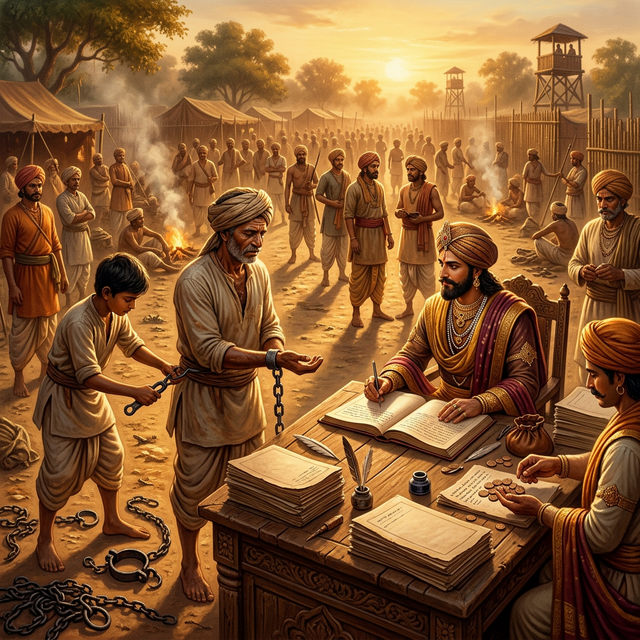
A heavy iron shackle, its surface worn and pitted from years of use but now resting open on a judge’s bench, lies beside a small bag of copper panas. This object is the stake of the empire’s control over the "logic of exploitation": it is the "Vessel of Freedom." Kautilya explains that the state is the ultimate master of the "rules regarding slaves and labourers." He points to the systematic protection of the lineage: "An Arya shall never be a slave...
and the slave shall be entitled to earn property and to purchase his freedom." To Kautilya, labor is not just a resource but a "forensic contract." The stability of the Maurya realm is built upon this "human accounting." A master who "enjoys the life of a female slave" against her will or fails to "pay the stipulated wage" to a laborer is a man who is destabilizing the King’s social peace.
The action of the hall is a forensic monitoring of duty and rights. Kautilya walks the Prince through the mapping of the "hired worker," explaining the precise penalties for "non-payment of wages" and the "recovery of the work." They watch as a judge hears the petition of a slave who has earned enough "through his own effort" to buy back his liberty from his master. It is a world of total social liability: the law details the "fines for making an Arya a slave" and the precise "rights of the bonded to their own property." They observe the "rules of the guild," ensuring that the "co-operative undertaking" is as regulated as the military formation.
It is a technical, human discipline: the state measures the "rhythm of the labor" as precisely as it measures the "depth of the coffer," ensuring that the subject remains a source of loyalty as much as muscle.
But the bound and the hired are also a center of total strategic preservation. Kautilya points to the "maintenance of the laborers," explaining that the state must ensure that the "producers of wealth" are never pushed to the point of "collective despair." The Prince realizes that "The Bound and the Hired" is the ultimate expression of the "Concerning Law"—the place where the state’s power to "harness and release" is literalized in the striking open of a shackle. The King’s power is the power to "ascertain the honesty of the masters" and to ensure that the "determination of wages" is as regulated as the weight of a grain jar. "The Bound and the Hired" is the enduring conscience of the state, captured in the "clatter of the looms" that binds the individual to the economic destiny of the empire.
The selling or mortgaging by kinsmen of the life of a Súdra who is not a born slave... but is an Arya in birth shall be punished... but an Arya shall never be a slave... The slave shall be entitled to earn property... and for the payment of his value, he shall be free... Labourers shall be paid as much as they have earned.
This is the rule of the labor regulation, the documentation for a world where "social unrest" is the enemy of the state. It says that the "Labor Ledger" must be a scientist of dignity, and that the "protection of a slave's gold" is as strategic as the defense of a frontier outpost. It recognizes that "rhythmic grinding" and "iron shackles" are the nodes of a network of stability that connects the King to "The Bound and the Hired." The weaving hall, with its "vows of work" and its "scrupulous wage-keeping," is the physical evidence of this discipline. The men who need such a rule are those who have understood that the state's strength is first labored, then liberated.
The logic of the laborer is the logic of the "Concerning Law." It completes the transition from the contract of the exchange to the contract of the heartbeat. It assumes that if you can master the "form of the labor" and the "forensic precision of the wage record," you can master the spirit of any civilization in the world. The state is no longer a master of the value; it is a master of the person.
The canto concludes on the image of a slave’s heavy iron shackle being struck open by a judge's hammer, the metal clanging with a resonant, sharp sound against the stone floor of the courtroom. The sound is a vibration of legal liberation that echoes the collective conscience of the kingdom. Kautilya looks at the "net balance" of the day’s releases and sees the resilient reach of the Mauryas written in the dignity of the man who is free to walk.
Outside, the sun of the empire illuminates the million workers of the realm. But inside "The Bound and the Hired," the world is categorized, protected, and secure. The Prince walks back from the weaving hall, his mind full of wages and freedmen. He has seen the shackle fall, and he has heard the loom’s clatter. He now knows that the empire is held together not just by laws or walls, but by the "uniform texture" of the labor and the unblinking eye of the man who knows exactly what it means to be a master or a servant in the King's account.