Chapter 93 of 126
The scales of the vulgar—the forensic management of the common people, ensuring their lives are orderly and their labor is productive.
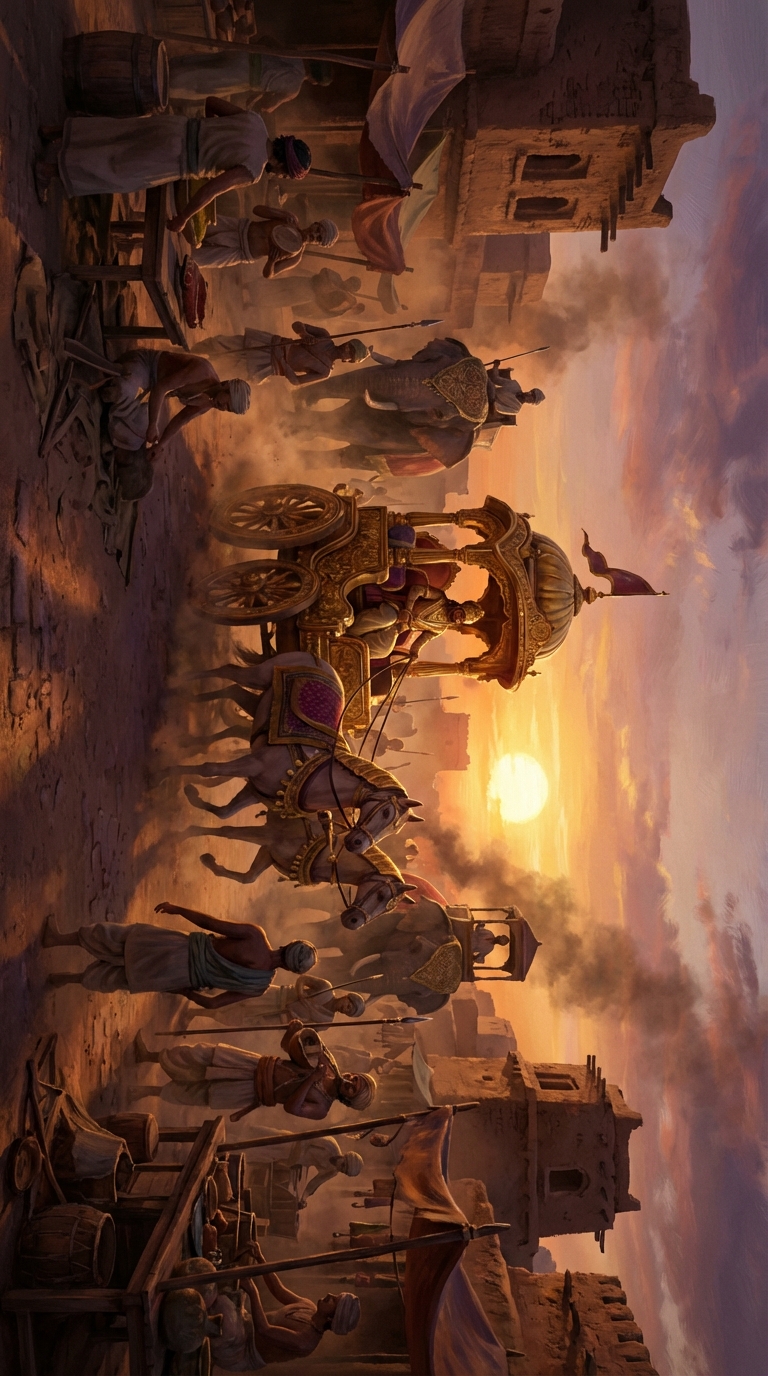
A busy municipal square during a public festival at noon, where the air is filled with the rhythmic sound of drums and the smell of fried sweets and incense, while a massive royal procession of gilded chariots and trumpeting elephants slowly makes its way through a dense, "sporting" crowd of citizens, is a world of forensic social logic and the sight of a "Scale of the Vulgar" being literalized in the celebration. Here, the Prince and Kautilya observe the forensic logic of "The Scales of the Vulgar," where the state’s internal health is literalized in the conduct of the masses. This is a place where the social pulse is measured in the noise of the square.
Kautilya leads the Prince past the temporary festival booths to where a local governor determines the "integrity of the labor" and the state-spy ensures the "purity of the public peace." In this forensic sphere, the state does not just celebrate; it anchors the absolute liability of the quarrel. The "suppression of the sport thorn" is the measure of the state’s social and moral control.
A large, festive mask made of painted clay, its features a caricature of a jovial spirit and its surface bright with mineral pigments, is held aloft by a "vulgar" reveler in the crowd. This object is the stake of the empire’s control over the "chaos of the unguided": it is the "Vessel of the Abhyantara-vyasana." Kautilya explains that the state is the ultimate master of "Internal Calamity" (Abhyantara-vyasana). He points to the reveler: "The people are the majority, but the noble man is the refuge...
we do not merely permit sports; we weigh the sportive country against the sportive king, we calculate the injuriousness of our own Circle against the enemy's, and we ensure that even among a thousand vulgar men, the one who is possessed of excessive courage remains the anchor of the state." To Kautilya, an unguided crowd is not just a crowd but a "forensic gap" that invites the state's own disintegration. The stability of the Maurya machine is built upon this "social accounting." A King who "fails to arrest the leaders of a domestic quarrel" or a ruler who "perpetuates a sportive habit that ruins the results of work" is a man who is rusting his own internal strength.
The action of the square is a forensic monitoring of rebellion and recreation. Kautilya walks the Prince through the mapping of the "legal quarrel," explaining the precise rules for "troubles arising from one's own circle" and the "differentiation between the quarrel of people and kings." They watch as a social officer evaluates the "integrity of the labor," noting the "sportive country resume work after enjoyment" alongside the "irremediable troubles of a self-inflicted Circle." It is a world of total informational liability: the law details the "penalties for failing to protect the noble refuge" and the precise "rights of the state to arrest leaders of disunion." They observe the "rules of the festival," ensuring that the "integrity of the sovereign procession" is as respected as the King’s own standard.
It is a technical, social discipline: the state measures the "rhythm of the drums" as precisely as it measures the "depth of the treasury," ensuring that the subject remains a source of security as much as service.
But the scales of the vulgar are also a center of total strategic stability. Kautilya points to the "Social Ledger," explaining that the state must ensure that the "engines of the people" are never paralyzed by the "friction of the irremediable." The Prince realizes that "The Scales of the Vulgar" is the ultimate expression of the "Calamities of the Elements"—the place where the state’s power to "anchor and arrest" is literalized in the guidance of the noble. The King’s power is the power to "ascertain the honesty of the social peace" and to ensure that the "determination of the collective truth" is as regulated as the weight of a gold coin. "The Scales of the Vulgar" is the enduring conscience of the state, captured in the "festive clay masks" that bind the kingdom to the social peace.
The Calamities of the King and of a Manufacture... Troubles due to one's own Circle are doubly injurious... inimical Circle can be fought out... one noble in a thousand is the refuge of vulgar people... quarrel among the people brings about disunion... possible to end by arresting leaders... a sportive king is beneficial to artisans, but a sportive country is ruinous to the results of work... a King should be the refuge.
This is the rule of the social regulation, the documentation for a world where "unity precision" is the security of the kingdom. It says that the "Ledger of the Mandala" must be a scientist of the mass, and that the "protection of the state's internal strength" is as strategic as the defense of a state-owned fort. It recognizes that "festive clay masks" and "royal chariots" are the nodes of a network of power that connects the King to "The Scales of the Vulgar." The square, with its "vows of unyielding unity" and its "scrupulous labor-keeping," is the physical evidence of this discipline. The men who need such a rule are those who have understood that the state's strength is first unified, then secured.
The logic of the scales is the logic of "Concerning Vices and Calamities." It completes the transition from the contract of the internal integrity to the contract of the social order. It assumes that if you can master the "form of the crowd" and the "forensic precision of the social record," you can master the stability of any civilization in the world. The state is no longer a master of the Self; it is a master of the Many.
The canto concludes on the image of the royal procession moving past the last of the festival booths at sunset, the golden light reflecting off the King's chariot as the music begins to fade and the "sporting" citizens begin to dismantle their temporary stalls. The sight of the crowd dispersing peacefully into the evening shadows is a visual, final anchor that echoes the collective stabilization of the kingdom's social foundations. Kautilya looks at the "net balance" of the book’s initial social syntheses and sees the resilient reach of the Mauryas written in the resumption of the nation's work.
Outside, the stars begin to appear over the quieted square, but the order is maintained, and the labor is secured. But inside "The Scales of the Vulgar," the world is categorized, unified, and secure. The Prince walks back from the square, his mind full of masks and chariots. He has seen the procession pass, and he has heard the drumbeat of the Many. He now knows that the empire is held together not just by laws or walls, but by the "uniform texture" of the unity and the unblinking eye of the man who knows exactly what it means to be the refuge in the King's account.