Chapter 122 of 126
The scales of the injury—the forensic management of reparations, ensuring that the cost of the conflict is paid by those who started it.
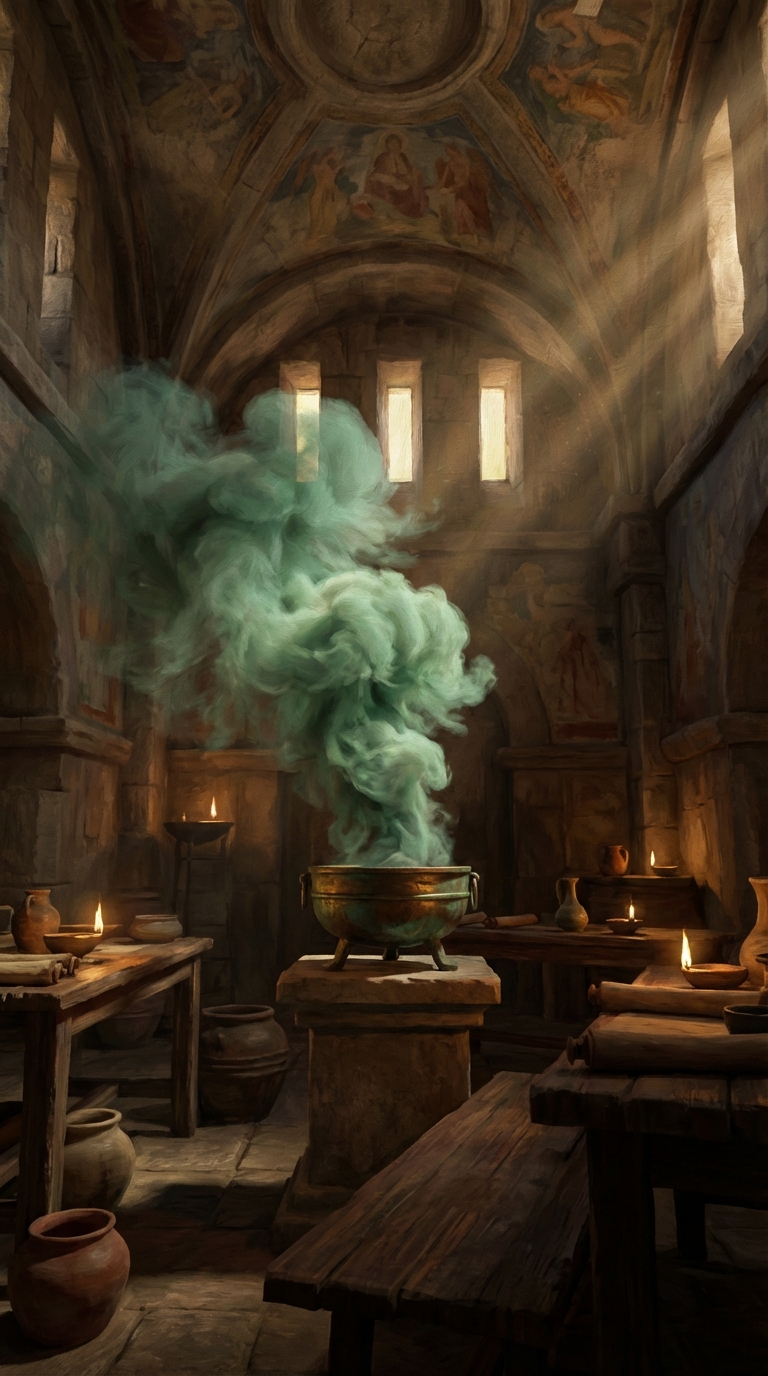
A hidden laboratory in a secret apothecary's chamber deep beneath the Maurya capital at dead midnight, where the only sound is the rhythmic, low bubbling of a series of dark, translucent liquids and the sight of a King's secret agent methodically grinding a collection of exotic animal carcasses and toxic plants while the first green light of a magical fire revealed the silhouettes of the state's chemists in the distance, is a world of forensic chemical logic and the sight of a "Scale of the Injury" being literalized in the laboratory. Here, the Prince and Kautilya observe the forensic logic of "The Scales of the Injury," where the state’s sovereign survival is literalized in the lethality of the secret means. This is a place where the strategic pulse is measured in the silence of the vial.
Kautilya leads the Prince past the bubbling beakers to where the chief chemist determines the "integrity of the toxin" and the state-nayaka ensures the "purity of the death-smoke." In this forensic sphere, the state does not just injure; it anchors the absolute liability of the lethality. The "suppression of the uncaptured-wicked thorn" is the measure of the state’s strategic and moral control.
A single, bubbling vial of dark green liquid, its surface releasing a thin, acrid vapor and its glass marked with the scrupulous ratios of centipedes, black snakes, and panic seeds, sits on a stone pedestal. This object is the stake of the empire’s control over the "chaos of the elusive-wicked": it is the "Vessel of the Ghora-vighna." Kautilya explains that the state is the ultimate master of "Injury Priority" (Ghora-vighna). He points to the vials: "The elimination of the enemy is a machine of many triggers—powders, smokes, and oils...
we do not merely slay; we weigh the smoke of the lizard against the ointment of the maina, and we ensure that although the sword is the first power, the geometric precision of the King's strategic science is the second." To Kautilya, an empire that faces its enemies only with steel is not just a risk but a "forensic gap" that invites the state's own frustration. The stability of the Maurya machine is built upon this "lethal accounting." A King who "administers kálakúta and other manifold poisons in the diet of the wicked" or a ruler who "burns powders that cause instantaneous death" is a man who is rusting his own internal strength.
The action of the laboratory is a forensic monitoring of composition and consequence. Kautilya walks the Prince through the mapping of the "legal injury," explaining the precise rules for "means to injure an enemy" and the "use of secret science." They watch as a chemical officer evaluates the "integrity of the smoke," noting the "mixture of powders of krikalása and grihagaulika that causes leprosy" alongside the "use of human blood to cause consumption." It is a world of total informational liability: the law details the "penalties for failing to reduce the black snake to powder" and the precise "rights of the state to expect an agent to be a night-walker or a fire-keeper." They observe the "rules of the vial," ensuring that the "integrity of the sovereign lethality" is as respected as the King’s own standard.
It is a technical, chemical discipline: the state measures the "rhythm of the reaction" as precisely as it measures the "depth of the treasury," ensuring that the subject remains a source of security as much as service.
But the scales of the injury are also a center of total strategic stability. Kautilya points to the "Lethality Ledger," explaining that the state must ensure that the "engines of the survival" are never paralyzed by the "friction of the overt." The Prince realizes that "The Scales of the Injury" is the ultimate expression of the "Secret Means"—the place where the state’s power to "poison and prevail" is literalized in the bubbling vial. The King’s power is the power to "ascertain the honesty of the chemical health" and to ensure that the "determination of the strategic truth" is as regulated as the weight of a gold coin. "The Scales of the Injury" is the enduring conscience of the state, captured in the "bubbling vials and lethal smokes" that bind the kingdom to the strategic peace.
Means to Injure an Enemy... secret science applied against the wicked... kálakúta and other manifold poisons administered in diet... smoke caused by burning powders causes instantaneous death... powders of animals such as bheka (frog), krikalásá (lizard), andháhika (blind snake)... mixed with juice of bhallátaka... mixture of yavaka and root of sála... ointment mixing excretion of sáriká and milk of snuhi causes blindness... smoke causes gonorrhœa, leprosy, or consumption... strike him down at the sound of trumpets.
This is the rule of the injury regulation, the documentation for a world where "science precision" is the security of the kingdom. It says that the "Ledger of the Mandala" must be a scientist of the toxin, and that the "protection of the state's sovereign reach" is as strategic as the defense of a state-owned fort. It recognizes that "bubbling vials" and "toxic smokes" are the nodes of a network of power that connects the King to "The Scales of the Injury." The laboratory, with its "vows of unyielding lethality" and its "scrupulous science-keeping," is the physical evidence of this discipline. The men who need such a rule are those who have understood that the state's strength is first secured from within the vial, then projected.
The logic of the scales is the logic of "Secret Means." It completes the transition from the restoration of the peace to the science of the injury. It assumes that if you can master the "form of the smoke" and the "forensic precision of the lethal record," you can master the stability of any civilization in the world. The state is no longer a master of the Bell; it is a master of the Vial.
The canto concludes on the image of a single, green-tinged cloud of smoke rising from a small brazier as the first light of dawn begins to touch the laboratory ceiling and the scent of bitter almonds lingers in the cold, waiting air. The sight of the vial in the morning light is a visual, final anchor that echoes the collective stabilization of the kingdom's strategic foundations. Kautilya looks at the "net balance" of the book’s initial lethal syntheses and sees the resilient reach of the Mauryas written in the silence of the vial.
Outside, the first alarms begin to ring across the empire, but the injury is prepared, and the science is secured. But inside "The Scales of the Injury," the world is categorized, lethal, and secure. The Prince walks back from the laboratory, his mind full of vials and smokes. He has seen the poison mixed, and he has heard the secret death named. He now knows that the empire is held together not just by laws or walls, but by the "uniform texture" of the science and the unblinking eye of the man who knows exactly what it means to be a vial in the King's account.