Chapter 119 of 126
The scales of the siege—the industrial mechanics of the assault on the fortress, where the King's patience outlasts the enemy's walls.
A muddy, rain-drenched siege-line outside the enemy's formidable fortress walls at deep midnight, where the only sound is the rhythmic, sharp splash of digging and the sight of a King's secret agent methodically inspecting a series of tunnels and ladders while a hidden wagon loaded with "firewood" revealed a secret cache of iron-tipped spears, is a world of forensic tactical logic and the sight of a "Scale of the Siege" being literalized in the mud. Here, the Prince and Kautilya observe the forensic logic of "The Scales of the Siege," where the state’s sovereign control is literalized in the subversion of the garrison. This is a place where the strategic pulse is measured in the silence of the bolt.
Kautilya leads the Prince past the digging-crews to where the chief agent determines the "integrity of the cart" and the state-spy ensures the "purity of the madana-juice." In this forensic sphere, the state does not just besiege; it anchors the absolute liability of the subversion. The "suppression of the uncaptured-fortress thorn" is the measure of the state’s strategic and moral control.
A single, heavy iron bolt from a fortress-gate, its metal cold and its surface lubricated with a layer of animal fat for a silent withdrawal, is held by an agent disguised as a carpenter. This object is the stake of the empire’s control over the "chaos of the unyielding-garrison": it is the "Vessel of the Durga-vyadha-vighna." Kautilya explains that the state is the ultimate master of "Siege Subversion Priority" (Durga-vyadha-vighna). He points to the wagons: "The capture of the fort is a machine of many triggers—carts, priests, and poisons...
we do not merely attack; we weigh the intoxication of the cowherds against the panic of the citizens, and we ensure that although the wall is the first power, the geometric precision of the King's internal subversion is the second." To Kautilya, a fortress that trusts its own walls more than its own people is not just a target but a "forensic gap" that invites the state's own entry. The stability of the Maurya machine is built upon this "subversive accounting." A King who "supplies weapons in carts loaded with firewood" or a ruler who "poisons the beverages of the enemy's cowherds with the juice of the madana plant" is a man who is rusting his own internal strength.
The action of the siege-line is a forensic monitoring of supply and subversion.
Kautilya walks the Prince through the mapping of the "legal siege," explaining the precise rules for "the work of spies in a siege" and the "destruction of flocks." They watch as a subversive officer evaluates the "integrity of the cart," noting the "spies disguised as priests who announce a besieging army by blowing conch shells" alongside the "use of merchants and peddlers to collect army and weapons inside the enemy's fort." It is a world of total informational liability: the law details the "penalties for failing to surrender the fort-gate in the tumult" and the precise "rights of the state to expect an agent to be an agriculturist or an actor." They observe the "rules of the bolt," ensuring that the "integrity of the sovereign subversion" is as respected as the King’s own standard.
It is a technical, subversive discipline: the state measures the "rhythm of the intrusion" as precisely as it measures the "depth of the treasury," ensuring that the subject remains a source of security as much as service.
But the scales of the siege are also a center of total strategic stability. Kautilya points to the "Siege Ledger," explaining that the state must ensure that the "engines of the capture" are never paralyzed by the "friction of the untechnical." The Prince realizes that "The Scales of the Siege" is the ultimate expression of the "Strategic Means to Capture"—the place where the state’s power to "open and overcome" is literalized in the iron bolt. The King’s power is the power to "ascertain the honesty of the subversive health" and to ensure that the "determination of the strategic truth" is as regulated as the weight of a gold coin. "The Scales of the Siege" is the enduring conscience of the state, captured in the "gate-bolts and technical firewood-carts" that bind the kingdom to the strategic peace.
The Work of Spies in a Siege... Spies disguised as agriculturists, supply weapons in carts loaded with firewood... grass, grains... disguised as priests, announce besieging army... blowing conch shells and beating drums... surrender the fort-gate and the towers... poisons with the juice of the madana plant... beverage kept for enemy's cowherds... carry off the cattle... worshippers of god Sankarshana... mix sacrificial beverage with juice of madana plant.
This is the rule of the siege regulation, the documentation for a world where "intrusion precision" is the security of the kingdom. It says that the "Ledger of the Mandala" must be a scientist of the gate, and that the "protection of the state's sovereign reach" is as strategic as the defense of a state-owned fort. It recognizes that "heavy iron bolts" and "madana-juice" are the nodes of a network of power that connects the King to "The Scales of the Siege." The fortress wall, with its "vows of unyielding subversion" and its "scrupulous intrusion-keeping," is the physical evidence of this discipline. The men who need such a rule are those who have understood that the state's strength is first opened from within, then secured.
The logic of the scales is the logic of "Strategic Means to Capture a Fortress." It completes the transition from the stratagem of the luring to the subversion of the siege. It assumes that if you can master the "form of the intrusion" and the "forensic precision of the siege record," you can master the stability of any civilization in the world. The state is no longer a master of the Signal; it is a master of the Bolt.
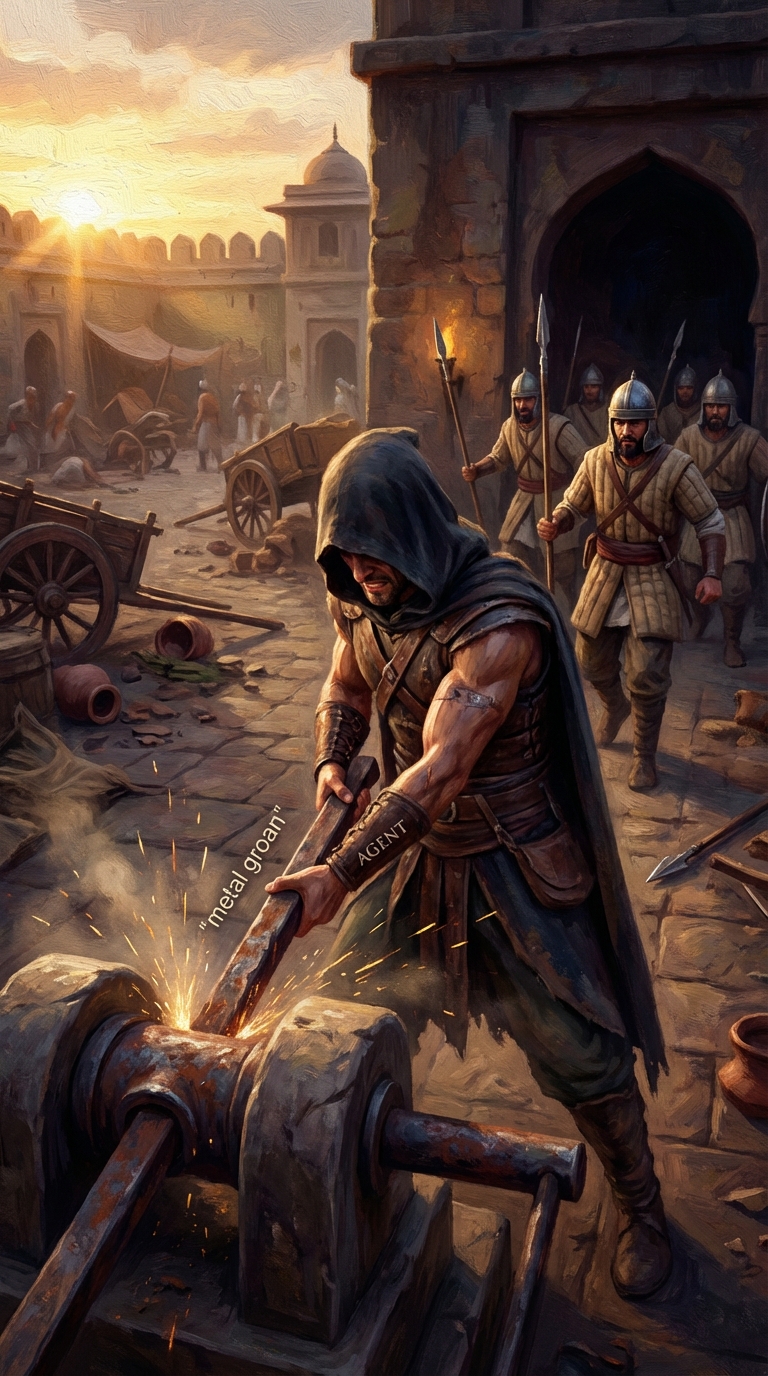
The canto concludes on the image of the agent pulling the heavy iron bolt from its housing with a single, sharp groan of metal just as the first of the King's soldiers emerge from a nearby tunnel and the first light of dawn begins to reveal the chaos within the fortress gates. The sight of the bolt in the mud is a visual, final anchor that echoes the collective stabilization of the kingdom's strategic foundations. Kautilya looks at the "net balance" of the book’s final subversive syntheses and sees the resilient reach of the Mauryas written in the silence of the bolt.
Outside, the first alarms begin to ring within the fortress, but the subversion is completed, and the gate is secured. But inside "The Scales of the Siege," the world is categorized, besieged, and secure. The Prince walks back from the fortress gates, his mind full of bolts and carts. He has seen the entry made, and he has heard the secret madana named. He now knows that the empire is held together not just by laws or walls, but by the "uniform texture" of the subversion and the unblinking eye of the man who knows exactly what it means to be a bolt in the King's account.