Chapter 113 of 126
The scales of the weak—the strategic survival of the small state in the shadow of giants, proving that wit can outlast brute force.
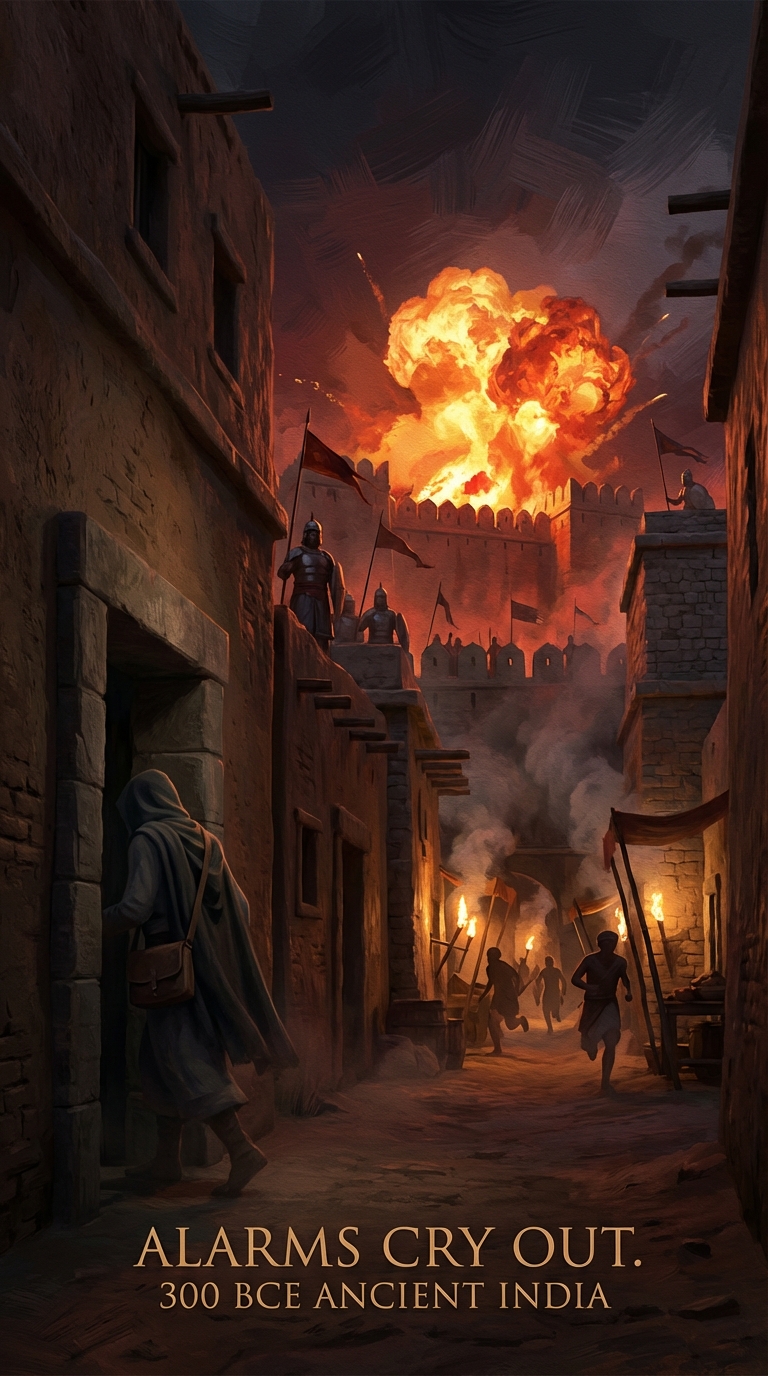
A dimly lit, narrow alleyway in the heart of the enemy's sprawling capital at deep midnight, where the only sound is the rhythmic, sharp click of a closing door and the sight of a King's secret agent methodically exchanging a series of coded birch-bark scrolls with a hooded figure while a sudden, orange glow begins to flicker in the distance behind the silhouette of the enemy's granary, is a world of forensic subversive logic and the sight of a "Scale of the Weak" being literalized in the shadows. Here, the Prince and Kautilya observe the forensic logic of "The Scales of the Weak," where the state’s sovereign survival is literalized in the battle of intrigue. This is a place where the strategic pulse is measured in the silence of the spark.
Kautilya leads the Prince past the shadowy exchanges to where the chief agent determines the "integrity of the discension" and the state-spy ensures the "purity of the tactical fire." In this forensic sphere, the state does not just subvert; it anchors the absolute liability of the intrigue. The "suppression of the brute-force thorn" is the measure of the state’s strategic and moral control.
A single, soot-stained coin, its surface scratched with the hidden mark of a double-agent and its metal smelling of woodsmoke, is pressed into the hand of a corrupt sentinel. This object is the stake of the empire’s control over the "chaos of the overmatched": it is the "Vessel of the Mantrayuddha-vighna." Kautilya explains that the state is the ultimate master of "Intrigue Battle Priority" (Mantrayuddha-vighna). He points to the glow: "The battle of intrigue is a machine of many triggers—sparks, whispers, and blood...
we do not merely fight; we weigh the dissension of the collector-general against the fear of the people, and we ensure that although the enemy is the first power, the geometric precision of the King's active subversion is the second." To Kautilya, a weak king who relies on steel instead of soot is not just a risk but a "forensic gap" that invites the state's own annihilation. The stability of the Maurya machine is built upon this "subversive accounting." A King who "uses fiery spies to slay leaders while people are collected" or a ruler who "sets fire to the harem and store-house to spread false news of danger" is a man who is rusting his own internal strength.
The action of the alleyway is a forensic monitoring of trigger and terror.
Kautilya walks the Prince through the mapping of the "legal intrigue," explaining the precise rules for "the battle of intrigue" and the "employment of secret agents." They watch as a subversive officer evaluates the "integrity of the spark," noting the "spies who inform citizens that the officer expects the king to return without life" alongside the "spies who throw down blood-bespattered weapons on waste lands." It is a world of total informational liability: the law details the "penalties for failing to cause disagreement between the collector-general and the people" and the precise "rights of the state to expect an agent to disappear into the shadows." They observe the "rules of the mark," ensuring that the "integrity of the sovereign subversion" is as respected as the King’s own standard.
It is a technical, subversive discipline: the state measures the "rhythm of the panic" as precisely as it measures the "depth of the treasury," ensuring that the subject remains a source of security as much as service.
But the scales of the weak are also a center of total strategic Plurality. Kautilya points to the "Intrigue Ledger," explaining that the state must ensure that the "engines of the subversion" are never paralyzed by the "friction of the overt." The Prince realizes that "The Scales of the Weak" is the ultimate expression of the "Concerning a Powerful Enemy"—the place where the state’s power to "burn and break" is literalized in the soot-stained coin. The King’s power is the power to "ascertain the honesty of the subversive health" and to ensure that the "determination of the strategic truth" is as regulated as the weight of a gold coin. "The Scales of the Weak" is the enduring conscience of the state, captured in the "coded scrolls and tactical fires" that bind the kingdom to the strategic peace.
Battle of Intrigue... Informing citizens of the king's danger... Spies should throw down weapons bespattered with blood... other spies spread news that the officer plunders the people... Spies cause disagreement between collector-general and people... slaying either of them... set fire to the harem, the gates of the town, and the store-house of grains... slay the sentinels.
This is the rule of the subversive regulation, the documentation for a world where "intrigue precision" is the security of the kingdom. It says that the "Ledger of the Mandala" must be a scientist of the trigger, and that the "protection of the state's sovereign reach" is as strategic as the defense of a state-owned fort. It recognizes that "coded scrolls" and "tactical fires" are the nodes of a network of power that connects the King to "The Scales of the Weak." The alleyway, with its "vows of unyielding subversion" and its "scrupulous intrigue-keeping," is the physical evidence of this discipline. The men who need such a rule are those who have understood that the state's strength is first broken from within, then secured.
The logic of the scales is the logic of "Concerning a Powerful Enemy." It completes the transition from the survival of the reed to the subversion of the spark. It assumes that if you can master the "form of the panic" and the "forensic precision of the intrigue record," you can master the stability of any civilization in the world. The state is no longer a master of the Reed; it is a master of the Shadow.
The canto concludes on the image of the agent disappearing into a dark doorway as a second, larger explosion of fire illuminates the enemy's city walls and the first cries of alarm begin to echo through the streets. The sight of the smoke rising over the city is a visual, final anchor that echoes the collective stabilization of the kingdom's strategic foundations. Kautilya looks at the "net balance" of the book’s initial subversive syntheses and sees the resilient reach of the Mauryas written in the silence of the shadow.
Outside, the fires begin to spread, but the subversion is completed, and the trigger is secured. But inside "The Scales of the Weak," the world is categorized, subversive, and secure. The Prince walks back from the shadows, his mind full of sparks and scrolls. He has seen the trap set, and he has heard the secret dissension named. He now knows that the empire is held together not just by laws or walls, but by the "uniform texture" of the subversion and the unblinking eye of the man who knows exactly what it means to be a shadow in the King's account.