Chapter 100 of 126
The scales of the invader—the strategic defense of the nation against those who would dare to cross the master's borders.
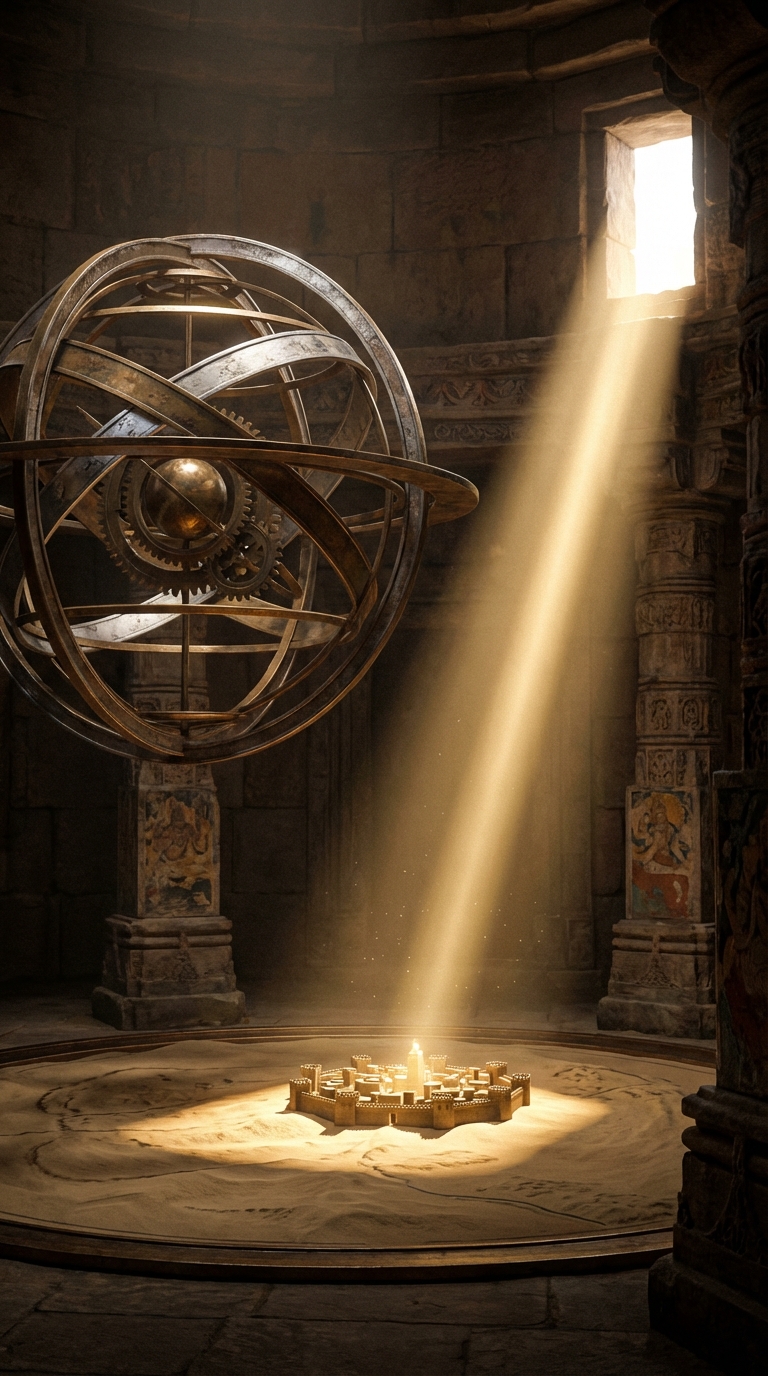
A grand, high-ceilinged war-room within the citadel at dawn, where the first clear light of morning illuminates a massive sandalwood table bearing a complex bronze armillary sphere and a detailed sand-map of the entire continent, while the air is still and silent as the chief strategist adjust the silver rings of the sphere to align with the rising sun, is a world of forensic strategic logic and the sight of a "Scale of the Invader" being literalized in the chronometer. Here, the Prince and Kautilya observe the forensic logic of "The Scales of the Invader," where the state’s external momentum is literalized in the calculation of the march. This is a place where the strategic pulse is measured in the silence of the war-room.
Kautilya leads the Prince past the shelves of geography-rolls to where the chief astrologer determines the "integrity of the time" and the state-spy ensures the "purity of the power-count." In this forensic sphere, the state does not just march; it anchors the absolute liability of the place. The "suppression of the friction thorn" is the measure of the state’s strategic and moral control.
A complex bronze armillary sphere, its rings interlocking and etched with the signs of the seasons and the hours and its central earth-sphere made of dark iron, rests in the center of the war-room. This object is the stake of the empire’s control over the "chaos of the ill-timed": it is the "Vessel of the Shakti-desha-kala." Kautilya explains that the state is the ultimate master of "Power-Place-Time" (Shakti-desha-kala). He points to the sphere: "The invader is a scientist of the clock...
we do not merely move men; we weigh the enthusiasm of the spirit against the power of the treasury and the army, and we ensure that although counsel is the first power, the iron rings of the budget are the second." To Kautilya, a march without timing is not just a movement but a "forensic collision" that invites the state's own exhaustion. The stability of the Maurya machine is built upon this "chronometric accounting." A King who "marches in the heat without water" or a ruler who "fails to recognize that power of might is better than energy of spirit" is a man who is rusting his own internal strength.
The action of the war-room is a forensic monitoring of terrain and timing. Kautilya walks the Prince through the mapping of the "legal march," explaining the precise rules for "the knowledge of power, place, and time" and the "triad of shakti (powers)." They watch as a strategic officer evaluates the "integrity of the plan," noting the "enthusiasm vs. might vs. counsel" alongside the "determination of the auspicious season for the campaign." It is a world of total informational liability: the law details the "penalties for failing to perceive strength and weakness" and the precise "rights of the state to expect an army to fight in the rains if en-camped abroad." They observe the "rules of the sphere," ensuring that the "integrity of the sovereign chronometer" is as respected as the King’s own standard.
It is a technical, strategic discipline: the state measures the "angle of the sun" as precisely as it measures the "depth of the treasury," ensuring that the subject remains a source of security as much as service.
But the scales of the invader are also a center of total strategic sovereignty. Kautilya points to the "Campaign Ledger," explaining that the state must ensure that the "engines of the march" are never paralyzed by the "friction of the ill-calculated." The Prince realizes that "The Scales of the Invader" is the ultimate expression of the "Work of an Invader"—the place where the state’s power to "map and master" is literalized in the alignment of the sphere. The King’s power is the power to "ascertain the honesty of the strategic health" and to ensure that the "determination of the chronometric truth" is as regulated as the weight of a gold coin. "The Scales of the Invader" is the enduring conscience of the state, captured in the "bronze armillary spheres" that bind the kingdom to the strategic peace.
The Knowledge of Power, Place, and Time... The Invader should march after considering these... enthusiasm (utsaha), power (prabhu), and counsel (mantra)... Kautilya says Prabhu-shakti (treasury/army) is better than Utsaha-shakti (enthusiasm)... a king with treasure can hire the enthusiastic... Mantra-shakti (counsel) is the most important... march in the cold, hot, or rainy seasons depending on the objective... the knowledge of enumeration of distress is the cause of operations.
This is the rule of the strategic regulation, the documentation for a world where "momentum precision" is the security of the kingdom. It says that the "Ledger of the Mandala" must be a scientist of the campaign, and that the "protection of the state's external momentum" is as strategic as the defense of a state-owned fort. It recognizes that "bronze armillary spheres" and "sand-maps of the world" are the nodes of a network of power that connects the King to "The Scales of the Invader." The war-room, with its "vows of unyielding calculation" and its "scrupulous time-keeping," is the physical evidence of this discipline. The men who need such a rule are those who have understood that the state's strength is first calculated, then secured.
The logic of the scales is the logic of "The Work of an Invader." It completes the transition from the contract of the internal diagnostic to the contract of the external expansion. It assumes that if you can master the "form of the moment" and the "forensic precision of the campaign record," you can master the stability of any civilization in the world. The state is no longer a master of the Void; it is a master of the Way.
The canto concludes on the image of the silver rings of the armillary sphere clicking into a final, perfect alignment as the dawn sun hits the center of the sand-map, illuminating the target city in a sharp, unforgiving beam of light. The sight of the shadow falling precisely across the map is a visual, final anchor that echoes the collective stabilization of the kingdom's strategic foundations. Kautilya looks at the "net balance" of the book’s initial strategic syntheses and sees the resilient reach of the Mauryas written in the precision of the march.
Outside, the first horns of the campaign begin to sound from the barracks, but the calculation is completed, and the timing is secured. But inside "The Scales of the Invader," the world is categorized, calculated, and secure. The Prince walks back from the war-room, his mind full of spheres and maps. He has seen the rings aligned, and he has heard the secret power named. He now knows that the empire is held together not just by laws or walls, but by the "uniform texture" of the timing and the unblinking eye of the man who knows exactly what it means to be an invader in the King's account.