# The Whole Story in 15 Minutes
**Narrator:**
In the late 4th century BCE, a Brahmin scholar from Takshashila named Kauṭilya — also remembered as Chāṇakya or Viṣṇugupta — wrote a book that has no real parallel in the history of political philosophy. Machiavelli would write something distantly similar eighteen centuries later. Sun Tzu had written something more compact a hundred years earlier on the other side of Asia. But what Kauṭilya wrote was a *manual* — fifteen books, six thousand verses, covering every operational concern of a sovereign state from the price of grain in famine years to the protocol for assassinating an enemy king.
It was called the *Arthaśāstra* — literally, *the treatise on wealth* — and it was written, by all evidence, as an actual working document for an actual working king: Chandragupta Maurya, whom Kauṭilya had personally placed on the throne after engineering the overthrow of the Nanda dynasty.
The book disappeared. Or rather: it survived only in fragments, quoted by other texts, until 1905, when a complete palm-leaf manuscript surfaced in a Mysore Sanskrit library and a scholar named R. Shamasastry began to translate it. The world had not seen a serious treatise on Indian statecraft in nineteen centuries. Suddenly it had one in front of it. The publication of Shamasastry's translation in 1909 changed how India's own scholars understood their political history.
This page is a tour. What's in the book. Why it matters. What to read first.
## Who Kautilya Was
**Narrator:**
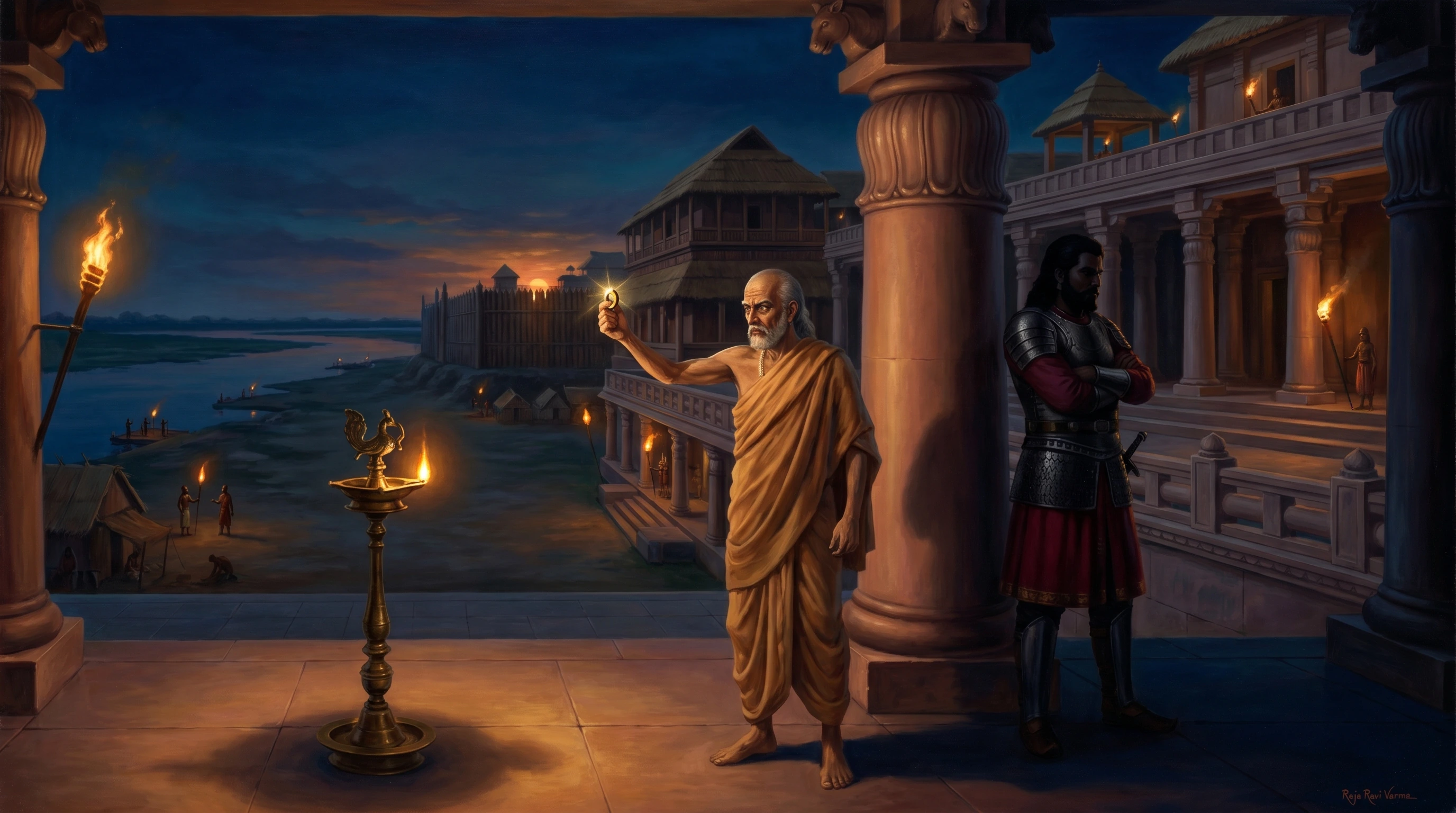
The biography is uncertain, partly legendary. The traditional account: a Brahmin teacher at Takshashila — the great university in what is now northwest Pakistan — was insulted at the Nanda court. He swore he would unmake the dynasty. He found a young man of mixed ancestry — Chandragupta — and shaped him over years into a sovereign. They campaigned together. They overthrew the Nandas in roughly 321 BCE. They unified northern India. They beat back Alexander's successors. They built the Maurya empire that, two generations later, Ashoka would inherit.
Then, having installed his student on the throne, Kauṭilya sat down and wrote the manual for what they had just done. The *Arthaśāstra* is what a man who has actually built an empire writes for the man who will inherit it.
## The Big Idea
**Narrator:**
The book's foundational claim is that the state has its own logic, distinct from religion, distinct from family, distinct from personal morality. Kauṭilya does not say the state should violate dharma. He says the state operates by *rāja-dharma* — a specific subset of duty that applies only to rulers — and rāja-dharma has rules of its own.
The rules are pragmatic. A king who refuses to use spies will lose to a king who uses them. A king who refuses to defect a corruptible minister will lose his treasury. A king who cannot distinguish between *real* loyalty and *performed* loyalty will sleep one night in a chamber where he should not have slept.
This sounds Machiavellian because Machiavelli, eighteen hundred years later, would say similar things — but Kauṭilya is more systematic. He is not arguing that the prince should *occasionally* deceive. He is laying out, with the precision of a tax code, *how* deception is to be operationalized — by which officers, against which targets, with which budgets, under what oversight, with what fallback if the deception is discovered.
The book is, in fact, a bureaucratic document. It is what a king's chief minister actually does.
## The Fifteen Books
**Narrator:**
The *Arthaśāstra* is organized into 15 *adhikaraṇas* (sections), 150 chapters, ~6,000 sutras (aphorisms). Here is the architecture.
**Book I — Concerning Discipline.** How a king is educated. How ministers are selected, tested, classified. How royal officers are appointed. *The foundation: a state begins with a sovereign who has trained his own mind.*
**Book II — Government Superintendents.** The civil service in operation. Department-by-department: treasury, mining, salt monopoly, agriculture, weights and measures, customs duty, animal husbandry. *The most encyclopedic book — and the one closest in form to an actual operations manual.*
**Book III — Concerning Law.** Civil law. Property, marriage, inheritance, debt, contracts. The Arthashastra is one of the most important sources of pre-Islamic Indian civil law.
**Book IV — Removal of Thorns.** Criminal law. Suppression of bandits, religious cults, forgers, false witnesses, illegal gambling, illegal slaughter. *Some of this book is historically disturbing to modern readers — gendered punishments, caste-graded penalties — and should be read with that flagged honestly.*
**Book V — The Conduct of Courtiers.** Royal household management. Pay scales for ministers. Promotion criteria. Removal procedures.
**Book VI — Source of Sovereign States.** The seven elements of state — the *saptāṅga* — described below. Foreign policy theory begins here.
**Book VII — The Six-fold Policy.** The *ṣāḍguṇya*. How a king should orient toward each neighboring state. Six possible postures: peace, war, neutrality, aggressive march, alliance, dual policy. The choice depends on the relative strength of each state in the system.
**Book VIII — Vices and Calamities.** What can go wrong. Drought, flood, famine, plague, royal succession crisis, the king's personal vices.
**Book IX — The Work of an Invader.** How to plan and execute a foreign campaign. Logistics, supply lines, signaling.
**Book X — Relating to War.** Battle operations.
**Book XI — Conduct of Corporations.** How to manage and (when necessary) break up the merchant guilds and republican corporations that operated as semi-autonomous powers within the kingdom.
**Book XII — Concerning a Powerful Enemy.** What a weak king does when facing a stronger one. Buying time. Cultivating internal dissent in the enemy's camp.
**Book XIII — Capture of Fortresses.** Siege warfare.
**Book XIV — Secret Means.** Poisons, magic, false miracles. The book Kauṭilya almost certainly meant to be read in secrecy.
**Book XV — The Plan of a Treatise.** A short methodological coda. How Kauṭilya thinks about the genre of treatise-writing itself.
## Three Big Ideas
**Narrator:**
Three concepts in the *Arthaśāstra* have outlived everything else in the book.
### Saptāṅga — The Seven Limbs of State
**Narrator:**
A state, Kauṭilya says, has seven constituent elements: *svāmin* (the sovereign), *amātya* (the ministers), *janapada* (the territory and its people), *durga* (the fortified city), *kośa* (the treasury), *daṇḍa* (the army and police), *mitra* (the allies). A state is healthy when all seven are. The collapse of any one weakens all the rest. A king's job is to keep all seven in good order simultaneously — which is harder than it sounds, because investment in one often comes at the expense of another.
The saptāṅga framework is one of the earliest *systems theories of government* in any tradition. It is still cited in modern Indian political-science curricula.
### Maṇḍala — The Geopolitical Circle
**Narrator:**
The world, Kauṭilya says, is structured in concentric rings around your kingdom. Your immediate neighbor is, by default, your enemy — because your interests collide along the shared border. *Your enemy's enemy* — the kingdom on the other side of your neighbor — is your natural ally. *Their enemy*, in turn, is your enemy. The world alternates: friend, enemy, friend, enemy, in concentric rings.
This is the *mandala* theory of foreign policy. It is the oldest formal model of geopolitical alignment in any civilization's record. The modern realist tradition in international relations — Kissinger, Mearsheimer — re-derived something extremely close to it without knowing Kauṭilya had written it twenty-three centuries earlier.
### Daṇḍa — The Theology of Force
**Narrator:**
*Daṇḍa* literally means "the rod" — the staff of office a king carries. In Kauṭilya's hands, it becomes the philosophical name for the legitimate use of coercion. He argues that without *daṇḍa*, society regresses to *mātsya-nyāya* — the "law of the fishes," where the big fish eat the small fish. The whole project of civilization, he says, is to insert *daṇḍa* between human and human so the strong cannot devour the weak by default.
But *daṇḍa* is dangerous. Excessive *daṇḍa* — tyrannical rule — provokes revolt. Insufficient *daṇḍa* — weakness — invites conquest. *Daṇḍa* is calibrated. The book spends hundreds of pages explaining how to calibrate it.
This is one of the few places in Indian political philosophy where the *use of force itself* is theorized at the depth Weber and Hobbes theorized it in the modern West.
## What's Modern About It
**Narrator:**
Several things will surprise a modern reader.
**The intelligence apparatus is industrial-scale.** Kauṭilya describes a network of *cāras* (spies) operating in every village of the kingdom — disguised as ascetics, beggars, traders, courtesans, even children. There is a *whole bureaucracy* for managing intelligence — separating gathering from analysis, cross-checking sources, paying informers in salt or coin, providing safe houses. The level of detail is closer to a modern intelligence service textbook than to anything written in Europe before the 17th century.
**Fiscal policy is treated mathematically.** Tax rates are graded by income, by trade, by region. Deficits are anticipated. Reserve treasuries are mandated. The *Arthaśāstra*'s fiscal sophistication is roughly the level of mid-modern European cameralism — sixteen centuries ahead.
**Famine policy is humane and operational.** Kauṭilya tells the king to *build granaries before the famine arrives* — not after. To distribute grain at controlled prices. To suspend taxes in famine zones. To deport sections of the population to less-affected regions if necessary. These are policies that the British colonial government would, in the famines of the 19th century, fail to apply — to disastrous effect.
**Diplomatic protocol is fully developed.** Envoys, ambassadors, treaties, secret clauses, the diplomatic immunity of foreign messengers — all of it described at length, with proper procedure, in Book VII.
**Urban planning is detailed.** Width of streets, location of water sources, fortification systems, designated quarters for craft guilds. Pataliputra, the Mauryan capital, was built to *Arthaśāstra* specifications.
## What's Historical-Only
**Narrator:**
And several things will, honestly, disturb a modern reader. The book contains gendered punishments that are unjust by any contemporary standard. It contains caste-graded penalties — the same crime drew different punishments depending on the offender's *varṇa*. It assumes slavery as a normal institution. It is unflinching about torture, assassination, ritual deception of the public.
The *Arthaśāstra* is a working political manual for an ancient empire. It is not a document of universal ethics. Pretending it is — or worse, pretending it isn't — both fail the text.
The honest position is the one Kauṭilya himself takes: *here is how this state actually operates. Here is the mathematics of its survival. Whether all of it is just is a separate question.*
## What to Read First
**Narrator:**
If you have an hour and want to know the book, here is a reading guide.
1. **Book I, Chapter 1** — *The Science of Discipline.* The foundational chapter. Kauṭilya's epistemology — what counts as knowledge for a sovereign.
2. **Book I, Chapter 7** — *The Network of Eyes.* The spy-system, introduced from scratch. Read it for the procedural specificity.
3. **Book VI, Chapter 1** — *The Saptanga Theory.* The seven limbs of state. The framework that holds the whole book together.
4. **Book VII, Chapter 1** — *The Six-fold Policy.* The mandala theory. The most-cited single chapter in the *Arthaśāstra*.
5. **Book III, Chapter 1** — *Civil Law.* For a sense of how Kauṭilya thinks about the relationships between citizens, not just between king and citizen.
6. **Book XV, Chapter 1** — *The Plan of a Treatise.* The methodological coda. Short. Read it last — it reframes everything.
Six chapters. About 90 minutes of reading.
After that, you can decide whether you want to read the whole 150-chapter book, sample particular topics that interest you (Book II for civil service, Book IX for military operations, Book XIV for the genuinely strange material on poisons and ritual deception), or stop.
## Why It Survived
**Narrator:**
The *Arthaśāstra* was not lost because it was unimportant. It was lost because it was *technical*. The literature that survives the longest in any tradition is the literature that priests are willing to memorize. The Vedas survived because Brahmins chanted them. The Mahabharata survived because storytellers told it. The *Arthaśāstra* — a working manual of statecraft — had no constituency dedicated to its oral transmission. When the political conditions that produced it (the unified Maurya empire) collapsed, the text drifted into manuscript-only transmission, and most of those manuscripts were lost.
The 1905 rediscovery was almost an accident. A scholar named Rudrapatna Shamasastry, working in the Government Oriental Library at Mysore, was sorting through palm-leaf manuscripts when he noticed one that he could not identify by genre. He read it. He realized what it was.
The text had been silent for nineteen hundred years. It is now back. Reading it is, among other things, watching a buried civilization speak about itself in its own voice, with its own bureaucratic vocabulary, on its own terms, after a long sleep.
## Coda
**Narrator:**
Most readers will not read all 150 chapters. That is fine. The *Arthaśāstra* is a reference manual, not a novel. Pick the six chapters above. Read them slowly. Notice how often the text feels modern — and notice, just as often, how it feels ancient. Both are correct.
What you have in your hands, in this book, is what Chandragupta Maurya is said to have kept by his bed.
0
Kautilya’s Manual of Statecraft
Overview
Kautilya’s Manual of Statecraft
अर्थशास्त्रसङ्क्षेपः
Kautilya's 150-chapter manual of statecraft in one sitting — who he was, the saptanga and mandala theories, what's modern about the text, what's historical-only, and a 6-chapter reading guide for the working reader.